How To Create Mission and Vision Statements

Free to read β€’ Save or share with one click

FreeHow To Create Mission and Vision Statements Template

At a glance

What it is
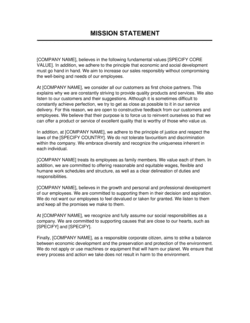
How To Create Mission And Vision Statements is a structured Word template that guides founders, executives, and leadership teams through defining their organization's core purpose, long-term direction, and guiding values. It is a free download you can edit online and export as PDF for use in strategic plans, investor decks, employee handbooks, and brand guidelines.
When you need it
Use it when launching a new business, rebranding an existing organization, onboarding a new leadership team, or realigning strategy after significant growth or a pivot. It is also essential before drafting a business plan, strategic plan, or company handbook.
What's inside
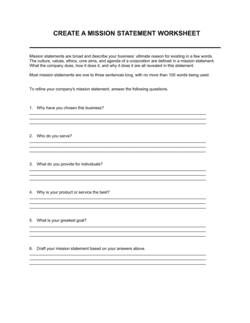
Guided prompts for defining organizational purpose, customer impact, and long-term aspirations, plus structured sections for core values, a completed mission statement, a completed vision statement, and an implementation checklist for embedding both across the organization.

What is a Mission and Vision Statement Guide?

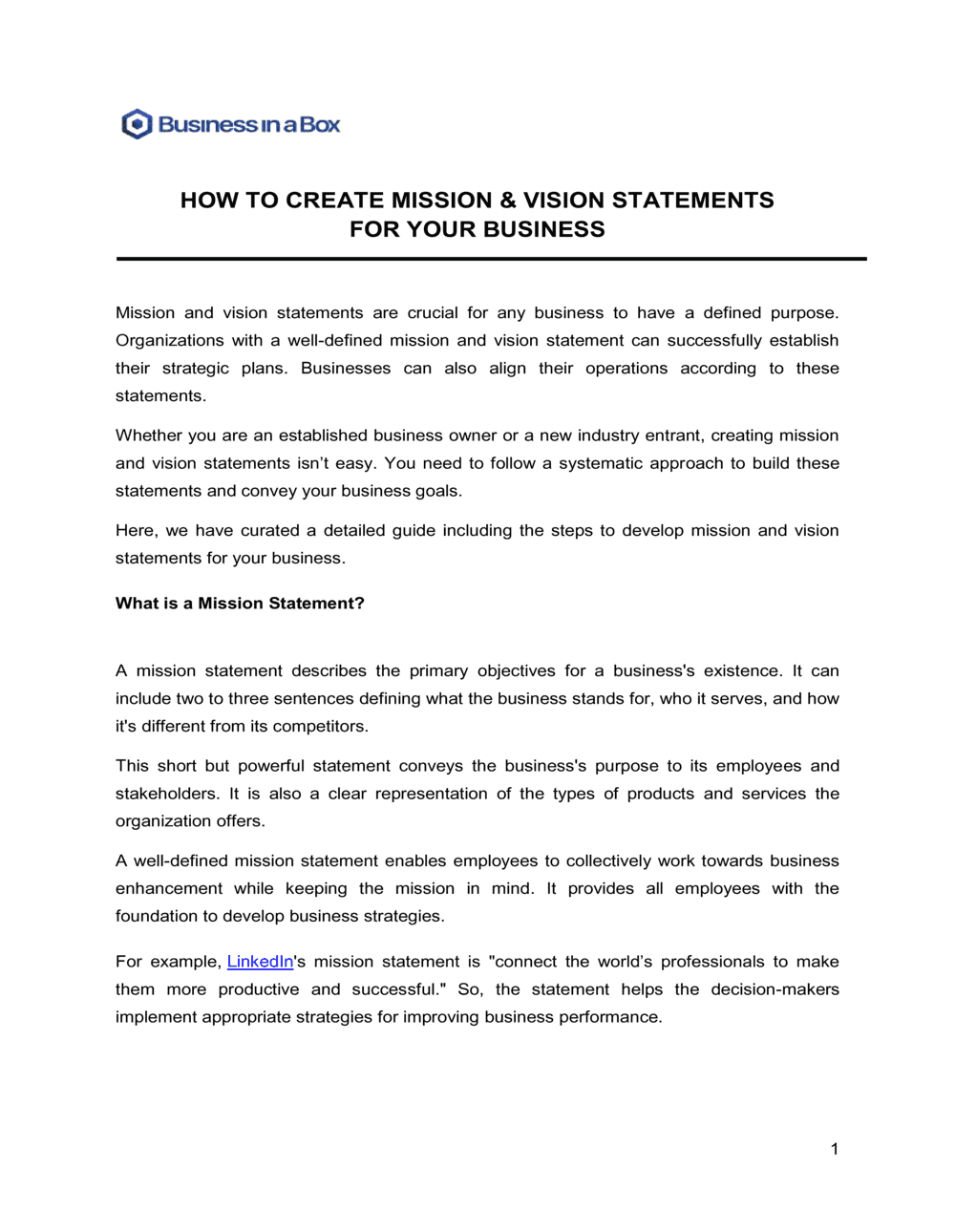
A Mission and Vision Statement document is a structured guide that leads founders, executives, and leadership teams through the process of defining their organization's core purpose, long-term aspirations, and guiding values. The mission statement articulates what the organization does today, for whom, and to what end β€” grounded in current operations. The vision statement describes the future state the organization is committed to building, typically over a 5–10 year horizon. Together, they form the strategic foundation that every business plan, hiring decision, marketing message, and performance framework should reflect. This free Word download provides step-by-step prompts, draft formulas, and an implementation checklist so your team can move from blank page to published statements in a single working session.

Why You Need This Document

Organizations that operate without clear, written mission and vision statements consistently face the same avoidable problems: hiring managers select candidates based on skill alone and onboard people who undermine the culture; marketing teams produce messaging that lacks coherence across channels; leadership teams pursue conflicting priorities in quarterly planning because there is no shared north star. The consequences compound over time β€” high turnover, diffuse brand positioning, and strategic plans that change with every new voice in the room. Investors and lenders notice the absence too: a founder who cannot articulate organizational purpose in one sentence raises an immediate credibility question. This template removes the blank-page barrier by providing the exact prompts, formulas, and review steps your team needs to produce statements that are specific, memorable, and operational β€” not generic placeholders that live in a folder no one opens.

Which variant fits your situation?

If your situation is…Use this template
Establishing foundational identity for a brand-new companyHow To Create Mission And Vision Statements
Developing a full organizational strategy around the mission and visionStrategic Planning Template
Documenting company values alongside mission and vision for HR useEmployee Handbook
Communicating the mission and vision to investors in a capital raiseBusiness Plan Template
Summarizing mission and vision in a one-page visual formatOne-Page Business Plan
Aligning the leadership team around mission-driven quarterly goalsBusiness Goals and Objectives Template

Common mistakes to avoid

❌ Writing statements in isolation without team input

Why it matters: Mission and vision statements written by one person β€” typically the founder β€” reflect personal perspective rather than shared organizational identity, reducing buy-in from the team they are supposed to inspire.

Fix: Run a structured 60–90 minute workshop with 3–5 key stakeholders before drafting. Use the purpose prompts to surface divergent views and synthesize them into a shared position.

❌ Making the vision statement indistinguishable from the mission

Why it matters: If both statements describe the same thing in similar language, neither performs its distinct function β€” the mission loses its operational clarity and the vision loses its inspirational pull.

Fix: Write the mission in present tense around current work and the vision in future tense around the world you are building. Read them side by side and confirm a clear distinction in scope and time horizon.

❌ Using generic values that apply to every company

Why it matters: Values like 'integrity,' 'teamwork,' and 'customer focus' carry no behavioral meaning when they could appear on any competitor's website β€” they do not guide decisions or differentiate culture.

Fix: For each value, write the specific behavior it requires and the specific behavior it prohibits. If you cannot fill in both blanks, the value is too vague to use.

❌ Publishing statements without an activation plan

Why it matters: Research consistently shows that most employees cannot recall their company's mission statement β€” because it was written once, filed, and never operationalized into hiring criteria, performance reviews, or daily decisions.

Fix: Build the implementation section of the template before publishing. Assign an owner for each channel, set a 12-month review date, and reference the statements explicitly in the next onboarding cycle.

❌ Drafting a vision so conservative it is already achieved

Why it matters: A vision statement that describes where the company currently is β€” or will be in 18 months β€” provides no aspirational pull and fails to motivate long-term strategic commitment from the team.

Fix: Apply the 10-year test: would achieving this vision still feel significant a decade from now? If the answer is no, expand the scope, the geography, or the depth of impact until the answer is yes.

❌ Including jargon or internal acronyms in either statement

Why it matters: Mission and vision statements are read by candidates, customers, investors, and partners who have no context for internal language β€” jargon signals insularity and makes the statements unusable in external communications.

Fix: Test both statements on someone outside the organization β€” a friend, a new hire, or a prospective customer. If they need a glossary, rewrite in plain language.

The 9 key sections, explained

Organizational context and background

Purpose discovery prompts

Customer and impact definition

Long-term aspiration framing

Core values identification

Mission statement draft and refinement

Vision statement draft and refinement

Consistency check and alignment review

Implementation and communication plan

How to fill it out

  1. 1

    Complete the organizational context section

    Fill in your company's legal name, founding year, core offering, target customer, and current operating geography. This grounds every subsequent section in factual reality.

    πŸ’‘ Use the same company description you use in your business plan or investor materials β€” consistency across documents matters.

  2. 2

    Run the purpose discovery prompts with your leadership team

    Answer each guided prompt in a 60–90 minute working session with 3–5 leaders or co-founders. Capture all responses before filtering β€” the most useful raw material often appears in unexpected answers.

    πŸ’‘ Ask 'why' three times for each answer β€” shallow responses usually reveal a deeper, more compelling purpose after two or three iterations.

  3. 3

    Define your customer and the change you create for them

    Be specific: name the customer segment, the exact problem you solve, and the measurable outcome you deliver. This section feeds directly into the mission statement draft.

    πŸ’‘ If you serve multiple customer segments, pick the primary one β€” trying to serve everyone in a mission statement produces language that serves no one.

  4. 4

    Articulate your 5–10 year aspiration

    Describe the bold future state your organization is building toward. It should be ambitious enough to require genuine organizational effort but grounded enough to be credible.

    πŸ’‘ Test the aspiration by asking whether it would still be meaningful if it took 10 years β€” a goal that feels big today but trivial in a decade is not a vision.

  5. 5

    Identify and define 3–6 core values

    Choose values that describe how your organization actually operates, not how you wish it operated. Write one sentence for each value explaining what it looks like in practice.

    πŸ’‘ Reject any value that every competitor could also claim β€” 'integrity' and 'excellence' are generic; 'we say no to a deal that requires us to cut corners' is a value.

  6. 6

    Draft and refine the mission statement

    Use the template formula to write a first draft, then read it aloud to a colleague who knows nothing about the business. If they cannot summarize it back to you in their own words, simplify.

    πŸ’‘ Aim for one sentence under 25 words. The most memorable mission statements β€” Amazon's 'to be Earth's most customer-centric company' β€” are specific and use ordinary language.

  7. 7

    Draft and refine the vision statement

    Write the vision to describe the world you are trying to create, not the company you are trying to build. It should make the reader feel the magnitude of what you are working toward.

    πŸ’‘ If your mission and vision statements could be swapped without anyone noticing, one of them is wrong β€” they should be clearly distinct in tense, scope, and purpose.

  8. 8

    Build the implementation and communication plan

    List every channel and touchpoint where the mission and vision will appear, assign owners, and set a review date. Without this step, the document never leaves the template.

    πŸ’‘ Schedule the first annual review before you publish β€” putting a date on the calendar now prevents the statements from going stale during a period of rapid growth.

Frequently asked questions

What is the difference between a mission statement and a vision statement?

A mission statement describes what an organization does today, for whom, and to what end β€” it is grounded in present-tense operations. A vision statement describes the future state the organization is working toward, typically 5–10 years out. The mission explains the work; the vision explains the destination. Both are necessary, and they should complement rather than duplicate each other.

How long should a mission statement be?

The most effective mission statements are one to two sentences, ideally under 25 words. Shorter statements are more memorable and more likely to be quoted accurately by employees, customers, and partners. If you find yourself writing three or more sentences, you are describing strategy, not mission β€” cut to the core purpose.

Do small businesses need formal mission and vision statements?

Yes β€” mission and vision statements matter as much for a 5-person company as for a 500-person one. They clarify hiring decisions, guide customer communication, and give the founding team a shared reference point when priorities conflict. Small businesses that skip them often find they cannot articulate their differentiation to investors, candidates, or new customers without a 10-minute explanation.

How often should mission and vision statements be updated?

Review both statements annually as part of your strategic planning cycle. Revise when there is a significant change in business model, target market, leadership team, or company scale. Minor word changes are rarely necessary β€” the more disruptive case is when the core purpose or long-term aspiration genuinely evolves, which typically happens during a pivot, acquisition, or major market shift.

Who should be involved in writing the mission and vision statements?

The founding team or senior leadership should lead the process, with input from 3–5 representatives of the broader team to test resonance. For nonprofits or mission-driven organizations, board members and key volunteers are often included. The goal is shared ownership β€” not a document written by one person and announced to everyone else.

Can the mission and vision statements be used in a business plan or investor pitch?

Yes, and they should be. Investors use the mission statement to evaluate whether the founding team understands the problem they are solving and for whom. The vision statement communicates the size and ambition of the opportunity. A clear, specific mission and vision placed early in a business plan or pitch deck signals strategic clarity and operational focus.

What is the relationship between core values and the mission statement?

Core values define how the organization behaves in pursuit of its mission. The mission explains what you are doing and for whom; the values explain the principles that govern how you do it. Values that are inconsistent with the mission create cultural confusion β€” for example, a mission built on accessibility paired with a value of 'premium at all costs' sends contradictory signals to employees and customers.

How do I know if my mission statement is good?

Apply three tests: first, read it to someone unfamiliar with your business and ask them to summarize what you do β€” if they cannot, simplify. Second, check whether a direct competitor could use the exact same statement β€” if they could, add more specificity. Third, confirm it could guide a hiring or product decision β€” if it is too vague to influence a real choice, it is not operational enough to serve its purpose.

How this compares to alternatives

vs Strategic Planning Template

A strategic plan translates mission and vision into multi-year goals, initiatives, resource allocation, and KPIs. The mission and vision statements come first β€” they are the foundation that the strategic plan is built on. Drafting a strategic plan without finalized mission and vision statements produces goals that lack a coherent organizing principle.

vs Business Plan Template

A business plan is an external-facing document that combines market analysis, financial projections, and operational detail for investors or lenders. Mission and vision statements appear near the front of a business plan to establish purpose and direction, but the business plan itself contains far more financial and market evidence. Complete the mission and vision statements before drafting the business plan.

vs Employee Handbook

An employee handbook is an operational document that codifies HR policies, conduct expectations, and employment conditions. Mission and vision statements typically appear in the opening section of the handbook to frame the culture, but the handbook itself governs day-to-day employment rather than organizational identity. The statements feed into the handbook; they are not a substitute for it.

vs One-Page Business Plan

A one-page business plan is a rapid-alignment tool that summarizes the business model, target customer, revenue streams, and key metrics on a single page. It includes mission and vision in summary form but does not guide you through the process of creating them. Use the mission and vision statement template to develop the content, then pull the outputs into the one-page plan.

Industry-specific considerations

Technology / SaaS

Mission statements in SaaS typically center on the specific workflow problem solved and the customer segment, while vision statements describe the scale of the market transformation the product enables.

Nonprofit and Social Enterprise

Mission statements are foundational to grant applications, donor communications, and volunteer recruitment, and must be specific enough to differentiate the organization within a crowded cause area.

Retail / E-commerce

Retail mission statements often emphasize the customer experience and product values β€” sustainability, accessibility, or community β€” that differentiate the brand beyond price and convenience.

Professional Services

Consulting and agency mission statements serve as positioning tools that signal specialization and client outcomes to prospects who are evaluating multiple firms with similar credentials.

Healthcare

Healthcare organizations anchor mission statements in patient outcomes and access, and use the vision statement to articulate systemic change goals that motivate clinical staff beyond day-to-day patient care.

Education

Educational institutions use mission and vision statements to communicate pedagogical philosophy to students, parents, and accreditation bodies, and to align faculty hiring and curriculum development.

Template vs pro β€” what fits your needs?

PathBest forCostTime
Use the templateFounders, small business owners, and leadership teams creating or refreshing statements independentlyFree2–4 hours for the workshop and drafting session
Template + professional reviewOrganizations preparing statements for investor materials, grant applications, or a public rebrand$300–$1,000 for a brand strategist or facilitator review1–2 weeks
Custom draftedEnterprises, nonprofits undertaking a full rebrand, or organizations with complex multi-stakeholder alignment requirements$2,000–$10,000 for a facilitated strategy or brand engagement4–8 weeks

Glossary

Mission Statement
A concise declaration of an organization's current purpose β€” what it does, who it serves, and how it creates value today.
Vision Statement
A forward-looking statement describing the future state the organization aims to create, typically 5–10 years out.
Core Values
The fundamental beliefs and behavioral standards that guide how an organization operates and makes decisions.
Purpose Statement
A deeper articulation of why an organization exists beyond financial returns β€” the human or societal problem it is committed to solving.
Brand Identity
The combination of visual, verbal, and behavioral elements β€” including mission and vision β€” that distinguish an organization in its market.
Strategic Alignment
The degree to which an organization's goals, decisions, and daily actions reflect and reinforce its stated mission and vision.
Stakeholder
Any individual or group with an interest in the organization's activities β€” including employees, customers, investors, partners, and the community.
OKRs (Objectives and Key Results)
A goal-setting framework in which each objective is anchored to measurable key results β€” ideally derived from the organization's mission and vision.
Value Proposition
A clear statement of the specific benefit a product or service delivers to a defined customer, and why it is preferable to alternatives.
Culture Fit
The alignment between an individual's beliefs and behaviors and the values, working style, and purpose of the organization.

Part of your Business Operating System

This document is one of 3,000+ business & legal templates included in Business in a Box.

  • Fill-in-the-blanks β€” ready in minutes
  • Compatible with all office suites
  • Export to PDF and share electronically

Create your document in 3 simple steps.

From template to signed document β€” all inside one Business Operating System.
1
Download or open template

Access over 3,000+ business and legal templates for any business task, project or initiative.

2
Edit and fill in the blanks with AI

Customize your ready-made business document template and save it in the cloud.

3
Save, Share, Send, Sign

Share your files and folders with your team. Create a space of seamless collaboration.

Save time, save money, and create top-quality documents.

β˜…β˜…β˜…β˜…β˜…

"Fantastic value! I'm not sure how I'd do without it. It's worth its weight in gold and paid back for itself many times."

Managing Director Β· Mall Farm
Robert Whalley
Managing Director, Mall Farm Proprietary Limited
β˜…β˜…β˜…β˜…β˜…

"I have been using Business in a Box for years. It has been the most useful source of templates I have encountered. I recommend it to anyone."

Business Owner Β· 4+ years
Dr Michael John Freestone
Business Owner
β˜…β˜…β˜…β˜…β˜…

"It has been a life saver so many times I have lost count. Business in a Box has saved me so much time and as you know, time is money."

Owner Β· Upstate Web
David G. Moore Jr.
Owner, Upstate Web

Run your business with a system β€” not scattered tools

Stop downloading documents. Start operating with clarity. Business in a Box gives you the Business Operating System used by over 250,000 companies worldwide to structure, run, and grow their business.

Free Forever PlanΒ Β·Β No credit card required