Data Scientist Job Description Template

Free Word download • Edit online • Save & share with Drive • Export to PDF

2 pages20–30 min to fillDifficulty: StandardSignature requiredLegal review recommended
Learn more ↓
FreeData Scientist Job Description Template

At a glance

What it is
A Data Scientist Job Description is a formal hiring document that defines the scope of a data science role — covering required skills, core responsibilities, reporting structure, compensation range, IP assignment, and confidentiality obligations. This free Word download gives you a structured, legally grounded starting point you can edit online and export as PDF to post on job boards or attach to an employment contract.
When you need it
Use it when opening a new data science position, backfilling an existing role, or restructuring your analytics team. It is also the baseline document for employment contracts and onboarding paperwork for any data-focused hire.
What's inside
Role title and seniority level, reporting structure, core responsibilities and deliverables, required and preferred qualifications, compensation and benefits overview, IP assignment and confidentiality obligations, and equal-employment compliance language.

What is a Data Scientist Job Description?

A Data Scientist Job Description is a formal hiring and legal document that defines the full scope of a data science role within an organization — specifying the job title, seniority level, core responsibilities, required and preferred qualifications, compensation band, reporting structure, and binding obligations around intellectual property assignment, confidentiality, and data handling. Unlike a casual role summary, a properly structured job description functions as the foundation for an enforceable employment contract: when incorporated as a schedule or exhibit to that contract, its IP assignment and confidentiality clauses become legally binding on the employee from day one.

Why You Need This Document

Without a written data scientist job description, four specific problems emerge simultaneously. First, without explicit IP assignment language, models, algorithms, and code a data scientist builds — particularly on personal devices or while working remotely — may not legally belong to the company. Second, without a confidentiality clause referencing the specific datasets and systems the role accesses, departing employees face no documented restriction on taking proprietary training data, model weights, or customer records. Third, vague or missing responsibilities make performance management nearly impossible: you cannot document underperformance against a standard you never set in writing. Fourth, omitting salary range disclosure in jurisdictions where it is legally required exposes the company to fines up to $10,000 per violation. This template gives you a structured, jurisdiction-aware starting point that closes all four gaps — and pairs directly with the Employment Contract and NDA templates in Business in a Box for a complete onboarding package.

Which variant fits your situation?

If your situation is…Use this template
Hiring an entry-level analyst with 0–2 years of experienceJunior Data Scientist Job Description
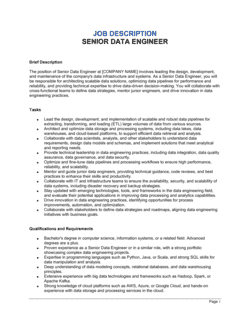
Hiring a senior IC responsible for model architecture and mentoringSenior Data Scientist Job Description
Filling a leadership role overseeing a data science teamHead of Data Science Job Description
Hiring primarily for ML model deployment and MLOpsMachine Learning Engineer Job Description
Engaging a data scientist on a project basis rather than full-timeIndependent Contractor Agreement
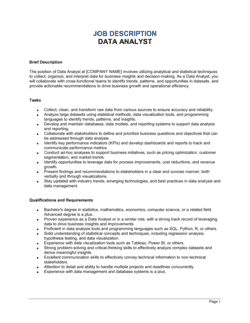
Hiring a data analyst focused on reporting rather than modelingData Analyst Job Description
Formalizing the hire with a binding employment agreementEmployment Contract (At-Will)

Common mistakes to avoid

❌ Requiring advanced degrees for mid-level roles

Why it matters: Requiring a master's or PhD where one is not genuinely necessary screens out highly qualified candidates with practical experience and creates potential disparate-impact liability under EEOC guidelines.

Fix: Substitute degree requirements with demonstrated competency criteria — a GitHub portfolio, a take-home assessment, or two years of production model deployment — and reserve advanced degree requirements for research-heavy roles.

❌ Omitting salary range where disclosure is legally required

Why it matters: Colorado, California, New York, and Washington state all mandate salary range disclosure in job postings. Noncompliance carries fines up to $10,000 per violation in New York City and potential DFEH investigations in California.

Fix: Identify every jurisdiction where the role may be filled — including remote candidates — and apply the most stringent applicable salary transparency requirement to the posting.

❌ IP assignment limited to on-premises work only

Why it matters: Data scientists frequently build models and write code on personal laptops or home networks. Language limited to 'company premises' leaves ownership of off-site work legally ambiguous.

Fix: Replace location-based IP language with scope-based language: 'all work product created in connection with the Company's business, regardless of time or place of creation.'

❌ No reference to data security or PII handling obligations

Why it matters: Data scientists routinely access customer PII, financial records, and proprietary datasets. Omitting data-handling obligations creates compliance gaps under GDPR, CCPA, and HIPAA and may void professional indemnity coverage.

Fix: Add a clause requiring the employee to comply with named data security policies and applicable privacy regulations, and incorporate those policies by reference in the confidentiality section.

❌ Conflating preferred and required qualifications

Why it matters: When hiring managers treat preferred qualifications as de facto requirements, they effectively enforce undisclosed criteria, making the job description legally indefensible if a rejected candidate files a discrimination complaint.

Fix: Use distinct, clearly labelled sections — 'Required Qualifications' and 'Preferred Qualifications' — and brief hiring managers on the enforceable distinction before screening begins.

❌ Vague or generic responsibilities with no measurable outputs

Why it matters: A job description that says 'analyze data and build models' cannot serve as a performance management baseline, making it harder to document underperformance or justify termination for cause.

Fix: Rewrite each responsibility as a specific, observable deliverable tied to a business outcome — 'Maintain a churn prediction model with monthly retraining and <5% MAPE on the held-out test set.'

The 9 key clauses, explained

Role title, seniority, and department

In plain language: Specifies the exact job title, seniority level, and which team or department the role sits within — establishing the scope of authority and career ladder placement.

Sample language
Position: Data Scientist II | Department: Data and Analytics | Reports to: Head of Data Science | Location: [CITY / REMOTE / HYBRID]

Common mistake: Using a generic title like 'Data Scientist' without a seniority qualifier. Candidates cannot self-screen for fit, and the posting attracts both $80K and $180K salary expectations simultaneously.

Core responsibilities and deliverables

In plain language: Lists the specific, measurable tasks the employee is expected to perform — model development, data pipeline ownership, stakeholder reporting, and research — distinguishing essential from ancillary duties.

Sample language
Design, train, and deploy supervised and unsupervised machine learning models to support [BUSINESS OBJECTIVE]. Own the end-to-end data pipeline from [DATA SOURCE] to production inference. Deliver a monthly model performance report to [STAKEHOLDER TEAM].

Common mistake: Listing generic responsibilities like 'analyze data and build models' with no specifics. Vague duties prevent the job description from serving as a performance management baseline after hire.

Required qualifications and skills

In plain language: States the minimum education, years of experience, programming languages, and domain knowledge that are non-negotiable prerequisites for the role.

Sample language
Required: Bachelor's degree in Statistics, Computer Science, Mathematics, or a related field; [X]+ years of hands-on experience with Python and SQL; demonstrated experience building and deploying [MODEL TYPE] models in a production environment.

Common mistake: Requiring a master's degree or PhD for a mid-level role when those credentials are not genuinely necessary. This screens out qualified candidates and creates potential disparate-impact exposure under EEOC guidelines.

Preferred qualifications

In plain language: Lists additional skills, certifications, or experience that would strengthen a candidate's profile but are not disqualifying if absent — giving recruiters a secondary filter.

Sample language
Preferred: Experience with [CLOUD PLATFORM] (AWS SageMaker, GCP Vertex AI, or Azure ML); familiarity with [INDUSTRY DOMAIN] data; experience with MLOps tooling (MLflow, Kubeflow, or equivalent).

Common mistake: Making the preferred qualifications list longer than the required list. When preferred criteria outnumber required ones, hiring managers effectively enforce unstated requirements, undermining the job description's legal defensibility.

Reporting structure and collaboration

In plain language: Identifies the direct manager, cross-functional stakeholders the role interacts with, and the team size and composition the employee will work within.

Sample language
This role reports directly to the [HEAD OF DATA SCIENCE / VP ANALYTICS]. The Data Scientist will collaborate closely with [ENGINEERING], [PRODUCT], and [BUSINESS INTELLIGENCE] teams to translate business requirements into model specifications.

Common mistake: Omitting cross-functional reporting relationships entirely. A data scientist who unexpectedly reports to both an engineering lead and a product director will be misaligned on priorities unless it is documented upfront.

Compensation, benefits, and work location

In plain language: States the base salary range or band, bonus eligibility, equity if applicable, key benefits, and whether the role is on-site, remote, or hybrid — including travel expectations.

Sample language
Base salary range: $[MIN]–$[MAX] USD, depending on experience. Eligible for annual performance bonus of up to [X]% of base. [Remote / Hybrid / On-site at LOCATION]. Occasional travel to [CITY / OFFICE] expected up to [X] days per quarter.

Common mistake: Omitting the salary range where local law now mandates disclosure — Colorado, New York, California, and Washington state all require salary ranges in job postings. Noncompliance carries fines up to $10,000 per violation in New York City.

Intellectual property assignment

In plain language: Assigns to the employer all models, algorithms, code, data pipelines, and research produced by the employee in connection with their role — including work performed remotely or on personal devices.

Sample language
All models, algorithms, code, datasets, documentation, and other work product created by the Employee in connection with their employment are the sole property of [COMPANY NAME] and are hereby irrevocably assigned to the Company.

Common mistake: Limiting IP assignment to work performed 'on company premises.' Data scientists frequently work remotely and build models on personal hardware — narrow language leaves IP ownership ambiguous and creates disputes at departure.

Confidentiality and data handling obligations

In plain language: Prohibits the employee from disclosing or misusing proprietary datasets, model architectures, customer data, or business intelligence during and after employment — and specifies data security obligations.

Sample language
Employee shall not disclose or use any Confidential Information — including proprietary datasets, model weights, customer PII, and business metrics — without prior written consent from [COMPANY NAME]. Employee shall comply with the Company's data security and access control policies at all times.

Common mistake: No explicit reference to data security policies or PII handling. For data scientists with access to customer datasets, omitting data-handling obligations creates compliance gaps under GDPR, CCPA, and HIPAA.

Equal employment opportunity and accommodation statement

In plain language: Affirms the employer's commitment to non-discriminatory hiring and invites qualified applicants with disabilities to request accommodations — required under US federal law and equivalent statutes in other jurisdictions.

Sample language
[COMPANY NAME] is an Equal Opportunity Employer. We do not discriminate on the basis of race, color, religion, sex, national origin, age, disability, or any other characteristic protected by applicable law. Applicants requiring accommodation should contact [HR EMAIL / CONTACT].

Common mistake: Copying an EEO statement from a generic template without updating the contact details. Candidates who attempt to request an accommodation and reach a dead email address create ADA liability exposure.

How to fill it out

  1. 1

    Define the seniority level and team placement

    Confirm the exact title, level (junior, mid, senior, staff), department, and direct reporting line before filling in any other section. This anchors every downstream decision — scope, salary band, and required experience.

    💡 If you are hiring your first data scientist, use the mid-level (Data Scientist II) template and adjust down if the role evolves — it is easier to remove responsibilities than add them after posting.

  2. 2

    List core responsibilities as specific deliverables

    Write at least six to eight specific, measurable responsibilities using action verbs. Reference the actual business problem, data sources, and stakeholders where possible.

    💡 Distinguish 'essential functions' from 'other duties as assigned' explicitly — this distinction matters under the ADA if an employee later requests a disability accommodation.

  3. 3

    Set minimum and preferred qualifications separately

    Required qualifications should reflect only what a new hire genuinely needs on day one. Preferred qualifications should include skills learnable within three to six months on the job.

    💡 Audit required qualifications for credential inflation — replacing 'PhD preferred' with demonstrated portfolio work expands your qualified pool by 30–40% without lowering the bar.

  4. 4

    Enter the compensation range and work location

    State the full salary band, bonus eligibility, equity if any, and whether the role is remote, hybrid, or on-site. Check your state or country's salary transparency laws before posting.

    💡 Post the real range, not a compressed one. Candidates who discover the posted range was misleading during negotiation disengage at offer stage, wasting the entire recruiting cycle.

  5. 5

    Tailor the IP assignment and confidentiality clauses

    Review the IP assignment language to ensure it covers work performed on personal devices and off-site — critical for remote data science roles. Add references to specific data security policies by name.

    💡 If your company uses cloud platforms (AWS, GCP, Azure) for model training, name the specific environments whose access is governed by the confidentiality clause.

  6. 6

    Add or verify the EEO statement and accommodation contact

    Confirm the EEO statement reflects current protected categories in your jurisdiction and that the accommodation contact is a real, monitored email or phone number.

    💡 In the UK and EU, replace the US-style EEO statement with jurisdiction-appropriate equal-opportunity language referencing the Equality Act 2010 or applicable national law.

  7. 7

    Have a recruiter or HR lead review before posting

    A second set of eyes catches credential inflation, vague responsibilities, and missing salary disclosure before the posting goes live — each of which reduces application quality or creates compliance risk.

    💡 Run the finished job description against your state's or country's pay transparency checklist. New York, Colorado, California, and Washington each have different disclosure requirements.

  8. 8

    Attach to the employment contract before signing

    Incorporate the finalized job description as Schedule A to the employment contract so that duties, IP, and confidentiality terms are explicitly cross-referenced and binding.

    💡 Have the new hire initial Schedule A separately at signing — this creates a clear record that they reviewed and accepted the full scope of duties, not just the offer letter.

Frequently asked questions

What should a data scientist job description include?

A complete data scientist job description covers role title and seniority level, reporting structure, six to ten core responsibilities with specific deliverables, separately listed required and preferred qualifications, compensation range and work location, IP assignment, confidentiality and data handling obligations, and an EEO statement. Missing any of these sections reduces candidate quality, creates compliance risk, or leaves gaps that become disputes after hire.

Is a job description a legally binding document?

A job description is generally not a standalone contract, but it becomes legally significant when incorporated by reference into an employment contract as a schedule or exhibit. IP assignment, confidentiality, and listed duties in the job description can all be enforced when the employment contract explicitly references them. Courts have also used published job descriptions as evidence of employer representations in wrongful-termination and discrimination cases.

Do I have to disclose the salary range in a data scientist job posting?

It depends on where the role is based or where applicants are located. Colorado, California, New York state, Washington state, and several municipalities now require salary ranges in job postings. For remote roles, you must typically disclose a range if any applicant could reasonably be located in a covered jurisdiction. Noncompliance penalties range from $500 to $10,000 per violation depending on the jurisdiction.

What programming languages should be listed as required for a data scientist role?

Python is the near-universal requirement for data science roles in 2025 and should appear in required qualifications for any level above entry. SQL is required for most roles that involve querying production databases. R is relevant for statistics-heavy or academic-adjacent roles. Spark or Scala matters for large-scale distributed workloads. List only languages the role will genuinely use in the first 90 days — inflated language requirements reduce the qualified candidate pool without improving hire quality.

What is the difference between a data scientist and a machine learning engineer job description?

A data scientist job description emphasizes exploratory analysis, model development, and deriving business insights from data. A machine learning engineer description focuses on deploying, scaling, and maintaining models in production systems — MLOps, API serving, and infrastructure. In larger organizations these are distinct roles; at smaller companies one person may cover both. Mixing the two into one posting without clear prioritization produces a role that attracts neither profile well.

Can I use the same job description for a full-time hire and a contractor?

No. A full-time employment job description establishes the terms of an employment relationship — with IP assignment, benefits, and at-will or notice-based termination. Using it for a contractor arrangement risks misclassification as employment, triggering back taxes, benefits liability, and penalties. Contractors should receive a separate Statement of Work or Independent Contractor Agreement that defines project scope, deliverables, and payment without establishing an employer-employee relationship.

How often should a data scientist job description be updated?

Review and update the job description every time the role materially changes — new tools, new responsibilities, or a change in reporting structure. For active hiring, update it before each new posting cycle. A job description that is more than 18 months old is likely listing outdated tools (e.g., older ML frameworks) and may not reflect current compensation bands, creating mismatched expectations at offer stage.

Does a data scientist job description need an IP assignment clause?

Yes, for any data scientist accessing proprietary data or building models the company intends to commercialize. Without an IP assignment clause, the employee may retain rights to models, code, or algorithms they created, particularly for work done remotely or on personal devices. The IP clause in the job description should be reinforced by an identical or broader clause in the employment contract, executed before the first day of work.

What equal employment statements are required in a data scientist job posting?

In the US, federal contractors and employers with 15 or more employees must include EEO language covering race, color, religion, sex, national origin, age, disability, and veteran status. In the UK, the Equality Act 2010 covers nine protected characteristics. EU member states have varying requirements. At minimum, include a standard EEO statement with a working accommodation contact. For roles in multiple jurisdictions, use the most inclusive statement and localize as needed.

How this compares to alternatives

vs Machine Learning Engineer Job Description

A machine learning engineer job description focuses on production infrastructure, model serving, and MLOps pipelines rather than exploratory analysis and insight generation. Use the data scientist template when the primary output is business insight and model development; use the ML engineer template when the role's core output is scalable, production-deployed systems. Many organizations need both profiles and should not conflate them in a single posting.

vs Data Analyst Job Description

A data analyst description emphasizes reporting, dashboarding, and SQL-based querying — typically without machine learning model development. A data scientist description adds statistical modeling, feature engineering, and production ML responsibilities. Conflating the two in one posting attracts candidates misaligned on compensation expectations and technical depth, as data scientist salaries typically run 30–50% higher than data analyst salaries.

vs Independent Contractor Agreement

A job description establishes the terms of an employment relationship — with IP ownership, benefits eligibility, and at-will or notice-based termination. An independent contractor agreement defines a project-based engagement with no employment entitlements. Using a job description for a contractor engagement risks misclassification as employment under IRS and HMRC tests. Engage project-based data scientists with a contractor agreement and a Statement of Work instead.

vs Employment Contract (At-Will)

A job description defines the role's scope, qualifications, and responsibilities but is not a comprehensive legal contract on its own. An employment contract adds binding clauses on IP assignment, non-compete, termination, severance, and governing law. The job description should be incorporated as Schedule A to the employment contract so that duties and IP obligations become fully enforceable terms — the two documents work together, not as alternatives.

Industry-specific considerations

Financial services and fintech

Fraud detection model ownership, regulatory model risk management (SR 11-7 compliance), strict PII and transaction data confidentiality, and compensation bands aligned to front-office pay scales.

Healthcare and life sciences

HIPAA data handling obligations incorporated by reference, clinical trial data access controls, FDA software-as-medical-device (SaMD) considerations for deployed models, and IRB compliance awareness.

SaaS and technology

Cloud platform proficiency (AWS, GCP, or Azure) listed as required, MLOps and CI/CD pipeline ownership, equity compensation common at growth-stage companies, and IP assignment covering algorithmic innovations.

Retail and e-commerce

Recommendation engine and demand forecasting responsibilities, customer PII governed under CCPA and GDPR, seasonal hiring surges requiring fast onboarding, and A/B testing ownership across the product funnel.

Jurisdictional notes

United States

Colorado, California, New York state, and Washington state require salary range disclosure in job postings. The ADA requires job descriptions to distinguish essential from marginal functions to support reasonable accommodation requests. Non-compete clauses referencing data scientists should account for California's near-total ban on post-employment restrictions. CCPA governs customer data handled by employees in California-based roles.

Canada

Several Canadian provinces — including British Columbia, Prince Edward Island, and Ontario — have enacted pay transparency legislation requiring salary range disclosure. PIPEDA and provincial privacy laws (notably Quebec's Law 25) govern employee access to customer and personal data and should be referenced in confidentiality clauses. Quebec employers must provide French-language job descriptions for provincially regulated roles.

United Kingdom

The Equality Act 2010 covers nine protected characteristics and job postings must avoid language that could be perceived as discriminatory on those grounds. Employers must provide a written statement of employment particulars on or before day one, incorporating key job description terms. UK GDPR and the Data Protection Act 2018 impose strict obligations on employees handling personal data, which should be referenced explicitly in the data handling clause.

European Union

The EU Pay Transparency Directive (2023/970) requires member states to implement salary disclosure rules by June 2026, including disclosure before or during the first interview. GDPR Article 88 permits member states to set additional rules for employee data processing; the confidentiality and data handling clause should reference applicable national implementation. Post-employment non-compete clauses typically require financial compensation to the employee ranging from 25 to 100 percent of salary depending on the member state.

Template vs lawyer — what fits your deal?

PathBest forCostTime
Use the templateStandard domestic full-time data science hires below director level in a single US state or Canadian provinceFree30–45 minutes
Template + legal reviewRoles with access to sensitive PII, cross-border remote hires, or positions with custom equity and IP clauses$300–$6001–3 days
Custom draftedSenior or staff data scientists with material IP exposure, multi-jurisdiction teams, or regulated industries such as healthcare or financial services$1,000–$3,500+1–2 weeks

Glossary

Job Description
A formal written document specifying a role's title, duties, qualifications, compensation, and reporting structure — used in hiring and as a baseline for performance management.
IP Assignment
A clause transferring ownership of any work product, models, algorithms, or code created by the employee to the employer during the employment relationship.
Confidentiality Clause
A provision prohibiting the employee from disclosing proprietary data, model architectures, or business intelligence to unauthorized parties during or after employment.
Feature Engineering
The process of transforming raw data into structured inputs that improve a machine learning model's predictive accuracy.
MLOps
Machine Learning Operations — the practice of deploying, monitoring, and maintaining machine learning models in production environments at scale.
Seniority Ladder
A defined hierarchy of role levels — junior, mid-level, senior, staff, and principal — each with distinct scope of work, compensation bands, and decision-making authority.
Non-Disclosure Agreement (NDA)
A separate or incorporated legal agreement preventing the employee from sharing confidential company information with outside parties.
At-Will Employment
Employment that either party may end at any time, for any lawful reason, without advance notice or cause — the default standard in most US states.
Essential Functions
The core duties a role must perform, as defined under the ADA in the US — job descriptions must distinguish essential from marginal functions to support accommodation requests.
Compensation Band
The defined minimum and maximum base salary for a role tier, used to ensure pay equity and budget predictability across an organization.
EEO Statement
Equal Employment Opportunity language affirming the employer does not discriminate on the basis of race, gender, age, disability, or other protected characteristics — required or strongly recommended in most jurisdictions.

Part of your Business Operating System

This document is one of 3,000+ business & legal templates included in Business in a Box.

  • Fill-in-the-blanks — ready in minutes
  • 100% customizable Word document
  • Compatible with all office suites
  • Export to PDF and share electronically

Create your document in 3 simple steps.

From template to signed document — all inside one Business Operating System.
1
Download or open template

Access over 3,000+ business and legal templates for any business task, project or initiative.

2
Edit and fill in the blanks with AI

Customize your ready-made business document template and save it in the cloud.

3
Save, Share, Send, Sign

Share your files and folders with your team. Create a space of seamless collaboration.

Save time, save money, and create top-quality documents.

★★★★★

"Fantastic value! I'm not sure how I'd do without it. It's worth its weight in gold and paid back for itself many times."

Managing Director · Mall Farm
Robert Whalley
Managing Director, Mall Farm Proprietary Limited
★★★★★

"I have been using Business in a Box for years. It has been the most useful source of templates I have encountered. I recommend it to anyone."

Business Owner · 4+ years
Dr Michael John Freestone
Business Owner
★★★★★

"It has been a life saver so many times I have lost count. Business in a Box has saved me so much time and as you know, time is money."

Owner · Upstate Web
David G. Moore Jr.
Owner, Upstate Web

Run your business with a system — not scattered tools

Stop downloading documents. Start operating with clarity. Business in a Box gives you the Business Operating System used by over 250,000 companies worldwide to structure, run, and grow their business.

Free Forever Plan · No credit card required