Checklist Progressive Discipline Documentation

Free download β€’ Use as a template β€’ Print or share

1 pageβ€’15–25 min to useβ€’Difficulty: Standard
Learn more ↓
FreeChecklist Progressive Discipline Documentation Template

At a glance

What it is
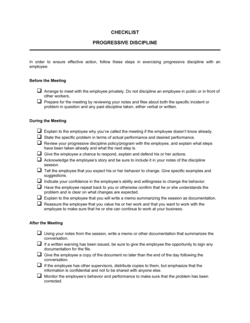
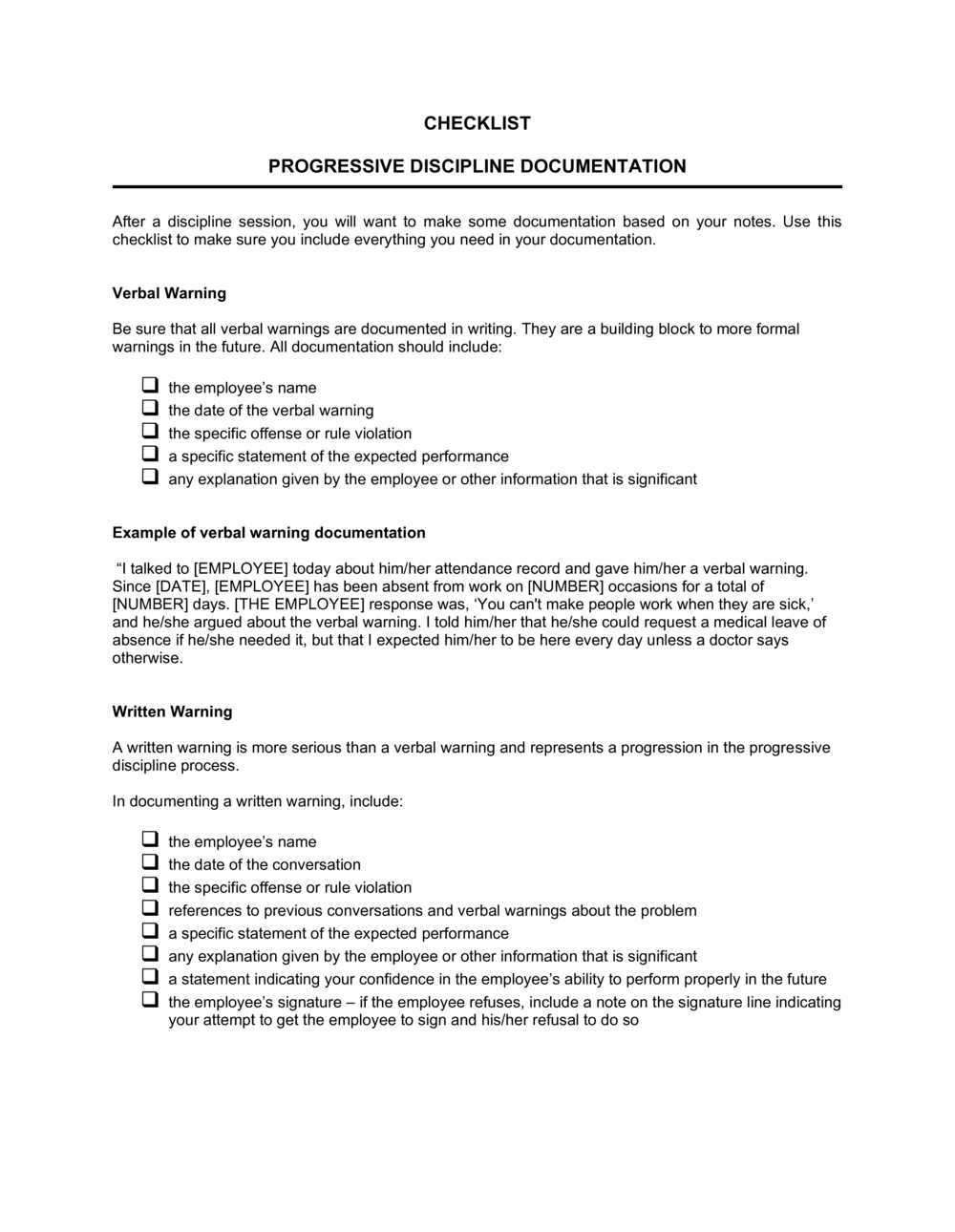
A Progressive Discipline Documentation Checklist is a structured form managers and HR professionals use to record each step of a corrective action process β€” from a verbal warning through to termination. This free Word download gives you a consistent, fillable checklist you can edit online and export as PDF to keep on file or share with HR and legal teams.
When you need it
Use it every time you issue a formal or informal disciplinary action so that each step is documented in the same format, in real time, creating a defensible record. It is especially critical before any termination that follows a pattern of prior warnings.
What's inside
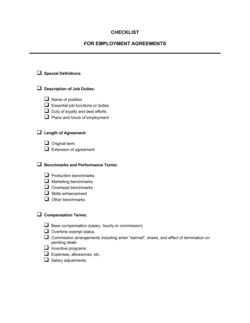
Employee and manager identification fields, a step indicator for the current disciplinary stage, a description of the policy violation or performance issue, prior discipline history, corrective action required, consequences for non-improvement, and acknowledgment fields for both parties.

What is a Progressive Discipline Documentation Checklist?

A Progressive Discipline Documentation Checklist is a structured form that managers and HR professionals complete each time a disciplinary action is issued β€” from a first verbal warning through to termination. It captures the employee's identifying information, the specific policy violation, any prior disciplinary history, the corrective action required, the consequence for non-compliance, and acknowledgment signatures from both parties. By standardizing what is recorded and when, the checklist creates a consistent, defensible paper trail that demonstrates the employer applied its disciplinary policy fairly and in good faith.

Why You Need This Document

Without documented disciplinary records, a termination that followed months of warnings can look β€” on paper β€” like it came without cause. That gap is where wrongful termination and discrimination claims gain traction. A completed checklist for every disciplinary step closes that gap: it establishes the progressive pattern, proves the employee was informed of the issue and the consequences, and shows that corrective opportunities were given before more serious action was taken. For small businesses and HR teams managing large hourly workforces, inconsistent documentation across managers is just as risky as no documentation at all β€” this template gives every supervisor the same structured format so your records hold up whether the dispute reaches an EEOC investigator or an employment attorney.

Which variant fits your situation?

If your situation is…Use this template
Recording a first informal verbal warningVerbal Warning Documentation Form
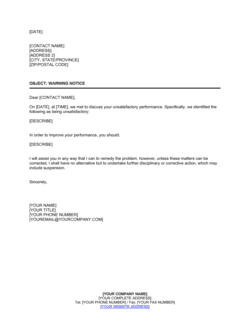
Issuing a formal written warning for a repeated issueEmployee Written Warning Form
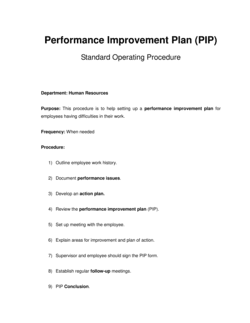
Placing an employee on a structured improvement planPerformance Improvement Plan (PIP)
Documenting a suspension pending investigationEmployee Suspension Letter
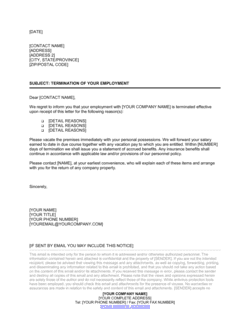
Formally terminating employment after failed corrective stepsEmployee Termination Letter
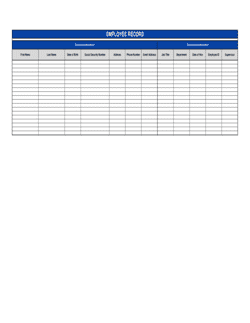
Tracking ongoing attendance or tardiness issues over timeEmployee Attendance Record

Common mistakes to avoid

❌ Vague violation descriptions

Why it matters: Language like 'poor attitude' or 'not meeting expectations' cannot be defended in an employment dispute and signals potential pretext to an investigator or judge.

Fix: Describe specific behaviors, dates, and policy references. Replace 'bad attitude' with 'On [DATE], employee raised their voice at a customer in the presence of [WITNESS], violating Policy 4.2.'

❌ Skipping disciplinary steps without documentation

Why it matters: Jumping from a verbal warning to termination β€” or from no warnings to termination β€” without recorded intermediate steps is among the most common grounds for a wrongful termination claim.

Fix: If severity justifies skipping a step, document the reason explicitly on the form. Reference the specific policy provision that permits immediate escalation for the offense type.

❌ Corrective action with no deadline or metric

Why it matters: An employee who is told to 'improve attendance' has no enforceable standard to meet, and the employer has no defensible baseline for a subsequent termination.

Fix: State the required outcome and a specific date: 'Zero unexcused absences in the 30 days following [DATE], assessed on [REVIEW DATE].'

❌ Not documenting verbal warnings in writing

Why it matters: An undocumented verbal warning does not exist as evidence. If the progressive pattern skips from zero to a written warning in HR records, the progressive process appears manufactured retroactively.

Fix: Complete this checklist for every disciplinary step β€” including verbal warnings β€” and file it in the employee's record the same day the meeting occurs.

The 9 key fields, explained

Employee and position information

Disciplinary step indicator

Date of incident and date of meeting

Description of the violation or performance issue

Prior discipline history

Required corrective action

Consequences for non-improvement

Manager and HR signatures with dates

Employee acknowledgment

How to fill it out

  1. 1

    Enter the employee's identifying information

    Fill in the employee's full legal name, job title, department, and the issuing manager's name. Include the HR contact if your organization requires HR review before delivery.

    πŸ’‘ Use the name exactly as it appears in your payroll system β€” discrepancies between records create unnecessary confusion in audits or legal proceedings.

  2. 2

    Select the correct disciplinary step

    Check the box or circle the stage that reflects the current action β€” verbal warning, first written warning, second written warning, suspension, or termination. Confirm this step is consistent with your written disciplinary policy.

    πŸ’‘ If you are skipping a step due to severity of the offense, document the reason explicitly in the violation description field.

  3. 3

    Record both the incident date and the meeting date

    Enter the specific date the violation occurred and the date the disciplinary meeting was held. If the gap between the two dates is more than five business days, note the reason.

    πŸ’‘ Discipline delivered weeks after an incident is easier to challenge β€” address issues promptly and document the same day the meeting occurs.

  4. 4

    Write a specific, factual violation description

    Describe what happened using observable facts β€” dates, times, policy section references, and business impact. Avoid opinion words and subjective characterizations.

    πŸ’‘ Apply the test: could a neutral third party who wasn't present understand exactly what happened from this description alone? If not, add more specifics.

  5. 5

    Document prior discipline history

    List each prior disciplinary action by date, step, and issue. If there is no prior history, check 'None' explicitly β€” do not leave the field blank.

    πŸ’‘ Pull prior records from the employee's HR file before the meeting so the history is complete and accurate at the time of delivery.

  6. 6

    Define the corrective action and review date

    Write specific, measurable requirements for the employee β€” not general improvement language. Set a concrete review date and name who will assess progress.

    πŸ’‘ A corrective action with no deadline is unenforceable. Even if improvement is expected to be ongoing, set a 30-day checkpoint at minimum.

  7. 7

    State the consequence for non-compliance

    Explicitly describe the next disciplinary step β€” suspension or termination β€” that will follow if corrective action is not completed by the review date.

    πŸ’‘ Use the exact language from your employee handbook for the consequence statement so the form and policy are consistent.

  8. 8

    Obtain signatures and file the completed form

    Have the manager and HR representative sign, then present the document to the employee for acknowledgment. If the employee refuses to sign, note the refusal with a witness. File the original in the employee's HR file.

    πŸ’‘ Deliver a copy to the employee at the meeting β€” not days later. Delayed delivery creates questions about when notice was actually given.

Frequently asked questions

What is progressive discipline documentation?

Progressive discipline documentation is the written record created at each step of a corrective action process β€” verbal warning, written warning, suspension, and termination. The documentation establishes a consistent, chronological record showing the employee was informed of the issue, given an opportunity to correct it, and warned of the consequences before more severe action was taken. This record is the primary defense in wrongful termination and discrimination claims.

Why is a checklist format useful for discipline documentation?

A checklist ensures that every required field β€” violation description, prior history, corrective action, consequences, and signatures β€” is completed consistently regardless of which manager issues the discipline. Inconsistent documentation across managers is one of the most common triggers for disparate-treatment claims, where one employee argues they were disciplined more harshly than a similarly situated colleague.

Does an employee have to sign a disciplinary form?

No. In most jurisdictions, an employee cannot be legally required to sign a disciplinary document. The acknowledgment signature confirms receipt, not agreement. If an employee refuses to sign, the manager should note the refusal on the form β€” 'Employee declined to sign; delivered in person on [DATE] in the presence of [WITNESS NAME]' β€” and have the witness initial the notation. The form is still valid and on record.

Should verbal warnings be documented in writing?

Yes. A verbal warning that exists only in memory has no evidentiary value. Complete this checklist β€” selecting the 'Verbal Warning' step β€” and file it in the employee's HR record the same day the conversation occurs. This creates the documented first step of a progressive pattern and prevents disputes about whether a warning was ever given.

When can an employer skip steps in the progressive discipline process?

Most disciplinary policies allow immediate escalation β€” including termination without prior warnings β€” for serious offenses such as workplace violence, theft, harassment, or safety violations. The key is to document the reason for skipping steps on the form itself, referencing the specific policy provision that permits escalation for the type of offense involved. Undocumented step-skipping is the issue, not the skipping itself.

How long should disciplinary records be kept on file?

Most HR professionals recommend retaining disciplinary records for at least four years after the action or two years after the employee's termination β€” whichever is longer. Some jurisdictions set specific retention requirements for employment records. For termination-related files, retain records indefinitely if any dispute, EEOC charge, or litigation is reasonably foreseeable.

Can progressive discipline documentation be used as evidence in a wrongful termination case?

Yes β€” it is typically the most important evidence on both sides. Complete, consistent, contemporaneous records support the employer's position that the termination was for documented, non-discriminatory reasons. Incomplete, vague, or retroactively created records support the employee's position that the stated reason was pretextual. The quality and specificity of each form matters as much as its existence.

What is the difference between a disciplinary checklist and a performance improvement plan?

A disciplinary checklist documents a specific policy violation or conduct issue at a single point in time and records the disciplinary step taken. A performance improvement plan (PIP) is a structured, forward-looking document that sets time-bound performance goals and scheduled check-ins over a period of 30–90 days. The two are often used together: a written warning triggers a PIP, and the PIP's outcome determines the next disciplinary step.

How this compares to alternatives

vs Employee Written Warning Form

An employee written warning form is a standalone document for a single written warning step. The progressive discipline checklist covers all steps β€” from verbal warning through termination β€” in one form and adds prior discipline history and a step indicator. Use the written warning form for a one-off formal notice; use this checklist when you need a single consistent record across the full disciplinary process.

vs Performance Improvement Plan

A PIP is a forward-looking document setting time-bound performance goals and scheduled check-ins over 30–90 days. This checklist documents the disciplinary action taken at a single point in time. The two work together β€” a written warning triggers the PIP, and the checklist records whether the PIP outcome leads to further discipline.

vs Employee Termination Letter

A termination letter formally notifies the employee that employment has ended and states the effective date and reason. This checklist is the internal record documenting the steps leading to that decision. The checklist protects the employer; the termination letter communicates the decision to the employee.

vs Employee Attendance Record

An attendance record tracks absences and tardiness over time as a factual log. This checklist documents the disciplinary action taken in response to attendance patterns. The attendance record provides the evidence; the discipline checklist is the formal response to what that evidence shows.

Industry-specific considerations

Retail and Hospitality

High turnover and large hourly workforces make consistent discipline documentation critical for defending terminations and reducing unemployment claim exposure.

Healthcare

Patient safety incidents and licensing requirements make documented corrective action essential before modifying or ending a clinical employee's duties.

Manufacturing

Safety policy violations require immediate documentation with specific policy references to support both disciplinary and workers' compensation records.

Professional Services

Performance-based discipline for billable professionals requires measurable utilization and quality metrics rather than subjective characterizations to withstand legal scrutiny.

Template vs pro β€” what fits your needs?

PathBest forCostTime
Use the templateSmall businesses, HR managers, and supervisors handling routine disciplinary documentationFree10–15 minutes per incident
Template + professional reviewOrganizations drafting or updating a company-wide disciplinary policy for the first time$300–$800 for an HR consultant or employment attorney review1–3 days
Custom draftedLarge employers, unionized workforces, or businesses in heavily regulated industries with complex disciplinary procedures$1,000–$3,000+ for custom HR policy and form development1–3 weeks

Glossary

Progressive Discipline
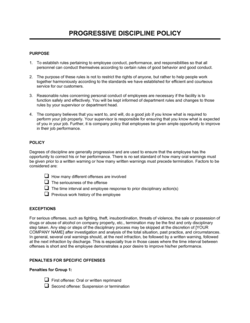
A corrective process that applies increasingly serious consequences β€” verbal warning, written warning, suspension, termination β€” for repeated or escalating policy violations.
Verbal Warning
The first formal step in most progressive discipline processes, delivered in a private conversation and recorded in writing even though it is delivered orally.
Written Warning
A formal disciplinary document that describes the violation, prior warnings, required corrective action, and consequences for continued non-compliance.
Corrective Action
Specific, measurable steps the employee must take β€” such as completing training or meeting an attendance target β€” to resolve the documented issue.
Performance Improvement Plan (PIP)
A structured document that sets time-bound performance goals and check-in milestones before more severe discipline is applied.
At-Will Employment
An employment relationship in most US states where either party may end the relationship at any time, but disciplinary documentation still protects against wrongful termination claims.
Acknowledgment Signature
The employee's signature confirming they received and reviewed the disciplinary document β€” not necessarily that they agree with its content.
Documentation Trail
The chronological file of all disciplinary records for a given employee, used to demonstrate consistent, good-faith corrective efforts in disputes or litigation.
Wrongful Termination Claim
A legal claim by a former employee alleging dismissal was unlawful β€” typically on grounds of discrimination, retaliation, or breach of an implied contract. Complete disciplinary records are a primary defense.
Suspension
A temporary removal of an employee from work duties, with or without pay, as a disciplinary measure or during an investigation.

Part of your Business Operating System

This document is one of 3,000+ business & legal templates included in Business in a Box.

  • Fill-in-the-blanks β€” ready in minutes
  • 100% customizable Word document
  • Compatible with all office suites
  • Export to PDF and share electronically

Create your document in 3 simple steps.

From template to signed document β€” all inside one Business Operating System.
1
Download or open template

Access over 3,000+ business and legal templates for any business task, project or initiative.

2
Edit and fill in the blanks with AI

Customize your ready-made business document template and save it in the cloud.

3
Save, Share, Send, Sign

Share your files and folders with your team. Create a space of seamless collaboration.

Save time, save money, and create top-quality documents.

β˜…β˜…β˜…β˜…β˜…

"Fantastic value! I'm not sure how I'd do without it. It's worth its weight in gold and paid back for itself many times."

Managing Director Β· Mall Farm
Robert Whalley
Managing Director, Mall Farm Proprietary Limited
β˜…β˜…β˜…β˜…β˜…

"I have been using Business in a Box for years. It has been the most useful source of templates I have encountered. I recommend it to anyone."

Business Owner Β· 4+ years
Dr Michael John Freestone
Business Owner
β˜…β˜…β˜…β˜…β˜…

"It has been a life saver so many times I have lost count. Business in a Box has saved me so much time and as you know, time is money."

Owner Β· Upstate Web
David G. Moore Jr.
Owner, Upstate Web

Run your business with a system β€” not scattered tools

Stop downloading documents. Start operating with clarity. Business in a Box gives you the Business Operating System used by over 250,000 companies worldwide to structure, run, and grow their business.

Start freeΒ Β·Β No credit card required