Checklist Alternate Term Sheet Provisions

Free download β€’ Use as a template β€’ Print or share

2 pagesβ€’20–25 min to useβ€’Difficulty: Standard
Learn more ↓
FreeChecklist Alternate Term Sheet Provisions Template

At a glance

What it is
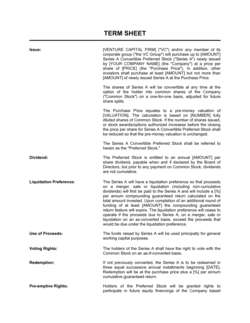
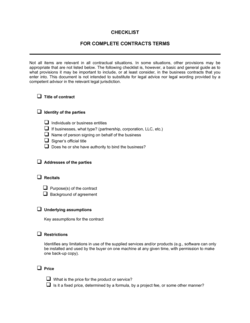
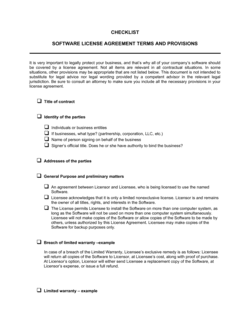
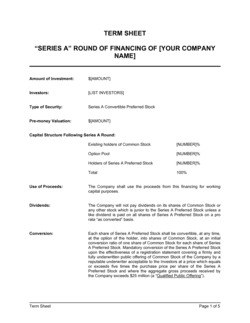
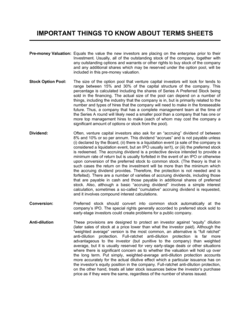
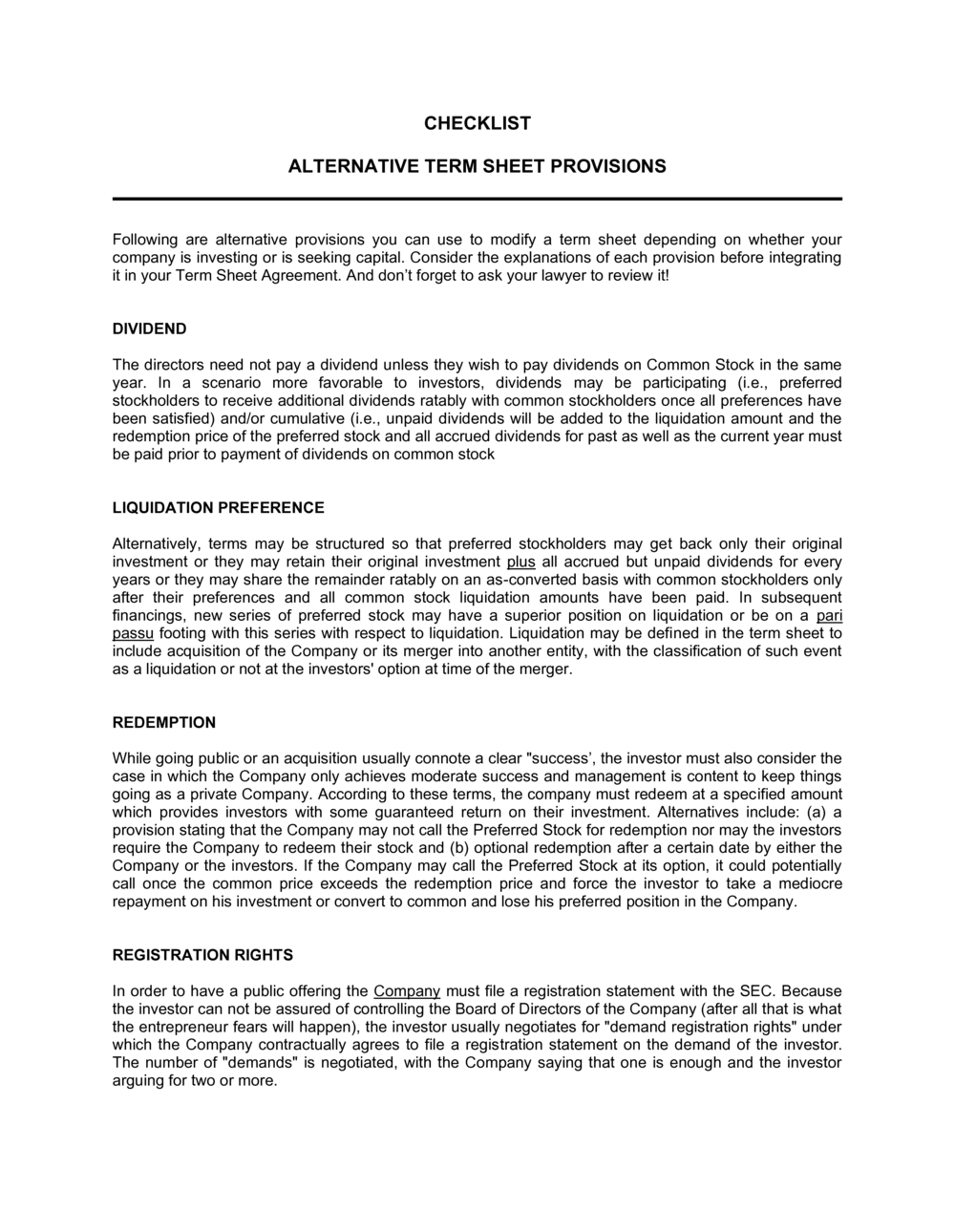
A Checklist Alternate Term Sheet Provisions is a structured form that lists the key provisions found in a financing or acquisition term sheet and lets you record, compare, and evaluate alternate versions of each clause side by side. This free Word download gives you a ready-to-use checklist you can edit online and share with counsel or counterparties before finalizing binding documents.
When you need it
Use it when you have received two or more term sheets from different investors or acquirers, or when a single term sheet contains multiple alternative structures for key provisions β€” such as a choice between a pre-money SAFE and a priced round β€” and you need to evaluate the trade-offs before committing to one approach.
What's inside
The checklist organizes provisions into labeled rows covering valuation, investment amount, security type, liquidation preference, anti-dilution, board composition, voting rights, information rights, and exit conditions. Each row captures the baseline term, one or more alternates, and a notes field for flagging risk, preference, or open negotiation points.

What is a Checklist Alternate Term Sheet Provisions?

A Checklist Alternate Term Sheet Provisions is a structured comparison form that extracts the key provisions from one or more financing or acquisition term sheets and displays alternate versions of each clause side by side for evaluation. It captures the baseline term, one or more competing alternatives, the economic impact of each, a documented preference, and a live negotiation status β€” all in a single document. Rather than forcing decision-makers to flip between multiple term sheets, the checklist concentrates every material choice in one place so the team can align on positions before entering negotiations.

Why You Need This Document

Accepting a term sheet provision without comparing it to market alternatives is one of the most expensive mistakes a founder or executive can make. Liquidation preference structures, anti-dilution formulas, and board composition terms that appear similar in plain language can differ by hundreds of thousands of dollars in actual founder proceeds at exit. Without a structured checklist, teams negotiate reactively β€” agreeing to provisions in real time without understanding their cumulative economic effect. This template forces the analysis before the call, documents every open point so nothing falls through, and creates an audit trail that protects you when definitive documents are drafted weeks later. It takes two to four hours to complete and gives every negotiation session a clear, pre-approved mandate.

Which variant fits your situation?

If your situation is…Use this template
Comparing multiple investor term sheets for a priced equity roundChecklist Alternate Term Sheet Provisions
Drafting the initial term sheet to send to an investorTerm Sheet (Venture Capital)
Documenting agreed deal terms before a full purchase agreementLetter of Intent (Acquisition)
Tracking open deal points during active negotiationDeal Points Memorandum
Summarizing equity financing terms for board approvalBoard Resolution β€” Equity Financing
Comparing convertible note terms from multiple lendersConvertible Note Term Sheet
Reviewing SAFE provisions before countersigningSimple Agreement for Future Equity (SAFE)

Common mistakes to avoid

❌ Paraphrasing instead of copying exact provision language

Why it matters: Paraphrased summaries introduce subtle differences that become negotiation disputes when definitive documents are drafted against the checklist.

Fix: Copy the exact clause text or numeric parameters from the source term sheet into every baseline and alternate field.

❌ Skipping the economic impact calculation

Why it matters: Provisions like participating preferred and broad anti-dilution can reduce founder proceeds by hundreds of thousands of dollars at typical exit multiples β€” without the math, their real cost is invisible.

Fix: Model at least three exit scenarios for every economic provision before the first negotiation call.

❌ Leaving the preference column blank before negotiations

Why it matters: Without a pre-documented preferred position, founders make in-the-moment concessions on material terms under investor time pressure.

Fix: Complete the preference and rationale columns and share with all decision-makers before any investor conversation.

❌ Not updating negotiation status after each touchpoint

Why it matters: Stale status fields cause teams to re-open agreed provisions or miss escalations, lengthening deal timelines and eroding investor confidence.

Fix: Assign one person as checklist owner who updates the status column within 24 hours of every negotiation touchpoint.

The 8 key fields, explained

Provision name and category

Baseline term (Investor A / Option 1)

Alternate term (Investor B / Option 2)

Economic impact summary

Preference or recommendation

Negotiation status

Linked document reference

Counsel notes

How to fill it out

  1. 1

    List every material provision from each term sheet received

    Read each term sheet and create one row per distinct provision. Group rows by category: economics, governance, information rights, and exit.

    πŸ’‘ Use the National Venture Capital Association (NVCA) model term sheet as a reference list of standard provisions β€” it covers every category you should expect to see.

  2. 2

    Enter baseline and alternate terms verbatim

    Copy the exact clause language or key parameters β€” dollar amounts, multiples, percentages β€” directly from each source document into the baseline and alternate columns.

    πŸ’‘ If a provision appears in only one term sheet, note 'not addressed' in the other column rather than leaving it blank β€” silence on a material point is itself a negotiating position.

  3. 3

    Calculate the economic impact for each provision

    Run at least three exit scenarios β€” 1x, 3x, and 5x invested capital β€” and compute how each version of economic provisions (liquidation preference, anti-dilution, participation) affects common stockholder proceeds.

    πŸ’‘ A simple spreadsheet with a shared exit-proceeds waterfall model takes under an hour to build and makes the economic impact column trivial to complete.

  4. 4

    Record your preference and rationale before the negotiation call

    For each open provision, document which version you prefer and a one-line reason. Share the completed checklist with your co-founders or board before any investor conversation.

    πŸ’‘ Rank provisions by importance β€” must-have, should-have, nice-to-have β€” so you know which concessions are acceptable trade-offs for must-have wins.

  5. 5

    Update negotiation status in real time

    After each call or email exchange, update the status column immediately. Mark agreed items closed and flag escalated items for a follow-up decision.

    πŸ’‘ Set a shared version of the checklist in a cloud document so all parties see the same status β€” version-control confusion on term sheet tracking is a common source of deal delays.

  6. 6

    Route counsel notes to your attorney before finalizing

    Send the completed checklist to legal counsel with the original term sheets attached. Ask them to populate or review the counsel notes column before you respond to investors.

    πŸ’‘ Even a one-hour attorney review of a checklist like this costs $200–$400 and can prevent agreeing to a provision that costs 10x more to unwind in the definitive documents.

Frequently asked questions

What is a checklist of alternate term sheet provisions?

A checklist of alternate term sheet provisions is a structured comparison form that lists the key provisions in one or more financing or acquisition term sheets and records the alternate versions of each clause side by side. It allows founders, investors, and advisors to evaluate trade-offs, document preferences, and track negotiation status before binding documents are drafted.

When should I use this checklist?

Use it whenever you receive two or more competing term sheets, when a single term sheet presents optional structures for key provisions, or when preparing for a negotiation call and you need your team aligned on preferred positions. It is most valuable in the window between receiving a term sheet and responding with a counteroffer.

Is a term sheet legally binding?

Most term sheets are not legally binding in their entirety, but typically contain two binding carve-outs: a no-shop clause preventing the company from soliciting other offers during the exclusivity period, and a confidentiality provision. The economic and governance terms are non-binding until reflected in definitive agreements. Confirm which provisions carry binding effect with your attorney before signing.

What are the most negotiable provisions in a term sheet?

Liquidation preference structure (participating vs. non-participating), anti-dilution type (broad-based weighted average vs. full ratchet), board seat allocation, pro rata rights for future rounds, and information rights frequency are consistently the most negotiated provisions in venture and growth-equity term sheets. Valuation and investment amount are negotiated first but are often more anchored to market comparables than governance terms.

What is the difference between participating and non-participating preferred?

Non-participating preferred stockholders collect their liquidation preference first, then convert to common and share in remaining proceeds β€” or receive whichever amount is greater. Participating preferred stockholders collect their preference first and then also share in remaining proceeds alongside common stockholders without converting. Participating preferred consistently reduces common stockholder proceeds at exits below 5–7x invested capital.

Do I need a lawyer to review a term sheet?

Yes, for any financing above $250K or any acquisition term sheet. A qualified corporate attorney can identify provisions that look standard but carry unusual economic or control consequences β€” for example, a full-ratchet anti-dilution clause that functionally resets founder ownership at the next down round. A 2–4 hour attorney review typically costs $600–$1,200 and is among the highest-return legal expenditures a founder makes.

How is this checklist different from the term sheet itself?

A term sheet presents one set of proposed terms in narrative form. This checklist is a comparison and evaluation tool β€” it extracts the individual provisions, places alternates side by side, quantifies economic impact, and tracks negotiation status. It does not replace the term sheet; it is the working document your team uses to analyze and respond to it.

What is anti-dilution protection and which type is more founder-friendly?

Anti-dilution protection adjusts an investor's conversion price if the company issues shares at a lower valuation in a future round. Broad-based weighted average anti-dilution is the most common and most founder-friendly variant β€” it dilutes the adjustment across all outstanding shares. Full-ratchet anti-dilution is highly investor-favorable and can dramatically reduce founder ownership in a down round; it is uncommon in standard venture deals and should be flagged for immediate negotiation.

Can I use this checklist for debt financing term sheets?

Yes. While the default provisions listed in the template are oriented toward equity financing, the same framework applies to debt term sheets β€” substitute rows for interest rate, maturity, covenants, security interest, prepayment penalty, and conversion features. The comparison and negotiation tracking structure is identical regardless of instrument type.

How this compares to alternatives

vs Term Sheet

A term sheet proposes a single set of deal terms from one party's perspective. This checklist is a downstream evaluation tool that extracts those provisions, pairs them with alternates, and tracks negotiation progress. You need the term sheet first; the checklist is how you work through it.

vs Letter of Intent (Acquisition)

A letter of intent is a semi-binding document that advances a specific agreed structure toward definitive documents. This checklist sits earlier in the process β€” it helps you select which structure to commit to before an LOI is signed. Once the LOI is executed, this checklist becomes a negotiation record rather than a decision tool.

vs Deal Points Memorandum

A deal points memorandum summarizes only the agreed terms after negotiation concludes. This checklist captures both agreed and open items throughout the negotiation process, making it the more useful tool while the deal is live. Convert it to a deal points memo once all provisions are closed.

vs Due Diligence Checklist

A due diligence checklist tracks the documents and information an investor or acquirer needs to verify before closing. This checklist focuses exclusively on the deal structure and economic terms β€” the two documents cover different workstreams and are typically run in parallel once a term sheet is signed.

Industry-specific considerations

Technology / SaaS

Founders compare SAFE valuation caps and discount rates from multiple angels alongside priced-round terms from institutional seed funds.

Healthcare / MedTech

Longer commercialization timelines make liquidation preference multiples and milestone-based tranching the most commonly contested alternate provisions.

Private Equity

Management fee offsets, ratchets, and rollover equity structures appear as alternate provisions in leveraged buyout and recapitalization term sheets.

Professional Services

Firms evaluating strategic investment or acquisition offers use the checklist to compare earnout structures, non-compete durations, and retention bonus provisions.

Template vs pro β€” what fits your needs?

PathBest forCostTime
Use the templateFounders and finance teams comparing two or three term sheets for a standard seed or Series A roundFree2–4 hours to complete
Template + professional reviewAny financing above $500K, complex governance provisions, or deals with participating preferred or full-ratchet anti-dilution$600–$1,200 (attorney review of completed checklist and source term sheets)1–2 days
Custom draftedGrowth-equity rounds above $5M, M&A transactions, or multi-party syndicated deals with competing economic structures$2,000–$8,000+ (full deal counsel engagement)1–3 weeks

Glossary

Term Sheet
A non-binding document summarizing the key economic and governance terms of a proposed investment or acquisition before definitive agreements are drafted.
Pre-Money Valuation
The agreed value of a company immediately before new investment proceeds are added β€” used to calculate the investor's ownership percentage.
Liquidation Preference
The right of preferred stockholders to receive a specified multiple of their investment before common stockholders receive any proceeds in a sale or wind-down.
Anti-Dilution Protection
A provision that adjusts an investor's conversion price downward if the company later issues shares at a lower price, protecting the investor's effective ownership percentage.
Pro Rata Rights
The right of an existing investor to participate in future funding rounds in proportion to their current ownership, preventing dilution.
Participating Preferred
A preferred share structure where the investor collects their liquidation preference first and then also participates in remaining proceeds alongside common stockholders.
Board Composition
The agreed number of board seats and how they are allocated among founders, investors, and independent directors under the term sheet.
Drag-Along Rights
A provision allowing a majority of shareholders to compel minority shareholders to approve and participate in a sale of the company on the same terms.
Information Rights
Contractual rights granted to investors to receive regular financial statements, budgets, and other company records, typically on a monthly or quarterly basis.
Conversion Rights
The right of preferred stockholders to convert their shares into common stock, typically triggered automatically at a qualified IPO or optionally at any time.

Part of your Business Operating System

This document is one of 3,000+ business & legal templates included in Business in a Box.

  • Fill-in-the-blanks β€” ready in minutes
  • 100% customizable Word document
  • Compatible with all office suites
  • Export to PDF and share electronically

Create your document in 3 simple steps.

From template to signed document β€” all inside one Business Operating System.
1
Download or open template

Access over 3,000+ business and legal templates for any business task, project or initiative.

2
Edit and fill in the blanks with AI

Customize your ready-made business document template and save it in the cloud.

3
Save, Share, Send, Sign

Share your files and folders with your team. Create a space of seamless collaboration.

Save time, save money, and create top-quality documents.

β˜…β˜…β˜…β˜…β˜…

"Fantastic value! I'm not sure how I'd do without it. It's worth its weight in gold and paid back for itself many times."

Managing Director Β· Mall Farm
Robert Whalley
Managing Director, Mall Farm Proprietary Limited
β˜…β˜…β˜…β˜…β˜…

"I have been using Business in a Box for years. It has been the most useful source of templates I have encountered. I recommend it to anyone."

Business Owner Β· 4+ years
Dr Michael John Freestone
Business Owner
β˜…β˜…β˜…β˜…β˜…

"It has been a life saver so many times I have lost count. Business in a Box has saved me so much time and as you know, time is money."

Owner Β· Upstate Web
David G. Moore Jr.
Owner, Upstate Web

Run your business with a system β€” not scattered tools

Stop downloading documents. Start operating with clarity. Business in a Box gives you the Business Operating System used by over 250,000 companies worldwide to structure, run, and grow their business.

Free Forever PlanΒ Β·Β No credit card required