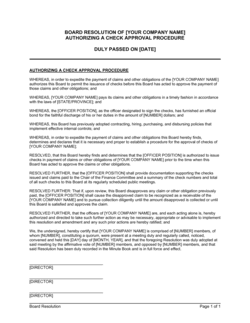
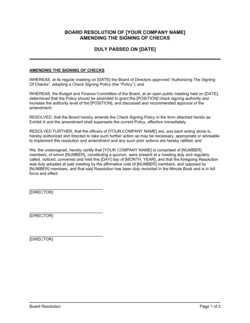
Board Resolution Amending the Check Approval Procedure

Free Word download • Edit online • Save & share with Drive • Export to PDF

1 page20–25 min to fillDifficulty: Standard
Learn more ↓
FreeBoard Resolution Amending the Check Approval Procedure Template

At a glance

What it is
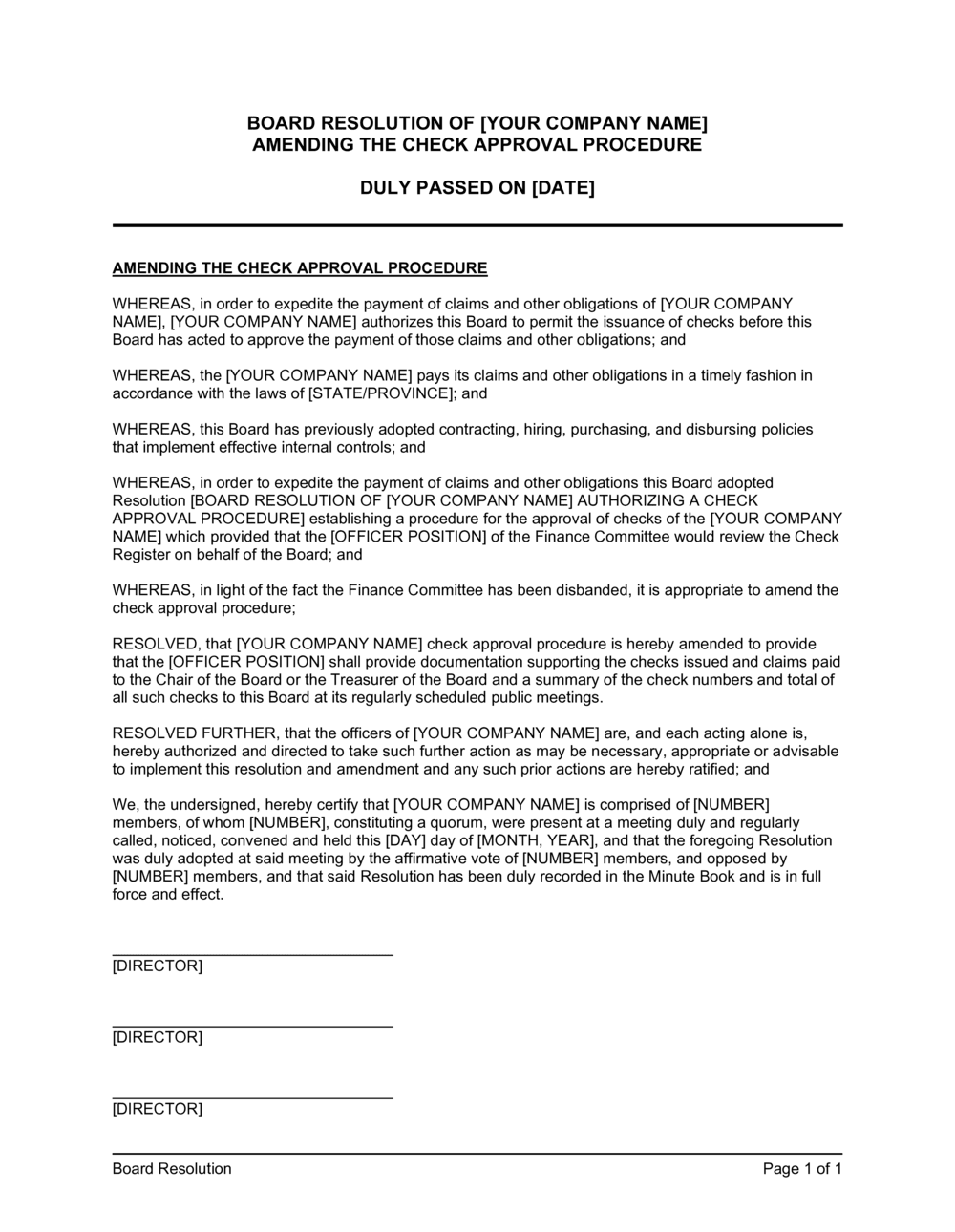
A Board Resolution Amending the Check Approval Procedure is a formal corporate document in which the board of directors officially replaces or modifies the organization's existing rules for authorizing, signing, and releasing checks. This free Word download gives you a ready-to-edit template covering resolution recitals, amended authority thresholds, dual-signature requirements, and effective date — exportable as PDF for your corporate records book.
When you need it
Use it whenever the board needs to change who can sign checks, raise or lower dollar thresholds that trigger secondary approval, or respond to an audit finding that identified a gap in disbursement controls.
What's inside
Recitals explaining the reason for the amendment, a rescission of the prior procedure, the newly adopted signing-authority table with dollar thresholds, dual-signature requirements, notification obligations to the bank, and an effective date with board attestation.

What is a Board Resolution Amending the Check Approval Procedure?

A Board Resolution Amending the Check Approval Procedure is a formal corporate document in which a company's board of directors officially updates the rules governing who may sign checks on behalf of the organization, the dollar thresholds that apply to each authorized signatory, and the conditions under which a second signature is required. It supersedes any prior version of the procedure, creating a single authoritative record that is filed in the corporate minute book and delivered to the company's bank to update its signature authority records. The resolution functions both as an internal governance document and as a legally recognized instruction to the financial institution holding the company's accounts.

Why You Need This Document

Operating without a current, board-approved check approval procedure leaves your organization exposed to unauthorized disbursements, audit findings, and potential fraud. Banks are legally required to honor checks signed by anyone listed as an authorized signatory in their records — if a former employee's name is still on file because no amendment was ever adopted, that person retains the ability to write checks against your account. Auditors treat an outdated or undocumented check procedure as a material internal control weakness, which can trigger a qualified audit opinion for nonprofits and regulated entities. Beyond fraud risk, a clear signing-authority table with specific dollar thresholds removes ambiguity for staff, reduces delays on routine payments, and gives the board a documented basis for enforcing accountability when disbursement policies are not followed. This template gives you a correctly structured, bank-ready resolution you can complete in under 30 minutes.

Which variant fits your situation?

If your situation is…Use this template
Changing who can sign checks up to a specific dollar limitBoard Resolution Amending the Check Approval Procedure
Authorizing a new bank account and designating signatories at openingBoard Resolution to Open a Bank Account
Formally approving a single large one-time expenditure outside normal limitsBoard Resolution Authorizing a Specific Expenditure
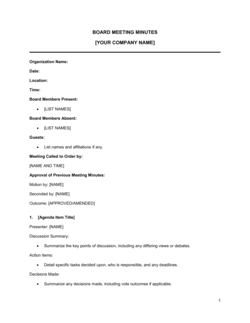
Recording all board decisions made at a scheduled board meetingBoard Meeting Minutes
Passing a board decision without convening a formal meetingUnanimous Written Consent of the Board
Updating the full suite of financial authorization policiesDelegation of Authority Policy
Appointing a new officer with financial signing authorityBoard Resolution Appointing an Officer

Common mistakes to avoid

❌ Failing to notify the bank after adoption

Why it matters: The bank's records control who can actually cash or transfer funds. Until signature cards are updated, the old signatories remain authorized on the account and the new resolution has no practical effect.

Fix: Assign the notification task to a named officer in the resolution itself, with a deadline of 5 business days, and require written bank confirmation be filed with the corporate record.

❌ Listing titles instead of named individuals in the authority table

Why it matters: Banks and auditors require specific names. If a title is held by multiple people or the role changes hands, the authorization becomes unenforceable and checks may be rejected.

Fix: Always use full legal names alongside titles. When personnel change, adopt a new amending resolution immediately rather than relying on the title to carry authority forward.

❌ Not rescinding the prior resolution

Why it matters: Two active resolutions with conflicting signing authorities create compliance confusion. Auditors may flag the inconsistency; banks may apply the older, lower threshold as the more conservative control.

Fix: Include a formal rescission clause identifying the prior resolution by date and stating it is cancelled in its entirety on the new effective date.

❌ Setting the dual-signature threshold too high to be meaningful

Why it matters: A $500,000 dual-signature threshold at an organization whose largest single check is $80,000 means the control is never triggered — providing no fraud deterrence.

Fix: Calibrate the threshold to the organization's actual disbursement patterns. The threshold should catch the top 5–10% of payments by dollar value to provide a genuine control layer.

❌ Using a retroactive effective date without interim documentation

Why it matters: Setting the effective date before the resolution was adopted means checks issued in the gap technically lacked proper authorization, creating audit exposure.

Fix: Use the actual adoption date as the effective date. If a retroactive date is unavoidable, attach a schedule listing all checks issued in the interim and confirm they were reviewed and ratified.

❌ Omitting the corporate secretary's certification

Why it matters: A resolution without attestation of the vote or consent is not a complete corporate record. Banks routinely reject unattested resolutions as evidence of signing authority.

Fix: Include a certification block for the corporate secretary to sign, stating the date, vote count (or unanimous consent), and confirmation that quorum was present.

The 9 key sections, explained

Resolution header and meeting identification

Recitals (whereas clauses)

Rescission of prior procedure

Amended signing authority table

Dual-signature threshold

Prohibited transactions and exceptions

Bank notification obligation

Effective date and supersession clause

Board attestation and signatures

How to fill it out

  1. 1

    Insert the company's legal name and meeting details

    Enter the full registered legal name, state of incorporation, and whether the resolution was adopted at a regular meeting, special meeting, or by unanimous written consent. Include the exact date.

    💡 Pull the legal name directly from your certificate of incorporation — trade names and assumed business names are not sufficient.

  2. 2

    Write the recitals explaining the reason for the amendment

    Draft two to four 'whereas' clauses summarizing what prompted the change — a personnel transition, audit recommendation, increased transaction volume, or updated risk policy.

    💡 Be specific: 'whereas the Company's average monthly disbursements have grown from $50,000 to $200,000 since the prior procedure was adopted' is more defensible than a vague reference to changed circumstances.

  3. 3

    Formally rescind the prior resolution

    Identify the prior resolution by its adoption date and state that it is rescinded in its entirety effective the same date as the new amendment.

    💡 If you cannot locate the original resolution date, check the corporate minute book. If no prior written resolution exists, state that the amendment supersedes any prior informal practice.

  4. 4

    Complete the signing authority table

    List each authorized signatory by full legal name and current title, paired with their individual dollar limit. Confirm these names match the individuals' names on government-issued ID for bank verification.

    💡 Set individual limits in round numbers that align with your existing expense approval tiers — e.g., $5,000, $25,000, $50,000 — to make the table intuitive for staff and auditors.

  5. 5

    Set the dual-signature threshold

    Choose a threshold that corresponds to a meaningful control point — typically the amount above which a single erroneous or fraudulent payment would have a material financial impact on the organization.

    💡 For organizations with annual budgets under $1M, a dual-signature threshold of $10,000–$25,000 is common. Scale up proportionally — the threshold should trigger on roughly 5–10% of disbursements.

  6. 6

    Document exceptions and prohibited transactions

    List any payment types exempt from the standard procedure (payroll, automated ACH, petty cash) and any transaction categories that require full board approval regardless of amount.

    💡 Review your accounts payable register for the past 12 months to identify recurring payment types before drafting this section — omissions create compliance gaps.

  7. 7

    Assign the bank notification obligation

    Name the specific officer responsible for delivering the certified resolution to the bank and updating signature cards, and set a deadline — typically within 5 business days of adoption.

    💡 Request written confirmation from the bank that the new signatories have been registered. File that confirmation with the resolution in your corporate records.

  8. 8

    Obtain board attestation and file the resolution

    Have the corporate secretary certify the vote count or unanimous consent, collect signatures, and file the executed original in the corporate minute book with a certified copy sent to the bank.

    💡 Scan and store a digital copy alongside the minute book entry — auditors and banks increasingly request electronic copies and a paper-only filing creates retrieval delays.

Frequently asked questions

What is a board resolution amending the check approval procedure?

It is a formal decision of the board of directors that replaces or modifies the organization's existing rules for authorizing and signing checks. The resolution identifies who is permitted to sign checks, the dollar limits that apply to each signatory, when a second signature is required, and the date the new rules take effect. It becomes a permanent entry in the corporate minute book and is provided to the company's bank to update signature authority records.

When should a board adopt this resolution?

Adopt it whenever a signatory leaves or joins, when dollar thresholds no longer reflect the organization's transaction volume, after an internal or external audit recommends tighter controls, or when the board decides to add a dual-signature requirement for large disbursements. Any change to who can sign checks on behalf of the organization should be formalized through a board resolution rather than managed informally.

Does this resolution need to be filed with the state?

No. Board resolutions amending internal financial procedures are internal corporate records — they are not filed with the secretary of state or any government agency. However, a certified copy must be delivered to the company's bank so the financial institution can update its records. Keep the executed original in the corporate minute book alongside the prior resolution it replaces.

What is the difference between this resolution and a board resolution to open a bank account?

A resolution to open a bank account is used when establishing a new account and designating the initial signatories. This amending resolution is used after an account is already open to change the authorized signatories, dollar thresholds, or approval rules on an existing account. Both are typically required by the bank as part of its records, but they serve different triggering events.

How specific do the dollar thresholds need to be?

Thresholds should be specific dollar amounts — for example, $10,000 for individual signatory authority and $50,000 for dual-signature requirements — not ranges or percentages. Vague language like 'ordinary course payments' creates interpretation disputes. Use amounts that align with your existing budgeting and expense approval tiers so the check procedure integrates cleanly with other financial controls.

How often should the check approval procedure be reviewed?

Review it at least annually as part of the board's standard governance calendar, and immediately any time a signatory's employment status changes, the organization's disbursement volume changes materially, or an audit raises a concern. Outdated procedures listing former employees as authorized signatories are one of the most commonly cited internal control weaknesses in nonprofit and small business audits.

Should the company's external auditor receive a copy?

Yes. Providing your external auditor with the current executed resolution at the start of each audit engagement allows them to verify disbursement testing against the correct authority thresholds. Many auditors request this document as part of their standard internal controls review. Keeping the auditor's copy current also demonstrates active governance and can reduce audit hours spent tracing check-signing authority.

How this compares to alternatives

vs Board Meeting Minutes

Board meeting minutes record everything discussed and decided at a full board meeting, including motions, votes, and attendance. A board resolution is a standalone document recording a single specific decision. When check approval changes are made at a full meeting, both are created — the minutes note the vote and the resolution provides the operative policy document that goes to the bank.

vs Board Resolution to Open a Bank Account

A resolution to open a bank account establishes the initial signatories and terms when a new account is created. This amending resolution modifies those terms after the account is in operation. Use the opening resolution once, then use this amendment resolution every time the signatories or thresholds need to change.

vs Delegation of Authority Policy

A delegation of authority policy is a comprehensive internal document covering all categories of financial and operational decisions — purchases, contracts, hires, and disbursements — across the entire organization. A board resolution amending the check approval procedure is narrower and more formal, targeting only check-signing authority and serving as the bank-facing legal record. The two documents should be consistent with each other.

vs Unanimous Written Consent of the Board

A unanimous written consent is the mechanism by which board members approve a resolution without convening a meeting. A board resolution is the decision itself. When adopting a check approval amendment without a formal meeting, you use both: the written consent document triggers the process, and the resolution records the substantive decision adopted through that process.

Industry-specific considerations

Nonprofit organizations

Funders and grant auditors routinely require dual-signature rules and documented board approval of check procedures as a condition of funding compliance.

Professional services

Law firms, accounting firms, and consultancies update check authority when partners join or depart, typically requiring partner-level approval above the firm's standard client disbursement threshold.

Construction and real estate

Large and frequent subcontractor payments and draw requests make tiered signing authority critical; thresholds are typically set at the project milestone payment level.

Healthcare

Healthcare organizations subject to cost-report audits and Stark Law compliance need a clear documented trail of who authorized each disbursement, making a current board resolution essential.

Template vs pro — what fits your needs?

PathBest forCostTime
Use the templateSmall businesses, startups, and nonprofits making routine changes to signatory names or dollar thresholdsFree15–30 minutes
Template + professional reviewOrganizations with complex multi-account structures, multiple subsidiaries, or after an audit finding requiring documented remediation$150–$400 for a one-hour legal or accounting review1–2 days
Custom draftedRegulated entities (banks, healthcare organizations, federally-funded nonprofits) where disbursement controls are subject to regulatory examination$500–$1,5003–5 days

Glossary

Board Resolution
A formal written record of a decision made by a company's board of directors, which becomes part of the permanent corporate record.
Check Approval Procedure
The internal policy that defines who may authorize and sign checks, at what dollar thresholds, and under what conditions.
Signing Authority
The delegated power granted to a named individual to sign checks or payment instruments on behalf of the organization up to a defined limit.
Dual-Signature Requirement
A control requiring two authorized signatories to co-sign any check that exceeds a defined dollar threshold.
Dollar Threshold
A specific monetary limit that, when exceeded, triggers a higher level of approval or a second signature on a disbursement.
Recital
The introductory 'whereas' clauses in a resolution that explain the background and business reason for the board's decision.
Rescission
The formal cancellation of a prior board resolution or policy, typically included in an amendment resolution to prevent two conflicting policies from coexisting.
Effective Date
The specific calendar date on which the amended procedure takes legal effect and supersedes the prior version.
Unanimous Written Consent
A mechanism allowing all board members to approve a resolution by signing a written document rather than convening a formal meeting.
Internal Controls
Processes and policies designed to safeguard assets, prevent fraud, and ensure financial transactions are properly authorized and recorded.

Part of your Business Operating System

This document is one of 3,000+ business & legal templates included in Business in a Box.

  • Fill-in-the-blanks — ready in minutes
  • 100% customizable Word document
  • Compatible with all office suites
  • Export to PDF and share electronically

Create your document in 3 simple steps.

From template to signed document — all inside one Business Operating System.
1
Download or open template

Access over 3,000+ business and legal templates for any business task, project or initiative.

2
Edit and fill in the blanks with AI

Customize your ready-made business document template and save it in the cloud.

3
Save, Share, Send, Sign

Share your files and folders with your team. Create a space of seamless collaboration.

Save time, save money, and create top-quality documents.

★★★★★

"Fantastic value! I'm not sure how I'd do without it. It's worth its weight in gold and paid back for itself many times."

Managing Director · Mall Farm
Robert Whalley
Managing Director, Mall Farm Proprietary Limited
★★★★★

"I have been using Business in a Box for years. It has been the most useful source of templates I have encountered. I recommend it to anyone."

Business Owner · 4+ years
Dr Michael John Freestone
Business Owner
★★★★★

"It has been a life saver so many times I have lost count. Business in a Box has saved me so much time and as you know, time is money."

Owner · Upstate Web
David G. Moore Jr.
Owner, Upstate Web

Run your business with a system — not scattered tools

Stop downloading documents. Start operating with clarity. Business in a Box gives you the Business Operating System used by over 250,000 companies worldwide to structure, run, and grow their business.

Free Forever Plan · No credit card required