Apology to Receiver of NSF Check Template

Free Word download β€’ Edit online β€’ Save & share with Drive β€’ Export to PDF

1 pageβ€’15–25 min to fillβ€’Difficulty: Standard
Learn more ↓
FreeApology to Receiver of NSF Check Template

At a glance

What it is
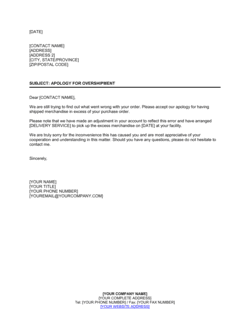
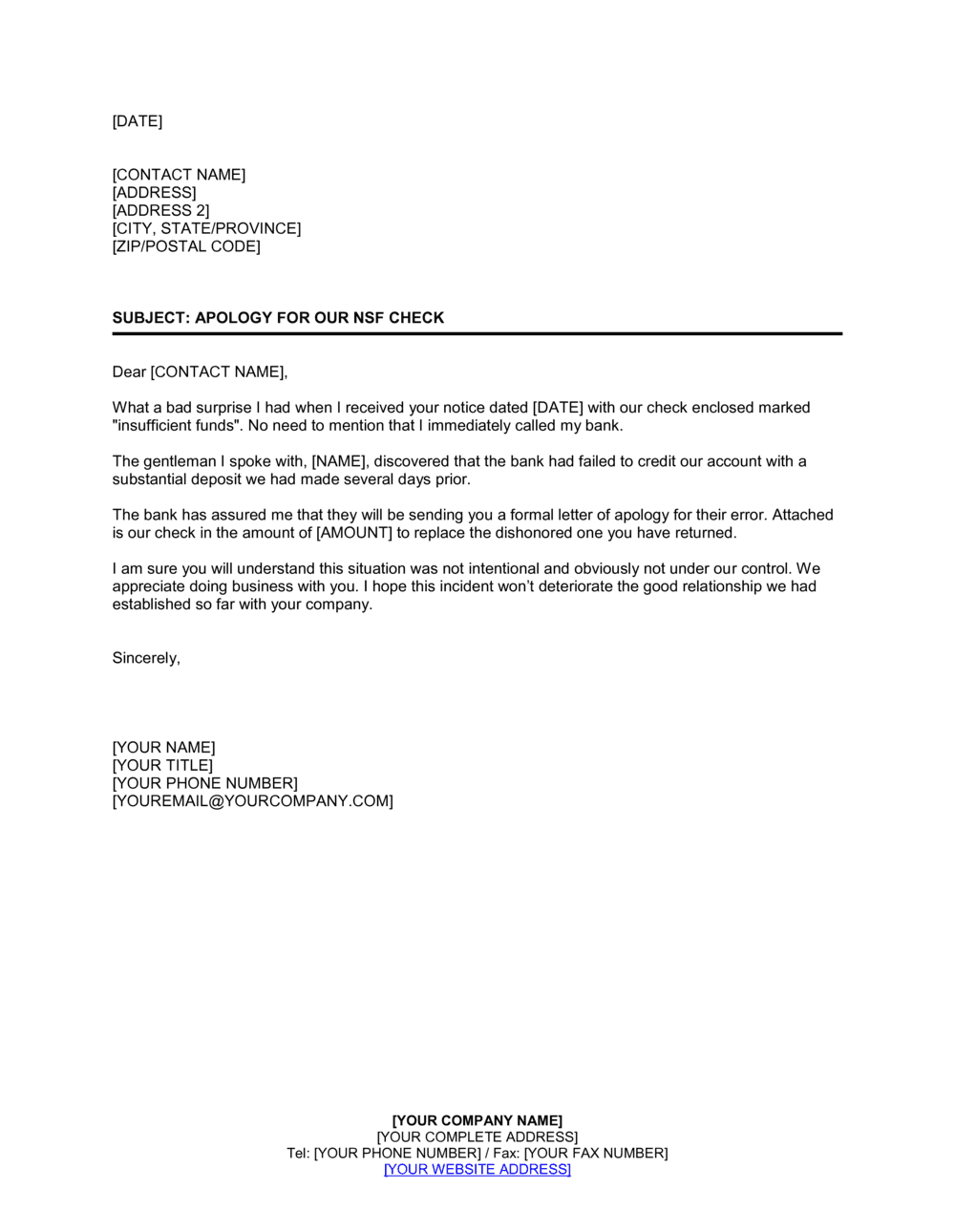
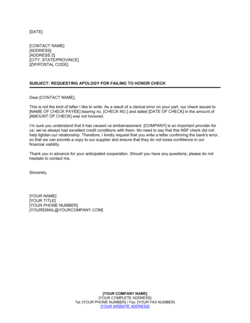
An Apology to Receiver of NSF Check is a formal business letter sent by the issuer of a returned check to the recipient, acknowledging that the check was dishonored due to insufficient funds, expressing regret, and outlining the corrective steps being taken. This free Word download gives you a ready-to-edit template you can personalize and send within minutes.
When you need it
Use it as soon as you are notified that a check you issued has been returned unpaid. Prompt communication reduces bank fees, late payment penalties, and damage to the business relationship. Sending this letter before the recipient escalates the matter to collections or legal action keeps the situation manageable.
What's inside
A formal salutation, a clear acknowledgment of the returned check with its reference details, an explanation of the cause, an apology, a statement of the remedy being taken (replacement payment or wire transfer), and a closing commitment to prevent recurrence.

What is an Apology to Receiver of NSF Check?

An Apology to Receiver of NSF Check is a formal business letter sent by the issuer of a returned check to the party who attempted to deposit it, acknowledging that the check was dishonored due to insufficient funds in the issuer's account. It serves three practical purposes: it documents that the issuer is aware of the problem, it preserves the business relationship through a direct and professional response, and it outlines the exact remedy β€” replacement payment method, amount, and timeline β€” so the recipient can close the matter without escalating to collections or legal action. The letter functions as a written record of accountability and intent to pay in full.

Why You Need This Document

Ignoring a bounced check rarely makes the problem smaller. Recipients who receive no communication within two to three business days of a return frequently refer the balance to a collections agency, assess compounding returned-check fees, or β€” where statutory thresholds are met β€” file a criminal bad-check complaint. A prompt, professional apology letter with a concrete remedy plan interrupts that escalation path at the lowest-cost point. It also protects the issuer's credit profile and vendor relationships by demonstrating that the NSF event was an isolated oversight, not a pattern of non-payment. This template gives you a complete, ready-to-send letter in under ten minutes β€” covering every element a recipient needs to confirm the matter is being resolved.

Which variant fits your situation?

If your situation is…Use this template
Check bounced due to a temporary cash shortfallApology to Receiver of NSF Check
Notifying a vendor that payment is delayed beyond the original due dateOverdue Payment Apology Letter
Requesting additional time to make a payment you cannot currently coverRequest for Extension of Payment Terms
Formally disputing a returned check fee charged by the recipientDispute of Bank Charges Letter
Confirming that a replacement payment has been sent by wire or ACHPayment Confirmation Letter
Notifying a bank of a stop payment placed in error that caused a returnBank Error Notification Letter

Common mistakes to avoid

❌ Delaying the letter while waiting for the replacement payment to clear

Why it matters: Every day of silence after a check bounces increases the recipient's anxiety and the likelihood they escalate to collections or legal action.

Fix: Send the apology letter immediately upon arranging the replacement payment β€” even if the wire has not yet settled. Include the expected settlement date.
❌ Omitting specific check details in the subject line

Why it matters: A recipient managing multiple vendors cannot match a vague letter to their records, delaying reconciliation and keeping the dispute open.

Fix: Always include the check number, original issue date, and dollar amount in the subject line and the opening paragraph.

❌ Promising another personal or business check as the replacement

Why it matters: Many recipients β€” and their banks β€” will not accept a second standard check from an issuer who already returned one NSF, leading to a second return and further fees.

Fix: Always offer a certified check, money order, or ACH/wire transfer as the remedy payment after an NSF event.

❌ Ignoring the returned check fee the recipient incurred

Why it matters: Leaving the recipient out of pocket for $25–$40 in bank fees they did not cause creates a separate grievance that can outlast the original dispute.

Fix: Explicitly offer to reimburse the returned check fee in the letter, and include it in the replacement payment amount.

The 9 key clauses, explained

Date and recipient address block

In plain language: The standard business letter header identifying when the letter was written and to whom it is addressed.

Sample language
[DATE] | [RECIPIENT NAME] | [RECIPIENT COMPANY] | [STREET ADDRESS] | [CITY, STATE, ZIP]

Common mistake: Using only a first name or nickname instead of the full legal name of the recipient β€” this reduces the letter's formality and can create matching problems in the recipient's records.

Subject line

In plain language: A one-line reference identifying the specific check involved, including the check number and original amount.

Sample language
Re: Returned Check No. [CHECK NUMBER] dated [DATE] for $[AMOUNT]

Common mistake: Omitting the check number or date, which forces the recipient to search their own records and slows the resolution process.

Acknowledgment of the returned check

In plain language: Opens the letter by directly acknowledging that a check was returned, without deflection or ambiguity.

Sample language
I am writing to acknowledge that Check No. [CHECK NUMBER], dated [DATE], in the amount of $[AMOUNT], issued to [RECIPIENT NAME] was returned by our bank due to insufficient funds.

Common mistake: Using vague language like 'regarding a recent payment issue' instead of directly stating the check was returned NSF β€” vagueness signals evasiveness and prolongs resolution.

Apology statement

In plain language: A sincere, direct apology that takes responsibility without excessive qualification or blame-shifting.

Sample language
We sincerely apologize for the inconvenience and any fees or disruption this has caused. We take full responsibility for this oversight and understand the impact it may have had on your operations.

Common mistake: Qualifying the apology with phrases like 'if this caused any inconvenience' β€” the inconvenience is factual, not hypothetical, and hedged apologies come across as insincere.

Brief explanation of the cause

In plain language: A one- to two-sentence explanation of why the check was returned β€” kept factual and brief, without over-justifying or making excuses.

Sample language
This occurred due to [BRIEF REASON β€” e.g., an unanticipated timing difference between an expected deposit and the check's presentment]. We have since resolved the underlying account issue.

Common mistake: Writing a lengthy explanation of your financial circumstances β€” this shifts the letter's tone from professional to sympathetic and rarely accelerates resolution.

Remedy and replacement payment

In plain language: States exactly what replacement payment is being sent, in what form, and by what date β€” the most operationally important paragraph.

Sample language
To resolve this matter promptly, we have arranged a [certified check / wire transfer / money order] in the amount of $[ORIGINAL AMOUNT + RETURNED CHECK FEE, IF APPLICABLE], which will be [delivered / transferred] to you by [DATE].

Common mistake: Promising a replacement payment without specifying the form or delivery date β€” vague promises without timelines give the recipient no basis to close the matter.

NSF fee reimbursement offer

In plain language: Offers to cover any returned check fee the recipient incurred, demonstrating good faith and preventing a separate dispute over fees.

Sample language
We would also like to reimburse any bank fees charged to you as a result of the returned check. Please provide the fee amount and we will include it in the replacement payment.

Common mistake: Ignoring the fee entirely β€” leaving the recipient out of pocket for a charge they incurred because of your error erodes goodwill and can trigger a collections escalation over a small amount.

Commitment to prevent recurrence

In plain language: A brief forward-looking statement that demonstrates the issue has been addressed and is not expected to repeat.

Sample language
We have reviewed our account management procedures to ensure this does not occur again and remain committed to honoring our financial obligations to you promptly and reliably.

Common mistake: Making an unqualified guarantee that it will never happen again β€” if it does recur, this statement can be used against you. Use language like 'have taken steps to prevent' rather than 'guarantee.'

Closing and contact information

In plain language: A professional closing that invites the recipient to reach out with questions and provides a direct contact name and number.

Sample language
If you have any questions or require additional information, please do not hesitate to contact me directly at [PHONE NUMBER] or [EMAIL ADDRESS]. Thank you for your understanding and continued business relationship. Sincerely, [NAME] | [TITLE] | [COMPANY]

Common mistake: Closing without providing a direct contact β€” forcing the recipient to navigate a general phone tree to follow up signals low priority and prolongs resolution.

How to fill it out

  1. 1

    Enter the date and recipient's full contact details

    Insert today's date and the recipient's full legal name, company name, and mailing address in the header block. Use the name as it appears on your original check.

    πŸ’‘ If the returned check was issued to an individual rather than a business, confirm the correct mailing address before sending β€” people move, and a letter to a wrong address restarts the clock.

  2. 2

    Fill in the subject line with check details

    Enter the check number, issue date, and dollar amount in the subject line. These three data points allow the recipient to match the letter to their records immediately.

    πŸ’‘ Pull the check number directly from your bank's NSF notice rather than relying on your checkbook β€” bank records are authoritative in any dispute.

  3. 3

    Write the acknowledgment paragraph

    State clearly that Check No. [X] dated [Y] for $[Z] was returned due to insufficient funds. Be direct β€” do not bury the acknowledgment in softening language.

    πŸ’‘ Keep this paragraph to two sentences. The recipient already knows the check bounced; your job is to confirm you know it too.

  4. 4

    Insert a brief, factual explanation

    Write one to two sentences explaining the cause β€” a timing issue, an unexpected debit, or a clerical error. Keep it factual and move on quickly.

    πŸ’‘ Avoid referencing broader financial difficulties. Even if true, this information can affect the recipient's willingness to extend credit or continue the relationship.

  5. 5

    Specify the remedy payment in full detail

    State the replacement payment method (certified check, wire, money order), the exact amount including any fee reimbursement, and the specific delivery or transfer date.

    πŸ’‘ Use a certified check or wire transfer for the replacement β€” sending another standard check after an NSF return will often be rejected by the recipient.

  6. 6

    Add the returned check fee reimbursement amount

    If you know the fee amount, include it in the replacement payment total. If you do not know it yet, ask the recipient to confirm the amount and commit to including it.

    πŸ’‘ A typical bank returned item fee runs $25–$40. Proactively covering it costs less than the relationship damage of ignoring it.

  7. 7

    Sign and send promptly

    Add your name, title, direct phone, and email in the closing block. Send by email with a PDF attachment and follow up with a physical copy if the amount is significant.

    πŸ’‘ Send the letter the same day you arrange the replacement payment β€” simultaneous action signals that the matter is being handled, not just acknowledged.

Frequently asked questions

What is an NSF check apology letter?

An NSF check apology letter is a formal written communication sent by the issuer of a returned check to the recipient, acknowledging the dishonored payment, explaining the cause briefly, apologizing for any inconvenience, and specifying the replacement payment being made. It serves as both a goodwill gesture and a documented record that the issuer has taken responsibility and is actively resolving the matter.

When should I send an NSF check apology letter?

Send the letter as soon as you are notified β€” ideally the same business day β€” that your check has been returned. Prompt communication is the single most effective way to prevent the recipient from escalating the matter to a collections agency or pursuing legal remedies. Waiting more than two business days after notification significantly increases the risk of escalation.

Do I need to include a replacement payment with the letter?

The letter and the replacement payment should be arranged simultaneously. Sending a letter without a concrete plan and timeline for payment is unlikely to satisfy the recipient. Specify the payment method, exact amount (including any fee reimbursement), and the date the funds will be delivered or transferred.

What form of replacement payment should I use after an NSF check?

Use a certified check, money order, or bank wire transfer. Most recipients and their banks will not accept a second standard personal or business check after an NSF return. Certified funds or electronic transfers settle reliably and demonstrate that the funds are actually available.

Am I legally required to send an apology letter for a bounced check?

There is no general legal requirement to send an apology letter, but the letter serves important practical functions. In many jurisdictions, the recipient must provide the check writer with written notice before pursuing legal remedies or pressing criminal bad-check charges. Sending a proactive apology letter with a remedy plan typically prevents the situation from escalating to that point.

Should I mention the reason my check bounced?

Keep the explanation to one or two factual sentences β€” a timing issue, an unexpected debit, or a processing error. Do not detail broader financial difficulties or over-explain. The recipient needs to know the cause was identifiable and corrected, not a full accounting of your financial position.

Can this letter be used by an individual as well as a business?

Yes. While the template uses business-oriented language, it is easily adapted for personal use β€” replace company name and title with your individual name and adjust the tone slightly. The core structure (acknowledgment, explanation, apology, remedy, commitment) applies equally to personal and commercial contexts.

What happens if I ignore a returned check?

Ignoring a returned check exposes you to escalating consequences: the recipient may add returned check fees and late charges to your balance, refer the debt to a collections agency, report the default to credit bureaus, or β€” in some jurisdictions β€” file a criminal bad-check complaint if the amount exceeds a statutory threshold and proper notice has been given. Addressing the matter promptly in writing with a documented remedy plan is almost always the faster and cheaper path.

Is a signature required on this letter?

A handwritten signature adds formality and demonstrates personal accountability, and is recommended for any significant amount. For routine small-dollar NSF letters sent by email, a typed signature block with your name, title, and direct contact is generally sufficient. Check your company's correspondence policy for guidance on formal sign-off requirements.

How this compares to alternatives

vs NSF Check Notice (to the check writer)

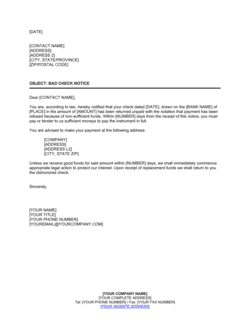
An NSF check notice is sent by the recipient to the check writer demanding repayment, often as a precursor to legal action. An NSF apology letter is sent in the opposite direction β€” by the check writer to the recipient β€” proactively acknowledging the issue and providing a remedy. Using this apology template preempts the need for a formal demand notice in most cases.

vs Overdue Payment Apology Letter

An overdue payment letter addresses a late payment where the original check or transfer was never sent. An NSF apology letter addresses a payment that was sent but returned by the bank. The NSF version must include specific check reference details and a certified replacement payment commitment, which a general late-payment letter does not require.

vs Debt Settlement Letter

A debt settlement letter proposes paying less than the full amount owed, typically after a prolonged dispute. An NSF apology letter commits to paying the full original amount plus any fees incurred β€” it is an acknowledgment and remedy document, not a negotiation. Using a settlement letter in response to an NSF return signals inability to pay in full and will typically escalate the matter.

vs Payment Confirmation Letter

A payment confirmation letter documents that a payment has already been made and cleared. An NSF apology letter is sent before the replacement payment settles, to communicate intent and timeline. Both letters should ultimately be sent: the apology letter immediately, and the confirmation letter once the replacement payment has cleared.

Industry-specific considerations

Retail and E-commerce

Retailers issuing checks to suppliers for inventory purchases must respond quickly to NSF returns to avoid supply disruptions and account holds.

Construction and Trades

Subcontractor and material supplier payments are time-sensitive; an NSF return can trigger lien rights or work stoppages if not addressed immediately with a formal written remedy.

Professional Services

Law firms, accounting practices, and consultancies depend on clean payment histories with courts, regulators, and professional bodies β€” an NSF letter preserves those relationships.

Nonprofit Organizations

Nonprofits issuing grant disbursements or vendor payments from restricted funds must document NSF resolution carefully to satisfy auditor and funder reporting requirements.

Template vs pro β€” what fits your needs?

PathBest forCostTime
Use the templateAny business or individual needing to respond promptly to a returned checkFree5–10 minutes
Template + professional reviewHigh-value returned checks where the relationship or legal exposure warrants a reviewed communication$50–$150 (attorney or senior manager review)Same day
Custom draftedSituations involving potential litigation, repeated NSF history with the same recipient, or a check over $10,000$150–$500 (attorney-drafted letter)1–2 business days

Glossary

NSF (Non-Sufficient Funds)
A bank designation indicating a check was returned because the issuer's account did not contain enough money to cover the amount at the time of presentment.
Returned Check
A check that a bank declines to honor and sends back to the depositor's bank, typically stamped with a reason code such as NSF or account closed.
Check Return Fee
A fee charged by the recipient's bank β€” and sometimes by the recipient themselves β€” each time a deposited check is returned unpaid.
Remedy Payment
The replacement payment β€” often a certified check, money order, or wire transfer β€” issued to replace the dishonored original check.
Certified Check
A check guaranteed by the issuing bank, which verifies that sufficient funds have been set aside to cover the amount.
ACH Transfer
An electronic bank-to-bank transfer processed through the Automated Clearing House network, commonly used as a fast and reliable alternative to a paper check.
Dishonored Instrument
Any payment instrument β€” check, draft, or note β€” that a financial institution refuses to honor upon presentment.
Presentment
The act of submitting a check or payment instrument to the drawee bank for payment.
Maker
The person or entity that signs and issues a check, legally responsible for ensuring sufficient funds are available at presentment.
Payee
The person or entity named on the check as the intended recipient of the funds.

Part of your Business Operating System

This document is one of 3,000+ business & legal templates included in Business in a Box.

  • Fill-in-the-blanks β€” ready in minutes
  • 100% customizable Word document
  • Compatible with all office suites
  • Export to PDF and share electronically

Create your document in 3 simple steps.

From template to signed document β€” all inside one Business Operating System.
1
Download or open template

Access over 3,000+ business and legal templates for any business task, project or initiative.

2
Edit and fill in the blanks with AI

Customize your ready-made business document template and save it in the cloud.

3
Save, Share, Send, Sign

Share your files and folders with your team. Create a space of seamless collaboration.

Save time, save money, and create top-quality documents.

β˜…β˜…β˜…β˜…β˜…

"Fantastic value! I'm not sure how I'd do without it. It's worth its weight in gold and paid back for itself many times."

Managing Director Β· Mall Farm
Robert Whalley
Managing Director, Mall Farm Proprietary Limited
β˜…β˜…β˜…β˜…β˜…

"I have been using Business in a Box for years. It has been the most useful source of templates I have encountered. I recommend it to anyone."

Business Owner Β· 4+ years
Dr Michael John Freestone
Business Owner
β˜…β˜…β˜…β˜…β˜…

"It has been a life saver so many times I have lost count. Business in a Box has saved me so much time and as you know, time is money."

Owner Β· Upstate Web
David G. Moore Jr.
Owner, Upstate Web

Run your business with a system β€” not scattered tools

Stop downloading documents. Start operating with clarity. Business in a Box gives you the Business Operating System used by over 250,000 companies worldwide to structure, run, and grow their business.

Free Forever PlanΒ Β·Β No credit card required