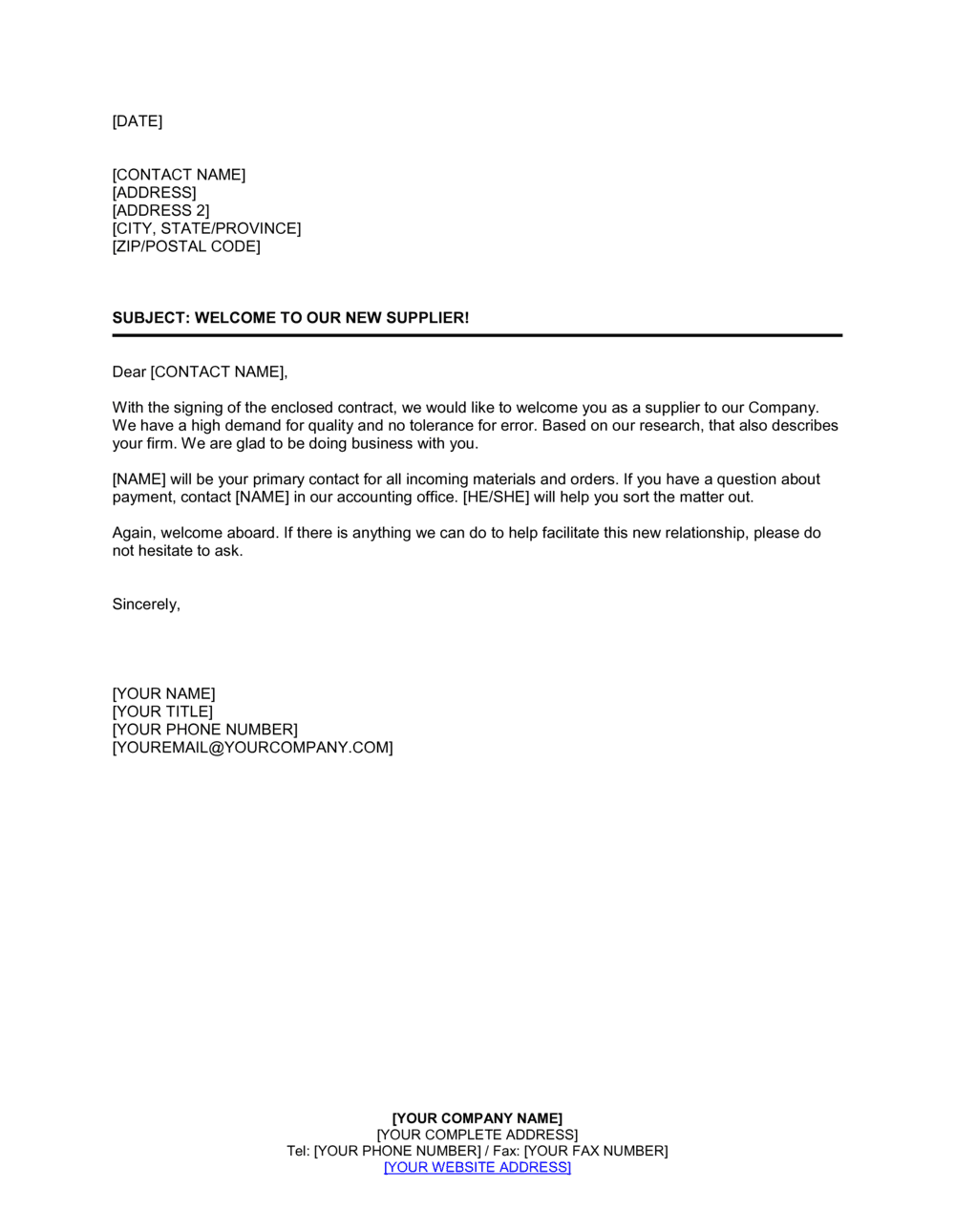
Welcome to New Supplier Template

Free Word download β€’ Edit online β€’ Save & share with Drive β€’ Export to PDF

1 pageβ€’20–30 min to fillβ€’Difficulty: Standardβ€’Signature requiredβ€’Legal review recommended
Learn more ↓
FreeWelcome to New Supplier Template

At a glance

What it is
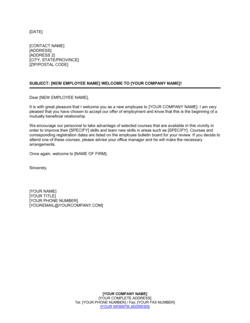
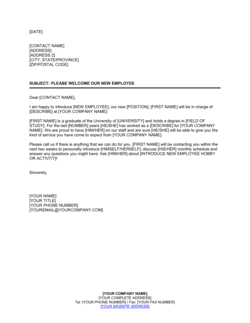
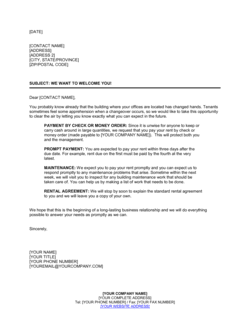
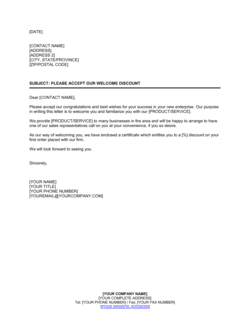
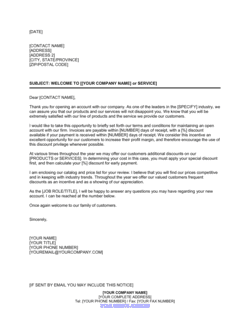
A Welcome to New Supplier letter is a formal binding document a buyer sends to a newly approved vendor to establish the foundational terms of the commercial relationship before the first purchase order is issued. This free Word download covers purchasing conditions, payment terms, compliance obligations, and quality expectations in a single concise document you can edit online and export as PDF for countersignature.
When you need it
Use it when your procurement team approves a new vendor and needs to communicate standard trading terms, code-of-conduct requirements, and invoicing procedures before goods or services are exchanged. It is particularly important for businesses with formal vendor-approval processes, regulatory compliance obligations, or supply-chain audit requirements.
What's inside
Buyer and supplier identification, effective date, purchasing and ordering procedures, payment terms and invoicing requirements, quality and compliance standards, confidentiality obligations, termination provisions, and governing law β€” all structured to create a clear, enforceable record of agreed trading conditions from day one of the relationship.

What is a Welcome to New Supplier Letter?

A Welcome to New Supplier Letter is a formal binding document a buyer issues to a newly approved vendor to establish the standard terms of the commercial trading relationship before the first purchase order is raised. It identifies both parties as legal entities, confirms ordering and invoicing procedures, sets out payment terms, communicates quality and compliance expectations, and records confidentiality and termination conditions β€” all in a single concise document that both parties sign. Unlike a full vendor agreement, it is designed to be processed quickly during the supplier onboarding workflow while still creating clear, enforceable obligations that protect the buyer from day one of the relationship.

Why You Need This Document

Without a signed welcome letter in place before the first purchase order, you are effectively trading under your supplier's standard terms β€” and supplier standard terms are written to favor the supplier on payment timelines, liability limits, and returns. The consequences are concrete: invoices arrive with missing fields that your accounts-payable team cannot process, deliveries of non-conforming goods arrive with no documented right to reject them, and confidential pricing or product information flows out of the relationship with no post-termination restriction. Procurement teams that skip this step also expose their businesses to supply-chain compliance risk β€” a supplier who never acknowledged your code of conduct is a liability in an ESG audit or regulatory investigation. This template gives you a professional, legally sound onboarding document you can issue to every new vendor in under 30 minutes, closing all four of those gaps before the first box ships.

Which variant fits your situation?

If your situation is…Use this template
Onboarding a supplier who will provide ongoing services rather than goodsService Level Agreement
Engaging a supplier under a long-term exclusive supply arrangementSupply Agreement
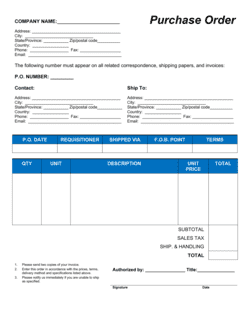
Purchasing a one-time batch of goods with defined delivery milestonesPurchase Order
Requiring a supplier to keep product or pricing information confidentialNon-Disclosure Agreement
Formalizing ongoing vendor terms in a master contract rather than a letterVendor Agreement
Terminating an existing supplier relationship with formal written noticeSupplier Termination Letter
Evaluating multiple potential suppliers before selecting oneRequest for Proposal (RFP)

Common mistakes to avoid

❌ Issuing the first PO before the letter is signed

Why it matters: Goods delivered before the letter is countersigned may be subject only to the supplier's own standard terms β€” not yours. Supplier standard terms almost always favor the supplier on payment, liability, and returns.

Fix: Make countersignature of the welcome letter a mandatory step in your vendor-approval workflow before any PO can be raised in your procurement system.

❌ Not attaching the supplier code of conduct

Why it matters: Referencing a code of conduct without attaching it means the supplier cannot be held to standards they never formally received. This is particularly critical for audits involving labor, environmental, or anti-bribery compliance.

Fix: Attach the code of conduct as Exhibit A and include a signature block or checkbox requiring the supplier to acknowledge it specifically.

❌ Ambiguous payment clock start date

Why it matters: If the letter says 'Net 30' without specifying whether the clock starts from invoice date or receipt of a compliant invoice, every payment cycle becomes a dispute about when the timer began.

Fix: State explicitly: 'The payment period runs from the date Buyer receives a compliant invoice meeting the requirements of Section [X].'

❌ No right-to-reject clause for non-conforming goods

Why it matters: Without a written right to reject, accepting a delivery can legally constitute acceptance of whatever was delivered β€” eliminating the buyer's claim for replacements or refunds.

Fix: Include a clause stating that Buyer may inspect goods on delivery and reject non-conforming items within [X] business days, at Supplier's cost for return shipping and replacement.

❌ Using trade names instead of registered legal entity names

Why it matters: An agreement signed by 'Acme Supplies' rather than 'Acme Supplies Pty Ltd' may be unenforceable against the corporate entity, making it difficult to pursue claims or recover damages.

Fix: Require the supplier to provide their full registered legal name and company registration number as part of the onboarding process before drafting the letter.

❌ No post-termination confidentiality obligation

Why it matters: A supplier who knows your pricing, product roadmap, and customer volumes has no contractual reason to keep that information confidential after the relationship ends β€” unless the clause explicitly survives termination.

Fix: Add a survival clause to the confidentiality section: 'This obligation shall survive termination of this agreement for a period of [three] years.'

The 10 key clauses, explained

Parties and effective date

In plain language: Identifies the buyer and supplier as legal entities and records the date from which the terms apply.

Sample language
This letter sets out the terms on which [BUYER LEGAL NAME] ('Buyer'), a [STATE/COUNTRY] [ENTITY TYPE], agrees to purchase goods and/or services from [SUPPLIER LEGAL NAME] ('Supplier'), effective [DATE].

Common mistake: Using a trading name instead of the supplier's registered legal entity name β€” this creates enforcement gaps if the relationship sours and legal action is needed.

Purchasing and ordering procedures

In plain language: Establishes how orders will be placed β€” PO-only, email confirmation, or electronic procurement platform β€” and which documents constitute a binding order.

Sample language
All purchases shall be made by written Purchase Order issued by Buyer's procurement department. No order shall be binding on Buyer unless issued on an official PO form referencing this agreement. Verbal orders shall have no effect.

Common mistake: Failing to state that only PO-authorized orders are binding β€” leaving the buyer exposed to invoices for goods or services nobody formally approved.

Pricing and invoicing requirements

In plain language: Confirms agreed pricing, any volume discount structure, and the mandatory fields a supplier invoice must contain for it to be accepted and processed.

Sample language
Supplier shall invoice at the prices confirmed in each Purchase Order. Each invoice must reference the applicable PO number, itemize goods or services delivered, and include Supplier's [TAX ID / VAT NUMBER]. Invoices missing required fields will be returned unpaid.

Common mistake: Not specifying mandatory invoice fields β€” resulting in invoices that cannot be matched to POs, causing payment delays and disputes that damage the relationship from the outset.

Payment terms and method

In plain language: States when and how the buyer will pay approved invoices, including the payment method and the trigger date for the payment clock.

Sample language
Buyer shall pay undisputed invoices within [NET 30 / NET 60] days of receipt of a compliant invoice. Payment shall be made by [bank transfer / ACH / check]. The payment clock starts on the date a compliant invoice is received, not the invoice date.

Common mistake: Leaving 'payment clock start' ambiguous β€” suppliers assume it runs from the invoice date while buyers count from receipt, creating chronic late-payment disputes.

Quality standards and delivery requirements

In plain language: Defines the product or service specifications the supplier must meet and the delivery lead times and procedures the buyer requires.

Sample language
All goods supplied must conform to the specifications set out in Schedule A and applicable [ISO / INDUSTRY] standards. Delivery shall be made to [DELIVERY ADDRESS] within [X] business days of PO issuance. Buyer reserves the right to inspect and reject non-conforming goods at Supplier's cost.

Common mistake: Omitting a right-to-reject clause β€” without it, accepting a delivery can be construed as acceptance of any quality defects, eliminating the buyer's right to claim damages.

Compliance, ethical trading, and code of conduct

In plain language: Requires the supplier to comply with applicable laws, including labor, environmental, anti-bribery, and data protection legislation, and to acknowledge the buyer's supplier code of conduct.

Sample language
Supplier shall comply with all applicable laws and regulations, including those relating to employment, health and safety, environmental protection, anti-bribery, and data privacy. Supplier acknowledges receipt of Buyer's Supplier Code of Conduct and agrees to be bound by its terms.

Common mistake: Referencing a code of conduct by name without attaching it β€” the supplier cannot be held to a document they never received, and the clause becomes unenforceable.

Confidentiality

In plain language: Restricts both parties from disclosing each other's confidential business information β€” pricing, forecasts, product plans β€” to third parties during and after the relationship.

Sample language
Each party shall keep confidential all non-public information received from the other party ('Confidential Information') and shall not disclose it to any third party without prior written consent. This obligation survives termination of the trading relationship for a period of [X] years.

Common mistake: No post-termination survival period β€” a supplier who knows your pricing, margins, and product roadmap faces no restriction on sharing that information after the relationship ends.

Termination

In plain language: States the notice period required to end the relationship, the conditions that allow immediate termination for cause, and the effect of termination on outstanding orders.

Sample language
Either party may terminate this agreement with [30] days' written notice. Buyer may terminate immediately upon written notice if Supplier commits a material breach, becomes insolvent, or fails to meet quality standards on [two] or more occasions in any [12]-month period. Termination does not affect outstanding POs already accepted.

Common mistake: Not specifying what happens to open purchase orders on termination β€” leaving both parties uncertain about whether in-flight deliveries must still be completed and paid for.

Liability and indemnification

In plain language: Allocates responsibility for losses arising from the supplier's defective goods, negligence, or non-compliance β€” and typically caps the supplier's liability at the value of the affected order.

Sample language
Supplier shall indemnify Buyer against all losses, damages, and costs arising from Supplier's breach of this agreement, defective goods, or negligence. Supplier's aggregate liability shall not exceed the total value of the Purchase Order(s) giving rise to the claim, except in cases of fraud or gross negligence.

Common mistake: No liability cap β€” an open-ended indemnity can expose a small supplier to claims far exceeding the value of any single order, making the agreement commercially unreasonable and harder to get signed.

Governing law and dispute resolution

In plain language: Specifies which jurisdiction's law governs the agreement and the process for resolving disputes before they escalate to litigation.

Sample language
This agreement is governed by the laws of [STATE / PROVINCE / COUNTRY]. The parties shall attempt to resolve any dispute by good-faith negotiation within [30] days before commencing arbitration or litigation. Disputes that cannot be resolved shall be submitted to [arbitration / the courts of [CITY]].

Common mistake: Choosing a governing law that has no connection to either party's operating location β€” resulting in a jurisdiction neither side can practically use to enforce its rights.

How to fill it out

  1. 1

    Enter buyer and supplier legal entity names

    Use the full registered legal name for both parties β€” not trade names or abbreviations. Include the entity type (LLC, Ltd, Inc) and the jurisdiction of incorporation.

    πŸ’‘ Verify the supplier's legal name against their company registry filing or W-9 before drafting β€” mismatches delay enforcement.

  2. 2

    Set the effective date

    Enter the date the trading terms take effect. This should be on or before the date the first purchase order is issued β€” not backdated after goods have already changed hands.

    πŸ’‘ If supplier approval happens before the contract is signed, use the approval date as the effective date and note it in a brief recital.

  3. 3

    Define ordering procedures

    Specify the exact method by which valid orders will be placed β€” PO form number, procurement platform, or email with specific subject-line format β€” and state that no other method creates a binding obligation.

    πŸ’‘ Name your PO form or system (e.g., 'Coupa PO') so the supplier cannot argue that an informal email or phone call constitutes a valid order.

  4. 4

    Confirm pricing and required invoice fields

    State that prices are those confirmed in each PO and list every field a compliant invoice must contain: PO number, line-item description, quantity, unit price, applicable taxes, and supplier tax ID.

    πŸ’‘ Attach a one-page invoice sample or template to eliminate ambiguity about format expectations.

  5. 5

    Set payment terms and the payment clock trigger

    Enter the payment period (Net 30, Net 45, or Net 60), the accepted payment method, and specify that the clock runs from receipt of a compliant invoice β€” not from the invoice date.

    πŸ’‘ For cross-border suppliers, state the invoice currency explicitly and confirm which party bears foreign exchange conversion costs.

  6. 6

    Attach or reference quality standards and your supplier code of conduct

    Either embed the key quality specifications in Schedule A or reference the relevant ISO or industry standard. Attach your supplier code of conduct as a named exhibit so it is formally incorporated by reference.

    πŸ’‘ If your code of conduct is updated annually, include language saying the supplier agrees to the current version as updated from time to time β€” so you are not required to re-execute the letter on every update.

  7. 7

    Tailor the termination and liability clauses

    Set a notice period proportionate to the typical order cycle β€” 30 days works for most commodity suppliers; 60–90 days is more appropriate for suppliers with long production lead times. Set the liability cap at the value of the relevant PO(s).

    πŸ’‘ For critical sole-source suppliers, consider raising the termination notice period to 90 days to give yourself time to qualify an alternative before supply is cut off.

  8. 8

    Execute before the first purchase order is issued

    Both parties must sign the letter before the first PO is raised. Send a countersignature copy to the supplier's authorized signatory β€” not just their sales contact β€” and retain the executed copy in your vendor management system.

    πŸ’‘ Use an eSign tool to timestamp execution. A timestamped signature is far easier to rely on in a dispute than a scanned PDF with no execution audit trail.

Frequently asked questions

What is a welcome to new supplier letter?

A welcome to new supplier letter is a formal document a buyer sends to a newly approved vendor to establish the terms of the commercial relationship before the first purchase order is issued. It sets out ordering procedures, payment terms, quality standards, compliance requirements, and termination conditions in a binding written record that both parties sign. Unlike a full vendor agreement, it is concise enough to be processed quickly while still creating enforceable obligations on both sides.

Is a welcome to new supplier letter legally binding?

Yes, when properly drafted and signed by authorized representatives of both parties, a welcome to new supplier letter is generally enforceable as a binding contract in most jurisdictions. It establishes the material terms of the trading relationship β€” price, payment, quality, and termination β€” which courts treat as contractual obligations. As with any commercial agreement, the specific enforceability of individual clauses depends on the applicable jurisdiction and whether the terms meet local contract law requirements.

What is the difference between a welcome to new supplier letter and a vendor agreement?

A welcome to new supplier letter is a shorter, less formal document that communicates standard trading terms and onboards a supplier quickly. A vendor agreement is a more comprehensive contract covering detailed warranties, indemnities, intellectual property rights, insurance requirements, and step-in rights. Use the welcome letter for standard suppliers where speed and simplicity matter; use a full vendor agreement for strategic or high-value supplier relationships where the risk exposure justifies more detailed legal protection.

When should a buyer send a welcome to new supplier letter?

Send it immediately after your internal vendor-approval process is complete and before the first purchase order is issued. The letter should be countersigned by the supplier and returned before any goods or services change hands. Issuing a PO before the letter is signed exposes the buyer to the supplier's own standard terms, which almost always contain less favorable payment, liability, and return conditions.

Does the welcome to new supplier letter need to be signed by both parties?

Yes. Both parties should sign the document for it to create mutual binding obligations. A letter sent but not countersigned by the supplier may still have some legal effect β€” particularly if the supplier acts in accordance with its terms β€” but a signed copy from both parties is the cleanest and most reliable evidence of agreed terms. Always obtain and retain the countersigned original before the relationship begins.

What payment terms should I include in the welcome letter?

Net 30 is the most common standard for B2B supplier payments. Larger businesses with supply-chain leverage often use Net 45 or Net 60 to manage cash flow. For critical suppliers with short production cycles, Net 15 or partial prepayment may be more appropriate. Whatever terms you choose, specify the exact trigger date for the payment clock β€” receipt of a compliant invoice is clearer than invoice date β€” and state the accepted payment method to prevent disputes.

Should the supplier code of conduct be part of the welcome letter?

Yes β€” attach it as a named exhibit and require the supplier to acknowledge it specifically in the signature block. Referencing a code of conduct without attaching it means the supplier has not formally agreed to its contents, which creates gaps in your ability to enforce compliance. This is especially important for businesses subject to supply-chain due-diligence regulations, ESG reporting obligations, or anti-bribery compliance programs.

Can I use this letter for international suppliers?

Yes, with modifications. For cross-border supplier relationships, specify the invoice currency and which party bears foreign exchange conversion costs, confirm the applicable governing law and dispute-resolution forum, and add any country-specific tax or customs compliance obligations. In some jurisdictions β€” the EU in particular β€” specific data protection clauses are required if the supplier will process personal data on your behalf. Consider having the letter reviewed by a lawyer familiar with the supplier's home jurisdiction for high-value international relationships.

How often should the welcome to new supplier letter be updated?

Review and update your standard template at least annually, or whenever your payment terms, compliance requirements, or standard PO conditions change. For existing suppliers, changes to trading terms require a fresh agreement or a written amendment β€” you cannot unilaterally alter binding terms mid-relationship without the supplier's consent. Including language that allows the buyer to update the code of conduct from time to time (with notice) avoids the need to re-execute the letter on every update.

How this compares to alternatives

vs Vendor Agreement

A vendor agreement is a comprehensive multi-page contract covering warranties, intellectual property, insurance minimums, audit rights, and detailed indemnities. A welcome to new supplier letter is a concise onboarding document that establishes standard trading terms quickly. Use the letter for routine suppliers and a full vendor agreement for strategic or high-value relationships where deeper legal protection is justified.

vs Purchase Order

A purchase order authorizes a single, specific transaction β€” quantities, prices, and delivery for one order. The welcome to new supplier letter establishes the overarching terms that govern every purchase order issued to that supplier. The two documents work together: the letter sets the framework, the PO executes individual transactions within it.

vs Non-Disclosure Agreement

A non-disclosure agreement protects confidential information shared during evaluation or negotiations, typically before a trading relationship is agreed. The welcome to new supplier letter includes confidentiality provisions as one clause within a broader trading-terms document. If the confidentiality requirements are complex or the information particularly sensitive, a standalone NDA provides stronger and more detailed protection.

vs Supply Agreement

A supply agreement is a long-term contract governing an ongoing, often exclusive supply arrangement β€” typically covering volume commitments, price escalation mechanisms, minimum order quantities, and step-in rights. A welcome to new supplier letter is appropriate for standard, non-exclusive vendor relationships. Use a supply agreement when the supplier relationship is strategic, involves significant volumes, or requires volume or exclusivity commitments from either party.

Industry-specific considerations

Retail and e-commerce

Product specifications and packaging standards in Schedule A, lead-time requirements tied to seasonal ordering windows, and right-to-audit clauses for supplier factory compliance.

Manufacturing

ISO or industry-specific quality certifications as conditions of supply, tooling ownership clauses, and delivery terms referencing Incoterms for cross-border component sourcing.

Food and beverage

Food safety certification requirements (FSSC 22000, SQF), allergen declaration obligations, temperature-controlled delivery standards, and right-to-recall provisions.

Professional services

Hourly-rate or statement-of-work references, timesheet approval procedures, confidentiality over client data, and professional indemnity insurance requirements.

Jurisdictional notes

United States

US commercial contracts are primarily governed by Article 2 of the Uniform Commercial Code (UCC) for goods transactions. Under the UCC, a supplier's written acknowledgment of a PO can incorporate their own standard terms unless the buyer's terms expressly exclude them β€” making the welcome letter's 'PO-only' ordering clause particularly important. Anti-bribery obligations under the FCPA apply to suppliers operating internationally on a US buyer's behalf.

Canada

Canadian contract law is provincially governed under common law (in all provinces except Quebec) and the Civil Code of Quebec. Quebec-based suppliers may require the letter to be provided in French under the Charter of the French Language. CASL anti-spam provisions apply to commercial electronic communications, so confirming the supplier's consent to electronic notices in the letter is advisable.

United Kingdom

UK supply contracts are governed by the Sale of Goods Act 1979 and the Supply of Goods and Services Act 1982, which imply minimum quality and fitness-for-purpose warranties that cannot be excluded in B2B contracts to an unreasonable degree under the Unfair Contract Terms Act 1977. The UK Modern Slavery Act 2015 requires businesses with annual turnover above Β£36M to publish a supply-chain transparency statement β€” the welcome letter's compliance clause should reference this where applicable.

European Union

EU suppliers processing personal data on behalf of the buyer must execute a Data Processing Agreement (DPA) under Article 28 of the GDPR β€” a standalone document or annex to the welcome letter. The EU Corporate Sustainability Due Diligence Directive (CSDDD), phasing in from 2026–2029, will require larger EU businesses to conduct and document supply-chain due diligence on human rights and environmental risks, making the compliance clause and supplier code of conduct provisions increasingly important.

Template vs lawyer β€” what fits your deal?

PathBest forCostTime
Use the templateStandard domestic supplier relationships for goods or services below $50,000 per yearFree30 minutes
Template + legal reviewSuppliers handling sensitive data, international suppliers, or relationships with meaningful liability exposure$200–$500 for a lawyer review1–3 days
Custom draftedStrategic sole-source suppliers, high-value contracts above $250,000 annually, or heavily regulated industries such as food, pharma, or financial services$1,000–$3,000+1–2 weeks

Glossary

Supplier Onboarding
The process of approving, registering, and communicating trading terms to a new vendor before the first transaction takes place.
Purchase Order (PO)
A buyer-issued document that authorizes a specific purchase from a supplier, specifying quantities, prices, and delivery requirements.
Payment Terms
The agreed conditions under which the buyer will pay the supplier β€” typically expressed as Net 30, Net 60, or a discount for early payment such as 2/10 Net 30.
Code of Conduct
A set of ethical, legal, and operational standards a buyer requires all suppliers to acknowledge and comply with as a condition of trading.
Indemnification
A contractual obligation by which one party agrees to compensate the other for specified losses, damages, or liabilities arising from the relationship.
Force Majeure
A clause that excuses a party from performance obligations when extraordinary events outside their control β€” such as natural disasters or government actions β€” make performance impossible.
Governing Law
The jurisdiction whose laws apply to the interpretation and enforcement of the agreement in the event of a dispute.
Counterpart Signature
A signature block that allows each party to sign a separate copy of the same document, with both copies together forming a single binding agreement.
Material Breach
A failure to perform a contractual obligation so significant that it defeats the purpose of the agreement and entitles the non-breaching party to terminate and seek damages.
Net 30 / Net 60
Payment terms requiring the buyer to remit the full invoice amount within 30 or 60 days of the invoice date.
Audit Rights
A contractual provision allowing the buyer to inspect the supplier's records, facilities, or processes to verify compliance with agreed standards.

Part of your Business Operating System

This document is one of 3,000+ business & legal templates included in Business in a Box.

  • Fill-in-the-blanks β€” ready in minutes
  • 100% customizable Word document
  • Compatible with all office suites
  • Export to PDF and share electronically

Create your document in 3 simple steps.

From template to signed document β€” all inside one Business Operating System.
1
Download or open template

Access over 3,000+ business and legal templates for any business task, project or initiative.

2
Edit and fill in the blanks with AI

Customize your ready-made business document template and save it in the cloud.

3
Save, Share, Send, Sign

Share your files and folders with your team. Create a space of seamless collaboration.

Save time, save money, and create top-quality documents.

β˜…β˜…β˜…β˜…β˜…

"Fantastic value! I'm not sure how I'd do without it. It's worth its weight in gold and paid back for itself many times."

Managing Director Β· Mall Farm
Robert Whalley
Managing Director, Mall Farm Proprietary Limited
β˜…β˜…β˜…β˜…β˜…

"I have been using Business in a Box for years. It has been the most useful source of templates I have encountered. I recommend it to anyone."

Business Owner Β· 4+ years
Dr Michael John Freestone
Business Owner
β˜…β˜…β˜…β˜…β˜…

"It has been a life saver so many times I have lost count. Business in a Box has saved me so much time and as you know, time is money."

Owner Β· Upstate Web
David G. Moore Jr.
Owner, Upstate Web

Run your business with a system β€” not scattered tools

Stop downloading documents. Start operating with clarity. Business in a Box gives you the Business Operating System used by over 250,000 companies worldwide to structure, run, and grow their business.

Free Forever PlanΒ Β·Β No credit card required