1
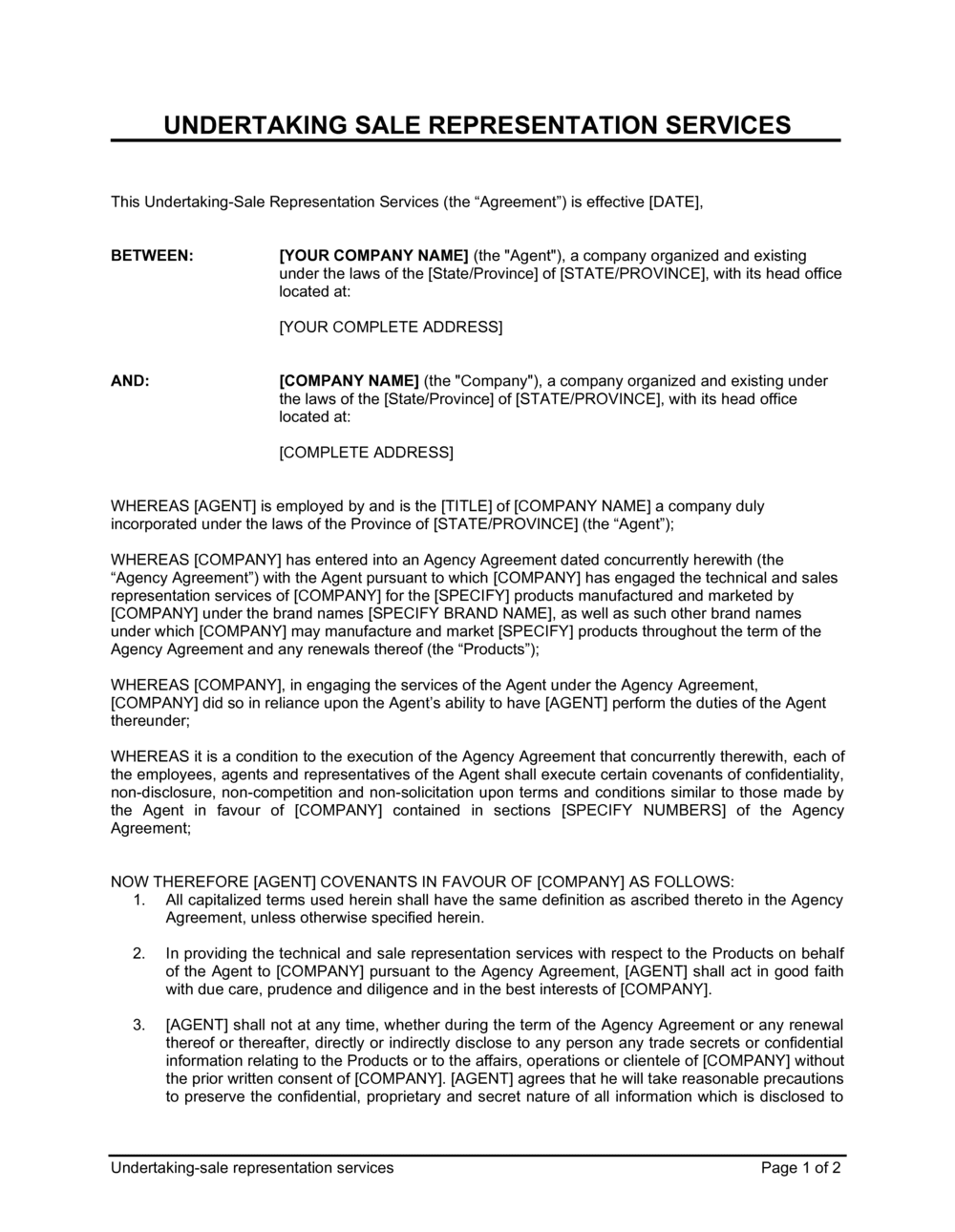
Identify the parties and confirm legal entity names
Enter the principal's registered company name and jurisdiction of incorporation, and the representative's full legal name or registered business name. Include contact addresses for both parties.
💡 Use the exact registered entity name — not a trading name — so the agreement binds the right legal entity and is enforceable in court.
2
Define the territory and exclusivity arrangement
Specify the territory by country, region, state, or named-account list. Decide whether the appointment is exclusive (no other agents in the territory) or non-exclusive, and state this clearly in the body and in Schedule A.
💡 If exclusivity is conditional on hitting a performance threshold, state the threshold in the same clause — not separately — to avoid ambiguity about when exclusivity reverts.
3
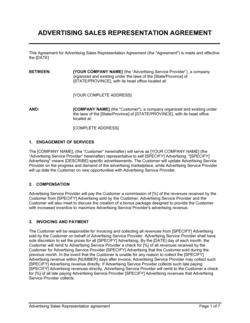
Complete the commission schedule in Schedule B
Set the commission rate or flat fee, the transaction basis (net invoice value, gross revenue, or collected cash), the payment date, and any tiered rates for exceeding targets. Attach a sample calculation to Schedule B for clarity.
💡 State whether commission is earned on invoicing or cash collection — this single choice determines your cash-flow exposure on slow-paying customers.
4
Set performance thresholds for exclusive appointments
For every exclusive territory, insert a quarterly or annual minimum sales figure. Specify the consequence of missing the threshold: notice of conversion to non-exclusive, or right to terminate on 30 days' notice.
💡 Set the threshold at 70–80% of the representative's own sales forecast — ambitious but defensible, and unlikely to trigger unnecessary disputes in a slow quarter.
5
Tailor the duties clause to the representative's role
List the specific obligations: reporting cadence, CRM updates, trade show attendance, sample management, and customer feedback submissions. Remove obligations that do not apply to avoid unenforceable provisions.
💡 A monthly pipeline report obligation — even a one-page email — creates the paper trail you need to calculate tail commission accurately at termination.
6
Configure the term, notice, and renewal mechanics
Enter the start date, initial term length (typically 12 months), renewal period (typically 6 or 12 months), and the notice period required to prevent auto-renewal. Decide whether notice must be sent by registered mail or email with read receipt.
💡 Calendar a reminder 45 days before the renewal date so you are never caught in an unwanted automatic renewal.
7
Draft the tail commission and non-solicitation terms
Set the tail period (typically 60–120 days), the pipeline documentation requirement that unlocks the entitlement, and the post-termination non-solicitation duration. Align the non-solicitation scope to the representative's actual customer contacts.
💡 Require the representative to submit a signed, dated pipeline list within 5 business days of termination notice — this eliminates post-termination disputes about which deals qualify for tail commission.
8
Execute before the representative begins selling
Both parties must sign before the representative approaches any customer on behalf of the principal. Post-commencement signatures raise consideration issues in common-law jurisdictions and may void restrictive covenants.
💡 Use a digital signature tool with timestamp capability to create an audit trail proving the agreement was executed before selling commenced.