Telecommuting Policy Template

Free Word download β€’ Edit online β€’ Save & share with Drive β€’ Export to PDF

1 pageβ€’20–25 min to fillβ€’Difficulty: Standard
Learn more ↓
FreeTelecommuting Policy Template

At a glance

What it is
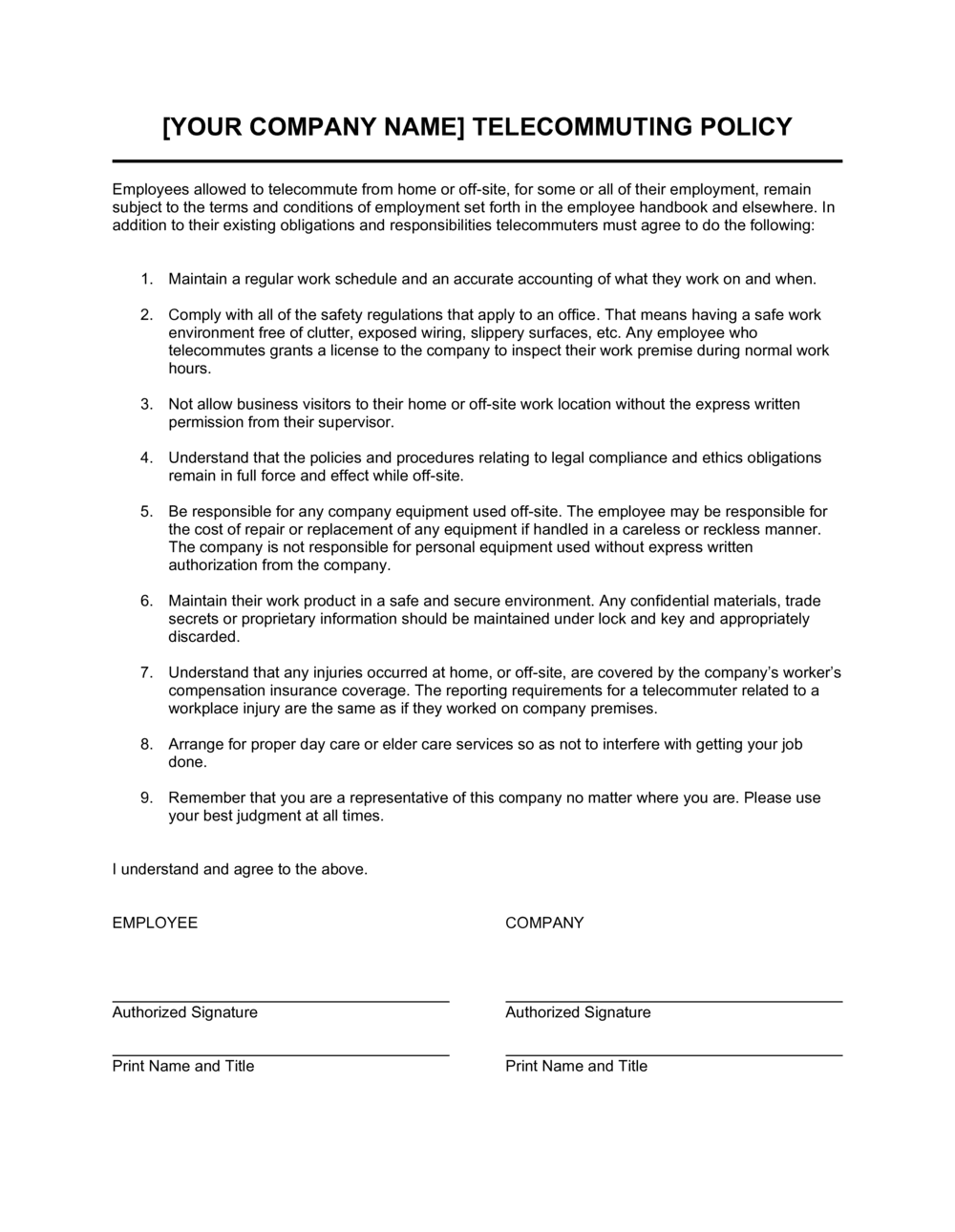
A Telecommuting Policy is an internal HR document that defines who is eligible to work remotely, under what conditions, and what standards they must meet while doing so. This free Word download gives you a structured, manager-ready starting point you can edit online and export as PDF to distribute to employees and include in your employee handbook.
When you need it
Use it when introducing or formalizing a remote or hybrid work arrangement for part or all of your workforce. It is also the right document to update whenever your existing informal remote-work practice needs written guardrails after a workforce restructuring or office consolidation.
What's inside
Eligibility criteria and approval process, designated work location requirements, availability and communication expectations, equipment and expense provisions, data security and confidentiality rules, performance standards, and the process for modifying or terminating a telecommuting arrangement.

What is a Telecommuting Policy?

A Telecommuting Policy is an internal HR document that establishes the rules, standards, and procedures governing remote work arrangements across an organization. It defines which employees are eligible to work from home, what approval process they must follow, where they are permitted to work, what hours they must be available, who provides their equipment, and how their performance will be measured. It also specifies the conditions under which the company can modify or revoke a remote arrangement. Unlike a casual manager-level approval, a written telecommuting policy creates consistent, enforceable expectations that apply equally to every employee regardless of department or seniority.

Why You Need This Document

Operating without a written telecommuting policy leaves four significant gaps simultaneously. First, eligibility decisions become manager-dependent β€” two employees with the same role and performance record receive different answers, creating morale and legal exposure. Second, there is no documented standard for data security at home offices, meaning a single employee's use of public Wi-Fi can expose customer records or proprietary systems. Third, without a termination or revocation clause, remote arrangements become implied permanent entitlements, making any return-to-office requirement a potential legal dispute. Fourth, employees working from unapproved locations β€” a different state, a co-working cafe, or another country β€” create payroll tax nexus and employment law compliance issues the company discovers only at audit time. A single, well-structured telecommuting policy closes all four gaps, takes under two hours to complete with this template, and gives every manager a defensible, consistent framework to apply from day one.

Which variant fits your situation?

If your situation is…Use this template
Full-time remote arrangement for all employeesRemote Work Policy
Hybrid schedule with set in-office daysHybrid Work Policy
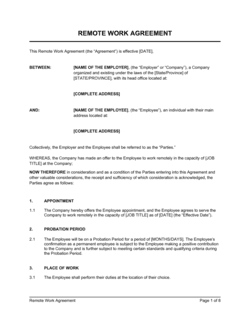
Individual remote work agreement for a single employeeRemote Work Agreement
Temporary work-from-home during an emergency or disruptionBusiness Continuity Plan
Employees working across international bordersInternational Remote Work Policy
Contractor or freelancer working off-siteIndependent Contractor Agreement
Governing equipment loans to remote employeesEquipment Loan Agreement

Common mistakes to avoid

❌ No defined eligibility criteria

Why it matters: Without criteria, managers make approval decisions inconsistently, creating claims of favoritism or disparate treatment across demographic groups.

Fix: Anchor eligibility to at least two objective, documented factors β€” tenure and performance rating are the most defensible and easiest to apply consistently.

❌ Approving arrangements verbally with no written record

Why it matters: Verbal approvals are impossible to enforce consistently, and when schedules or expectations change, neither side has a baseline to reference.

Fix: Route all approvals through a Telecommuting Request Form that captures the approved location, schedule, and duration β€” signed by the manager and HR.

❌ Leaving data security requirements in a separate document only

Why it matters: Employees read the telecommuting policy when they set up remote work and rarely revisit the IT security handbook independently. Critical rules go missed.

Fix: Embed the five to seven non-negotiable security rules β€” VPN, screen lock, no public Wi-Fi, no personal device storage β€” directly in the telecommuting policy section.

❌ Omitting a termination or revocation clause

Why it matters: Without explicit language reserving the right to revoke, employees treat a remote arrangement as permanent, and returning them to office becomes an HR and legal challenge.

Fix: Include both a standard notice period for voluntary or company-initiated termination and a short list of immediate-revocation triggers such as a security incident or performance failure.

❌ Not specifying a fixed approved work location

Why it matters: Employees working from different cities, states, or countries create payroll tax nexus, employment law compliance, and data sovereignty issues the company may not discover until an audit.

Fix: Require employees to submit and get approval for a fixed home address. Add a change-of-location notification requirement so HR is informed before any move.

❌ Vague availability language

Why it matters: Terms like 'during normal business hours' or 'reasonably available' are interpreted differently by every employee and manager, making performance conversations harder to have.

Fix: Define core hours as specific start and end times in a named time zone, and state a maximum response time for messages β€” for example, 30 minutes for chat and 4 hours for email.

The 10 key sections, explained

Purpose and scope

Eligibility criteria

Approval process

Designated work location requirements

Work schedule and availability

Equipment, technology, and expenses

Data security and confidentiality

Performance expectations and monitoring

Health, safety, and workspace standards

Modification and termination of arrangement

How to fill it out

  1. 1

    Define the scope and excluded roles

    Identify which job titles and departments the policy covers. List any roles that are explicitly excluded β€” on-site roles, roles requiring physical access to equipment, or roles in regulated environments.

    πŸ’‘ Attach a Schedule A listing remote-compatible job titles rather than embedding them in the body; this lets you update the list without amending the full policy.

  2. 2

    Set measurable eligibility criteria

    Enter the minimum tenure, performance rating, and any other objective criteria an employee must meet before applying. Keep criteria tied to documented records so decisions are defensible.

    πŸ’‘ Align eligibility criteria with your performance review cycle β€” e.g., 'satisfactory or above in the most recent annual review' β€” so managers always have a current data point.

  3. 3

    Document the approval workflow

    Name the approving roles (direct manager plus HR, for example), specify the form or channel employees use to apply, and state how long approvals remain valid before renewal.

    πŸ’‘ Route approvals through a shared HR system rather than email chains so there is a single, searchable record of every active arrangement.

  4. 4

    Specify the approved work location

    Require employees to submit their home address as the designated work location. Note any conditions the location must meet β€” minimum internet speed, private workspace, country of residence.

    πŸ’‘ Include a checkbox on the request form confirming the location meets minimum requirements; this puts the employee on record and reduces later disputes.

  5. 5

    Set core hours and availability expectations

    Enter the required availability window, the time zone it applies to, and your expected response time for messages and calls. Be specific β€” 'within 30 minutes during core hours' is enforceable; 'reasonably available' is not.

    πŸ’‘ If your team spans multiple time zones, define core hours as the overlap window and document it explicitly rather than defaulting to headquarters time.

  6. 6

    Detail equipment provision and expense reimbursement

    List every item the company provides, the monthly stipend amount (if any) for internet or home-office expenses, and the process for returning company equipment when the arrangement ends.

    πŸ’‘ Cap monthly expense reimbursements at a specific dollar amount to prevent ambiguity β€” 'reasonable internet costs' generates disputes; '$75/month' does not.

  7. 7

    Embed the minimum data security rules

    List the non-negotiable security requirements directly in this section β€” VPN use, screen lock, prohibition on public Wi-Fi without VPN, and no storage of confidential data on personal devices.

    πŸ’‘ Cross-reference your full IT security policy by name and version number so that policy updates automatically apply without requiring a telecommuting policy amendment.

  8. 8

    State the modification and termination terms

    Enter the notice period for ending the arrangement from either side, and list the conditions that allow the company to revoke approval immediately without notice.

    πŸ’‘ Include a plain-language acknowledgment line at the bottom of the policy that the employee signs β€” this creates a record that they understood the arrangement is not permanent.

Frequently asked questions

What is a telecommuting policy?

A telecommuting policy is an internal HR document that governs who may work remotely, under what conditions, and what standards they must meet. It sets out eligibility criteria, the approval process, work location requirements, availability expectations, equipment provisions, data security rules, and the company's right to modify or end a remote arrangement. It applies to any business that allows employees to work outside the primary office on a regular or occasional basis.

Do I need a telecommuting policy if my whole team is remote?

Yes β€” a fully remote team needs a written policy more than a hybrid one. Without it, there are no documented standards for availability, data security, equipment ownership, or performance expectations, and no formal mechanism for handling disputes or changes to individual arrangements. A policy also protects the company when onboarding new hires who have never worked in an office and therefore have no default expectations to fall back on.

What is the difference between a telecommuting policy and a remote work agreement?

A telecommuting policy is a company-wide document that sets the rules for all remote workers. A remote work agreement is an individual document signed by one employee and their manager confirming the specific terms of that person's arrangement β€” their approved address, schedule, and equipment. The policy is the rulebook; the agreement is the individual application of it.

Can a company require employees to return to the office after a remote arrangement is in place?

In most jurisdictions, yes β€” provided the employment contract or the telecommuting policy itself reserves that right with reasonable notice. Without a modification or termination clause in the policy, employers may face resistance or claims that the remote arrangement has become an implied term of employment. Always include explicit revocation language and a notice period, typically two to four weeks.

Should employees sign the telecommuting policy?

Employees should sign an acknowledgment confirming they have read and understood the policy β€” either as a standalone signature page attached to the policy or as part of the individual Telecommuting Request Form. A signed acknowledgment establishes that the employee knew the arrangement was not permanent and agreed to the data security and availability requirements.

Does a telecommuting policy need to address workers' compensation?

It should. In most US states and Canadian provinces, a work-related injury occurring at a home workspace is covered by workers' compensation regardless of where the work is performed. The policy should require employees to maintain a safe workspace, designate the specific work area within their home, and report any work-related injury to HR within a defined timeframe. Stating that the company bears no liability for home injuries does not override statutory coverage.

How often should a telecommuting policy be updated?

Review the policy at least once a year, and update it immediately when there is a significant change in your workforce structure, office footprint, data security requirements, or applicable employment law. The rapid evolution of remote work norms since 2020 means policies written before 2022 are likely to contain gaps β€” particularly around cross-border work, monitoring disclosure, and equipment stipend amounts.

Can the same policy apply to both full-time remote and hybrid employees?

A single policy can cover both, provided it clearly distinguishes between the two arrangements where the rules differ β€” particularly around required in-office days, desk-booking procedures, and equipment provisions. If the arrangements are substantially different in practice, separate sections or a separate hybrid addendum prevent confusion and make manager training easier.

How this compares to alternatives

vs Remote Work Agreement

A remote work agreement is an individual document signed by one employee and their manager to confirm the specific terms of that person's remote arrangement β€” address, schedule, equipment, and performance targets. A telecommuting policy is the company-wide rulebook that governs all such arrangements. You need both: the policy sets the rules; the agreement applies them to each individual.

vs Employee Handbook

An employee handbook is a comprehensive reference document covering all HR policies β€” benefits, conduct, PTO, and more. A telecommuting policy is a standalone document that goes into far more operational detail on remote work than a handbook section can. The handbook should reference the standalone telecommuting policy rather than attempt to replicate it.

vs Business Continuity Plan

A business continuity plan governs how the company maintains operations during emergencies β€” including emergency remote-work scenarios. A telecommuting policy governs planned, ongoing remote work arrangements under normal conditions. They serve different triggers and different timeframes, though the BCP may cross-reference the telecommuting policy for its remote-work procedures.

vs Independent Contractor Agreement

An independent contractor agreement governs a self-employed individual engaged for project-based work β€” it does not create an employment relationship. A telecommuting policy applies to employees working remotely. Applying employee remote-work rules to contractors blurs the classification line and can create misclassification liability.

Industry-specific considerations

Technology / SaaS

Emphasis on data security protocols, VPN requirements, and equipment standards for employees accessing production systems and customer data from home.

Financial services

Regulatory obligations β€” including FINRA, SEC, and FCA rules β€” require specific data handling, call recording, and supervision standards that must be reflected in any remote work policy.

Professional services

Client confidentiality and billable-hour tracking requirements make availability windows and workspace privacy standards especially important to document.

Healthcare

HIPAA compliance requires that remote employees handling protected health information use encrypted connections, locked screens, and approved devices at all times.

Retail / E-commerce

Remote eligibility is limited to back-office, marketing, and customer-service roles; the policy must be explicit that warehouse and fulfillment staff are excluded.

Education

Remote teaching and administration roles require specific platform security standards and student data privacy rules β€” particularly for K-12 institutions subject to FERPA.

Template vs pro β€” what fits your needs?

PathBest forCostTime
Use the templateSmall and mid-sized businesses formalizing remote work rules for a domestic workforceFree1–2 hours to complete and distribute
Template + professional reviewCompanies with employees in multiple US states, unionized workforces, or recent rapid expansion of remote headcount$200–$500 for an HR consultant or employment attorney review3–5 business days
Custom draftedEnterprises with cross-border remote employees, regulated industries (financial services, healthcare), or workforces subject to collective bargaining agreements$1,000–$3,000+1–3 weeks

Glossary

Telecommuting
A work arrangement in which an employee performs their regular job duties from a location other than the employer's primary office, typically their home.
Hybrid Work
A schedule in which an employee splits working time between a remote location and the employer's physical office, often on set days.
Designated Work Location
The specific address β€” typically the employee's home β€” approved by the employer as the employee's remote work site.
Core Hours
The defined window of the workday during which all employees, regardless of location, are expected to be available and responsive.
Availability and Responsiveness Standards
Employer-defined expectations for how quickly a remote employee must acknowledge messages, join calls, or respond to requests during working hours.
Equipment Stipend
A fixed amount the employer pays β€” once or monthly β€” toward the cost of a home office setup, including hardware, internet, or furniture.
Data Security Protocol
The set of technical and behavioral rules employees must follow to protect company data when working outside the corporate network.
VPN (Virtual Private Network)
Software that encrypts internet traffic and routes it through the company's network, required by many employers for remote access to internal systems.
Performance Agreement
A documented understanding between a manager and a remote employee specifying measurable output targets for the telecommuting period.
Telecommuting Termination Clause
A provision reserving the employer's right to revoke a remote work arrangement with defined notice if business needs change or performance standards are not met.

Part of your Business Operating System

This document is one of 3,000+ business & legal templates included in Business in a Box.

  • Fill-in-the-blanks β€” ready in minutes
  • 100% customizable Word document
  • Compatible with all office suites
  • Export to PDF and share electronically

Create your document in 3 simple steps.

From template to signed document β€” all inside one Business Operating System.
1
Download or open template

Access over 3,000+ business and legal templates for any business task, project or initiative.

2
Edit and fill in the blanks with AI

Customize your ready-made business document template and save it in the cloud.

3
Save, Share, Send, Sign

Share your files and folders with your team. Create a space of seamless collaboration.

Save time, save money, and create top-quality documents.

β˜…β˜…β˜…β˜…β˜…

"Fantastic value! I'm not sure how I'd do without it. It's worth its weight in gold and paid back for itself many times."

Managing Director Β· Mall Farm
Robert Whalley
Managing Director, Mall Farm Proprietary Limited
β˜…β˜…β˜…β˜…β˜…

"I have been using Business in a Box for years. It has been the most useful source of templates I have encountered. I recommend it to anyone."

Business Owner Β· 4+ years
Dr Michael John Freestone
Business Owner
β˜…β˜…β˜…β˜…β˜…

"It has been a life saver so many times I have lost count. Business in a Box has saved me so much time and as you know, time is money."

Owner Β· Upstate Web
David G. Moore Jr.
Owner, Upstate Web

Run your business with a system β€” not scattered tools

Stop downloading documents. Start operating with clarity. Business in a Box gives you the Business Operating System used by over 250,000 companies worldwide to structure, run, and grow their business.

Start freeΒ Β·Β No credit card required