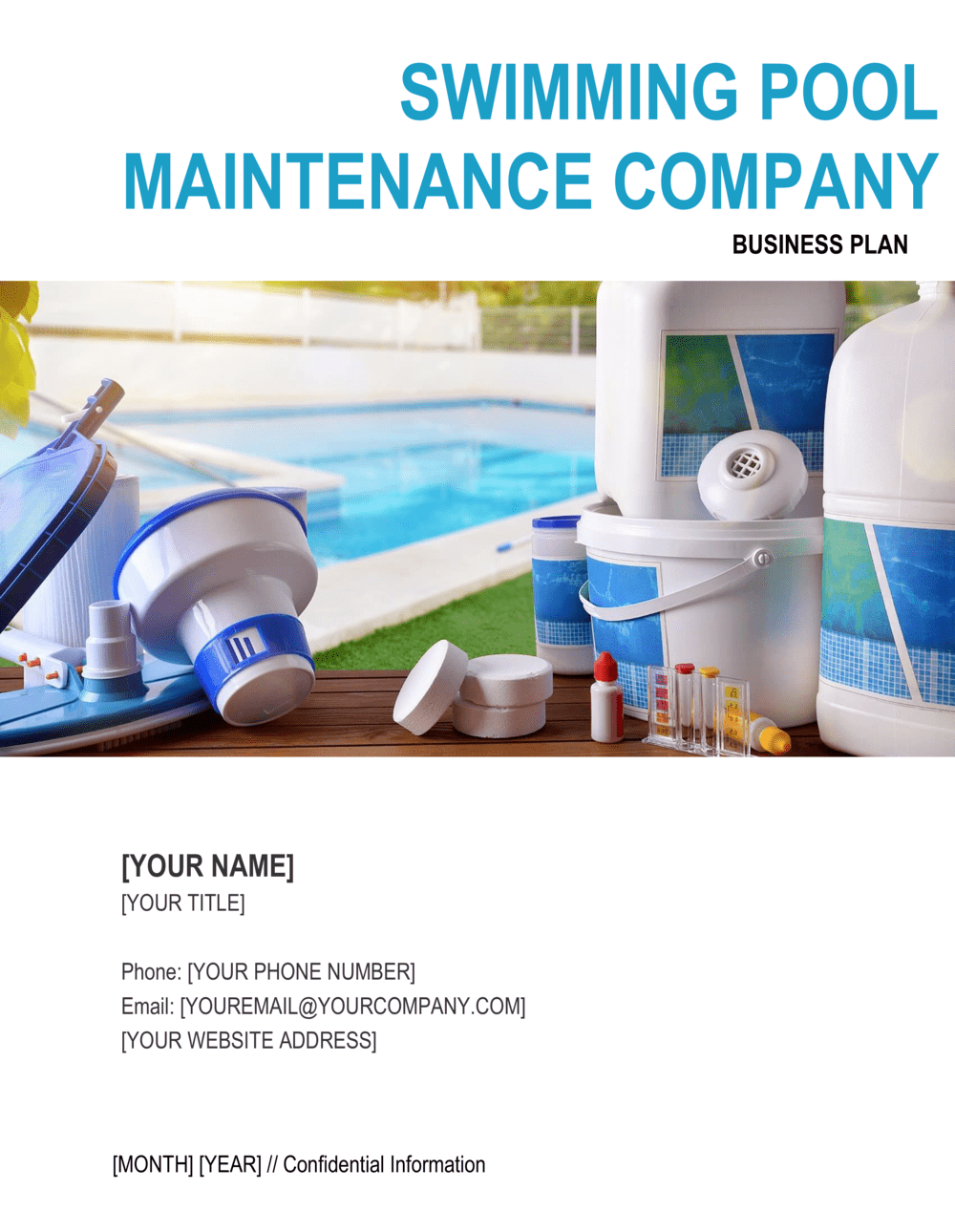
Swimming Pool Maintenance Company Business Plan Template

Free Word download β€’ Edit online β€’ Save & share with Drive β€’ Export to PDF

26 pagesβ€’2h 20m – 3h 5m to fillβ€’Difficulty: Expert
Learn more ↓
FreeSwimming Pool Maintenance Company Business Plan Template

At a glance

What it is
A Swimming Pool Maintenance Company Business Plan is a structured document that maps your pool service business from concept to operation β€” covering your service offerings, target market, pricing model, staffing plan, equipment needs, and financial projections. This free Word download gives you a ready-to-edit framework you can customize for your local market and export as PDF to share with lenders, partners, or investors.
When you need it
Use it when launching a new pool maintenance company, applying for a small business loan, or formalizing an existing route-based operation into a scalable business. It is also appropriate when bringing on a business partner who needs to understand your operating model.
What's inside
Executive summary, company overview, service offerings and pricing, market and competitive analysis, marketing and customer acquisition strategy, operations and staffing plan, equipment and supply chain, and three-year financial projections including revenue, expenses, and cash flow.

What is a Swimming Pool Maintenance Company Business Plan?

A Swimming Pool Maintenance Company Business Plan is a structured operational document that defines how a pool service business will attract customers, deliver recurring maintenance, manage technicians and equipment, and generate sustainable revenue. It covers service offerings and pricing, local market sizing, competitive positioning, route and staffing capacity, startup costs, and three-year financial projections β€” giving the owner a concrete operating roadmap and a credible document to present to lenders, franchisors, or investors. This free Word download is pre-structured for the pool service industry and can be edited online and exported as PDF in a matter of hours.

Why You Need This Document

Operating a pool maintenance company without a written plan means making pricing, hiring, and equipment decisions reactively β€” typically at the cost of margin and cash flow. Without documented service inclusions and pricing logic, technicians and customers interpret scope differently, disputes erode retention, and profitability per route becomes impossible to track. Banks and SBA lenders require a written plan for any loan application, and franchisors use it to approve territory assignments. Beyond capital, the planning process itself forces you to model route density, calculate your break-even account count, and stress-test seasonal cash flow before you spend money on a vehicle and chemicals. This template gives you the structure to complete that work in days rather than weeks, and to present the result in a format that lenders, partners, and investors recognize as credible.

Which variant fits your situation?

If your situation is…Use this template
Starting a residential-only weekly cleaning routeSwimming Pool Maintenance Company Business Plan
Offering pool repair and renovation alongside maintenanceHome Services Company Business Plan
Quick internal planning before hiring a first technicianOne-Page Business Plan
Applying for an SBA or bank loanBank Loan Business Plan
Expanding into commercial pool accounts (hotels, HOAs)Business Expansion Plan
Raising equity capital from an angel investorInvestor Business Plan
Presenting the plan to a potential business partnerPartnership Agreement

Common mistakes to avoid

❌ Modeling full-capacity revenue from Month 1

Why it matters: New pool routes take 3–6 months to build a sustainable account base. Projecting 100 accounts from Day 1 makes the cash flow statement unreliable and immediately undermines lender confidence.

Fix: Model a realistic ramp: 10–15 new accounts per month in Months 1–3, accelerating as referrals compound. Show the cumulative account count driving each month's revenue line.

❌ Omitting the vehicle as a startup cost

Why it matters: A service vehicle is the largest single capital requirement for a pool maintenance startup β€” typically $15,000–$35,000. Leaving it out makes startup costs appear artificially low and cash flow projections unworkable.

Fix: Include the vehicle as a line item in startup costs and show whether it is purchased outright or financed, with monthly payments in the cash flow model.

❌ Vague service descriptions with no stated inclusions

Why it matters: A monthly price with no defined scope makes it impossible to calculate cost per service visit, defend pricing to customers, or resolve disputes about what is covered.

Fix: Write out every included task for each service tier β€” chemical testing, chemical addition, skimming, brush, filter check, and any exclusions β€” before setting the price.

❌ Using national pool industry statistics instead of local market data

Why it matters: The US has roughly 5.7 million residential pools, but that number means nothing for a company operating in a 15-mile radius. Lenders and investors will ask how many pools are in your service area.

Fix: Obtain permit data from your local building department or use county GIS mapping tools to count pools in your target zip codes.

❌ No churn assumption in the financial model

Why it matters: Projecting account growth without modeling cancellations overstates revenue in Years 2 and 3 by 15–30% in a typical service market.

Fix: Apply a monthly churn rate of 1.5–3% to your active account base and show net account growth β€” new adds minus cancellations β€” as the driver of recurring revenue.

❌ Listing marketing channels without a budget or CAC estimate

Why it matters: A marketing section that names six channels without allocating dollars or estimating cost per customer is a list, not a strategy β€” and lenders treat it as one.

Fix: Assign a monthly budget to each channel, estimate the CAC based on local ad benchmarks or industry data, and calculate how many accounts each channel is expected to produce per month.

The 8 key sections, explained

Executive Summary

Company Overview

Service Offerings and Pricing

Market and Competitive Analysis

Marketing and Customer Acquisition Strategy

Operations and Staffing Plan

Equipment, Vehicle, and Supply Chain

Financial Projections

How to fill it out

  1. 1

    Complete the company overview first

    Enter your legal business name, entity type, founding date, headquarters city, and service area radius. This anchors every other section and prevents scope drift as you write.

    πŸ’‘ Confirm your entity is registered with the state before completing this section β€” lenders and franchisors will verify it.

  2. 2

    Build your service menu with explicit inclusions

    List every service you will offer, write out exactly what is included at each price tier, and set prices based on local competitor research and your target gross margin per stop.

    πŸ’‘ Price your weekly service at a minimum of 2.5Γ— your direct cost per visit β€” labor plus chemicals β€” to leave room for overhead and profit.

  3. 3

    Research your local market size

    Contact your county or city building department to obtain the number of permitted residential and commercial pools in your target zip codes. Cross-reference with Google Maps and local pool supply stores.

    πŸ’‘ A market of 2,000 residential pools is sufficient for a 150-account route business β€” you do not need to serve the entire region to build a profitable company.

  4. 4

    Identify and profile at least three competitors

    Research local competitors using Google, Yelp, and Nextdoor. Note their pricing where visible, number of reviews (as a proxy for account volume), and any service gaps you can address.

    πŸ’‘ A competitor with hundreds of reviews but a 3.5-star rating has a service quality gap you can exploit with a satisfaction guarantee.

  5. 5

    Define your acquisition channels and monthly targets

    Choose two to three primary acquisition channels, estimate a CAC for each, and set a monthly new-account target for Months 1–12. Link these targets directly to the revenue ramp in your financial model.

    πŸ’‘ Door-to-door canvassing in high-density pool neighborhoods consistently produces the lowest CAC for new pool service companies β€” budget 2–3 hours per week in Year 1.

  6. 6

    Model route capacity and staffing triggers

    Calculate how many accounts one technician can service per day, multiply by working days per month, and set the account threshold that triggers each new hire. Map this against your revenue ramp.

    πŸ’‘ Hire one visit ahead β€” bring on a new technician when you reach 80% of current capacity, not after you exceed it.

  7. 7

    List all startup costs and calculate break-even

    Itemize every pre-launch cost β€” vehicle, equipment, insurance, licensing, software, and marketing. Then calculate how many recurring accounts you need to cover fixed monthly costs.

    πŸ’‘ Most solo-operator pool businesses break even between 40 and 60 accounts. If your model requires more than 80 to break even, re-examine your fixed cost structure.

  8. 8

    Write the executive summary last

    Pull the key figures from each completed section β€” service area, account target, Year 1 revenue, funding ask β€” and compress them into one to two pages. The summary is the first thing a lender reads.

    πŸ’‘ State your funding ask and specific use of funds in the first paragraph of the executive summary β€” do not make the reader hunt for the number.

Frequently asked questions

What should a swimming pool maintenance company business plan include?

A complete pool maintenance business plan covers eight core areas: executive summary, company overview, service offerings and pricing, market and competitive analysis, marketing and customer acquisition strategy, operations and staffing plan, equipment and supply chain, and financial projections including a monthly cash flow for Year 1. A supporting appendix with startup cost details and a break-even analysis is expected by most lenders.

How many pool accounts do I need to be profitable?

Most solo-operator pool maintenance businesses break even between 40 and 60 recurring accounts, depending on local pricing and fixed costs. At $150–$200 per month per account, 50 accounts generates $7,500–$10,000 in monthly revenue before chemicals and labor. Profitability depends heavily on route density β€” a compact geographic route generates significantly more profit per day than a dispersed one.

Is a pool maintenance business plan required for an SBA loan?

Yes. SBA lenders β€” including those offering 7(a) and microloan programs β€” require a written business plan as part of the loan application. The plan must include financial projections, a description of the business and its services, and a clear use-of-funds statement. A well-structured template is generally sufficient for SBA microloans and smaller 7(a) requests.

How do I estimate market size for a local pool service company?

Request permit data from your county or city building department β€” most maintain records of permitted residential and commercial pools by zip code. You can also cross-reference county GIS mapping tools, local pool supply store customer estimates, and neighborhood-level Google Maps searches. A realistic addressable market for a single-technician business is the number of pools within a 10–15 mile radius of your base of operations.

What is a realistic revenue target for a pool company in Year 1?

A solo operator who launches in spring and acquires 10–15 new accounts per month can realistically reach 80–100 active recurring accounts by Month 12, generating $12,000–$20,000 per month in recurring revenue depending on local pricing. Add one-time services β€” openings, closings, repairs, and filter cleanings β€” and Year 1 total revenue typically lands between $100,000 and $160,000 for a well-run single-technician operation.

What licenses or certifications should I include in the business plan?

At minimum, include your state business license, general liability insurance, and any required contractor license for pool service work in your state. Many operators also hold a Certified Pool Operator (CPO) designation from the Pool and Hot Tub Alliance β€” noting this in the plan strengthens your credibility with lenders and commercial accounts. Some states require a separate pesticide applicator license for chemical application.

How seasonal is a pool maintenance business, and how should I plan for it?

Seasonality varies significantly by climate. In Sun Belt markets (Florida, Texas, Arizona, Southern California), pool service is largely year-round. In Northern states, demand drops sharply from October through April as pools close for winter. Your financial model should reflect monthly revenue by season and show how you manage cash flow during low months β€” through winter service contracts, equipment repair work, or a cash reserve funded during the peak season.

Can I use this business plan template for a pool cleaning franchise application?

Yes. Most pool service franchisors require a business plan as part of the territory application or approval process. Adapt the company overview to reflect the franchise brand, replace the competitive analysis section with a description of the franchisor's competitive positioning, and use the financial projections section to model your specific territory's ramp-up based on the franchisor's average unit volume data.

How long should a pool maintenance company business plan be?

For a loan application or investor presentation, 15–25 pages including a financial model appendix is the accepted range. A plan for internal planning or a first hire can be shorter β€” 8–12 pages. Avoid padding with generic industry statistics; lenders and partners care about your specific service area, pricing, and financial model, not national pool industry trend reports.

How this compares to alternatives

vs General Home Services Business Plan

A general home services business plan covers a broad range of residential services β€” landscaping, cleaning, HVAC, or handyman work β€” without the pool-specific detail lenders and investors need. A pool maintenance plan includes route density modeling, chemical cost per stop, seasonal cash flow analysis, and CPO licensing requirements that a generic template omits entirely.

vs One-Page Business Plan

A one-page plan is useful for early ideation or internal team alignment but lacks the financial depth and market analysis required for a loan application or investor conversation. Use the one-page version to pressure-test your concept, then build the full pool maintenance plan before approaching any capital source.

vs Financial Projections Template

A standalone financial projections template covers P&L, cash flow, and balance sheet but provides no market context, competitive analysis, or operational narrative. Lenders and investors require both the story and the numbers β€” the business plan is the document that makes the projections credible.

vs Service Agreement Template

A service agreement is the customer-facing contract defining visit schedule, included services, pricing, and cancellation terms β€” an operational document, not a planning one. A business plan is the internal and investor-facing document that explains how the business will acquire, retain, and profit from the customers those service agreements govern.

Industry-specific considerations

Home Services

Route-based recurring revenue model, seasonal demand patterns, and upsell opportunities from an existing customer base are central to planning and valuation.

Hospitality

Hotels, resorts, and vacation rental operators require commercial-grade service contracts with defined response times and health code compliance documentation.

Property Management

HOAs and multi-family property managers consolidate pool service across many units, making them high-value commercial accounts with stable recurring contracts.

Franchise and Multi-Unit Operations

Franchise pool service brands require territory-specific business plans that model ramp-up using the franchisor's average unit volume benchmarks and system-wide pricing.

Template vs pro β€” what fits your needs?

PathBest forCostTime
Use the templateNew operators, solo technicians going independent, and SBA microloan applicantsFree1–2 weeks (15–30 hours)
Template + professional reviewSBA 7(a) loan applications, franchise territory approvals, or plans shared with outside investors$300–$1,000 for a SCORE mentor session or small-business advisor review2–3 weeks
Custom draftedMulti-location pool service acquisitions, equity raises above $250K, or complex franchise development agreements$2,000–$6,000 for a professional business plan writer3–6 weeks

Glossary

Route Density
The number of service stops clustered within a geographic area β€” higher density means lower drive time per job and better profit per technician per day.
Monthly Recurring Revenue (MRR)
Predictable revenue collected each month from customers on a recurring maintenance contract, as opposed to one-time service calls.
Chemical Balance
The maintenance of correct pH, chlorine, alkalinity, and stabilizer levels in pool water β€” the core technical service pool companies deliver on each visit.
Service Agreement
A recurring contract between the pool company and a customer defining visit frequency, included services, chemical policy, and monthly price.
CAC (Customer Acquisition Cost)
Total sales and marketing spend divided by the number of new customers acquired in the same period.
Churn Rate
The percentage of recurring customers who cancel service in a given month or year β€” the primary metric for evaluating customer retention.
Gross Margin per Route Stop
Revenue from a single service visit minus direct labor and chemical costs β€” the foundational unit-economics figure for a pool maintenance business.
Seasonality
The predictable fluctuation in pool service demand based on climate β€” critical for cash flow planning in markets where pools close during winter months.
Upsell Services
Higher-margin add-on work sold to existing maintenance customers, such as filter cleaning, equipment repairs, acid washes, and opening or closing packages.
Break-Even Point
The monthly revenue level at which total income equals total fixed and variable costs, with no profit or loss β€” a key milestone for new operators.

Part of your Business Operating System

This document is one of 3,000+ business & legal templates included in Business in a Box.

  • Fill-in-the-blanks β€” ready in minutes
  • 100% customizable Word document
  • Compatible with all office suites
  • Export to PDF and share electronically

Create your document in 3 simple steps.

From template to signed document β€” all inside one Business Operating System.
1
Download or open template

Access over 3,000+ business and legal templates for any business task, project or initiative.

2
Edit and fill in the blanks with AI

Customize your ready-made business document template and save it in the cloud.

3
Save, Share, Send, Sign

Share your files and folders with your team. Create a space of seamless collaboration.

Save time, save money, and create top-quality documents.

β˜…β˜…β˜…β˜…β˜…

"Fantastic value! I'm not sure how I'd do without it. It's worth its weight in gold and paid back for itself many times."

Managing Director Β· Mall Farm
Robert Whalley
Managing Director, Mall Farm Proprietary Limited
β˜…β˜…β˜…β˜…β˜…

"I have been using Business in a Box for years. It has been the most useful source of templates I have encountered. I recommend it to anyone."

Business Owner Β· 4+ years
Dr Michael John Freestone
Business Owner
β˜…β˜…β˜…β˜…β˜…

"It has been a life saver so many times I have lost count. Business in a Box has saved me so much time and as you know, time is money."

Owner Β· Upstate Web
David G. Moore Jr.
Owner, Upstate Web

Run your business with a system β€” not scattered tools

Stop downloading documents. Start operating with clarity. Business in a Box gives you the Business Operating System used by over 250,000 companies worldwide to structure, run, and grow their business.

Free Forever PlanΒ Β·Β No credit card required