Purchase Agreement Real Property_Short Form Template

Free Word download β€’ Edit online β€’ Save & share with Drive β€’ Export to PDF

3 pagesβ€’20–25 min to fillβ€’Difficulty: Standard
Learn more ↓
FreePurchase Agreement Real Property_Short Form Template

At a glance

What it is
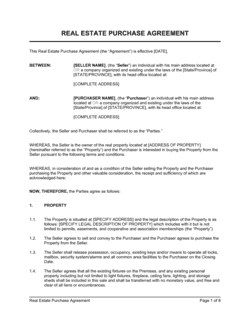
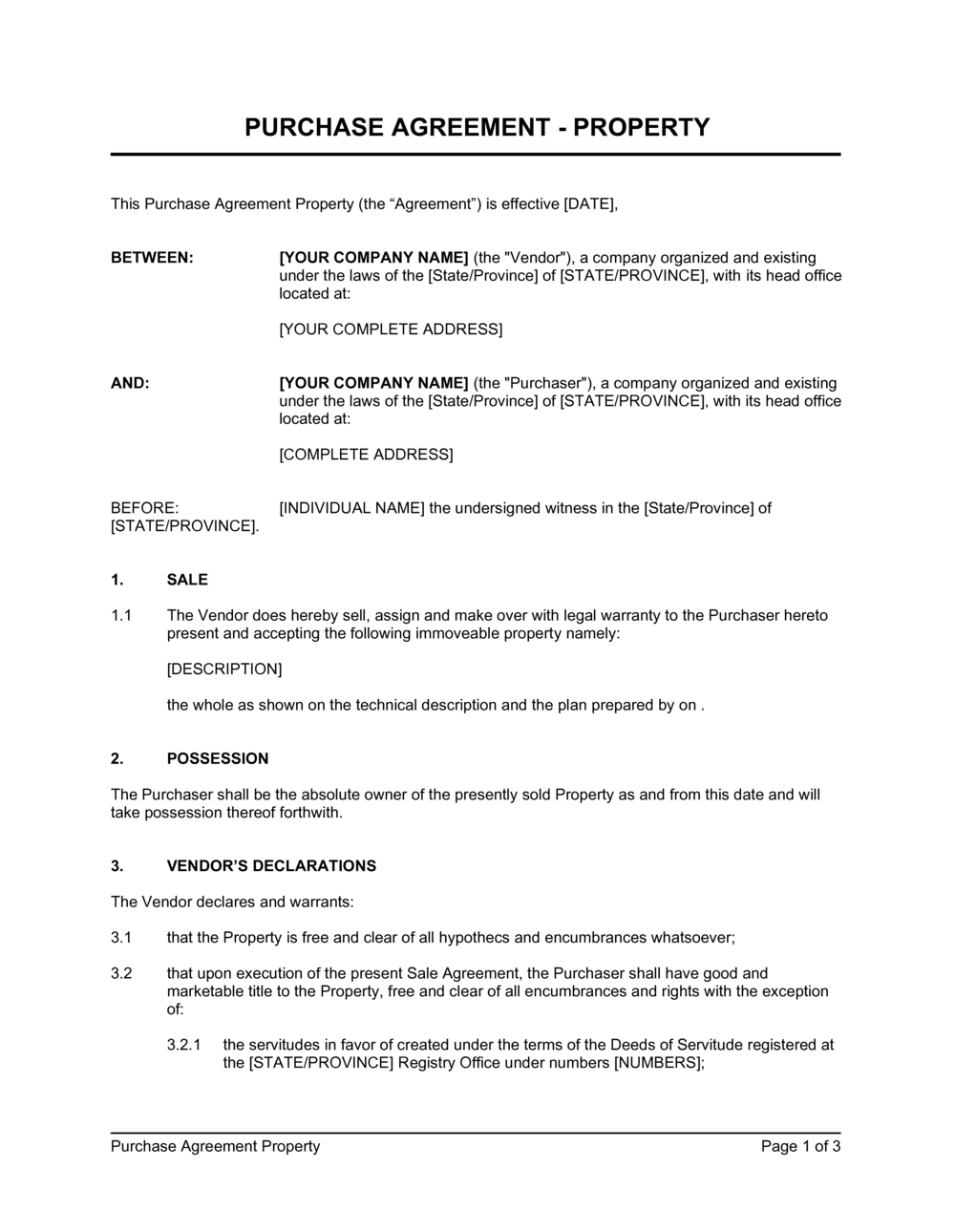
A Purchase Agreement Real Property Short Form is a concise written record that captures the essential terms of a real property sale β€” buyer and seller details, property description, purchase price, deposit amount, and proposed closing date β€” in a single, easy-to-complete form. This free Word download can be edited online and exported as PDF in minutes.
When you need it
Use it when both parties have agreed on the main terms of a property sale and need a quick, written record of those terms before a full-length purchase contract is drafted. It is also useful for straightforward transactions where a simplified form is sufficient.
What's inside
Buyer and seller identification, legal property description, agreed purchase price, earnest money deposit amount and holder, financing contingency, inspection contingency, proposed closing date, and signature lines for both parties.

What is a Purchase Agreement Real Property Short Form?

A Purchase Agreement Real Property Short Form is a concise written document that records the essential terms of a real estate sale β€” identifying the buyer and seller, describing the property by its legal description and address, stating the agreed purchase price, specifying the earnest money deposit and escrow holder, and setting the closing date and key contingencies. It functions as the first binding written step in a property transaction, replacing informal verbal agreements with a documented record both parties have accepted. Unlike a full-length purchase contract, the short form is designed for straightforward transactions where speed and simplicity are priorities and the deal points are already agreed.

Why You Need This Document

Without a signed purchase agreement β€” even a short one β€” a real estate transaction has no binding foundation. Verbal agreements to buy or sell property are generally unenforceable under the Statute of Frauds in most jurisdictions, meaning either party can walk away without consequence. A completed short-form agreement locks in the price, the deposit terms, and the closing timeline so that both parties are protected if one side changes their mind or attempts to renegotiate. It also gives the title company or closing attorney a clear starting point for the transaction. Completing this form correctly β€” with a precise legal description, a named escrow holder, and explicit contingency windows β€” prevents the most common disputes that arise between acceptance and closing, and this template gives you a ready-to-use structure to do exactly that in under 15 minutes.

Which variant fits your situation?

If your situation is…Use this template
Complex residential transaction requiring full legal protectionsReal Estate Purchase Agreement (Long Form)
Purchasing commercial property with lease-back or tenant provisionsCommercial Real Estate Purchase Agreement
Seller financing the purchase with installment paymentsLand Contract / Contract for Deed
Buyer needs more time to arrange financing before committingReal Estate Option Agreement
Recording the transfer of property ownership after closingWarranty Deed
Buyer and seller need a non-binding letter of intent before terms are finalizedLetter of Intent to Purchase Real Estate

Common mistakes to avoid

❌ Using only a street address to identify the property

Why it matters: Street addresses can be ambiguous if lot lines are disputed or the property spans multiple parcels. The legal description from the deed is the only unambiguous identifier.

Fix: Pull the legal description from the current deed or county assessor's records and paste it into the property description field verbatim.
❌ Leaving inclusions and exclusions blank

Why it matters: Fixtures attached to the property β€” built-in appliances, light fixtures, window treatments β€” are legally part of the real estate unless explicitly excluded. Disputes over these items regularly delay or derail closings.

Fix: List every item you intend to include or exclude, no matter how obvious it seems. A complete list takes five minutes and prevents a closing-day argument.

❌ Omitting the escrow holder for the earnest money deposit

Why it matters: Without a named escrow holder and clear refund conditions, both parties may claim the deposit if the deal falls through, leading to disputes that require legal intervention.

Fix: Name the escrow holder explicitly β€” title company, attorney, or licensed real estate broker β€” and state the conditions under which the deposit is refunded or forfeited.

❌ Setting an open-ended closing date without a drop-dead deadline

Why it matters: Phrases like 'on or before a mutually agreed date' leave the timeline undefined, allowing either party to delay indefinitely without being in breach.

Fix: Set a specific calendar date for closing and include a drop-dead clause: if closing does not occur by that date, either party may cancel and the deposit is returned.

The 9 key fields, explained

Buyer and Seller Identification

Property Description

Purchase Price

Earnest Money Deposit

Financing Contingency

Inspection Contingency

Closing Date and Possession

Inclusions and Exclusions

Signatures and Date

How to fill it out

  1. 1

    Enter full legal names for both parties

    Record the buyer's and seller's complete legal names exactly as they appear on government-issued ID or business registration documents. Include mailing addresses for both parties.

    πŸ’‘ If the buyer is an LLC or corporation, use the registered entity name and include the state of formation.

  2. 2

    Describe the property completely

    Enter the street address and the full legal description from the current deed or county assessor records. Do not rely on the address alone.

    πŸ’‘ You can find the legal description on the existing deed, title report, or your county assessor's online portal β€” it takes under five minutes to locate.

  3. 3

    Set the purchase price in words and figures

    State the agreed purchase price twice β€” spelled out in words and in numerals β€” to prevent any transcription dispute.

    πŸ’‘ If the price includes seller concessions or credits, state the gross price and the credit separately rather than netting them.

  4. 4

    Record the earnest money amount and escrow holder

    Enter the deposit amount, the name of the escrow holder (title company, attorney, or broker), and the number of business days the buyer has to deliver the funds.

    πŸ’‘ A deposit of 1–3% of the purchase price is customary in most US markets β€” a lower amount may signal weak buyer commitment to the seller.

  5. 5

    Fill in the contingency terms

    Specify whether a financing contingency applies and, if so, the loan amount, maximum interest rate, and approval deadline. Set the inspection window in calendar days.

    πŸ’‘ Give the inspection contingency at least 10 calendar days to allow scheduling flexibility β€” especially in markets where inspectors book 5–7 days in advance.

  6. 6

    Set the closing date and possession timing

    Enter the target closing date and state exactly when possession transfers β€” at closing, or a defined number of days after. Include a drop-dead date for closing.

    πŸ’‘ Coordinate with both parties' schedules and the lender's estimated timeline before locking in the closing date.

  7. 7

    List all inclusions and exclusions explicitly

    Write out every fixture, appliance, or item of personal property that is included in the sale price. Then list anything attached to the property that is not included.

    πŸ’‘ When in doubt, list it. An explicit exclusion is always easier to resolve before signing than a dispute on moving day.

  8. 8

    Obtain dated signatures from both parties

    Have both buyer and seller sign and date the form. Each party should retain a complete, signed copy for their records.

    πŸ’‘ Use Business in a Box eSign to capture a timestamped electronic signature and store the executed copy automatically.

Frequently asked questions

What is a short-form real property purchase agreement?

A short-form real property purchase agreement is a condensed written record of the essential terms of a property sale β€” parties, property description, price, deposit, contingencies, and closing date β€” presented in a single, easy-to-complete form. It is used when both parties have already agreed on the main deal points and need a quick written record before a full-length contract is prepared, or when the transaction is straightforward enough that a simplified form is sufficient.

Is a short-form purchase agreement legally binding?

A short-form purchase agreement is generally binding when it identifies the parties, describes the property, states the price, and is signed by both buyer and seller. However, enforceability depends on applicable state law and whether all required disclosures have been made. For complex transactions or significant amounts, consider supplementing the short form with a full-length agreement or having an attorney review it.

What is earnest money and how much should it be?

Earnest money is a deposit paid by the buyer at signing to demonstrate serious intent to purchase. It is typically held in escrow by a title company or attorney and applied to the purchase price at closing. In most US markets, 1–3% of the purchase price is customary. A lower deposit may concern sellers about the buyer's commitment; a higher deposit signals stronger motivation and can strengthen an offer in a competitive market.

What is the difference between a short-form and a long-form purchase agreement?

A short-form agreement captures the core deal terms β€” price, parties, property, deposit, and closing date β€” in a condensed format suitable for straightforward transactions. A long-form agreement covers additional provisions in detail: title insurance requirements, prorations, default remedies, dispute resolution, representations and warranties, and jurisdiction-specific disclosures. For high-value or complex transactions, the long form provides significantly more protection for both parties.

Do both buyer and seller need to sign the purchase agreement?

Yes. A real property purchase agreement requires signatures from both the buyer and the seller β€” with dates β€” to create a mutual, enforceable agreement. A form signed by only one party is generally not binding on the other. Each party should retain a complete, fully signed copy for their records.

What happens to the earnest money if the deal falls through?

Whether the deposit is refunded or forfeited depends on why the deal fell through and what the agreement says. If the buyer exercises a financing or inspection contingency within the specified window, the deposit is typically returned in full. If the buyer backs out without a valid contingency reason, the seller may be entitled to keep the deposit. The agreement should name an escrow holder and state these conditions explicitly to avoid disputes.

Can I use this form for commercial real estate?

This short form is designed for straightforward real property transactions and can be adapted for simple commercial purchases. However, commercial transactions often involve additional considerations β€” lease assignments, environmental assessments, zoning contingencies, and due diligence periods β€” that a short form does not address. A commercial real estate purchase agreement with industry-specific provisions is more appropriate for those situations.

Do I need a real estate agent or attorney to use this form?

For simple residential transactions in states where attorney involvement is not mandatory, a well-completed template is often sufficient for recording agreed terms. Some states β€” New York, Massachusetts, and several others β€” require attorney review of real estate contracts. For transactions involving significant value, unusual conditions, or unfamiliar market practices, consulting a licensed real estate agent or attorney is advisable even when the form itself is straightforward.

How this compares to alternatives

vs Purchase Agreement Real Property (Long Form)

The long-form agreement includes detailed clauses covering title insurance, prorations, default remedies, representations, and jurisdiction-specific disclosures that the short form omits. Use the short form for straightforward, lower-risk transactions where both parties are aligned; use the long form when the transaction is complex, high-value, or involves significant contingencies.

vs Letter of Intent to Purchase Real Property

A letter of intent is a non-binding expression of interest used to negotiate terms before committing to a contract. A purchase agreement β€” even in short form β€” is intended to be a binding record of agreed terms. Use the letter of intent when terms are still being worked out; use the purchase agreement once both parties have agreed.

vs Warranty Deed

A purchase agreement records the terms of the sale before closing. A warranty deed is the instrument that actually transfers ownership at closing, recorded with the county. Both documents are required in a complete real estate transaction β€” the agreement governs the process; the deed completes the transfer.

vs Real Estate Option Agreement

An option agreement gives the buyer the right β€” but not the obligation β€” to purchase a property within a defined period, typically in exchange for an option fee. A purchase agreement creates a mutual obligation to complete the sale. Use an option when the buyer needs time to conduct due diligence or arrange financing before fully committing.

Industry-specific considerations

Residential Real Estate

Used to record the terms of single-family home, condo, or townhouse sales quickly after verbal acceptance of an offer.

Commercial Real Estate

Captures initial deal terms for small-scale commercial property purchases before a more detailed contract is negotiated.

Construction and Development

Documents the acquisition of vacant land or development parcels as the first written step in a site assembly process.

Property Investment

Allows real estate investors to quickly lock in agreed terms on investment property acquisitions in competitive markets.

Template vs pro β€” what fits your needs?

PathBest forCostTime
Use the templateStraightforward residential or land purchases where both parties have already agreed on all main termsFree10–15 minutes
Template + professional reviewTransactions above $200K, first-time buyers, or properties with title issues or unusual contingencies$150–$500 (real estate attorney or agent review)1–2 days
Custom draftedComplex commercial acquisitions, multi-parcel transactions, or states requiring attorney-prepared contracts$500–$2,000+3–7 days

Glossary

Earnest Money Deposit
A sum paid by the buyer at the time of signing to demonstrate serious intent, typically held in escrow and applied to the purchase price at closing.
Legal Description
The formally recorded identification of a property using lot number, block, subdivision, or metes-and-bounds language β€” distinct from a street address.
Closing Date
The specific calendar date on which ownership transfers, funds are exchanged, and the deed is recorded.
Contingency
A condition that must be satisfied for the agreement to become binding β€” common examples include financing approval and a satisfactory inspection.
Title
Legal ownership of a property, evidenced by a deed and confirmed through a title search showing no outstanding liens or claims.
Escrow
A neutral third-party arrangement in which funds or documents are held until all conditions of the sale have been met.
Financing Contingency
A clause allowing the buyer to cancel the agreement without penalty if they cannot secure a mortgage at specified terms within a defined period.
Inspection Contingency
A clause giving the buyer the right to have the property professionally inspected and to negotiate repairs or withdraw if defects are found.
Prorations
The division of recurring property costs β€” property taxes, HOA dues, utility bills β€” between buyer and seller based on the closing date.
As-Is Sale
A transaction in which the seller makes no representations about the property's condition and the buyer accepts it in its current state.

Part of your Business Operating System

This document is one of 3,000+ business & legal templates included in Business in a Box.

  • Fill-in-the-blanks β€” ready in minutes
  • 100% customizable Word document
  • Compatible with all office suites
  • Export to PDF and share electronically

Create your document in 3 simple steps.

From template to signed document β€” all inside one Business Operating System.
1
Download or open template

Access over 3,000+ business and legal templates for any business task, project or initiative.

2
Edit and fill in the blanks with AI

Customize your ready-made business document template and save it in the cloud.

3
Save, Share, Send, Sign

Share your files and folders with your team. Create a space of seamless collaboration.

Save time, save money, and create top-quality documents.

β˜…β˜…β˜…β˜…β˜…

"Fantastic value! I'm not sure how I'd do without it. It's worth its weight in gold and paid back for itself many times."

Managing Director Β· Mall Farm
Robert Whalley
Managing Director, Mall Farm Proprietary Limited
β˜…β˜…β˜…β˜…β˜…

"I have been using Business in a Box for years. It has been the most useful source of templates I have encountered. I recommend it to anyone."

Business Owner Β· 4+ years
Dr Michael John Freestone
Business Owner
β˜…β˜…β˜…β˜…β˜…

"It has been a life saver so many times I have lost count. Business in a Box has saved me so much time and as you know, time is money."

Owner Β· Upstate Web
David G. Moore Jr.
Owner, Upstate Web

Run your business with a system β€” not scattered tools

Stop downloading documents. Start operating with clarity. Business in a Box gives you the Business Operating System used by over 250,000 companies worldwide to structure, run, and grow their business.

Free Forever PlanΒ Β·Β No credit card required