How to Incorporate a Business

Free to read β€’ Save or share with one click

FreeHow to Incorporate a Business Template

At a glance

What it is
A How To Incorporate A Business guide is a structured operational document that walks founders and business owners through every step required to form a corporation β€” from choosing the right entity type to filing articles of incorporation, drafting bylaws, issuing shares, and completing post-formation compliance tasks. This free Word download is fully editable online and exportable as PDF, giving you a reusable checklist and reference guide for a clean, complete incorporation.
When you need it
Use it when you are ready to convert a sole proprietorship or partnership into a formal corporation, launch a new venture as a corporation from day one, or guide a client or team through the incorporation process systematically.
What's inside
Entity type comparison, state or jurisdiction selection criteria, articles of incorporation checklist, registered agent requirements, corporate bylaws overview, initial board and shareholder actions, EIN application, banking setup, and ongoing compliance obligations.

What is a How To Incorporate A Business Guide?

A How To Incorporate A Business guide is a structured operational document that walks founders, business owners, and advisors through every step of the corporate formation process β€” from selecting the right entity type and state of incorporation to filing articles of incorporation, adopting bylaws, holding an organizational meeting, issuing founder shares, obtaining an EIN, and meeting ongoing compliance obligations. Unlike a legal filing form, this template provides the reasoning behind each decision, a checklist of required actions, and sample language for the core documents, so the person leading the process understands not just what to do but why each step matters.

Why You Need This Document

Without a clear incorporation roadmap, founders routinely make formation mistakes that are expensive to correct later: choosing the wrong entity type for their funding goals, incorporating in a jurisdiction that creates unnecessary tax and compliance costs, authorizing too few shares to accommodate a future option pool, or skipping the organizational meeting entirely β€” leaving the corporation without a documented capitalization table. These gaps surface at the worst possible moment β€” during a funding round, an acquisition, or an IRS audit β€” when fixing them costs far more in legal fees, delays, and lost deals than getting them right at formation. This template gives you a complete, sequenced process so that the corporation you form on day one is ready for investors, employees, and regulators from the moment it exists.

Which variant fits your situation?

If your situation is…Use this template
Forming a C-corporation to raise venture capitalHow To Incorporate A Business (C-Corp)
Forming an S-corporation for pass-through tax treatmentS-Corporation Formation Guide
Forming an LLC instead of a corporationLLC Operating Agreement
Incorporating a nonprofit or charitable organizationNonprofit Business Plan
Setting up a professional corporation for licensed practitionersProfessional Corporation Guide
Documenting governance rules after formation is completeCorporate Bylaws
Issuing equity to founders or early employees post-incorporationShareholders Agreement

Common mistakes to avoid

❌ Incorporating in Delaware without accounting for foreign qualification

Why it matters: A Delaware corporation operating in another state must register there as a foreign corporation β€” paying that state's fees and taxes on top of Delaware's β€” which eliminates the cost benefit for many small businesses.

Fix: Calculate the total annual cost of Delaware incorporation plus foreign qualification in your operating state, then compare it to simply incorporating locally. For businesses without VC plans, home-state incorporation is often cheaper.

❌ Missing the S-corp election deadline

Why it matters: Form 2553 must be filed within 75 days of incorporation or the beginning of the tax year. Missing it means the corporation is taxed as a C-corp for the entire year, resulting in double taxation on any distributed profits.

Fix: File Form 2553 the same week you receive your EIN. Note the deadline in your compliance calendar with a 2-week buffer.

❌ Skipping the organizational meeting and share issuance

Why it matters: Without a formally documented organizational meeting and issued shares, the corporation has no recorded capitalization β€” a fatal diligence gap that can derail a funding round or acquisition closing.

Fix: Hold the organizational meeting (or pass a unanimous written consent) within 30 days of filing. Sign and file all resolutions in a corporate minute book on the same day.

❌ Commingling personal and corporate funds

Why it matters: Using the corporate account for personal expenses β€” or personal accounts for business expenses β€” is the most common basis for piercing the corporate veil and eliminating the liability protection incorporation provides.

Fix: Open a dedicated corporate bank account before making any business expenditures and pay yourself only through documented payroll or board-approved distributions.

❌ Authorizing too few shares at formation

Why it matters: Issuing more shares than authorized requires a formal amendment to the articles of incorporation, which involves a state filing fee, board and shareholder approval, and a delay of days or weeks.

Fix: Authorize at least 10,000,000 shares at formation. The state filing fee in most jurisdictions does not increase meaningfully for higher authorized amounts at the startup stage.

❌ Missing annual report and compliance filings after incorporation

Why it matters: States administratively dissolve corporations that miss annual report deadlines, stripping the liability shield retroactively for all transactions during the lapsed period.

Fix: Set calendar reminders for every annual filing β€” state annual report, registered agent renewal, and tax return β€” on the same day you file the articles of incorporation.

The 9 key sections, explained

Entity type selection

State of incorporation selection

Articles of incorporation checklist

Registered agent appointment

Corporate bylaws overview

Organizational meeting and initial resolutions

EIN application and tax elections

Corporate bank account and capitalization

Post-incorporation compliance calendar

How to fill it out

  1. 1

    Choose your entity type

    Review the entity comparison section and select the structure that fits your liability, tax, and fundraising goals. Mark your choice and note the key implications for the sections that follow.

    πŸ’‘ If you plan to raise institutional venture capital within 3 years, default to a Delaware C-corp β€” converting an LLC or S-corp to a C-corp mid-raise is expensive and disruptive.

  2. 2

    Select your state of incorporation

    Decide between Delaware, your home state, or another jurisdiction. Document your rationale β€” investor expectations, legal predictability, or cost β€” so the decision is on record.

    πŸ’‘ Delaware incorporations require a separate foreign qualification filing in any state where you have employees or a physical office, adding $100–$300 per state annually.

  3. 3

    Complete the articles of incorporation checklist

    Gather all required information: your chosen corporate name (confirm availability with the state), registered agent name and address, authorized share count and par value, and incorporator details.

    πŸ’‘ Authorize at least 10,000,000 shares at $0.0001 par value β€” this is the standard startup structure in Delaware and gives you flexibility for future grants without amending the articles.

  4. 4

    Appoint a registered agent

    Designate a registered agent with a physical address in the state of incorporation. Decide whether to use a founder address, an employee, or a commercial registered agent service ($50–$300/year).

    πŸ’‘ A commercial registered agent service is worth the cost for privacy, reliability, and the ability to change offices without updating state records.

  5. 5

    Prepare and adopt corporate bylaws

    Use the bylaws overview section to confirm your board size, quorum requirements, officer titles, and meeting frequency. Adopt the bylaws at the organizational meeting and retain a signed copy in your corporate minute book.

    πŸ’‘ Set a quorum at a simple majority of the actual founding board β€” not a fixed number β€” so future board size changes do not inadvertently make quorum impossible.

  6. 6

    Hold the organizational meeting and issue shares

    Pass initial board resolutions adopting bylaws, appointing officers, authorizing a bank account, and issuing founder shares. Document everything in signed meeting minutes or a unanimous written consent.

    πŸ’‘ Founder shares should be issued at a nominal price (e.g., $0.0001/share) before any outside investment β€” issuing them later at a higher price creates unnecessary tax exposure for founders.

  7. 7

    Apply for your EIN and make tax elections

    Apply for an EIN on IRS.gov (takes 5 minutes online). If electing S-corp status, file Form 2553 within 75 days of incorporation. Register for state taxes if required in your jurisdiction.

    πŸ’‘ Download and retain the IRS EIN confirmation letter (CP 575) β€” banks and many government agencies require the original letter, not just the EIN number.

  8. 8

    Open a corporate bank account and fund it

    Open a dedicated business checking account in the corporation's name, make the initial capital contribution, and record the transaction on the corporate books with a share issuance receipt.

    πŸ’‘ Never deposit personal funds or pay personal expenses from the corporate account β€” a single instance of commingling can be used to argue the corporation is an alter ego of its owner.

Frequently asked questions

What does it mean to incorporate a business?

Incorporating a business means formally creating a corporation by filing articles of incorporation with a state government, establishing a legal entity separate from its owners. This separation limits personal liability, allows the business to enter contracts and own property in its own name, and creates a structure for issuing shares to investors or employees. The corporation exists independently of its founders β€” it can survive ownership changes, bring on co-founders, and raise capital in ways a sole proprietorship or partnership cannot.

What is the difference between incorporating and forming an LLC?

A corporation issues shares, is governed by a board of directors and officers, and is subject to corporate formalities like annual meetings and bylaws. An LLC issues membership interests, is governed by an operating agreement, and has fewer mandatory formalities. Corporations are the preferred structure for businesses planning to raise institutional venture capital or issue stock options to employees; LLCs are generally simpler and more flexible for small businesses, real estate holdings, and professional services firms.

Should I incorporate in Delaware or my home state?

Delaware is the default choice for venture-backed startups because its Court of Chancery offers predictable corporate law, and most institutional investors expect a Delaware C-corp. However, a Delaware corporation operating in another state must file a foreign qualification in that state and pay fees in both jurisdictions. For a small business with no plans to raise institutional capital, incorporating in the home state is typically cheaper and simpler. Run the numbers for your specific situation before defaulting to Delaware.

What are articles of incorporation?

Articles of incorporation β€” sometimes called a certificate of incorporation or corporate charter β€” are the founding document filed with the state to legally create a corporation. They typically include the corporate name, registered agent and address, number of authorized shares and par value, the incorporator's name and signature, and the corporation's stated purpose. Filing fees range from $50 in states like Kentucky to $90 in Delaware for a standard formation. The state returns a certified copy as proof of formation.

How long does it take to incorporate a business?

Standard state processing takes 1–5 business days in most states, with expedited same-day or 24-hour service available for an additional fee ranging from $50 to $200. Delaware standard processing is typically 1–2 business days. After the state approves the filing, you still need to apply for an EIN (5 minutes online), hold an organizational meeting, adopt bylaws, and open a bank account β€” the full post-incorporation setup typically takes 1–2 weeks if done systematically.

Do I need a lawyer to incorporate a business?

For a straightforward domestic incorporation, a high-quality guide and template handle the mechanics without a lawyer. Consider engaging an attorney when you have multiple co-founders with complex equity splits, plan to issue stock options and need an 83(b) election strategy, are incorporating in a regulated industry, or have IP assignments from prior employers to navigate. A 1–2 hour attorney consultation for a simple incorporation typically costs $300–$600 and is worthwhile for first-time founders.

What is an EIN and when do I need one?

An EIN (Employer Identification Number) is a federal tax ID issued by the IRS β€” the corporate equivalent of a Social Security number. You need it to open a business bank account, hire employees, file federal and state tax returns, and apply for many business licenses. Apply for one free on IRS.gov immediately after your articles of incorporation are approved. The application takes about 5 minutes and the EIN is issued instantly online.

What is the difference between a C-corp and an S-corp?

A C-corp is the default corporate tax structure β€” the corporation pays tax on its income, and shareholders pay tax again on dividends they receive. An S-corp is a tax election (filed on IRS Form 2553) that passes profits and losses through to shareholders' personal returns, avoiding double taxation. S-corps are limited to 100 shareholders, all of whom must be US citizens or residents β€” making them ineligible for institutional VC investment. C-corps are preferred for startups raising outside capital; S-corps suit small, profitable businesses distributing earnings to a small group of owners.

What ongoing compliance obligations does a corporation have?

Every corporation must file an annual report with its state of incorporation (and any states where it is foreign-qualified), hold an annual shareholder meeting (or pass a written consent in lieu of a meeting), maintain a corporate minute book with resolutions and meeting records, renew its registered agent annually, file federal and state corporate tax returns, and maintain a separate bank account. Missing annual report deadlines is the most common cause of administrative dissolution, which voids the liability protection that made incorporating worthwhile in the first place.

How this compares to alternatives

vs LLC Operating Agreement

An LLC operating agreement governs the internal rules of a limited liability company, which offers liability protection and pass-through taxation with fewer formalities than a corporation. A how-to incorporate guide is the right choice when you need the share-issuance structure required for venture capital, stock options, or a future IPO. LLCs are simpler for small businesses and real estate; corporations are standard for high-growth startups.

vs Corporate Bylaws

Corporate bylaws govern how an already-formed corporation is managed β€” board meetings, voting, officer roles. A how-to incorporate guide covers the entire formation process, of which adopting bylaws is one step. You need the incorporation guide first; the bylaws template fills in the governance detail once the corporation exists.

vs Shareholders Agreement

A shareholders agreement sets the rights and obligations of the corporation's equity owners β€” transfer restrictions, voting arrangements, drag-along and tag-along rights. It is executed after the corporation is formed and shares are issued. The incorporation guide gets you to the point where a shareholders agreement is appropriate and necessary.

vs Business Plan

A business plan documents your market opportunity, strategy, and financial projections β€” it is the strategic document you present to investors or lenders. A how-to incorporate guide is the operational document that creates the legal entity those investors or lenders will invest in or lend to. Both are typically needed at the same stage, but they serve entirely different purposes.

Industry-specific considerations

Technology / SaaS

Delaware C-corp formation with high authorized share counts, IP assignment agreements for all founders, and immediate 83(b) elections to minimize tax on low-priced founder shares.

Professional Services

Professional corporation (PC) or PLLC requirements for licensed practitioners (attorneys, doctors, engineers) vary by state and bar or licensing board rules.

Retail / E-commerce

Multi-state sales tax nexus triggered by incorporation and operations across states, requiring careful registered agent and foreign qualification planning from day one.

Healthcare / MedTech

Corporate practice of medicine doctrine in many states restricts physician ownership of corporations, requiring a management services organization (MSO) structure reviewed by a healthcare attorney.

Template vs pro β€” what fits your needs?

PathBest forCostTime
Use the templateSolo founders or small teams incorporating a standard domestic business with straightforward equity and no immediate fundraising plansFree (plus state filing fees, typically $50–$300)1–3 days
Template + professional reviewFirst-time founders with multiple co-founders, planned stock options, or a funding round within 12 months$300–$800 for a 1–2 hour attorney review3–7 days
Custom draftedComplex multi-founder equity structures, regulated industries, international ownership, or incorporation in multiple jurisdictions simultaneously$1,500–$5,000+1–3 weeks

Glossary

Articles of Incorporation
The founding document filed with the state that officially creates a corporation, stating its name, purpose, registered agent, and authorized shares.
Registered Agent
A person or entity designated to receive official legal and government correspondence on behalf of the corporation in its state of formation.
Corporate Bylaws
Internal rules governing how the corporation is managed, including board composition, meeting procedures, voting rights, and officer roles.
Authorized Shares
The maximum number of shares a corporation is permitted to issue, as stated in the articles of incorporation.
EIN (Employer Identification Number)
A federal tax ID number assigned by the IRS, required to open a business bank account, hire employees, and file corporate tax returns.
S-Corporation Election
An IRS filing (Form 2553) that allows a qualifying corporation to pass profits and losses through to shareholders' personal tax returns, avoiding double taxation.
C-Corporation
The default corporate tax structure, taxed at the entity level and again when dividends are distributed to shareholders β€” the preferred structure for venture-backed companies.
Organizational Meeting
The first official meeting of the board of directors after incorporation, used to adopt bylaws, appoint officers, authorize a bank account, and issue founder shares.
Par Value
A nominal per-share dollar amount stated in the articles of incorporation, used for accounting and tax purposes β€” often set at $0.0001 for startups.
Piercing the Corporate Veil
A legal finding that a corporation's owners are personally liable for corporate debts, typically due to commingled funds, failure to hold meetings, or inadequate capitalization.
Foreign Qualification
The process by which a corporation incorporated in one state registers to do business legally in a second state where it has employees, offices, or significant operations.

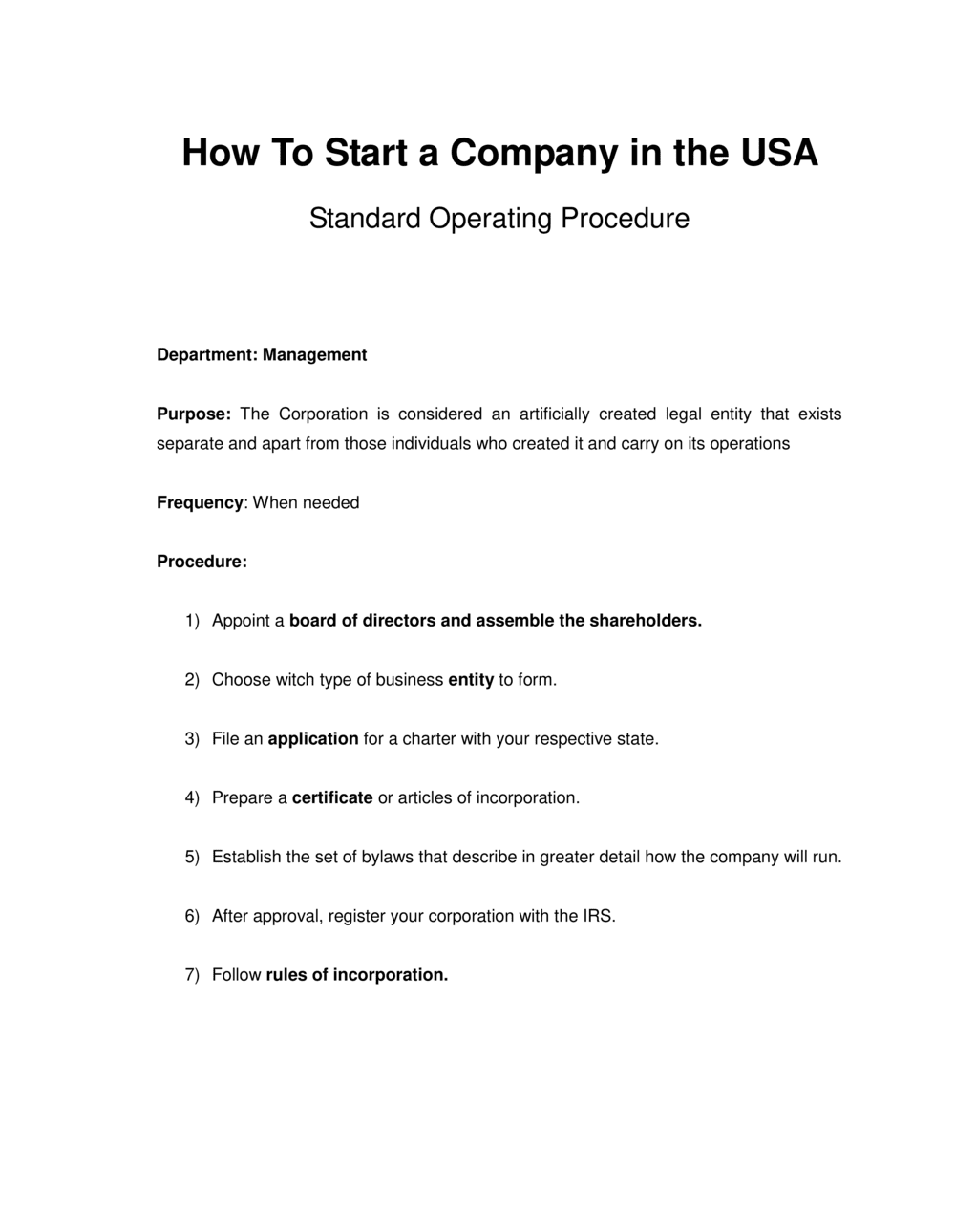
Part of your Business Operating System

This document is one of 3,000+ business & legal templates included in Business in a Box.

  • Fill-in-the-blanks β€” ready in minutes
  • Compatible with all office suites
  • Export to PDF and share electronically

Create your document in 3 simple steps.

From template to signed document β€” all inside one Business Operating System.
1
Download or open template

Access over 3,000+ business and legal templates for any business task, project or initiative.

2
Edit and fill in the blanks with AI

Customize your ready-made business document template and save it in the cloud.

3
Save, Share, Send, Sign

Share your files and folders with your team. Create a space of seamless collaboration.

Save time, save money, and create top-quality documents.

β˜…β˜…β˜…β˜…β˜…

"Fantastic value! I'm not sure how I'd do without it. It's worth its weight in gold and paid back for itself many times."

Managing Director Β· Mall Farm
Robert Whalley
Managing Director, Mall Farm Proprietary Limited
β˜…β˜…β˜…β˜…β˜…

"I have been using Business in a Box for years. It has been the most useful source of templates I have encountered. I recommend it to anyone."

Business Owner Β· 4+ years
Dr Michael John Freestone
Business Owner
β˜…β˜…β˜…β˜…β˜…

"It has been a life saver so many times I have lost count. Business in a Box has saved me so much time and as you know, time is money."

Owner Β· Upstate Web
David G. Moore Jr.
Owner, Upstate Web

Run your business with a system β€” not scattered tools

Stop downloading documents. Start operating with clarity. Business in a Box gives you the Business Operating System used by over 250,000 companies worldwide to structure, run, and grow their business.

Free Forever PlanΒ Β·Β No credit card required