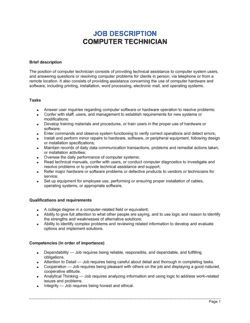
Computer System Analyst Job Description Template

Free Word download • Edit online • Save & share with Drive • Export to PDF

2 pages20–30 min to fillDifficulty: StandardSignature requiredLegal review recommended
Learn more ↓
FreeComputer System Analyst Job Description Template

At a glance

What it is
A Computer System Analyst Job Description is a formal binding document that defines the scope of work, required qualifications, reporting relationships, compensation structure, and employment terms for a computer systems analyst role. This free Word download lets you customize responsibilities, technical skill requirements, and contractual obligations, then export as PDF to attach to offer letters or employment agreements.
When you need it
Use it when hiring a new systems analyst, restructuring an existing IT role, or formalizing responsibilities for a contractor or full-time employee whose scope has expanded beyond their original hire terms. It is also required when HR needs documented role definitions for compensation benchmarking or compliance audits.
What's inside
Role summary and reporting structure, core duties and deliverables, required and preferred technical qualifications, compensation and benefits framework, performance expectations, confidentiality and IP obligations, and employment classification and termination terms.

What is a Computer System Analyst Job Description?

A Computer System Analyst Job Description is a formal binding document that defines the full scope of employment for a systems analyst role — covering duties, required technical qualifications, reporting relationships, compensation classification, intellectual property obligations, confidentiality requirements, and termination terms. Unlike a generic job posting, a signed job description incorporated into an employment agreement creates enforceable obligations on both sides, establishes the documented basis for performance management, and protects the employer's systems assets and proprietary data. This template is a free Word download you can edit to match your specific technology environment, then export as PDF to attach to offer letters or employment agreements.

Why You Need This Document

Without a clearly drafted computer systems analyst job description, you are exposed to four distinct risks simultaneously. First, FLSA misclassification — failing to document why the analyst meets the computer employee exemption — can trigger unpaid overtime claims plus liquidated damages doubling the liability. Second, without an explicit IP assignment clause covering remote work, system designs, integration documentation, and scripts created off company premises may not legally belong to you. Third, a departing analyst who retains access credentials or undocumented system knowledge represents an active security risk that contractual silence makes legally difficult to address. Fourth, vague or missing role scope makes it nearly impossible to manage performance or justify a termination decision if the relationship sours. This template closes all four gaps in 30 minutes, with a clear structure for every clause an IT employment relationship requires.

Which variant fits your situation?

If your situation is…Use this template
Hiring a full-time salaried employee for an in-house systems analyst roleComputer System Analyst Job Description (Employee)
Engaging an independent contractor for a defined systems analysis projectIndependent Contractor Agreement
Defining a senior or lead systems architect role with broader authorityIT Manager Job Description
Posting a combined developer and analyst hybrid roleSoftware Developer Job Description
Documenting a business analyst role focused on process rather than systemsBusiness Analyst Job Description
Creating a full employment contract to accompany the job descriptionEmployment Contract
Hiring a temporary or contract analyst through a probationary periodTemporary Employment Contract

Common mistakes to avoid

❌ Misclassifying the analyst as FLSA-exempt without meeting the test

Why it matters: The FLSA computer employee exemption requires both a minimum salary ($684/week as of 2024) and primary duties centered on systems analysis or programming. A misclassified analyst is entitled to unpaid overtime plus liquidated damages, often doubling the liability.

Fix: Document the classification analysis at the time of hire, referencing each element of the applicable exemption test. Reassess any time the role's duties change materially.

❌ Omitting a device and credential return clause

Why it matters: A departing systems analyst who retains access credentials, system documentation, or administrator passwords represents an active security and compliance risk — one that contractual silence makes harder to remediate quickly.

Fix: Include an explicit credential and device return clause with a 24–48 hour deadline after separation, and pair it with an IT offboarding checklist incorporated by reference.

❌ Using location-limited IP assignment language

Why it matters: Clauses that assign only work 'created on company premises' leave designs, scripts, or documentation produced remotely or on personal devices potentially unassigned — a critical gap for IT roles.

Fix: Draft IP assignment to cover all work product created 'in connection with employment,' regardless of location or device used.

❌ Mixing required and preferred qualifications without distinction

Why it matters: Treating preferred certifications as mandatory requirements reduces the qualified candidate pool, may create disparate impact exposure under EEOC guidelines, and leads to rejecting strong candidates for credentials that have no bearing on day-one performance.

Fix: Explicitly label each qualification as 'Required' or 'Preferred.' Before posting, confirm each required credential is genuinely essential for the role as designed.

❌ No confidentiality definition tailored to IT access

Why it matters: A generic confidentiality clause that says 'all business information' may not clearly cover system architecture diagrams, security configurations, or access credentials — the most sensitive assets a systems analyst handles.

Fix: Expand the confidentiality definition to enumerate IT-specific categories: system architectures, network configurations, access credentials, proprietary code, and any data processed by company systems.

❌ Applying an at-will clause to employees in non-at-will jurisdictions

Why it matters: At-will employment is a US doctrine. Using it in Canada, the UK, the EU, or Australia creates a false impression of the employer's termination rights and may void legitimate notice and severance terms.

Fix: Replace at-will language with a notice-period clause calibrated to the statutory minimums of the employee's work location. Review jurisdiction-specific notes before finalizing.

The 10 key clauses, explained

Role summary and job title

In plain language: States the official job title, department, employment type (full-time, part-time, or contract), and a two- to three-sentence summary of the role's primary purpose.

Sample language
[COMPANY NAME] is seeking a Computer Systems Analyst to join the [DEPARTMENT] team on a [FULL-TIME / PART-TIME / CONTRACT] basis. The Analyst will evaluate, design, and optimize technology systems that support [COMPANY NAME]'s operational and strategic objectives.

Common mistake: Using a generic title like 'IT Analyst' without specifying the systems domain. Candidates and courts rely on the stated title to define the role's scope — vague titles generate misaligned expectations and complicate performance management.

Reporting structure and authority

In plain language: Identifies who the analyst reports to, which teams they collaborate with, and the limits of their decision-making authority — particularly around system changes, vendor selection, and budget.

Sample language
The Computer Systems Analyst reports directly to the [IT DIRECTOR / CIO / DEPARTMENT HEAD] and collaborates with the [LIST TEAMS]. The Analyst has authority to recommend system changes up to $[AMOUNT] in cost impact; purchases above this threshold require approval from [TITLE].

Common mistake: Omitting a dollar authority threshold. Without defined spending or change-approval limits, analysts may commit the company to unapproved vendor contracts or system modifications.

Core duties and deliverables

In plain language: Lists the primary day-to-day and project-based responsibilities, tied to measurable outputs where possible — system assessments, documentation, integration projects, and stakeholder reporting.

Sample language
Primary duties include: (a) analyzing current IT systems and workflows to identify inefficiencies; (b) documenting technical requirements and preparing system specifications; (c) managing implementation of approved system changes; and (d) providing post-deployment support and user training.

Common mistake: Listing duties without distinguishing ongoing operational tasks from project deliverables. Mixing the two makes it impossible to set clear performance benchmarks or prioritize workload.

Required qualifications and technical skills

In plain language: Defines the minimum education, certifications, years of experience, and specific technical competencies — programming languages, platforms, methodologies — required to perform the role.

Sample language
Minimum qualifications: Bachelor's degree in Computer Science, Information Systems, or related field; [X] years of experience in systems analysis; proficiency in [SQL / Python / Java / ERP PLATFORM]; familiarity with [AGILE / WATERFALL / SCRUM] methodologies. Preferred: [CERTIFICATION NAME] certification.

Common mistake: Listing every possible technical skill without distinguishing required from preferred. Overly restrictive minimum requirements reduce the candidate pool and may create disparate impact discrimination exposure in some jurisdictions.

Compensation, classification, and benefits

In plain language: States the salary range or hourly rate, FLSA classification (exempt or non-exempt), pay frequency, bonus eligibility, and benefits entitlements.

Sample language
Compensation: $[MIN]–$[MAX] annually / $[RATE]/hour, paid [bi-weekly / semi-monthly]. Classification: [Exempt / Non-Exempt] under the FLSA. Benefits: eligible for [HEALTH / DENTAL / VISION / RETIREMENT / PTO] as per the Company's standard benefits program.

Common mistake: Misclassifying the analyst as exempt when their duties do not meet the FLSA computer employee exemption test — salary threshold of at least $684/week and primary duty must involve systems analysis, design, or programming. Misclassification triggers back-pay and penalties.

Intellectual property assignment

In plain language: Assigns to the employer all work product, system designs, documentation, code, and technical deliverables created by the analyst in connection with their role.

Sample language
All systems documentation, technical specifications, code, designs, and other work product created by Employee in connection with their employment are the sole property of [COMPANY NAME] and are hereby irrevocably assigned to the Company, whether created on or off company premises.

Common mistake: Limiting IP assignment to work created on company premises or equipment. Analysts frequently work remotely or on personal devices — a location-based clause can leave critical system designs unassigned.

Confidentiality and data handling

In plain language: Prohibits the analyst from disclosing proprietary technical architectures, security configurations, vendor contracts, and sensitive business data during and after employment.

Sample language
Employee shall not, during or after employment, disclose or use any Confidential Information of [COMPANY NAME], including but not limited to system architectures, security protocols, customer data, and vendor arrangements, without prior written authorization.

Common mistake: No definition of 'Confidential Information' in a technical context. For IT roles, the definition must explicitly cover system schematics, access credentials, security configurations, and any data processed by company systems.

Non-solicitation

In plain language: Restricts a departing analyst from recruiting colleagues or approaching the company's clients and vendors for a defined period after leaving.

Sample language
For [12] months following the termination of employment, Employee shall not directly or indirectly solicit, recruit, or hire any employee of [COMPANY NAME], or solicit or service any client, customer, or vendor with whom Employee had material contact during their employment.

Common mistake: Applying the same non-solicitation scope to an entry-level analyst as to a senior IT director. Courts scrutinize proportionality — a clause broader than necessary to protect legitimate business interests risks being voided entirely.

Termination, notice, and at-will status

In plain language: States whether employment is at-will, the required notice period for either party, conditions for immediate termination for cause, and any final-pay or device-return obligations.

Sample language
Employment is at-will and may be terminated by either party at any time with [X weeks'] written notice. [COMPANY NAME] may terminate immediately for Cause, including unauthorized access to or disclosure of Company systems. Upon separation, Employee must return all devices, credentials, and documentation within [48 hours].

Common mistake: No device and credential return clause in IT roles. A departing systems analyst with retained access credentials or undocumented system knowledge represents an immediate security and compliance risk.

Governing law and entire agreement

In plain language: Specifies which jurisdiction's law governs the document, confirms this is the complete agreement replacing prior representations, and identifies the process for amendments.

Sample language
This Job Description and the associated Employment Agreement are governed by the laws of [STATE / PROVINCE / COUNTRY]. This document, together with any attached schedules, constitutes the entire agreement between the parties with respect to the subject matter herein and supersedes all prior representations.

Common mistake: Selecting a governing law with no meaningful connection to where the analyst actually works. Some jurisdictions — particularly California — apply local employment law regardless of the contract's choice-of-law clause.

How to fill it out

  1. 1

    Define the role title, department, and employment type

    Enter the exact job title, the department the analyst will sit within, and whether the position is full-time, part-time, or contract. Confirm the title aligns with your internal compensation bands and external benchmarking data.

    💡 Cross-reference the title against your HRIS and payroll system before finalizing — a mismatch between the job description and payroll records creates compliance complications.

  2. 2

    Map the reporting structure and authority limits

    Identify the direct manager's title, list the cross-functional teams the analyst will collaborate with, and define any spending, change-approval, or vendor-selection authority limits.

    💡 Express authority limits as dollar thresholds, not vague adjectives like 'significant' or 'major' — this prevents ambiguity when an approval dispute arises.

  3. 3

    Draft the core duties using a deliverable-first format

    Write each duty starting with an action verb tied to a measurable output — 'documents system requirements to a defined specification standard' rather than 'helps with documentation.' Separate ongoing operational duties from project-based deliverables.

    💡 Limit the duties list to 8–12 items. A list of 20+ duties signals poor role design and makes performance reviews unmanageable.

  4. 4

    Distinguish required from preferred qualifications

    Mark minimum qualifications — degree, years of experience, core technical skills — as 'required.' Mark additional certifications, exposure to specific platforms, or advanced specializations as 'preferred.' Review both lists against applicable equal employment opportunity guidelines.

    💡 Before publishing, ask whether each 'required' credential is genuinely necessary to perform the role from day one — unnecessary requirements reduce diversity and may create legal exposure.

  5. 5

    Set the compensation range and confirm FLSA classification

    Enter the salary band or hourly rate, pay frequency, and bonus eligibility. Confirm whether the analyst meets the FLSA computer employee exemption criteria — salary of at least $684/week and primary duties centered on systems analysis or programming.

    💡 Document your classification rationale in a separate HR file at the time of hire. If the role later expands into management, reclassification without documentation creates back-pay exposure.

  6. 6

    Complete the IP assignment and confidentiality clauses

    Expand the IP assignment to include any domain-specific work product — system documentation, integration designs, data models, or proprietary scripts. Define 'Confidential Information' explicitly to cover system architectures, access credentials, and data processed on company systems.

    💡 For remote or hybrid analysts, confirm the IP clause covers work created outside company premises and on personal devices.

  7. 7

    Set notice, at-will status, and device-return obligations

    Confirm whether at-will employment applies (US only — see jurisdictional notes). Set the notice period, define cause-based termination triggers specific to IT roles (unauthorized access, data exfiltration), and add a device and credential return deadline.

    💡 Pair the credential return clause with an IT offboarding checklist reference — this makes the contractual obligation operational rather than theoretical.

  8. 8

    Execute before the start date and file a signed copy

    Both parties must sign the job description and any accompanying employment agreement before the first day of work. Post-start signatures may void restrictive covenants in common-law jurisdictions without additional consideration.

    💡 Use a timestamped e-signature tool so you have a dated execution record — critical if an IP or non-solicitation dispute arises later.

Frequently asked questions

What is a computer system analyst job description?

A computer system analyst job description is a formal document that defines the duties, required qualifications, reporting structure, compensation terms, and employment obligations for a systems analyst role. It functions as both a recruitment tool and a legally enforceable record of the agreed scope of work, forming part of the overall employment agreement. A well-drafted description reduces disputes over role expectations and provides the documentation basis for performance management and termination decisions.

What does a computer systems analyst do?

A computer systems analyst evaluates an organization's existing IT infrastructure, identifies inefficiencies and gaps, gathers technical requirements from stakeholders, and designs or oversees improvements to systems and workflows. Typical deliverables include requirements documentation, system specifications, implementation plans, and post-deployment support. Many analysts bridge the gap between business units and IT development teams, translating operational needs into technical solutions.

Is a job description legally binding?

A job description that is signed by both parties and incorporated into an employment agreement is generally treated as a binding document defining the scope of the role. Courts in many jurisdictions reference job descriptions when assessing wrongful dismissal claims, misclassification disputes, and IP ownership questions. A standalone unsigned job description carries less legal weight but still informs performance management and compensation benchmarking.

What qualifications should a computer systems analyst have?

Most employers require at minimum a Bachelor's degree in Computer Science, Information Systems, or a related field and two to five years of hands-on systems analysis experience. Common technical requirements include SQL proficiency, familiarity with at least one ERP or CRM platform, and experience with a structured development methodology such as Agile or Waterfall. Certifications such as CBAP, CompTIA, or platform-specific credentials (SAP, Salesforce) are commonly listed as preferred qualifications.

How is a computer systems analyst classified under the FLSA?

Under the FLSA computer employee exemption, a systems analyst may be classified as exempt from overtime if they earn at least $684 per week and their primary duties involve the analysis, design, or modification of computer systems. Analysts whose primary duties involve support, data entry, or routine maintenance typically do not meet the exemption test and must be classified as non-exempt. Misclassification exposes employers to back-pay liability plus liquidated damages.

Should the job description include IP assignment and confidentiality clauses?

Yes. For a systems analyst role, IP assignment and confidentiality provisions are particularly important because the analyst will routinely create technical documentation, system designs, and potentially code that represent significant business assets. Without explicit assignment language, the analyst may retain rights to work product. Without a tailored confidentiality definition, system architecture details and security configurations may not be clearly protected.

Can I use this job description for a contractor instead of an employee?

A job description template designed for employment relationships is not appropriate as a standalone document for independent contractors. Contractor engagements require a separate Independent Contractor Agreement that defines the contractor's independent status, scope of services, deliverables, payment terms, and IP assignment — without employment terms like FLSA classification, benefits, or at-will language, which can strengthen a misclassification claim if included.

What notice period is standard for a systems analyst role?

In the US, there is no statutory notice requirement and at-will arrangements are common, though two weeks is the professional norm. In Canada, minimum notice under provincial Employment Standards Acts ranges from one week per year of service (capped at 8 weeks in most provinces). In the UK, statutory minimum notice is one week per year of service after two years, capped at 12 weeks. EU member states vary widely, from two weeks in some countries to three months in Germany.

How often should a computer systems analyst job description be updated?

Review the job description any time the role's duties change materially — such as when the analyst takes on new systems, supervisory responsibilities, or expanded access to sensitive data. Annual reviews aligned to performance cycles are also good practice. Outdated descriptions create mismatches between actual duties and FLSA classifications, compensation bands, and IP assignment scope.

How this compares to alternatives

vs Software Developer Job Description

A software developer job description focuses on writing, testing, and deploying code, with an emphasis on programming languages and technical build skills. A computer systems analyst job description centers on requirements gathering, systems evaluation, and process improvement — the analyst designs the solution while the developer builds it. Organizations hiring for a role that spans both functions should consider whether one description can accurately capture both sets of duties.

vs IT Manager Job Description

An IT manager job description covers team leadership, budget management, vendor oversight, and strategic technology planning. A computer systems analyst description defines an individual-contributor role focused on analysis, documentation, and implementation support. The analyst role typically reports to the IT manager, making the two documents complementary rather than interchangeable.

vs Business Analyst Job Description

A business analyst job description emphasizes process mapping, stakeholder communication, and business requirements documentation — often with no direct technical implementation responsibility. A computer systems analyst job description includes technical system evaluation, integration design, and hands-on platform expertise. Use the business analyst template when the role is process-focused; use the systems analyst template when the role requires direct technical ownership of IT systems.

vs Independent Contractor Agreement

An independent contractor agreement is appropriate when engaging a self-employed analyst for a defined project without creating an employment relationship. A job description paired with an employment contract governs an ongoing employee. Using employment-style terms in a contractor engagement increases misclassification risk. If the engagement involves direct supervision, set hours, and ongoing duties, an employment arrangement and this job description template are the correct documents.

Industry-specific considerations

Financial services and fintech

Systems analysts in financial services handle core banking, trading, or payment platform analysis, requiring explicit confidentiality provisions for customer financial data and regulatory compliance obligations under SOX or PCI-DSS.

Healthcare and MedTech

Healthcare systems analysts work with EHR platforms and medical device integrations, requiring HIPAA confidentiality obligations and often credentialing or HITRUST familiarity as a stated qualification.

Manufacturing and supply chain

Analysts in manufacturing focus on ERP systems such as SAP or Oracle, production scheduling integrations, and supply chain visibility tools, with authority limits tied to change-management and production-impact thresholds.

SaaS and technology

Technology companies require systems analysts to work within Agile or DevOps frameworks, with IP assignment clauses covering API designs, data pipeline architectures, and proprietary platform integrations.

Jurisdictional notes

United States

At-will employment applies in 49 states, but the FLSA computer employee exemption imposes a specific salary and duties test for exempt classification — misclassification triggers unpaid overtime liability plus liquidated damages. California imposes additional restrictions, including limits on IP assignment for inventions developed entirely on personal time (Labor Code §2870) and a near-total ban on post-employment non-competes. State-specific pay transparency laws in California, New York, and Colorado require salary ranges to be disclosed in postings.

Canada

At-will employment does not exist in Canada. Each province's Employment Standards Act sets minimum notice, termination pay, and severance entitlements — contracts that provide less are void to that extent. Ontario common-law notice for a mid-career systems analyst can reach 1–2 months per year of service. Quebec requires job descriptions and employment documents to be available in French for provincially regulated employers. Non-competes are enforceable only if narrowly scoped in duration and geography.

United Kingdom

UK employers must provide a written statement of employment particulars — including duties, pay, and hours — on or before day one of employment. Statutory minimum notice is one week per year of service after two years, capped at 12 weeks. Post-employment restrictive covenants are enforceable only if they protect a legitimate business interest and are reasonable in scope. The UK GDPR requires the confidentiality clause to address the analyst's handling of personal data processed through company systems.

European Union

The EU Transparent and Predictable Working Conditions Directive requires written employment terms — including a job description — within seven days of the start date. Post-employment non-competes typically require financial compensation to the employee to be enforceable, ranging from 25% to 100% of salary depending on the member state. The GDPR requires that any confidentiality clause covering personal data processed by the analyst aligns with the organization's data processing obligations. Germany, France, and the Netherlands each impose additional works council or notification requirements for IT role changes.

Template vs lawyer — what fits your deal?

PathBest forCostTime
Use the templateEmployers hiring standard domestic full-time or part-time systems analysts in a single jurisdiction with straightforward duties and compensationFree30–45 minutes
Template + legal reviewEmployers in regulated industries (healthcare, financial services), cross-state or cross-border hires, or roles with significant IP or data security exposure$300–$6001–3 days
Custom draftedSenior or principal analysts with broad system authority, complex equity or bonus structures, or multi-jurisdiction employment arrangements$1,000–$3,000+1–2 weeks

Glossary

Systems Analysis
The process of examining an organization's IT infrastructure and business processes to identify gaps, inefficiencies, and technical requirements for improvement.
Requirements Gathering
A structured process of collecting, documenting, and validating the technical and functional needs of stakeholders before designing or modifying a system.
SDLC (Software Development Life Cycle)
A framework of phases — planning, analysis, design, implementation, testing, and maintenance — used to govern the development and delivery of software systems.
Scope of Work
The documented boundaries of a role's responsibilities, deliverables, and authority, used to define performance expectations and prevent role creep.
IP Assignment
A contractual clause transferring ownership of any work product, documentation, or systems designs created by the analyst to the employer.
FLSA Classification
A US federal designation distinguishing exempt (salaried, no overtime) from non-exempt (hourly, overtime-eligible) employees under the Fair Labor Standards Act.
At-Will Employment
An employment arrangement in which either the employer or employee may end the relationship at any time for any lawful reason, common across most US states.
Non-Solicitation Clause
A contractual restriction preventing a departing employee from recruiting the employer's staff or approaching its clients for a defined period after leaving.
Confidentiality Obligation
A binding duty preventing the employee from disclosing proprietary technical, operational, or commercial information during or after employment.
Probationary Period
An initial employment phase — typically 30 to 90 days — during which performance is formally evaluated under reduced termination formalities.
Reporting Structure
The documented hierarchy identifying which manager or executive the analyst reports to and which teams or functions they collaborate with.

Part of your Business Operating System

This document is one of 3,000+ business & legal templates included in Business in a Box.

  • Fill-in-the-blanks — ready in minutes
  • 100% customizable Word document
  • Compatible with all office suites
  • Export to PDF and share electronically

Create your document in 3 simple steps.

From template to signed document — all inside one Business Operating System.
1
Download or open template

Access over 3,000+ business and legal templates for any business task, project or initiative.

2
Edit and fill in the blanks with AI

Customize your ready-made business document template and save it in the cloud.

3
Save, Share, Send, Sign

Share your files and folders with your team. Create a space of seamless collaboration.

Save time, save money, and create top-quality documents.

★★★★★

"Fantastic value! I'm not sure how I'd do without it. It's worth its weight in gold and paid back for itself many times."

Managing Director · Mall Farm
Robert Whalley
Managing Director, Mall Farm Proprietary Limited
★★★★★

"I have been using Business in a Box for years. It has been the most useful source of templates I have encountered. I recommend it to anyone."

Business Owner · 4+ years
Dr Michael John Freestone
Business Owner
★★★★★

"It has been a life saver so many times I have lost count. Business in a Box has saved me so much time and as you know, time is money."

Owner · Upstate Web
David G. Moore Jr.
Owner, Upstate Web

Run your business with a system — not scattered tools

Stop downloading documents. Start operating with clarity. Business in a Box gives you the Business Operating System used by over 250,000 companies worldwide to structure, run, and grow their business.

Free Forever Plan · No credit card required