Company Credit Account Denial for Unfavorable Report Template

Free Word download β€’ Edit online β€’ Save & share with Drive β€’ Export to PDF

1 pageβ€’20–25 min to fillβ€’Difficulty: Standard
Learn more ↓
FreeCompany Credit Account Denial for Unfavorable Report Template

At a glance

What it is
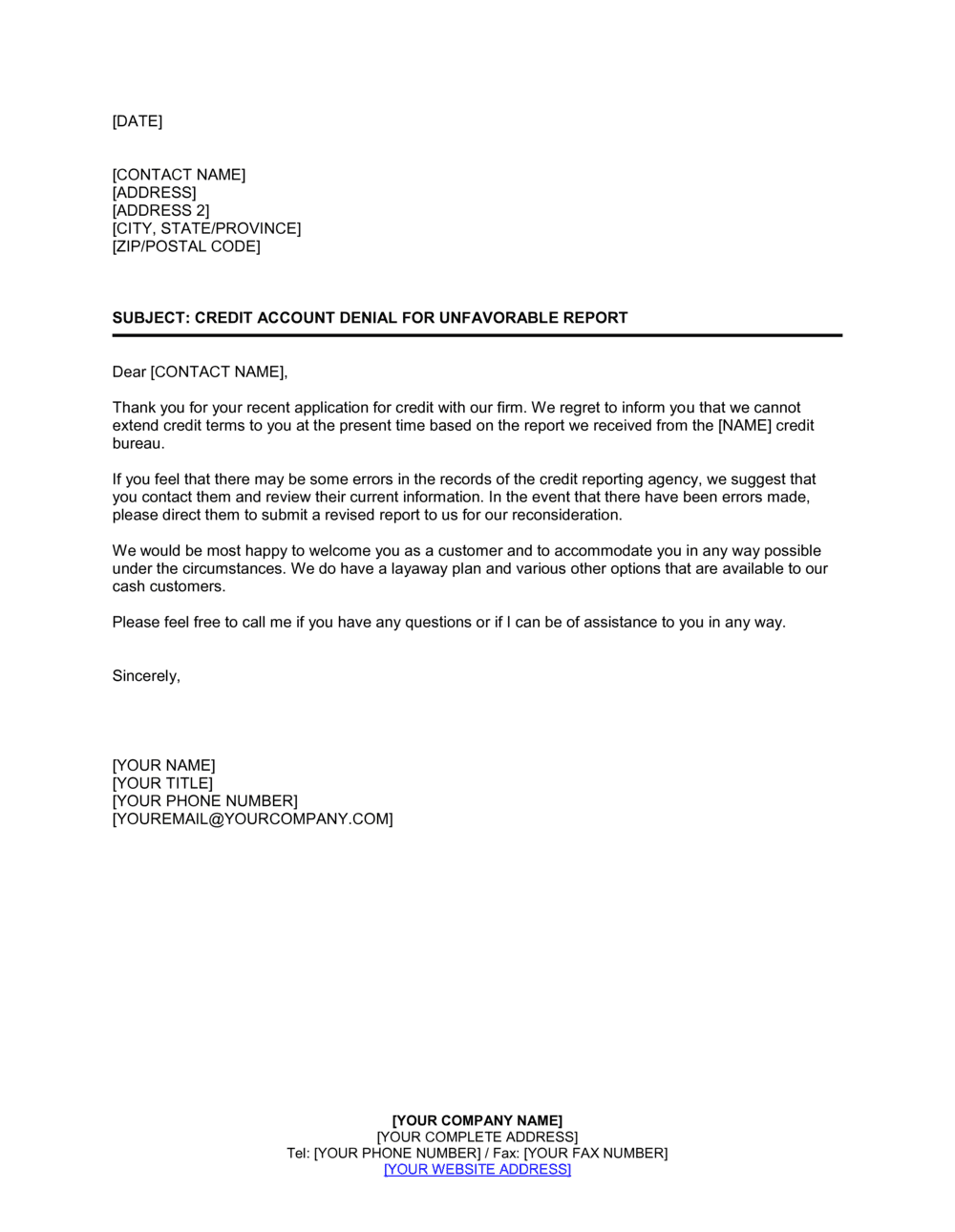
A Company Credit Account Denial for Unfavorable Report is a formal written notice a business sends to an applicant whose request for a credit account has been declined based on a negative finding in a consumer or commercial credit report. This free Word download gives you a structured, professional template you can edit online and export as PDF β€” covering the adverse action reason, the credit reporting agency used, and the applicant's rights to dispute the report.
When you need it
Issue this letter any time your company pulls a credit report as part of a credit account application review and the report results in a denial. It is particularly important when the decision is based β€” even in part β€” on third-party credit data, as disclosure obligations are triggered immediately upon that decision.
What's inside
Applicant and company identification, the denial decision and effective date, the specific unfavorable credit report finding that triggered the denial, the name and contact details of the reporting agency used, and a clear statement of the applicant's rights to obtain a free copy of the report and to dispute inaccurate information.

What is a Company Credit Account Denial for Unfavorable Report?

A Company Credit Account Denial for Unfavorable Report is a formal written notice a business sends to an applicant β€” individual or corporate β€” whose request to open a credit account has been refused because a review of their credit report returned negative findings. The letter specifies the exact reasons drawn from the report, identifies the credit reporting agency that provided the data, and informs the applicant of their right to obtain a free copy of the report and to dispute any inaccurate information. It functions simultaneously as a professional communication to the applicant and as a compliance record for the issuing company.

Why You Need This Document

Declining a credit application without a proper written notice exposes your business on two fronts: the applicant is left without the information they need to understand or contest the decision, and your company lacks a documented paper trail if the denial is later challenged. When a credit report influences a credit decision β€” even partially β€” the applicant is entitled to know which agency provided the data, what specific factors triggered the denial, and how to seek recourse. A vague verbal refusal or an undocumented email creates ambiguity about whether required disclosures were made and on what basis the decision rested. This template gives your credit and accounts receivable teams a consistent, professionally formatted letter they can complete in under ten minutes β€” reducing dispute escalations, protecting the company's compliance posture, and maintaining a clear audit trail for every denied application.

Which variant fits your situation?

If your situation is…Use this template
Denying a personal consumer credit application based on a credit bureau reportConsumer Credit Account Denial Letter
Denying credit due to insufficient credit history rather than a negative reportCredit Account Denial for Insufficient Credit History
Offering a reduced credit limit instead of a full denialCounter Credit Offer Letter
Placing an existing customer account on credit holdCredit Hold Notification Letter
Denying credit based on income verification or financial statement reviewCredit Denial for Financial Information
Requesting additional information before making a final credit decisionCredit Application Pending Letter
Approving credit with conditions such as a personal guarantee or depositConditional Credit Approval Letter

Common mistakes to avoid

❌ Vague denial reason citing only 'unfavorable report'

Why it matters: A denial that doesn't specify which factors in the report triggered the decision leaves the applicant unable to meaningfully dispute inaccuracies, and exposes the company to claims of non-disclosure.

Fix: List each specific reason code or finding from the credit report β€” e.g., 'delinquent account with [CREDITOR]' or 'collection action filed [DATE]' β€” so the applicant knows exactly what to address.

❌ Omitting the credit reporting agency's full contact details

Why it matters: The applicant has a right to contact the agency directly to obtain their report and dispute errors. Missing contact information makes it impossible for them to do so and is a standard disclosure gap.

Fix: Include the agency's full name, mailing address, phone number, and website in a dedicated section of every denial letter.

❌ Delaying the letter long after the denial decision was made

Why it matters: Adverse action notices are expected promptly after the credit decision β€” delays create ambiguity about whether the application was still under consideration and can generate regulatory scrutiny.

Fix: Establish an internal process to issue the denial letter within 3–5 business days of the credit decision, and log both the decision date and the send date separately.

❌ Guaranteeing future approval in the reapplication invitation

Why it matters: Stating 'you will be approved once you resolve X' creates a conditional promise the company may not be able to keep β€” credit conditions, company policy, or the applicant's circumstances may all change.

Fix: Use permissive language: 'You are welcome to reapply after [TIMEFRAME], and your application will be reviewed based on the information available at that time.'

❌ Sending the letter without a named signatory

Why it matters: An anonymous denial letter with no named contact makes follow-up difficult, signals impersonal handling, and often escalates into formal disputes that a quick conversation could have resolved.

Fix: Always include the full name, title, direct phone number, and email of the person authorized to answer questions about the decision.

❌ Failing to retain a copy of the denial letter and supporting credit report

Why it matters: Without a file copy, the company cannot demonstrate the basis for its decision if the applicant disputes the denial or alleges discriminatory treatment months later.

Fix: Archive the signed denial letter, the credit report pull, and the application in the applicant's account record and retain per your document retention policy β€” typically a minimum of 3 years.

The 9 key sections, explained

Header and date

Applicant identification

Denial decision statement

Reason for denial

Credit reporting agency disclosure

Applicant rights statement

Equal credit opportunity statement

Invitation to reapply

Closing and contact information

How to fill it out

  1. 1

    Enter your company's contact information in the header

    Add your company's full legal name, mailing address, phone number, and email to the top of the letter. Use the legal entity name β€” not just a brand or trade name.

    πŸ’‘ Pre-fill a master version of the template with your company details so staff only need to complete the applicant-specific fields for each denial.

  2. 2

    Identify the applicant and reference the application

    Enter the applicant's full legal name (and business name if applicable), the date they submitted their application, and any internal application reference number your system assigned.

    πŸ’‘ Cross-reference your CRM or accounts receivable system for the exact application date β€” discrepancies between your records and the letter date can create disputes.

  3. 3

    State the denial clearly with an effective date

    Use direct language confirming the denial decision. Avoid euphemisms. Include the date the decision was made or the date the letter is being issued.

    πŸ’‘ The effective date of the denial should match the date your credit team made the decision β€” not the date the letter is printed or mailed.

  4. 4

    List the specific reasons for denial

    Pull the specific reason codes or factors from the credit report and list them individually. Common reasons include delinquent accounts, high credit utilization, recent collections, or insufficient trade references.

    πŸ’‘ Use the standard reason code language from the credit bureau's report where possible β€” this reduces the risk of a dispute claiming the reason was vague or pretextual.

  5. 5

    Identify the credit reporting agency used

    Enter the full name, mailing address, phone number, and website of the agency that provided the report. If multiple agencies were used, list all of them.

    πŸ’‘ Confirm agency contact details against the agency's current website before sending β€” contact information changes and an incorrect address can leave the applicant unable to exercise their rights.

  6. 6

    Include the applicant rights and equal credit statements

    Ensure both the free-report entitlement language and the equal credit opportunity statement are present verbatim. These sections should not be edited or shortened.

    πŸ’‘ Do not paraphrase statutory disclosure language β€” standard template wording is specifically calibrated to meet disclosure requirements.

  7. 7

    Add an optional reapplication invitation and closing

    If your policy allows reapplication, include the suggested timeframe. Close with the name, title, and contact details of the person sending the letter.

    πŸ’‘ Use a named contact rather than a generic department address β€” applicants who can reach a real person are less likely to escalate to a complaint or dispute.

  8. 8

    Send within the required timeframe and retain a copy

    Issue the letter promptly after the denial decision is made. File a copy in the applicant's account record along with the credit report that supported the decision.

    πŸ’‘ Sending via tracked mail or email with read receipt creates a delivery record that is valuable if the applicant later claims they never received the notice.

Frequently asked questions

What is a credit account denial for unfavorable report?

A credit account denial for unfavorable report is a formal written notice a company sends to an applicant whose request for a credit account β€” such as net-30 or net-60 trade credit β€” has been declined because a credit report returned negative information. The letter identifies the reason for denial, the reporting agency used, and the applicant's rights to review and dispute the report. It serves both as a communication to the applicant and as a compliance record for the issuing company.

Is a credit denial letter legally required when a credit report is used?

In the United States, the Fair Credit Reporting Act (FCRA) requires creditors to provide an adverse action notice when a credit application is denied β€” in whole or in part β€” based on information in a consumer credit report. For commercial credit decisions based on business credit reports, the disclosure requirements vary but best practice is to issue a written denial in all cases. Consult applicable federal and state law or a compliance professional for your specific situation.

What information must a credit denial letter include?

A complete credit denial letter should include the applicant's name and application reference, a clear denial statement with an effective date, the specific reason or reasons for the denial drawn from the report, the name and full contact details of the credit reporting agency, the applicant's right to obtain a free copy of the report within 60 days, their right to dispute inaccurate information, and an equal credit opportunity statement. Omitting any of these elements creates a gap in the notice.

How quickly should a credit denial letter be sent after a decision?

Best practice is to issue the denial letter within 3 to 5 business days of the credit decision. Prompt issuance avoids ambiguity about whether the application was still under review, protects the company from claims of delayed disclosure, and gives the applicant the maximum time to seek alternatives or dispute the report data.

Can an applicant whose credit account was denied reapply?

Yes. A denial based on an unfavorable credit report is a point-in-time decision. The applicant may dispute inaccurate information with the reporting agency, allow time for negative items to age off, or pay down delinquent balances and then reapply. Including a clear reapplication invitation in the denial letter β€” with a suggested timeframe such as 6 months β€” is good business practice and often preserves a future customer relationship.

What is the difference between a consumer credit denial and a commercial credit denial?

A consumer credit denial relates to an individual's personal credit account application and is governed by the FCRA and the Equal Credit Opportunity Act. A commercial credit denial relates to a business entity applying for trade credit and is typically governed by a different regulatory framework, though many best-practice disclosure elements are the same. This template covers the commercial context β€” a business denying trade credit to another business β€” while also applying principles relevant to consumer-facing credit decisions.

Should the denial letter name the specific items on the credit report?

Yes. Vague references to an 'unfavorable report' are insufficient. The denial letter should list the specific reason codes or factors that drove the decision β€” such as delinquent accounts, recent collections, or excessive utilization β€” so the applicant knows precisely what information to investigate or dispute. Using the standard reason-code language from the reporting agency's output reduces ambiguity and strengthens the company's documentation.

How long should credit denial letters be retained?

Retain the denial letter, the credit report that supported the decision, and the original application together in the applicant's file for a minimum of 3 years, which aligns with the record-retention standard under the FCRA for adverse action notices. Some states and industries require longer retention periods β€” check applicable law and your internal document retention policy.

Can this letter be used for both sole traders and corporations?

Yes. The template is structured to accommodate both individual applicants and business entities by referencing the applicant's name alongside their business name where applicable. Adjust the salutation and identification fields to reflect whether the applicant is a person, a sole proprietor, a partnership, or a registered corporation to ensure the denial applies to the correct legal entity.

How this compares to alternatives

vs Credit Account Denial for Insufficient Credit History

A denial for insufficient credit history is issued when the applicant has too little credit data on file β€” not necessarily negative information β€” making it impossible to assess creditworthiness. The unfavorable report denial is used when negative information is present and specific. Both require disclosure of the reporting agency, but the reason language and remediation path differ significantly for the applicant.

vs Conditional Credit Approval Letter

A conditional approval letter extends credit on modified terms β€” such as a lower limit, a personal guarantee, or a security deposit β€” rather than refusing credit outright. Use the denial letter when the credit profile cannot support any form of credit account; use the conditional approval when the profile warrants credit with added protections. The conditional approval preserves the business relationship; the denial letter closes it cleanly.

vs Credit Hold Notification Letter

A credit hold notification applies to an existing active account that is being suspended due to overdue balances, deteriorating credit, or policy breach β€” the account relationship already exists. The denial letter is issued before any account is opened, rejecting the initial application. The two documents serve distinct stages of the credit lifecycle and should not be used interchangeably.

vs Debt Collection Letter

A debt collection letter is issued to an existing account holder who owes an outstanding balance and has failed to pay by the due date. The credit denial letter is issued before any credit is extended, to prevent an account from being opened. Using a denial letter to address an existing delinquent account β€” or vice versa β€” sends the wrong message and can confuse the legal standing of the correspondence.

Industry-specific considerations

Wholesale and Distribution

Wholesale distributors routinely extend net-30 or net-60 trade credit to retailer customers, making standardized credit denial letters essential for managing high application volumes efficiently.

Manufacturing

Manufacturers extending supplier credit to downstream buyers need documented denial processes to protect receivables and maintain compliance with credit reporting disclosure practices.

Professional Services

Accounting, legal, and consulting firms that offer deferred billing arrangements use credit denial letters when a new client's credit profile does not support an open account.

Retail and E-commerce

Retailers offering B2B trade accounts or installment-based purchasing for business customers issue denial letters when credit bureau checks return adverse results for corporate applicants.

Template vs pro β€” what fits your needs?

PathBest forCostTime
Use the templateSmall and mid-sized businesses issuing standard trade credit denials for straightforward adverse report findingsFree5–10 minutes per letter
Template + professional reviewBusinesses issuing high volumes of denials or operating in regulated industries where FCRA compliance is closely scrutinized$200–$500 for a compliance or legal review of your standard letter and process1–3 days for a one-time review
Custom draftedFinancial institutions, lenders, or companies with complex credit products requiring fully customized adverse action workflows$500–$2,000+ for a compliance attorney or credit policy consultant1–2 weeks

Glossary

Adverse Action Notice
A written notification required when a credit application is denied in whole or in part based on information from a consumer or commercial credit report.
Credit Reporting Agency (CRA)
A company that collects and maintains credit history data and provides credit reports to creditors β€” examples include Experian, Equifax, TransUnion, and Dun & Bradstreet.
Unfavorable Credit Report
A credit report containing negative information β€” such as late payments, high utilization, collections, or defaults β€” that led a creditor to deny a credit application.
FCRA (Fair Credit Reporting Act)
A US federal law governing how consumer credit information is collected, shared, and used β€” including mandatory disclosure requirements when a credit decision is based on a report.
Trade Credit
A B2B arrangement in which a supplier allows a customer to purchase goods or services and pay at a later date, typically on net-30, net-60, or net-90 terms.
Net Terms
Payment terms on a trade credit account specifying the number of days after invoice date by which full payment is due β€” e.g., net-30 means payment is due 30 days from invoice.
Credit Limit
The maximum outstanding balance a creditor is willing to extend to a credit account holder at any one time.
Dispute Rights
A credit applicant's legal right to contact the reporting agency that supplied the adverse report, obtain a free copy, and challenge any inaccurate or incomplete information.
Commercial Credit Report
A report on a business entity's creditworthiness, including payment history with suppliers, public filings, and financial data β€” distinct from a personal consumer credit report.
Credit Application
A formal request submitted by a business or individual to a creditor asking to open a credit account or line, typically including financial and identifying information.

Part of your Business Operating System

This document is one of 3,000+ business & legal templates included in Business in a Box.

  • Fill-in-the-blanks β€” ready in minutes
  • 100% customizable Word document
  • Compatible with all office suites
  • Export to PDF and share electronically

Create your document in 3 simple steps.

From template to signed document β€” all inside one Business Operating System.
1
Download or open template

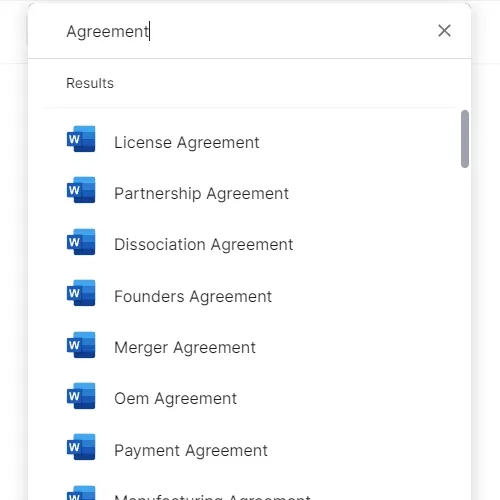
Access over 3,000+ business and legal templates for any business task, project or initiative.

2
Edit and fill in the blanks with AI

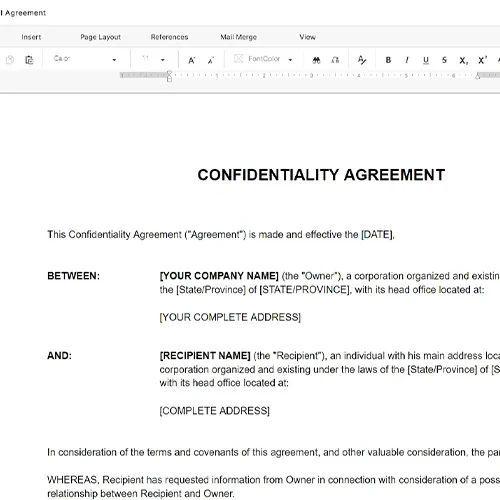
Customize your ready-made business document template and save it in the cloud.

3
Save, Share, Send, Sign

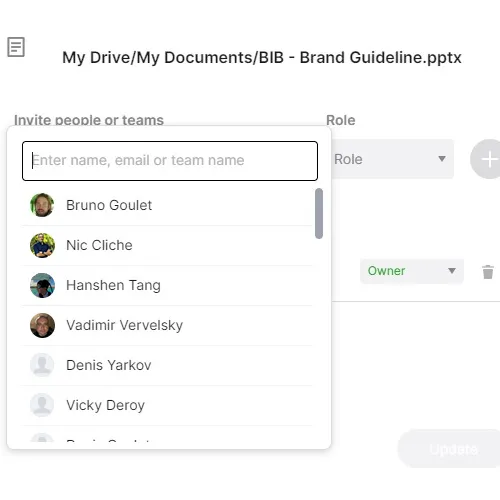
Share your files and folders with your team. Create a space of seamless collaboration.

Save time, save money, and create top-quality documents.

β˜…β˜…β˜…β˜…β˜…

"Fantastic value! I'm not sure how I'd do without it. It's worth its weight in gold and paid back for itself many times."

Managing Director Β· Mall Farm
Robert Whalley
Managing Director, Mall Farm Proprietary Limited
β˜…β˜…β˜…β˜…β˜…

"I have been using Business in a Box for years. It has been the most useful source of templates I have encountered. I recommend it to anyone."

Business Owner Β· 4+ years
Dr Michael John Freestone
Business Owner
β˜…β˜…β˜…β˜…β˜…

"It has been a life saver so many times I have lost count. Business in a Box has saved me so much time and as you know, time is money."

Owner Β· Upstate Web
David G. Moore Jr.
Owner, Upstate Web

Run your business with a system β€” not scattered tools

Stop downloading documents. Start operating with clarity. Business in a Box gives you the Business Operating System used by over 250,000 companies worldwide to structure, run, and grow their business.

Free Forever PlanΒ Β·Β No credit card required