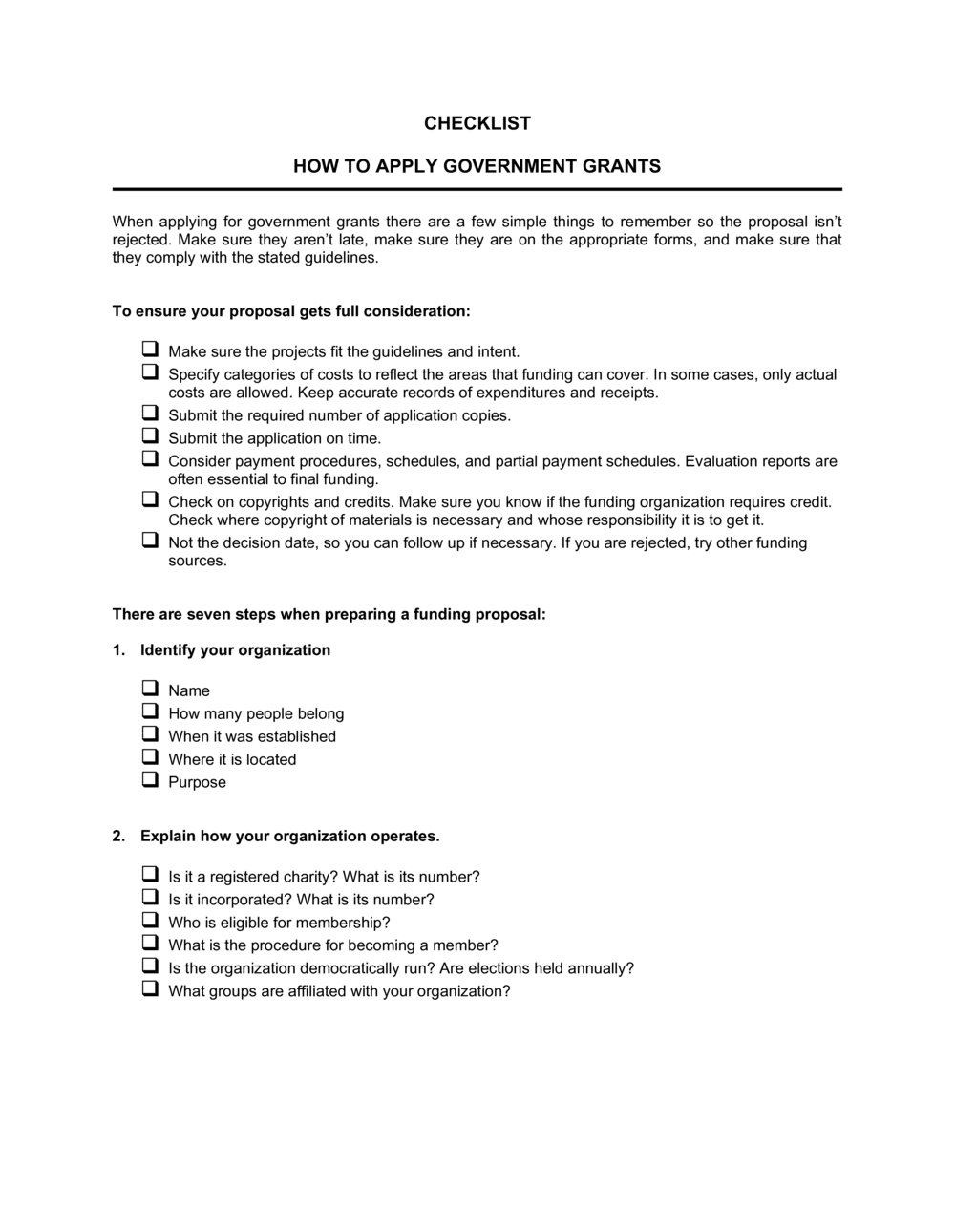
Checklist How to Apply Government Grants

Free download β€’ Use as a template β€’ Print or share

2 pagesβ€’20–25 min to useβ€’Difficulty: Standard
Learn more ↓
FreeChecklist How to Apply Government Grants Template

At a glance

What it is
A Government Grant Application Checklist is a structured form that guides applicants through every step required to successfully apply for public funding β€” from confirming eligibility to submitting final documents. This free Word download lets you customize the checklist for any federal, state, or local grant program, track completion status for each item, and share it with team members or advisors involved in the application process.
When you need it
Use it as soon as you identify a grant opportunity you intend to pursue. Starting the checklist early surfaces missing documents, eligibility gaps, and hard deadlines before they become last-minute crises.
What's inside
Eligibility verification steps, required business and financial documents, narrative and proposal preparation tasks, supporting materials, submission requirements, and post-submission follow-up actions β€” each with a status column and deadline field.

What is a Government Grant Application Checklist?

A Government Grant Application Checklist is a structured form that guides individuals and organizations through every required step of applying for public funding β€” from confirming eligibility and completing mandatory registrations to assembling supporting documents, preparing a project narrative, and submitting the final package before the deadline. Unlike a general to-do list, a grant checklist maps directly to the specific requirements published in a Notice of Funding Opportunity (NOFO), giving each task an owner, a status, and a deadline. It works equally well for federal, state, and local grant programs across industries.

Why You Need This Document

Government grant applications are disqualified for process failures as often as for weak proposals β€” an expired SAM.gov registration, a missing attachment, or a submission that arrives 10 minutes after the portal closes are all fatal errors that no amount of strong narrative can fix. Without a systematic checklist, teams rely on memory and email threads to track dozens of interdependent tasks across weeks of preparation, and critical steps fall through the gaps. A completed checklist also creates an audit trail showing the agency β€” and your own leadership β€” that the application was prepared responsibly. This template gives you a proven structure you can adapt to any grant program in minutes, so the time you have goes into writing a competitive application rather than reconstructing the requirements from scratch.

Which variant fits your situation?

If your situation is…Use this template
Applying for a federal small business grant (e.g., SBA, USDA)Checklist How To Apply Government Grants
Applying for a state or municipal economic development grantChecklist How To Apply Government Grants
Preparing a full grant proposal narrativeGrant Proposal Template
Tracking multiple grant opportunities in a pipelineGrant Tracking Log
Applying for nonprofit program fundingNonprofit Grant Application
Submitting a research or innovation grant (e.g., SBIR/STTR)SBIR/STTR Application Checklist
Reporting outcomes after a grant has been awardedGrant Progress Report

Common mistakes to avoid

❌ Letting SAM.gov registration lapse before submission

Why it matters: An expired SAM registration blocks submission on Grants.gov regardless of how complete the application package is. The agency cannot accept the application after the deadline.

Fix: Set a calendar reminder 30 days before your SAM.gov annual renewal date and check registration status at the start of every new application.

❌ Submitting at the deadline without a time buffer

Why it matters: Portal validation errors, file size rejections, and system outages occur most frequently in the final hours before a deadline, when server load peaks. Errors cannot be corrected after the deadline passes.

Fix: Set an internal submission deadline 48 hours before the official cutoff and treat it as non-negotiable.

❌ Including unallowable costs in the budget

Why it matters: Each NOFO specifies which cost categories are ineligible β€” lobbying, entertainment, and certain equipment purchases are commonly excluded. An unallowable line item can trigger disqualification or a reduced award.

Fix: Read the 'Allowable Costs' section of the NOFO before building the budget, and flag any line item that is not explicitly permitted.

❌ Assuming eligibility without reading the full NOFO

Why it matters: Program summaries and agency websites often omit specific restrictions buried in the NOFO β€” geographic limitations, ownership minimums, or prior-award exclusions that disqualify the application.

Fix: Read every section of the NOFO, not just the overview, and document how your organization meets each eligibility criterion before investing time in the full application.

The 9 key fields, explained

Grant program identification

Key dates and deadlines

Eligibility confirmation

Required registrations and accounts

Required business documents

Project narrative and proposal sections

Budget and financial documentation

Supporting materials and attachments

Submission checklist and confirmation

How to fill it out

  1. 1

    Enter the grant program details at the top

    Record the official program name, issuing agency, NOFO number, and program URL in the header section. These identifiers anchor every task on the checklist to the correct opportunity.

    πŸ’‘ Bookmark the official NOFO page directly β€” program summaries on third-party sites are sometimes outdated or incomplete.

  2. 2

    Enter all key dates and calculate lead times

    Fill in the submission deadline, SAM.gov renewal date, and any pre-application registration cutoffs. Work backward from the submission deadline to set internal due dates for each checklist section.

    πŸ’‘ Add a 48-hour buffer before the submission deadline as your internal cutoff β€” portal errors on the last day have disqualified otherwise complete applications.

  3. 3

    Confirm eligibility before investing further time

    Read the full NOFO eligibility section β€” not a program summary β€” and check each criterion against your organization's actual profile. Mark any criterion that requires verification before proceeding.

    πŸ’‘ If any eligibility item is unclear, contact the program officer listed in the NOFO before you write a single word of the narrative.

  4. 4

    Verify and renew required registrations

    Check SAM.gov registration status and expiry date, confirm your Grants.gov or state portal account is active, and initiate any renewals needed. Allow 7–10 business days for SAM.gov activations.

    πŸ’‘ Store portal usernames and passwords in a shared, secure location β€” grant applications frequently involve multiple team members needing access.

  5. 5

    Collect and format required business documents

    Gather each document listed in the NOFO, confirm it meets the required format (PDF, certified, dated within 12 months), and save files using the naming convention specified in the instructions.

    πŸ’‘ Create a dedicated folder for each grant opportunity and save the NOFO itself alongside the documents β€” you will reference it repeatedly during preparation.

  6. 6

    Assign narrative sections and track word limits

    Divide the project narrative into its required sections, assign a writer or owner for each, and note the page or word limit per section. Track draft completion status for each component separately.

    πŸ’‘ Write each narrative section against the scoring criteria in the NOFO β€” reviewers score against those criteria, so structure your response to mirror them.

  7. 7

    Complete the budget and gather matching fund documentation

    Fill in the line-item budget form using only allowable cost categories from the NOFO. Attach written documentation for any matching funds β€” a commitment letter from the funding source is standard.

    πŸ’‘ Have a financial officer review the budget narrative before submission β€” mismatches between the budget form totals and narrative descriptions are a common source of point deductions.

  8. 8

    Submit and record the confirmation number

    Complete the final pre-submission review, submit the full application package, and immediately save the confirmation number and timestamp to the checklist and to a backup location.

    πŸ’‘ Take a screenshot of the submission confirmation page β€” email confirmations sometimes go to spam, and the screenshot is your proof of timely submission if a dispute arises.

Frequently asked questions

What is a government grant application checklist?

A government grant application checklist is a structured form that breaks the grant application process into discrete, trackable tasks β€” eligibility verification, document collection, narrative preparation, budget completion, and submission steps. It ensures nothing is missed before a deadline and provides a shared reference for everyone involved in the application. Using one consistently reduces errors and cuts the time spent coordinating across team members.

What documents are typically required for a government grant application?

Most federal and state grant applications require proof of legal entity status (articles of incorporation), an IRS EIN confirmation letter, the most recent two to three years of federal tax returns or audited financial statements, a current business license, and evidence of any ownership certifications claimed (e.g., woman-owned, veteran-owned). Specific programs add requirements β€” check the NOFO for the exact list.

How early should I start a government grant application?

Start at least 60 days before the submission deadline for most federal grants β€” 90 days for complex programs like SBIR or USDA Rural Development. SAM.gov registration alone can take 7–10 business days. Document gathering, narrative drafting, and internal budget reviews routinely take longer than applicants expect. Applications started less than two weeks before the deadline are frequently incomplete or contain errors.

Do I need to register on SAM.gov to apply for a federal grant?

Yes. All entities applying for US federal grants must have an active SAM.gov registration with a current Unique Entity Identifier (UEI). Registration must be renewed annually. An expired registration blocks submission on Grants.gov and cannot be resolved after the application deadline. Initiate or renew your SAM.gov registration as the first step in any federal grant application process.

What is matching funds and do all grants require it?

Matching funds (also called cost share) require the applicant to contribute a portion of the total project cost from non-federal sources. Not all grants require matching funds β€” many federal programs for small businesses and nonprofits do not. When matching is required, it is expressed as a percentage of the award amount and must be documented with commitment letters or internal budget approvals at the time of application.

Can I apply for multiple government grants at the same time?

Yes, and many businesses do. Each application is independent, but some programs prohibit using the same project or the same dollar of matching funds for two simultaneous federal awards β€” read the terms of each NOFO. Using a separate checklist for each opportunity keeps requirements, deadlines, and documents from becoming confused across applications.

What happens after I submit a government grant application?

After submission, the agency validates your application for completeness and eligibility, then reviewers score it against the criteria in the NOFO. Award decisions typically take 3–6 months. You may receive a request for clarification during review. If awarded, you will sign a grant agreement and receive instructions for the period of performance and reporting. If not awarded, many agencies will provide reviewer scores and comments on request.

Is a grant checklist useful for state and local grants too?

Yes. State and local grant programs have their own portals, eligibility requirements, and document lists, but the preparation process follows the same structure as federal grants. The same checklist template works for any program β€” simply replace federal-specific fields (SAM.gov, SF-424) with the state portal and form equivalents. Many state programs are less competitive than federal ones, making them a strong starting point for first-time applicants.

How this compares to alternatives

vs Grant Proposal Template

A grant proposal is the full written narrative submitted to the funding agency β€” it makes the case for your project and budget. A grant application checklist is the organizational tool used to prepare and track all the components that go into that submission, including the proposal itself. Use the checklist to manage the process and the proposal template to write the narrative.

vs Business Plan Template

A business plan documents your overall company strategy, market, and financials for investors or lenders. Many grant applications require a business plan as an attachment, but the grant checklist tracks the specific documents, registrations, and narrative sections the funding agency requires β€” it is a submission management tool, not a strategic document.

vs Project Plan Template

A project plan outlines the tasks, milestones, and resources needed to execute a specific initiative. A grant application checklist focuses specifically on the pre-submission steps required to apply for funding for that initiative. Once the grant is awarded, a project plan becomes the operational tool for delivering the funded work.

vs Grant Tracking Log

A grant tracking log manages a pipeline of multiple grant opportunities β€” recording program names, award amounts, deadlines, and application status across many programs at once. A grant application checklist goes deeper on a single application, breaking every preparation task into trackable steps. Use both: the log for pipeline visibility, the checklist for execution on each individual opportunity.

Industry-specific considerations

Manufacturing

Federal and state manufacturing grants often require detailed equipment cost breakdowns, job creation projections, and Buy American certifications in the application package.

Technology / SaaS

SBIR and STTR programs require technical abstracts, IP ownership documentation, and evidence of commercial potential alongside the standard application package.

Agriculture and Food Production

USDA grant programs require farm registration numbers, land ownership or lease documentation, and conservation practice plans specific to each funding program.

Nonprofit / Social Services

Federal nonprofit grants typically require IRS 501(c)(3) determination letters, board member lists, and a logic model linking program activities to measurable community outcomes.

Template vs pro β€” what fits your needs?

PathBest forCostTime
Use the templateSmall businesses, startups, and nonprofits managing grant applications in-houseFree15 minutes to set up per grant opportunity
Template + professional reviewFirst-time applicants or organizations pursuing competitive federal programs$200–$500 for a grant consultant review session1–2 days
Custom draftedOrganizations applying for multiple large federal grants simultaneously or SBIR/STTR programs$1,000–$5,000 for a professional grant writer2–6 weeks

Glossary

Grant Eligibility
The set of criteria β€” business type, size, industry, location, or ownership profile β€” an applicant must meet before a grant application will be considered.
DUNS Number / SAM UEI
A unique identifier required to apply for most US federal grants; the legacy DUNS number has been replaced by the SAM Unique Entity Identifier (UEI) on SAM.gov.
Notice of Funding Opportunity (NOFO)
The official announcement from a grant-making agency describing eligibility, award amounts, application requirements, and deadlines.
Matching Funds
A portion of the project cost the applicant must contribute from non-federal sources, often expressed as a percentage of the total grant amount.
Indirect Costs
Overhead expenses β€” rent, utilities, administrative staff β€” not directly tied to the grant project but allocable to it under an approved indirect cost rate.
Project Narrative
The written section of a grant application that describes the problem, proposed solution, methodology, timeline, and expected outcomes.
Letters of Support
Written endorsements from partner organizations, community groups, or stakeholders submitted with the application to demonstrate collaboration or need.
SAM.gov Registration
The federal System for Award Management registration that all entities must complete and keep active to receive US federal grants or contracts.
Period of Performance
The defined start and end dates during which grant funds may be spent and project activities must occur.
Closeout Report
A final report submitted to the granting agency after the period of performance ends, documenting outcomes achieved and funds expended.

Part of your Business Operating System

This document is one of 3,000+ business & legal templates included in Business in a Box.

  • Fill-in-the-blanks β€” ready in minutes
  • 100% customizable Word document
  • Compatible with all office suites
  • Export to PDF and share electronically

Create your document in 3 simple steps.

From template to signed document β€” all inside one Business Operating System.
1
Download or open template

Access over 3,000+ business and legal templates for any business task, project or initiative.

2
Edit and fill in the blanks with AI

Customize your ready-made business document template and save it in the cloud.

3
Save, Share, Send, Sign

Share your files and folders with your team. Create a space of seamless collaboration.

Save time, save money, and create top-quality documents.

β˜…β˜…β˜…β˜…β˜…

"Fantastic value! I'm not sure how I'd do without it. It's worth its weight in gold and paid back for itself many times."

Managing Director Β· Mall Farm
Robert Whalley
Managing Director, Mall Farm Proprietary Limited
β˜…β˜…β˜…β˜…β˜…

"I have been using Business in a Box for years. It has been the most useful source of templates I have encountered. I recommend it to anyone."

Business Owner Β· 4+ years
Dr Michael John Freestone
Business Owner
β˜…β˜…β˜…β˜…β˜…

"It has been a life saver so many times I have lost count. Business in a Box has saved me so much time and as you know, time is money."

Owner Β· Upstate Web
David G. Moore Jr.
Owner, Upstate Web

Run your business with a system β€” not scattered tools

Stop downloading documents. Start operating with clarity. Business in a Box gives you the Business Operating System used by over 250,000 companies worldwide to structure, run, and grow their business.

Free Forever PlanΒ Β·Β No credit card required