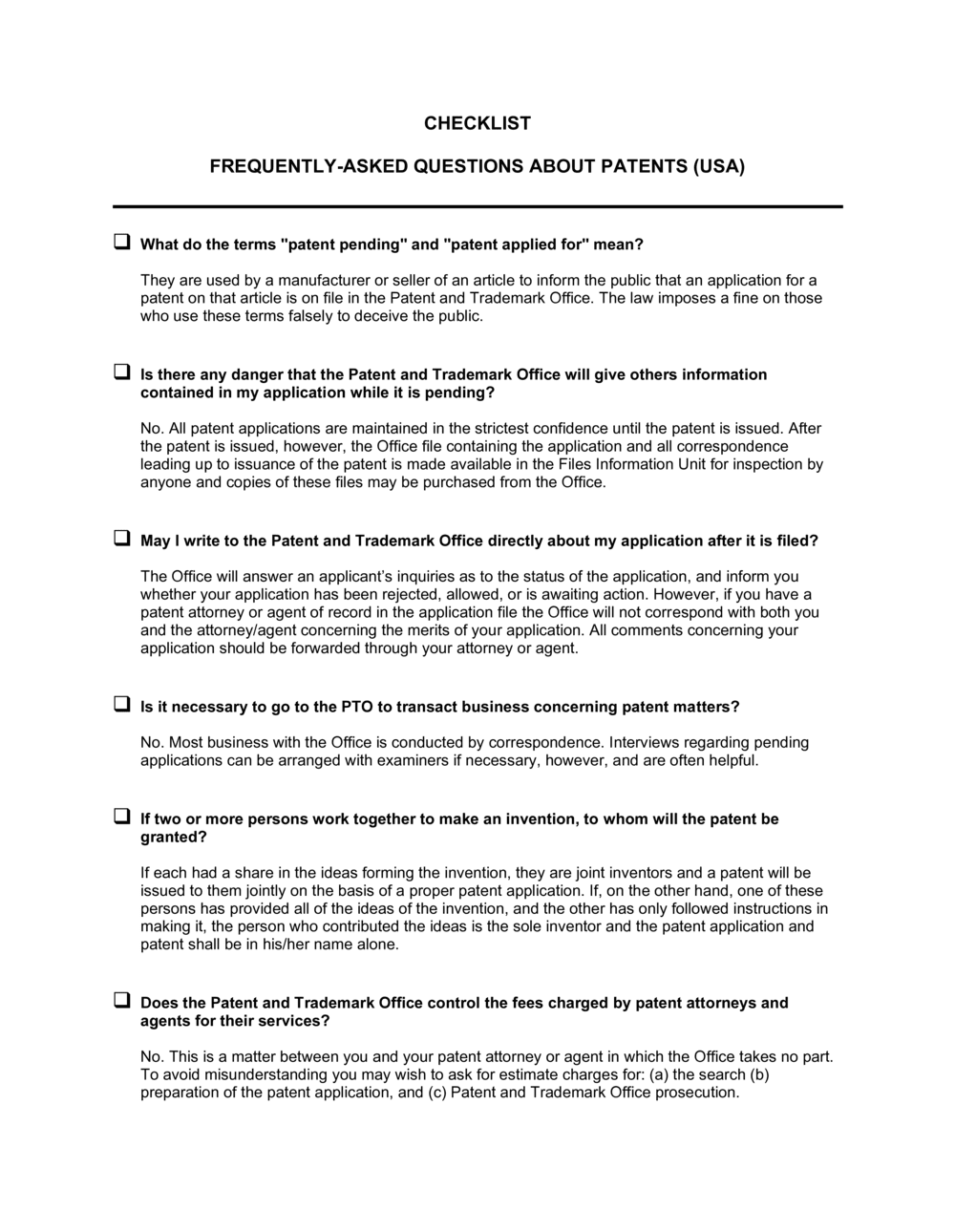
Checklist FAQ About Patents

Free download β€’ Use as a template β€’ Print or share

2 pagesβ€’20–25 min to useβ€’Difficulty: Standard
Learn more ↓
FreeChecklist FAQ About Patents Template

At a glance

What it is
A Checklist FAQ About Patents is a structured reference document that organizes the most common patent questions β€” covering invention eligibility, application types, costs, timelines, and enforcement β€” into a scannable checklist format. This free Word download lets you edit, brand, and distribute it to employees, inventors, or stakeholders who need a plain- English orientation to the patent process before engaging a patent attorney.
When you need it
Use it when onboarding inventors to your IP program, briefing a non-technical leadership team on patent strategy, or preparing internal staff to identify and disclose patentable inventions before they are publicly disclosed or shipped in a product.
What's inside
Sections covering what a patent is and what it protects, patentability criteria, types of patents, the application process, cost estimates, prosecution timelines, maintenance obligations, and enforcement basics β€” each formatted as a checked FAQ item with a concise answer.

What is a Checklist FAQ About Patents?

A Checklist FAQ About Patents is a structured reference document that organizes the most common patent questions β€” covering what a patent protects, how to determine patentability, application types, filing timelines, cost estimates, and enforcement basics β€” into a scannable checklist format with concise, plain-English answers. It is designed to educate inventors, engineers, and business stakeholders on the patent process before they engage a patent attorney, ensuring they understand their disclosure obligations, pre-filing restrictions, and realistic expectations for cost and timeline. The document is not legal advice β€” it is an orientation tool that bridges the gap between having an invention and knowing what to do with it.

Why You Need This Document

Without a structured patent FAQ, inventors on your team routinely make costly mistakes before a single application is filed: they present at a conference before filing a provisional, post details on LinkedIn, or ship a product containing an unprotected process β€” permanently eliminating foreign patent rights in every absolute-novelty jurisdiction. The FAQ checklist closes that gap by putting the right information in front of inventors before public disclosure events occur. It also reduces the billable time inventors consume in initial attorney consultations answering basic process questions, letting those meetings focus on the substance of the invention itself. This template gives you a professionally formatted, immediately distributable resource you can brand, customize for your jurisdiction, and integrate into your product-launch or IP onboarding workflow in under an hour.

Which variant fits your situation?

If your situation is…Use this template
Capturing details of a specific invention for attorney reviewInvention Disclosure Form
Tracking the status of multiple patent applications across a portfolioPatent Tracking Log
Assigning patent ownership from an inventor to a companyPatent Assignment Agreement
Sharing confidential invention details with a third party before filingNon-Disclosure Agreement
Licensing an existing patent to another company for royaltiesPatent License Agreement
Documenting IP ownership terms for a new employee or contractorIP Assignment Clause / Employment Contract

Common mistakes to avoid

❌ Distributing the checklist after a public disclosure

Why it matters: Once an invention is publicly disclosed, most foreign patent rights are permanently lost. The US 12-month grace period does not help in the EU, Japan, China, or most other markets.

Fix: Integrate the checklist into your product development and publication approval workflows so inventors review it before any external event.

❌ Leaving placeholder cost figures unchanged

Why it matters: Outdated fee estimates cause inventors to dismiss patent protection as too expensive or, conversely, to budget too little and get surprised by prosecution costs.

Fix: Update the cost FAQ item against current USPTO fee schedules and get a written fee estimate from your patent counsel before distributing.

❌ Using the checklist as a substitute for legal advice

Why it matters: Inventors who treat the FAQ answers as definitive legal guidance may skip attorney consultation on borderline patentability questions, leading to wasted filing fees or missed protection.

Fix: Add a visible disclaimer that the checklist is an educational orientation tool and that specific inventions require review by a registered patent attorney or agent.

❌ Omitting jurisdiction-specific guidance for international teams

Why it matters: An inventor in Germany who reads US grace-period rules and assumes they apply locally may publicly disclose an invention that can never be patented in Europe.

Fix: Flag every jurisdiction-specific item clearly and provide a separate one-page addendum for your most common non-US locations.

The 9 key fields, explained

What is a patent and what does it protect?

Is my invention patentable?

What type of patent do I need?

Should I file a provisional or non-provisional application?

What does the patent application process look like?

How much does a patent cost?

What should I do β€” and not do β€” before filing?

Can I enforce my patent and what does infringement mean?

Do I need to maintain my patent after it is granted?

How to fill it out

  1. 1

    Add your company name and branding

    Replace the placeholder company name and logo in the header with your organization's details so the checklist is recognizable as an internal or client-facing document.

    πŸ’‘ Save a branded master copy so every inventor who receives it sees a professional, consistent document β€” not a generic template.

  2. 2

    Review and customize the FAQ answers for your jurisdiction

    The default answers reflect US patent law. If your inventors operate in the EU, Canada, or other jurisdictions, update fee figures, timelines, and grace-period rules to match local practice.

    πŸ’‘ Tag jurisdiction-specific items with a visible label (e.g., '[US only]') so international inventors know which answers to verify with local counsel.

  3. 3

    Update cost and timeline figures to current rates

    USPTO filing fees and attorney rates change periodically. Verify current official fees at the USPTO fee schedule page before distributing and update the cost FAQ item accordingly.

    πŸ’‘ Add the date the figures were last verified at the bottom of the checklist β€” this prevents stale numbers from misleading inventors.

  4. 4

    Add your internal disclosure and escalation contacts

    Insert the name, email, and role of your IP coordinator or patent counsel in the checklist footer or a dedicated 'next steps' section so inventors know exactly who to contact.

    πŸ’‘ A named contact reduces the most common delay: inventors who are ready to disclose but don't know where to send the information.

  5. 5

    Distribute before β€” not after β€” public disclosure events

    Send the checklist to engineers, researchers, and product managers at least 30 days before any external conference, product launch, or publication submission deadline.

    πŸ’‘ Tie distribution to your product-launch approval workflow so no product ships without inventors reviewing the pre-filing dos and don'ts section.

  6. 6

    Archive a signed acknowledgment from each recipient

    Add a one-line acknowledgment at the bottom β€” 'I have read and understood this checklist' β€” and ask recipients to return a signed copy. Keep signed copies in your IP records.

    πŸ’‘ A signed acknowledgment creates a record that inventors were informed of their disclosure obligations, which matters if an undisclosed invention becomes a dispute later.

Frequently asked questions

What is a checklist FAQ about patents?

A checklist FAQ about patents is a structured document that compiles the most common patent questions β€” covering eligibility, application types, costs, timelines, and enforcement β€” into a checklist format that inventors and business stakeholders can work through systematically. It serves as a plain-English orientation resource before engaging a patent attorney, helping inventors arrive at consultations better prepared and with fewer basic questions to resolve at billable rates.

Who should receive this checklist?

Any employee, researcher, or contractor who may create patentable inventions in the course of their work should receive this checklist as part of their IP onboarding. R&D teams, product managers, and engineers are the primary audience. It is also useful for founders considering whether to file before a product launch or funding round.

Does completing this checklist mean my invention is patentable?

No. The checklist provides a general framework for evaluating patentability criteria β€” novelty, non-obviousness, and utility β€” but determining whether a specific invention qualifies for patent protection requires a prior art search and review by a registered patent attorney or patent agent. Use the checklist to prepare for that conversation, not to replace it.

What is the difference between a provisional and a non-provisional patent application?

A provisional application is an informal USPTO filing that establishes a priority date for 12 months at a lower cost, but it is never examined and does not mature into a patent on its own. A non-provisional application is the formal filing that enters examination and, if approved, becomes an issued patent. Inventors must file a non-provisional within 12 months of the provisional or lose the priority date entirely.

How long does it take to get a US patent?

The average time from non-provisional filing to first office action is 12–18 months. Total time from filing to grant typically runs 2–3 years for utility patents, though USPTO Track One prioritized examination can reduce this to 6–12 months for an additional fee. Design patents generally grant faster, averaging 18–24 months.

Can I lose my patent rights by talking about my invention publicly?

In the US, you have a 12-month grace period after a public disclosure to file a patent application without losing domestic rights. However, most other countries β€” including all EU member states, China, Japan, and Canada β€” require absolute novelty, meaning any public disclosure before filing permanently eliminates patent protection in those markets. File before disclosing whenever international protection is a priority.

Is a patent the only way to protect an invention?

No. Trade secrets protect confidential technical information indefinitely as long as secrecy is maintained β€” useful for processes that cannot be reverse-engineered. Copyrights protect original expression such as software code. Design patents protect ornamental appearance. The right strategy depends on whether the invention can be kept secret, how long protection is needed, and in which markets the invention will be commercialized.

How much does it cost to get a US utility patent?

A full US utility patent typically costs $15,000–$30,000 from initial filing through grant, including attorney fees for drafting, prosecution, and responding to office actions. USPTO filing fees alone range from $800 to $1,600 depending on entity size. Maintenance fees of roughly $900–$7,700 at three intervals keep the patent in force for the full 20-year term, adding $5,000–$15,000 over the patent's life.

How this compares to alternatives

vs Invention Disclosure Form

An invention disclosure form captures the technical details of a specific invention β€” conception date, inventors, drawings, and prior art knowledge β€” for attorney review. The patent FAQ checklist is an educational orientation document that prepares inventors to complete a disclosure form accurately. Use the checklist first, then the disclosure form for each specific invention.

vs Non-Disclosure Agreement

An NDA protects confidential information shared with third parties before a patent is filed β€” it does not replace filing. The patent FAQ checklist explains when an NDA is an appropriate pre-filing safeguard versus when a provisional application is the better protection. Both are often used together in early-stage discussions with potential partners or investors.

vs Patent Assignment Agreement

A patent assignment agreement legally transfers ownership of an issued patent or patent application from an inventor to a company. The FAQ checklist helps inventors understand why assignment is typically required as a condition of employment or contract before they are asked to sign an assignment. The checklist is educational; the assignment is the binding legal instrument.

vs IP Policy / Employee Handbook Section

An employee handbook IP policy sets out the company's ownership rules for inventions created by employees. The patent FAQ checklist is a standalone, plain-English educational supplement that explains the patent process itself β€” it complements the policy but does not replace it. Distribute both together during onboarding for maximum effectiveness.

Industry-specific considerations

Technology / SaaS

Engineers and product teams need clear guidance on when software features, algorithms, and system architectures cross the threshold into patentable subject matter under Alice/Mayo doctrine.

Manufacturing

Process improvements and novel machine designs are frequently patentable, but manufacturing teams often lack awareness of disclosure obligations before shipping new product lines.

Healthcare / MedTech

Medical device and pharmaceutical inventors must understand both utility and design patent options, plus the interaction of patent term with FDA approval timelines and patent term extension eligibility.

Professional Services

Consulting and engineering firms that develop proprietary methodologies or software tools for clients need this checklist to clarify IP ownership before project agreements are signed.

Template vs pro β€” what fits your needs?

PathBest forCostTime
Use the templateCompanies distributing a patent orientation resource to inventors, engineers, or non-legal staffFree30 minutes to customize and distribute
Template + professional reviewOrganizations adding jurisdiction-specific guidance or integrating the checklist into a formal IP program$300–$800 for a patent attorney review and localization2–5 business days
Custom draftedLarge R&D organizations requiring a tailored IP education program with jurisdiction-specific modules and legal sign-off$1,500–$5,000+2–4 weeks

Glossary

Patent
A government-granted exclusive right to make, use, and sell an invention for a defined period in exchange for public disclosure of how the invention works.
Utility Patent
The most common patent type, protecting the functional aspects of a new and useful process, machine, article of manufacture, or composition of matter.
Provisional Patent Application
A lower-cost, informal USPTO filing that establishes a priority date for 12 months without being examined β€” it does not mature into a patent on its own.
Prior Art
Any publicly available evidence β€” patents, publications, products, or public disclosures β€” that predates the claimed invention and can be used to challenge its novelty.
Patentability
The set of legal criteria an invention must satisfy to qualify for patent protection: novelty, non-obviousness, and utility.
Claims
The numbered sentences at the end of a patent application that legally define the exact scope of the invention being protected.
USPTO
The United States Patent and Trademark Office β€” the federal agency that examines and grants US patents.
Patent Prosecution
The back-and-forth process between a patent applicant and the USPTO examiner, including responding to office actions, that leads to a patent being granted or abandoned.
Non-Obviousness
A patentability requirement that the invention must not have been an obvious next step to a person with ordinary skill in the relevant field at the time it was made.
Maintenance Fees
Periodic fees paid to the USPTO at 3.5, 7.5, and 11.5 years after grant to keep a utility patent in force for its full 20-year term.

Part of your Business Operating System

This document is one of 3,000+ business & legal templates included in Business in a Box.

  • Fill-in-the-blanks β€” ready in minutes
  • 100% customizable Word document
  • Compatible with all office suites
  • Export to PDF and share electronically

Create your document in 3 simple steps.

From template to signed document β€” all inside one Business Operating System.
1
Download or open template

Access over 3,000+ business and legal templates for any business task, project or initiative.

2
Edit and fill in the blanks with AI

Customize your ready-made business document template and save it in the cloud.

3
Save, Share, Send, Sign

Share your files and folders with your team. Create a space of seamless collaboration.

Save time, save money, and create top-quality documents.

β˜…β˜…β˜…β˜…β˜…

"Fantastic value! I'm not sure how I'd do without it. It's worth its weight in gold and paid back for itself many times."

Managing Director Β· Mall Farm
Robert Whalley
Managing Director, Mall Farm Proprietary Limited
β˜…β˜…β˜…β˜…β˜…

"I have been using Business in a Box for years. It has been the most useful source of templates I have encountered. I recommend it to anyone."

Business Owner Β· 4+ years
Dr Michael John Freestone
Business Owner
β˜…β˜…β˜…β˜…β˜…

"It has been a life saver so many times I have lost count. Business in a Box has saved me so much time and as you know, time is money."

Owner Β· Upstate Web
David G. Moore Jr.
Owner, Upstate Web

Run your business with a system β€” not scattered tools

Stop downloading documents. Start operating with clarity. Business in a Box gives you the Business Operating System used by over 250,000 companies worldwide to structure, run, and grow their business.

Free Forever PlanΒ Β·Β No credit card required