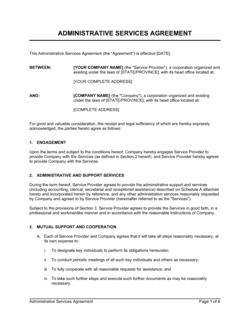
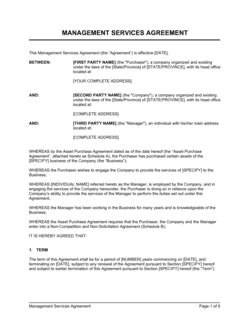
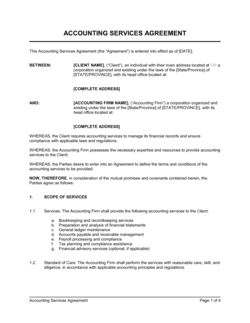
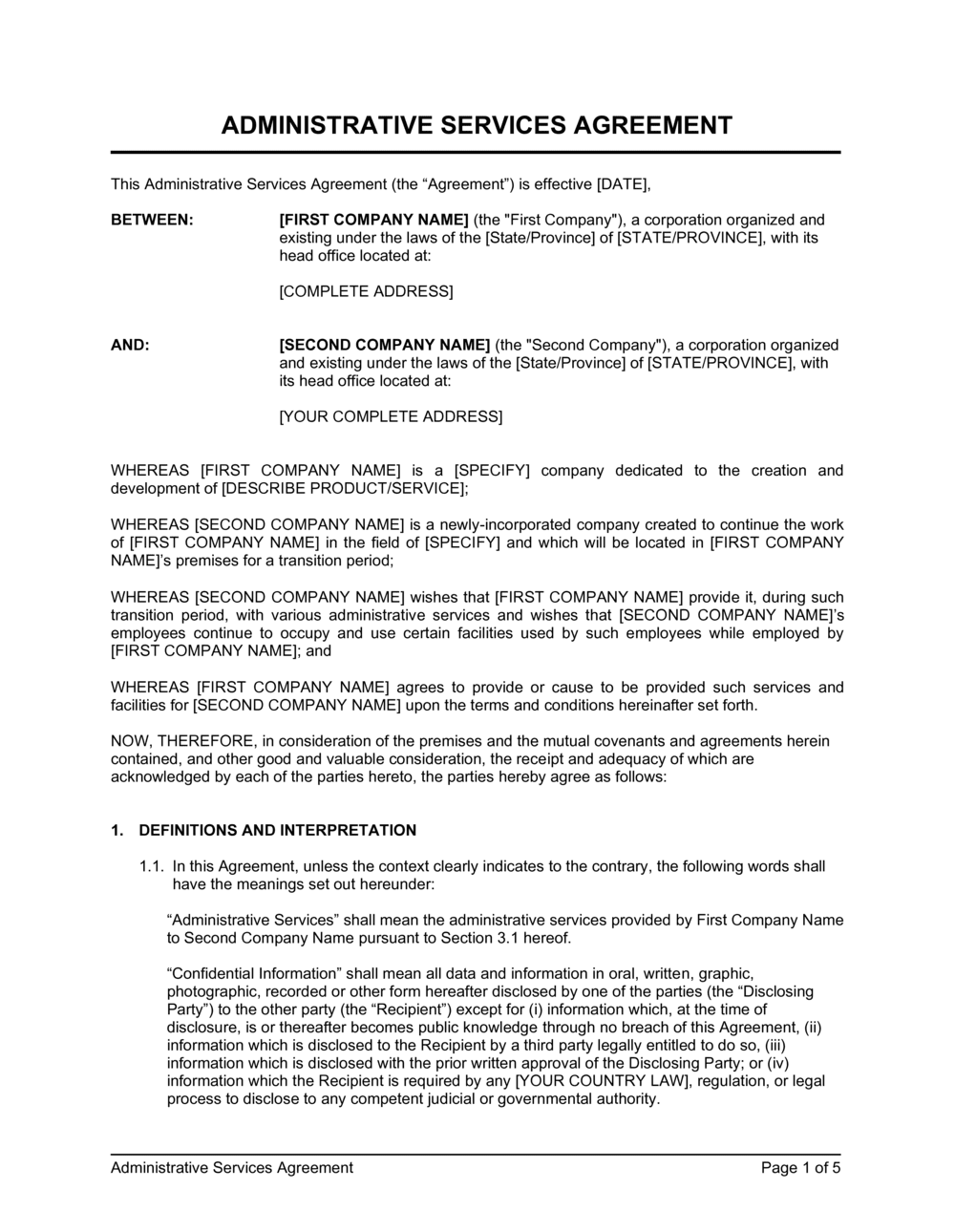
Administrative Services Agreement 2 Template

Free Word download • Edit online • Save & share with Drive • Export to PDF

5 pages25–35 min to fillDifficulty: ComplexSignature requiredLegal review recommended
Learn more ↓
FreeAdministrative Services Agreement 2 Template

At a glance

What it is
An Administrative Services Agreement is a legally binding contract between a service provider and a client organization that formalizes the outsourcing of back-office or administrative functions — such as bookkeeping, HR support, scheduling, data entry, IT helpdesk, or facilities management. This free Word download is fully editable online and can be exported as PDF, giving both parties a clear, enforceable record of scope, fees, confidentiality obligations, and termination rights.
When you need it
Use it whenever a business retains a third-party firm or individual to perform recurring administrative tasks that would otherwise be handled by in-house staff. It is equally appropriate for professional employer organizations (PEOs), management companies serving affiliated entities, and shared-services arrangements within corporate groups.
What's inside
Defined scope of services and service levels, fee structure and payment terms, confidentiality and data protection obligations, intellectual property ownership, liability limitations, indemnification, and a clear termination framework covering notice periods and transition assistance.

What is an Administrative Services Agreement?

An Administrative Services Agreement is a legally binding contract between a client organization and a third-party service provider that governs the outsourcing of ongoing back-office functions — including payroll processing, HR administration, bookkeeping, scheduling, data entry, facilities management, and IT helpdesk support. Unlike a one-time project contract, an administrative services agreement establishes a continuing operational relationship, defining measurable service levels, fee structures, confidentiality obligations, data security responsibilities, and a clear framework for termination and transition. Because the provider typically gains access to sensitive financial, HR, and operational data, the agreement carries data protection obligations that go beyond those found in a standard services contract.

Why You Need This Document

Operating without a written administrative services agreement exposes your business on every front that matters. Without defined service levels, there is no contractual basis to withhold payment or terminate when performance falls short — disputes become credibility contests rather than contract interpretation exercises. Without an explicit confidentiality and data breach clause, a provider who mishandles your payroll records or HR data faces no contractual obligation to notify you promptly, and you have no documented basis for indemnification. Without a transition assistance clause, a provider who exits abruptly can leave you without access to your own records, logins, and process documentation at precisely the moment you are most operationally exposed. For intercompany arrangements within corporate groups, the absence of a written arm's-length agreement invites tax authority scrutiny of related-party charges. This template gives you a professionally structured starting point that closes all of these gaps in under an hour.

Which variant fits your situation?

If your situation is…Use this template
Outsourcing a single defined project rather than ongoing admin supportProfessional Services Agreement
Engaging an independent contractor for administrative workIndependent Contractor Agreement
Providing IT helpdesk or technical support as the admin functionIT Services Agreement
Shared HR and payroll administration across affiliated companiesIntercompany Services Agreement
Virtual assistant or remote admin support on a retainer basisConsulting Agreement
Full outsourced back-office bundle including finance and complianceOutsourcing Agreement
One-time administrative task with a fixed deliverable and deadlineService Agreement

Common mistakes to avoid

❌ Vague scope with no Schedule A

Why it matters: Contracts describing services as 'general administrative support' give neither party a reliable measure of what has been delivered or what additional work triggers an extra charge. Scope disputes are the leading cause of early termination under admin services agreements.

Fix: Attach a Schedule A listing every task, frequency, and format. Review and update it annually or whenever the scope materially changes, using a signed amendment.

❌ No data breach notification clause

Why it matters: Regulatory frameworks in the US (state breach notification laws), Canada (PIPEDA), the UK (UK GDPR), and the EU (GDPR) all impose mandatory notification timelines ranging from 24 to 72 hours. A contract silent on this creates ambiguity about who notifies regulators and affected individuals — and who bears the resulting fines.

Fix: Specify a notification window (48 hours is a practical standard), the form of notice, and which party is responsible for notifying regulators and data subjects depending on whether the provider is acting as a processor or controller.

❌ Omitting a liability cap

Why it matters: Payroll errors, misfiled regulatory submissions, or data entry mistakes can create losses far exceeding the annual contract value. Without a cap, the provider faces theoretically unlimited exposure that their E&O insurance may not cover.

Fix: Insert a liability cap set at 12 months' fees and pair it with a mutual exclusion of consequential and indirect damages. Exceptions for willful misconduct and data breaches are standard and reasonable.

❌ Auto-renewal notice period shorter than the renewal cycle

Why it matters: A contract that renews monthly but requires 30 days' notice to cancel gives the client almost no practical exit window. They routinely miss the deadline and are locked into another term against their intent.

Fix: Set the auto-renewal notice period at a minimum of 60 days for annual renewals and 15 days for monthly ones. Confirm the notice delivery method — email to a named address, not just to a general inbox.

❌ No transition assistance clause

Why it matters: When a provider exits abruptly — or is terminated for cause — the client can be left without access to records, logins, or documented processes. This is operationally catastrophic for functions like payroll or compliance reporting.

Fix: Include a transition assistance clause obligating the provider to deliver all client data in a portable format, hand over credentials, and participate in knowledge-transfer sessions for a defined period (typically 30–60 days) after notice.

❌ Signing with an entity that lacks authority to contract

Why it matters: Administrative agreements are sometimes signed by office managers or operations staff who are not authorized signatories. If the signing entity later disputes the contract, enforcing payment or confidentiality obligations becomes significantly harder.

Fix: Require a countersignature from an authorized officer — CEO, CFO, or equivalent — and include a representation that the signatory has authority to bind the entity.

The 10 key clauses, explained

Parties and recitals

In plain language: Identifies the service provider and the client by their legal entity names, states the effective date, and briefly describes the purpose of the agreement.

Sample language
This Administrative Services Agreement ('Agreement') is entered into as of [EFFECTIVE DATE] between [SERVICE PROVIDER LEGAL NAME], a [STATE/PROVINCE] [ENTITY TYPE] ('Provider'), and [CLIENT LEGAL NAME], a [STATE/PROVINCE] [ENTITY TYPE] ('Client').

Common mistake: Using a trade name or brand name instead of the registered legal entity. If the named party doesn't match the signing entity, enforcement becomes complicated and assignment provisions may not operate correctly.

Scope of services

In plain language: Defines exactly which administrative functions the provider will perform, referencing a Schedule A for granular task lists and service-level standards.

Sample language
Provider shall perform the administrative services described in Schedule A ('Services') in accordance with the service levels set out therein. Any services outside Schedule A require a written amendment signed by both parties.

Common mistake: Describing services in vague terms like 'general admin support' without a Schedule. Disputes over what is and isn't included are the most common source of litigation under administrative services contracts.

Fees, invoicing, and payment terms

In plain language: States the retainer or fee-for-service rate, invoicing frequency, payment due date, and the consequence of late payment.

Sample language
Client shall pay Provider a monthly retainer of $[AMOUNT], invoiced on the first business day of each month and due within [30] days of invoice date. Overdue balances accrue interest at [1.5]% per month.

Common mistake: Omitting a late-payment interest clause. Without it, the provider has no contractual lever to accelerate collection short of termination or litigation.

Term and renewal

In plain language: Sets the initial contract period, whether it auto-renews, and the notice period required to prevent automatic renewal.

Sample language
This Agreement commences on the Effective Date and continues for an initial term of [12] months ('Initial Term'). Thereafter, it renews automatically for successive [12]-month periods unless either party provides [60] days' written notice of non-renewal before the end of the then-current term.

Common mistake: Setting an auto-renewal period shorter than the notice period — for example, a 30-day notice requirement on a monthly auto-renewal leaves no practical window to exit without inadvertently triggering another term.

Confidentiality and data protection

In plain language: Prohibits the provider from using or disclosing the client's confidential information outside the scope of the services, and assigns responsibility for data security measures.

Sample language
Provider shall treat all Confidential Information of Client as strictly confidential, use it solely to perform the Services, and implement security measures no less rigorous than industry standard. Provider shall notify Client within [48] hours of discovering any unauthorized access or data breach.

Common mistake: No data-breach notification timeline. Regulatory frameworks in the US, Canada, the UK, and the EU all impose mandatory breach notification windows — a contract silent on timing creates ambiguity and potential liability.

Intellectual property and work product ownership

In plain language: Assigns ownership of all deliverables and work product created during the engagement to the client, while carving out the provider's pre-existing tools and methodologies.

Sample language
All Work Product created by Provider specifically for Client under this Agreement is the sole property of Client and is hereby assigned to Client upon creation. Provider retains ownership of its pre-existing tools, templates, and methodologies ('Provider IP'), which it licenses to Client on a non-exclusive basis solely for use of the Services.

Common mistake: No carve-out for the provider's pre-existing IP. Without it, the broad assignment clause may unintentionally transfer ownership of the provider's core software or templates — voiding the commercial basis of the relationship.

Limitation of liability

In plain language: Caps the provider's total financial exposure under the contract — typically at the fees paid in the prior 12 months — and excludes consequential, indirect, and punitive damages.

Sample language
Provider's total cumulative liability under this Agreement shall not exceed the fees paid by Client in the [12] months immediately preceding the claim. Neither party shall be liable for indirect, consequential, incidental, or punitive damages, even if advised of the possibility of such damages.

Common mistake: Excluding the limitation of liability clause entirely to make the contract 'simpler.' Without it, the provider faces unlimited exposure for errors in bookkeeping, payroll, or data entry — risks that are commercially uninsurable at that scale.

Indemnification

In plain language: Requires each party to indemnify the other for losses arising from their own breach, negligence, or misconduct — and carves out any losses resulting from the indemnified party's own fault.

Sample language
Each party ('Indemnifying Party') shall indemnify, defend, and hold harmless the other party from any third-party claims, losses, or expenses arising from the Indemnifying Party's breach of this Agreement, gross negligence, or willful misconduct, except to the extent caused by the indemnified party's own negligence.

Common mistake: One-sided indemnification that only protects the client. Courts in some jurisdictions disfavor or limit enforcement of entirely one-sided indemnity provisions, and a provider who accepts unlimited indemnity without a corresponding liability cap is commercially exposed.

Termination for cause and convenience

In plain language: Sets out the grounds for immediate termination for cause — material breach, insolvency, regulatory action — and the notice period required to terminate for convenience.

Sample language
Either party may terminate this Agreement immediately for Cause upon written notice if the other party materially breaches this Agreement and fails to cure within [30] days of written notice. Either party may terminate for convenience upon [90] days' written notice.

Common mistake: No cure period for material breach. Immediate termination clauses without a cure window expose both parties to disputes over whether a breach was actually 'material,' and deny the breaching party a reasonable opportunity to remedy minor non-compliance.

Governing law and dispute resolution

In plain language: Specifies the jurisdiction whose law governs the agreement and the mechanism for resolving disputes — arbitration, mediation, or litigation — including the venue.

Sample language
This Agreement is governed by the laws of [STATE / PROVINCE / COUNTRY], without regard to conflict-of-law principles. Any dispute shall first be submitted to non-binding mediation in [CITY]; if unresolved within [30] days, the dispute shall be settled by binding arbitration under the rules of [AAA / JAMS / applicable body], with proceedings in [CITY].

Common mistake: Choosing a governing law with no connection to where either party operates. Several jurisdictions — including California and Ontario — apply local mandatory employment and consumer-protection statutes regardless of a contractual choice-of-law clause, making a mismatched choice practically unenforceable.

How to fill it out

  1. 1

    Identify both parties by their registered legal entity names

    Enter the full registered name, entity type (LLC, Inc., Ltd.), and state or province of formation for both the service provider and the client. Confirm these match the names on corporate registry filings.

    💡 Cross-check the client's legal name against their latest invoice or purchase order before executing — mismatches create enforcement headaches if a dispute arises.

  2. 2

    Draft Schedule A with a granular list of services

    List every administrative task the provider will perform — payroll processing, scheduling, data entry, report preparation — with the frequency, format, and any applicable service-level standard (e.g., 'payroll processed by 5 pm on the last business day of each month').

    💡 Specificity in Schedule A is the single best investment in dispute prevention. If you can't describe a task in one sentence, it's not scoped clearly enough.

  3. 3

    Set the fee structure and payment mechanics

    Choose between a flat monthly retainer, an hourly rate with a cap, or a task-based fee schedule. Enter the dollar amount, invoicing frequency, due date (Net 15 or Net 30), and the late-fee rate.

    💡 For retainer arrangements, add a clause specifying whether unused hours roll over or expire at month-end — ambiguity here is a recurring source of client disputes.

  4. 4

    Define the initial term and auto-renewal notice period

    Enter the initial contract length (typically 12 months), the auto-renewal period, and the notice required to prevent renewal. Make sure the notice period is at least 30 days longer than the renewal interval.

    💡 Set a calendar reminder 90 days before the contract anniversary to review whether renewal terms still reflect the current scope and pricing.

  5. 5

    Complete the confidentiality and data security provisions

    Specify which categories of information are confidential (financial records, HR data, client lists), the security standard required (ISO 27001, SOC 2, or 'industry standard'), and the breach notification window.

    💡 If the provider will process personal data of the client's employees or customers, add a data processing addendum (DPA) to comply with GDPR, PIPEDA, or applicable state privacy law.

  6. 6

    Calibrate the liability cap to actual fees

    Set the liability cap as a multiple of the fees paid in the prior 12 months — 1× fees is standard for admin services, 2× for higher-risk functions like payroll or financial reporting.

    💡 Confirm the cap is consistent with the provider's professional liability (E&O) insurance coverage. An uncapped contract that exceeds available insurance is commercially meaningless protection.

  7. 7

    Set termination notice and transition assistance obligations

    Enter the convenience termination notice period (90 days is typical), the cure period for material breach (30 days is standard), and the specific transition assistance the provider must render — data export, process documentation, handover meetings.

    💡 Providers often resist open-ended transition assistance obligations. Cap transition at a defined number of hours at the standard hourly rate to make it commercially acceptable.

  8. 8

    Execute before services begin and retain a countersigned copy

    Both parties must sign before services commence. File the fully executed agreement in a secure document repository and share a countersigned PDF with both parties' legal and finance contacts.

    💡 Use a timestamped eSignature platform to create an audit trail of execution. Unsigned drafts have been introduced in disputes as evidence of agreed terms — avoid the ambiguity.

Frequently asked questions

What is an administrative services agreement?

An administrative services agreement is a legally binding contract between a client organization and a third-party provider that formalizes the outsourcing of back-office functions such as payroll, scheduling, HR support, data entry, bookkeeping, or facilities management. It defines the scope of services, fees, confidentiality obligations, data protection requirements, liability limits, and termination rights. It is distinct from a general services agreement in that it typically covers ongoing, recurring functions rather than a one-time project.

When do I need an administrative services agreement?

You need one any time a third party performs recurring administrative functions that give them access to sensitive business data — payroll records, financial systems, HR files, or client lists. It is also required for intercompany arrangements where one entity in a corporate group provides back-office support to another, particularly for tax and transfer-pricing purposes. A handshake arrangement or informal email exchange does not provide enforceable protection on confidentiality, data security, or termination.

What is the difference between an administrative services agreement and an independent contractor agreement?

An independent contractor agreement governs the engagement of a self-employed individual for defined project work, with the contractor controlling how the work is performed. An administrative services agreement typically engages a firm or organization — not an individual — to deliver ongoing operational functions under defined service levels and with specific data-handling obligations. If the admin services provider is an individual, misclassification risk (employee vs. contractor) still applies and the agreement should be structured accordingly.

Does an administrative services agreement need to be reviewed by a lawyer?

For straightforward domestic arrangements with a small provider and limited data access, a high-quality template is typically sufficient. Legal review is recommended when the provider handles sensitive personal data regulated by GDPR, PIPEDA, or US state privacy laws; when the annual contract value exceeds $50,000; when the agreement is between affiliated entities and must satisfy transfer-pricing rules; or when the scope includes payroll, financial reporting, or regulatory filings where errors carry statutory penalties.

What service levels should be included in an administrative services agreement?

Service levels should be specific and measurable — for example, payroll processed by 5 pm on the last business day of the month, invoices coded within 24 hours of receipt, or helpdesk tickets acknowledged within 2 business hours. Avoid vague standards like 'in a timely manner.' Each SLA should specify the consequence of non-compliance — a fee credit, a right to cure, or grounds for termination — to make the standard commercially meaningful.

Who owns the work product created under an administrative services agreement?

Typically the client owns all deliverables and work product created specifically for them under the agreement — reports, databases, process documentation, and formatted records. The provider retains ownership of its pre-existing tools, templates, and proprietary methodologies, which it licenses to the client on a non-exclusive basis. This split should be explicit in the contract; without a written assignment clause, default IP rules in many jurisdictions may vest ownership in the creator, not the client who paid for the work.

How long should an administrative services agreement be?

Initial terms of 12 months with automatic annual renewal are most common for ongoing admin support arrangements. Shorter initial terms (3 or 6 months) are appropriate when the relationship is new and performance needs to be validated before a long-term commitment. Fixed-term contracts without auto-renewal are standard for project-based engagements with a defined end date. The termination-for-convenience notice period — typically 60 to 90 days — should always be proportionate to the operational dependency the client has on the provider.

What happens to client data when the agreement is terminated?

The agreement should require the provider to return all client data in a portable, usable format within a defined period after termination — typically 30 days — and to certify destruction of any copies retained on provider systems. Under GDPR and UK GDPR, data processors are legally required to delete or return personal data at the end of a contract. A contract silent on data return creates practical and regulatory risk, particularly for HR and financial records with statutory retention requirements.

Can an administrative services agreement be used for intercompany arrangements?

Yes, and it is strongly recommended. When one entity in a corporate group provides admin services to an affiliated entity, a written agreement documented at arm's-length terms is required in most jurisdictions to satisfy transfer-pricing rules and to establish that the charges are commercially reasonable. Tax authorities in the US, Canada, the UK, and the EU routinely scrutinize related-party service arrangements that lack written contracts or charge rates that differ materially from third-party benchmarks.

How this compares to alternatives

vs Independent Contractor Agreement

An independent contractor agreement governs a self-employed individual performing defined project work. An administrative services agreement typically engages a firm for ongoing, recurring functions under measurable service levels. The key distinctions are the entity type, the recurring nature of the obligation, and the data-handling and SLA provisions that admin agreements carry and contractor agreements typically do not.

vs Professional Services Agreement

A professional services agreement covers specialized, often project-based engagements — consulting, legal, engineering — where the deliverable is expertise and output. An administrative services agreement covers operational back-office functions delivered on an ongoing basis. Admin agreements place greater emphasis on service levels, data security, and transition assistance; professional services agreements focus more on deliverable acceptance and change-order management.

vs Service Agreement

A general service agreement is a broad-purpose document that can cover virtually any service relationship. An administrative services agreement is a specialized variant with provisions specific to back-office outsourcing — data handling, SLAs, transition assistance, and intercompany transfer-pricing considerations. Use the general service agreement for one-off or non-sensitive service arrangements; use the administrative services agreement when ongoing access to sensitive operational data is involved.

vs Consulting Agreement

A consulting agreement engages an advisor to provide strategic recommendations or specialized knowledge on a defined scope. An administrative services agreement engages a provider to execute operational tasks on an ongoing basis — the deliverable is a service performed, not advice given. Consulting agreements typically do not include SLAs, transition assistance, or data processor obligations that are standard in admin services agreements.

Industry-specific considerations

Financial Services

Compliance-heavy data handling requirements, mandatory breach notification timelines, and regulatory approval of third-party service providers under outsourcing rules set by bodies such as the SEC, FCA, or OSFI.

Healthcare

HIPAA Business Associate Agreement addendum required when the admin provider accesses protected health information; strict data retention and destruction schedules tied to patient record regulations.

Professional Services

Client-confidentiality pass-through obligations, conflict-of-interest representations, and professional indemnity insurance requirements that flow from the firm's own client engagements.

Technology / SaaS

System-access protocols for cloud-based admin tools, SOC 2 compliance requirements for third-party processors, and IP assignment clauses covering administrative automation scripts or integrations built during the engagement.

Jurisdictional notes

United States

No single federal statute governs administrative services agreements, but providers handling personal data must comply with applicable state privacy laws — including the California Consumer Privacy Act (CCPA), Virginia CDPA, and Colorado CPA. If the admin function includes payroll, FLSA and state wage-payment statutes apply to the underlying employees. Healthcare admin providers accessing PHI must execute a HIPAA Business Associate Agreement as an addendum.

Canada

PIPEDA (or provincial equivalents in Quebec, Alberta, and BC) requires a written contract with any service provider processing personal information on behalf of the client. Quebec's Law 25 imposes additional requirements including privacy impact assessments for cross-border data transfers. Intercompany admin services must be priced at arm's-length under the Income Tax Act transfer-pricing rules, and CRA routinely requests written agreements to support the pricing.

United Kingdom

UK GDPR requires a written Data Processing Agreement where the admin provider processes personal data as a processor. The contract must specify the subject matter, duration, nature, and purpose of processing and include standard controller-to-processor clauses. For financial services firms, the FCA's outsourcing rules require additional provisions covering audit rights, sub-contracting, and business continuity. Post-Brexit, data transfers to non-UK countries require an International Data Transfer Agreement or equivalent safeguard.

European Union

GDPR Article 28 mandates a written Data Processing Agreement for any admin provider acting as a processor, incorporating specific mandatory clauses on sub-processors, data subject rights, breach notification, and return or deletion of data. Transfers of personal data outside the EEA require Standard Contractual Clauses or an adequacy decision. In several member states — including France and Germany — collective bargaining agreements may impose additional requirements when admin services affect the client's employees.

Template vs lawyer — what fits your deal?

PathBest forCostTime
Use the templateDomestic admin outsourcing with a small provider, no regulated data, and an annual contract value under $50,000Free30–60 minutes
Template + legal reviewArrangements involving payroll, HR data, financial reporting, or any personal data regulated by GDPR, PIPEDA, or US state privacy laws$400–$9002–4 days
Custom draftedIntercompany shared-services arrangements with transfer-pricing implications, regulated financial services or healthcare data, or contracts exceeding $100,000 annually$1,500–$5,000+1–3 weeks

Glossary

Administrative Services
Back-office or support functions — such as payroll processing, scheduling, data entry, and facilities management — performed by one party on behalf of another.
Scope of Services
The specific tasks, deliverables, and responsibilities the service provider is contracted to perform, typically detailed in a Schedule or Statement of Work.
Service Level Agreement (SLA)
A measurable performance standard — such as response time, accuracy rate, or uptime — that the service provider must meet under the contract.
Retainer Fee
A fixed periodic payment (monthly or quarterly) that reserves the service provider's availability and covers an agreed volume of administrative work.
Confidential Information
Non-public data — including personnel records, financial data, and client lists — that the service provider accesses during the engagement and must not disclose or misuse.
Indemnification
A contractual obligation requiring one party to compensate the other for losses, damages, or legal costs arising from a specified act or omission.
Limitation of Liability
A clause capping the maximum financial exposure of one or both parties — typically expressed as a multiple of fees paid in the preceding 12 months.
Transition Assistance
Services the outgoing provider must render after a termination notice to help the client transfer records, processes, and knowledge to a successor or in-house team.
Work Product
Documents, reports, databases, or other outputs created by the service provider in performing the administrative services.
Force Majeure
A clause excusing a party's non-performance when caused by events outside their reasonable control, such as natural disasters, government orders, or cyberattacks.
At-Arm's-Length
A transaction or relationship structured as if between unrelated parties, important in related-party or intercompany service arrangements to satisfy tax and regulatory standards.

Part of your Business Operating System

This document is one of 3,000+ business & legal templates included in Business in a Box.

  • Fill-in-the-blanks — ready in minutes
  • 100% customizable Word document
  • Compatible with all office suites
  • Export to PDF and share electronically

Create your document in 3 simple steps.

From template to signed document — all inside one Business Operating System.
1
Download or open template

Access over 3,000+ business and legal templates for any business task, project or initiative.

2
Edit and fill in the blanks with AI

Customize your ready-made business document template and save it in the cloud.

3
Save, Share, Send, Sign

Share your files and folders with your team. Create a space of seamless collaboration.

Save time, save money, and create top-quality documents.

★★★★★

"Fantastic value! I'm not sure how I'd do without it. It's worth its weight in gold and paid back for itself many times."

Managing Director · Mall Farm
Robert Whalley
Managing Director, Mall Farm Proprietary Limited
★★★★★

"I have been using Business in a Box for years. It has been the most useful source of templates I have encountered. I recommend it to anyone."

Business Owner · 4+ years
Dr Michael John Freestone
Business Owner
★★★★★

"It has been a life saver so many times I have lost count. Business in a Box has saved me so much time and as you know, time is money."

Owner · Upstate Web
David G. Moore Jr.
Owner, Upstate Web

Run your business with a system — not scattered tools

Stop downloading documents. Start operating with clarity. Business in a Box gives you the Business Operating System used by over 250,000 companies worldwide to structure, run, and grow their business.

Free Forever Plan · No credit card required