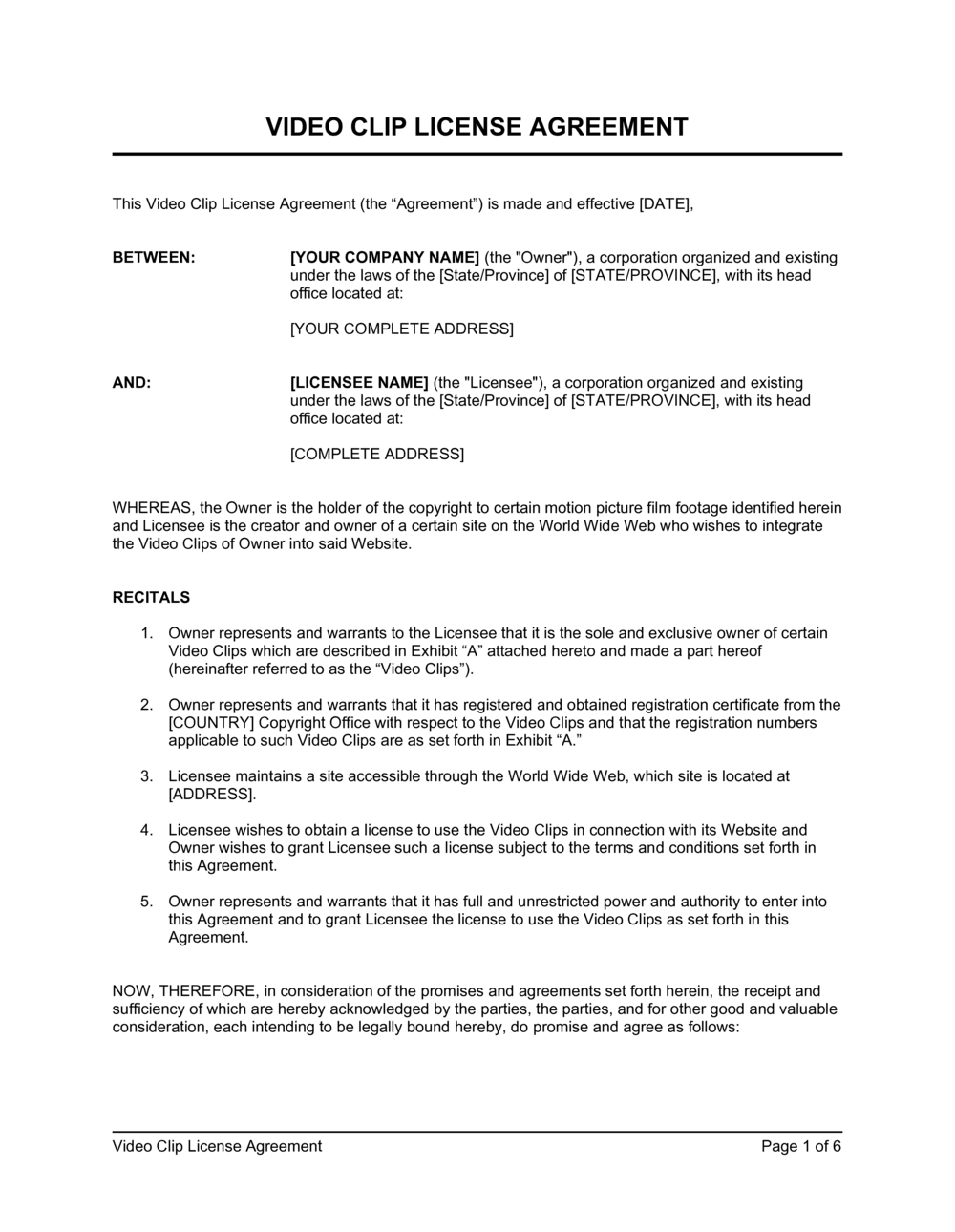
This video clip license agreement template has 6 pages and is a MS Word file type listed under our software & technology documents.
Video clip license agreement template
VIDEO CLIP LICENSE AGREEMENT This Video Clip License Agreement (the "Agreement") is made and effective [DATE], BETWEEN: [YOUR COMPANY NAME] (the "Owner"), a corporation organized and existing under the laws of the [State/Province] of [STATE/PROVINCE], with its head office located at: [YOUR COMPLETE ADDRESS] AND: [LICENSEE NAME] (the "Licensee"), a corporation organized and existing under the laws of the [State/Province] of [STATE/PROVINCE], with its head office located at: [COMPLETE ADDRESS] WHEREAS, the Owner is the holder of the copyright to certain motion picture film footage identified herein and Licensee is the creator and owner of a certain site on the World Wide Web who wishes to integrate the Video Clips of Owner into said Website. RECITALS Owner represents and warrants to the Licensee that it is the sole and exclusive owner of certain Video Clips which are described in Exhibit "A" attached hereto and made a part hereof (hereinafter referred to as the "Video Clips"). Owner represents and warrants that it has registered and obtained registration certificate from the [COUNTRY] Copyright Office with respect to the Video Clips and that the registration numbers applicable to such Video Clips are as set forth in Exhibit "A." Licensee maintains a site accessible through the World Wide Web, which site is located at [ADDRESS]. Licensee wishes to obtain a license to use the Video Clips in connection with its Website and Owner wishes to grant Licensee such a license subject to the terms and conditions set forth in this Agreement. Owner represents and warrants that it has full and unrestricted power and authority to enter into this Agreement and to grant Licensee the license to use the Video Clips as set forth in this Agreement. NOW, THEREFORE, in consideration of the promises and agreements set forth herein, the receipt and sufficiency of which are hereby acknowledged by the parties, the parties, and for other good and valuable consideration, each intending to be legally bound hereby, do promise and agree as follows: GRANT OF LICENSE Owner hereby grants to the Licensee, the non-exclusive right and license to use the Video Clips, or any portion of the Video Clips, as the Licensee shall see fit, in connection with the Licensee's Website. The license granted hereunder shall be a non-exclusive, worldwide, royalty free (subject only to the one time licensing fee set forth herein) right to use the Video Clips, subject to the terms and conditions set forth herein. The term of this license shall be perpetual, unless terminated pursuant to the terms hereof. The license granted herein shall be limited to the right to integrate the Video Clips into the Website of the Licensee. Licensee shall have no right to offer the Video Clips for sale or otherwise distribute, publish, grant any sub-licenses, sell, rent, convey, offer for download or otherwise exploit the Video Clips. Licensee shall not be permitted to create any derivative works based upon the Video Clips. Licensee shall be permitted to use portions, and not the entire Video Clips, in connection with its Website without violating any rights of the Owner hereunder. The License granted herein includes the right to synchronize and integrate the Video Clips into the Licensee's Website design and include the Video Clips in connection with Flash presentations, applets, page loads, online video presentations, and any other use that integrates the Video Clips into the design of the Licensee's Website. It is acknowledged and agrees by the Owner that users who access the Licensee's Website will be permitted to see the Video Clips upon accessing the Licensee's Website and that such access by users shall be permitted pursuant to the terms hereof. It is further acknowledged by the Owner that the Licensee cannot prevent users from violating the copyrights and other proprietary rights of the Owner and that Licensee is not responsible for the infringing acts of users. Owner holds Licensee harmless from and against any acts of the users that may infringe upon the rights of the Owner, including but not limited to actions based upon contributory infringements or any theory based upon the Licensee providing users with the means and facilities through which copyright or other proprietary rights infringement may take place. The License granted herein includes the right to adapt the Video Clips to an appropriate file format for access through the World Wide Web, including MPEG files, REAL format, or any other format which will permit integration into the Licensee's Website and access to the Video Clips over the World Wide Web. Owner hereby grants to the Licensee the right to use the name of the Owner and the composer and artists involved in the Video Clips in connection with it's Website. Owner represents and warrants that it has the full right and permission to grant such licenses and permissions from all such individuals. COMPENSATION FOR LICENSE In consideration of the license granted herein, Licensee agree to pay a one-time license fee to the Owner in an amount equal to [AMOUNT] ("License Fee"). Such License Fee shall be due and payable in full within [NUMBER] days following the execution of this Agreement. The right to use the Video Clips pursuant to this Agreement shall not commence until such License Fee is paid in full. TERM OF LICENSE This License Agreement shall be effective upon execution by both parties; provided however, that the Licensee's right to use the Video Clips shall not commence until the License Fee as set forth above is paid in full. The license granted hereunder to use the Video Clips within the scope and terms set forth herein shall be perpetual, but may be terminated by the Owner upon a breach hereof by the Licensee. Owner shall have the right to terminate this Agreement and the license granted herein upon written notice to the Licensee upon the occurrence of the following events:
 Dashboard
 HR Management
 Links
Links Chat
Chat Connect
 Contacts
 Inbox
Inbox Business Al
 Project Management
 Notes
Notes Business Templates
 Cloud Drive
 Docs
Docs Sheets