Top 10 Personality Traits Of Great Leaders Template

Free to read • Save or share with one click

FreeTop 10 Personality Traits Of Great Leaders Template

At a glance

What it is
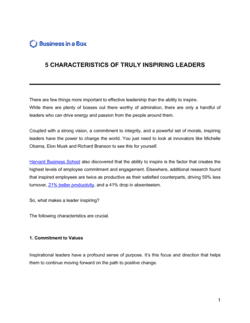
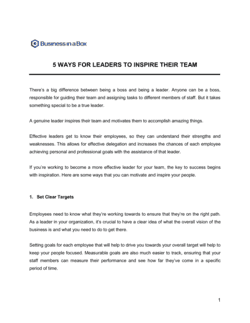
The Top 10 Personality Traits of Great Leaders is a structured Word reference document that defines, explains, and illustrates the ten core behavioral and character attributes consistently found in high-performing leaders across industries. This free Word download can be edited online, customized to your organization's leadership framework, and exported as PDF for use in hiring rubrics, performance reviews, coaching programs, or board presentations.
When you need it
Use it when building a leadership competency framework, evaluating candidates for senior roles, structuring a 360-degree feedback process, or onboarding new managers who need a concrete benchmark for what effective leadership looks like in your organization.
What's inside
A defined set of ten leadership personality traits — each with a plain-English description, behavioral indicators, and practical application guidance — plus an introduction explaining why personality-based leadership assessment outperforms skills-only evaluation, and a summary table for quick reference in hiring or coaching conversations.

What is the Top 10 Personality Traits of Great Leaders?

The Top 10 Personality Traits of Great Leaders is a structured reference document that identifies, defines, and illustrates the ten core behavioral and character attributes that research and practice consistently link to effective leadership across industries and organizational stages. Unlike skills inventories, which catalog what a leader knows how to do, this document focuses on who a leader is — the stable patterns of behavior, judgment, and character that determine how they perform under pressure, develop their teams, make decisions with incomplete information, and earn the trust of the people around them. The document is designed to be edited and customized in Word, allowing HR teams, coaches, and executives to anchor it to specific roles, levels, and organizational contexts before deploying it in hiring, coaching, or performance conversations.

Why You Need This Document

Without a documented leadership traits framework, hiring managers default to gut feel, performance reviewers assess different things for different people, and coaching conversations lack a shared vocabulary for what good leadership actually looks like in your organization. The consequences are concrete: inconsistent promotion decisions expose employers to discrimination claims, development plans lack measurable behavioral targets, and new leaders join without a clear picture of the behavioral standard they are expected to meet. A well-structured traits document gives every stakeholder — the leader, their manager, their peers, and HR — the same reference point, making assessment more reliable, feedback more actionable, and employment decisions more defensible. This template eliminates the blank-page problem and gives you a professionally structured, customizable starting point that takes 30 minutes to adapt rather than weeks to create from scratch.

Which variant fits your situation?

If your situation is…Use this template
Evaluating a candidate for a senior leadership or C-suite roleExecutive Leadership Assessment
Running a structured 360-degree feedback process for existing managers360-Degree Feedback Form
Building a full leadership competency model for the organizationLeadership Competency Framework
Onboarding a new manager and setting behavioral expectationsManager Onboarding Plan
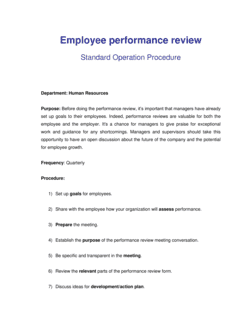
Conducting an annual performance review for a team leadEmployee Performance Review Template
Designing a leadership development program curriculumTraining Plan Template
Presenting leadership criteria to a board or search committeeExecutive Summary Template

Common mistakes to avoid

❌ Using the document in employment decisions without consistent application

Why it matters: Applying trait criteria selectively across candidates or employees creates disparate impact exposure under employment discrimination law in the US, Canada, UK, and EU.

Fix: Document the assessment process, use the same evaluators and criteria for all candidates in the same role tier, and retain assessment records for the period required by your jurisdiction's employment regulations.

❌ Defining traits in abstract terms without observable indicators

Why it matters: Abstract trait definitions like 'is visionary' or 'has integrity' cannot be measured consistently, producing unreliable assessments that collapse under legal or HR challenge.

Fix: Rewrite each trait definition as two to three specific, observable behaviors using the sample language in this template as a model.

❌ Treating all ten traits as equally weighted for every role

Why it matters: Evaluating a frontline supervisor on C-suite strategic vision criteria — or vice versa — produces scores that do not predict job performance and frustrate both evaluators and the leaders being assessed.

Fix: Assign explicit weights or priority tiers to each trait before the assessment cycle, calibrated to the specific role and level being evaluated.

❌ Skipping the signature and acknowledgment step

Why it matters: Without documented acknowledgment, leaders can credibly claim they were not informed of the criteria used to evaluate them — undermining performance improvement plans and termination decisions.

Fix: Obtain signatures from both the evaluator and the leader at the start of each review period, confirming the criteria and their definitions as mutually understood.

❌ Conflating personality traits with job skills in the assessment

Why it matters: Mixing trait criteria (e.g., resilience) with technical skill criteria (e.g., financial modeling) in the same rubric dilutes both and makes development feedback incoherent.

Fix: Keep this document focused on personality and behavioral traits only. Use a separate competency or skills matrix for technical and functional capabilities, and assess the two frameworks independently before combining scores.

❌ Never updating the document after organizational change

Why it matters: A leadership trait framework built for a 20-person startup often emphasizes the wrong traits at 200 people — leading to promotion of leaders who are effective at the old stage but not the current one.

Fix: Build an annual review of leadership criteria into the HR calendar, triggered by any significant change in company size, strategy, or market context.

The 10 key clauses, explained

Integrity and ethical consistency

In plain language: Describes the trait of maintaining honesty and alignment between words and actions, especially when facing difficult decisions or competing pressures.

Sample language
[LEADER NAME] demonstrates integrity by communicating decisions transparently, acknowledging mistakes publicly, and applying organizational values consistently regardless of who is in the room.

Common mistake: Listing integrity as a value without defining observable behaviors — assessors then apply it subjectively, making it useless in structured evaluations.

Emotional intelligence and self-awareness

In plain language: Covers the leader's ability to recognize their own emotional triggers, regulate responses under stress, and read the emotional state of their team accurately.

Sample language
In high-pressure situations, [LEADER NAME] identifies personal stress responses before they affect team dynamics and adapts communication style based on individual team member needs.

Common mistake: Confusing emotional intelligence with agreeableness. A high-EQ leader still delivers difficult feedback and makes unpopular decisions — they do so with awareness, not avoidance.

Strategic vision and long-term thinking

In plain language: Addresses the capacity to define a meaningful 3–5 year direction, connect daily decisions to larger goals, and anticipate competitive or market shifts.

Sample language
[LEADER NAME] articulates a [TIMEFRAME] vision for [TEAM/ORGANIZATION] that is specific enough to guide resource allocation decisions and compelling enough to sustain motivation through short-term setbacks.

Common mistake: Confusing activity with strategy. A leader who is always busy but cannot articulate a 12-month priority stack is demonstrating energy, not strategic vision.

Decisiveness under uncertainty

In plain language: Defines the ability to make and commit to well-reasoned decisions when information is incomplete, rather than deferring indefinitely to avoid risk.

Sample language
When [SCENARIO], [LEADER NAME] identifies the decision deadline, gathers input from [KEY STAKEHOLDERS] within [TIMEFRAME], makes a documented decision, and communicates the rationale to the team within [X] hours.

Common mistake: Rewarding speed over quality in decision-making assessments. The trait is calibrated decisiveness — deciding at the right time with the right inputs — not simply deciding fast.

Accountability and ownership

In plain language: Captures the leader's willingness to accept responsibility for outcomes — team results, project failures, and individual behavior — without deflecting to external factors.

Sample language
[LEADER NAME] responds to missed targets by conducting a documented post-mortem, identifying root causes attributable to their own decisions, and presenting a corrective action plan to [STAKEHOLDER] within [X] days.

Common mistake: Assessing accountability only when things go wrong. Effective accountability includes acknowledging when success was a team effort rather than claiming individual credit.

Communication clarity and active listening

In plain language: Covers both the ability to convey complex ideas simply and the discipline to listen fully before responding — particularly in conflict or ambiguity.

Sample language
In cross-functional meetings, [LEADER NAME] summarizes each contributor's position before responding, asks clarifying questions before disagreeing, and sends a written summary of decisions within [X] hours.

Common mistake: Assessing communication only through presentation skills. Leaders who present well but listen poorly create teams that withhold critical information — a direct operational risk.

Resilience and composure under pressure

In plain language: Defines the behavioral pattern of maintaining focus, rational decision-making, and a stable team environment during organizational crises, setbacks, or rapid change.

Sample language
During [TYPE OF CRISIS], [LEADER NAME] maintains a regular team communication cadence of [FREQUENCY], focuses the team on [CONTROLLABLE VARIABLES], and models calm urgency rather than reactive anxiety.

Common mistake: Confusing resilience with stoicism. A resilient leader acknowledges difficulty honestly to the team — leaders who pretend everything is fine lose credibility precisely when trust matters most.

Empathy and people development

In plain language: Addresses the leader's investment in understanding individual team members' motivations, removing their obstacles, and actively developing their capabilities over time.

Sample language
[LEADER NAME] conducts monthly 1:1s structured around [TEAM MEMBER]'s development goals, identifies one growth opportunity per quarter, and provides specific behavioral feedback within [X] days of observable events.

Common mistake: Treating empathy as unconditional validation. Genuine empathy includes honest feedback delivered with care — leaders who only affirm are not developing their people.

Adaptability and learning agility

In plain language: Captures the speed and quality with which a leader updates their mental model, changes approach, and absorbs new information when circumstances shift.

Sample language
When [MARKET CONDITION / ORGANIZATIONAL CHANGE] altered [ORIGINAL PLAN], [LEADER NAME] identified the key assumption that had changed, revised the approach within [TIMEFRAME], and communicated the pivot rationale to the team.

Common mistake: Confusing adaptability with inconsistency. Adaptable leaders change their approach in response to new evidence — not in response to pressure or the last person they spoke to.

Influence and coalition building

In plain language: Defines the ability to generate voluntary commitment from peers, stakeholders, and teams who are not direct reports — through credibility, persuasion, and shared interest alignment.

Sample language
To advance [INITIATIVE], [LEADER NAME] maps key stakeholders by influence and interest, engages [STAKEHOLDER TYPE] with tailored messaging tied to their priorities, and builds a coalition of at least [X] sponsors before formal approval.

Common mistake: Conflating influence with authority. A leader who can only move people through positional power has not demonstrated this trait — it requires generating alignment without mandate.

How to fill it out

  1. 1

    Customize the introduction to your organizational context

    Replace the placeholder company and role references in the introduction section with your organization's name, the leadership level this document addresses (e.g., team leads, directors, VPs), and any industry-specific framing.

    💡 Anchoring the document to a specific leadership tier — rather than leaving it generic — increases adoption in performance conversations and reduces assessor drift.

  2. 2

    Prioritize the traits relevant to your leadership level

    All ten traits matter, but their relative weight varies by role. For frontline managers, empathy and communication clarity typically rank highest. For C-suite roles, strategic vision and decisiveness carry more weight. Annotate each trait with a priority level (essential / important / developing) for the specific role.

    💡 Avoid marking all ten traits as equally essential — forced prioritization produces more useful hiring and development conversations.

  3. 3

    Add observable behavioral indicators for each trait

    For each of the ten traits, write two to three specific, observable behaviors that demonstrate the trait in action at your organization. Use the sample language as a starting point and adapt it to real scenarios from your environment.

    💡 Observable indicators should pass the 'video test' — a behavior you could capture on video is observable; a character conclusion like 'is honest' is not.

  4. 4

    Define your rating scale

    If this document will be used in structured assessments, add a 1–4 or 1–5 rating scale with anchor descriptions for each level. A 4-point scale (Does not demonstrate / Developing / Consistent / Exceptional) avoids the central tendency bias common with 5-point scales.

    💡 Include a written example of each rating level for at least two traits — this calibrates raters before a 360 cycle and reduces inter-rater variance.

  5. 5

    Integrate with your hiring or performance workflow

    Attach the completed document to your interview scorecard, performance review template, or development planning form. Assign each trait to a specific interview question, observation period, or 360 feedback category.

    💡 Traits assessed only in interviews have lower predictive validity than those tracked across multiple data points — add a 90-day observation window for new leaders.

  6. 6

    Review and align with legal and HR requirements

    Before using this document in formal employment decisions — promotions, terminations, or compensation reviews — confirm with HR or legal counsel that the criteria are applied consistently across protected class groups and meet local employment law standards.

    💡 Trait-based criteria can create disparate impact liability if applied inconsistently. Document how each trait is assessed and by whom for every formal decision.

  7. 7

    Distribute for acknowledgment and signature

    For formal use in performance or development plans, have both the evaluator and the leader being assessed sign the completed document to confirm shared understanding of the criteria and expectations.

    💡 Signature at the beginning of a review cycle — not just at the end — signals mutual commitment and reduces disputes about whether expectations were communicated.

  8. 8

    Schedule a review cadence

    Set a date to revisit and update the document — annually for general use, or after any significant organizational change that shifts leadership priorities. Note the review date in the document footer.

    💡 Leadership competency models that are not updated become artifacts rather than tools. A stale framework sends the signal that leadership standards are not actually enforced.

Frequently asked questions

What are the top personality traits of great leaders?

Research consistently identifies ten traits that distinguish high-performing leaders from average managers: integrity, emotional intelligence, strategic vision, decisiveness, accountability, communication clarity, resilience, empathy and people development, adaptability, and influence. No single trait defines great leadership — the combination and context matter more than any individual characteristic. This template defines each trait with observable behavioral indicators so they can be measured rather than assumed.

How is this document used in hiring and performance management?

The document functions as a structured reference framework that HR teams and managers attach to interview scorecards, 360-degree feedback forms, and performance review templates. Each trait is translated into observable behavioral indicators that assessors can score consistently, reducing the subjectivity that undermines most leadership evaluation processes. It is most effective when shared with the leader being assessed at the start of a review cycle, not after the fact.

Is a personality traits framework legally defensible in employment decisions?

A trait-based leadership framework is generally defensible when applied consistently across all candidates or employees in the same role tier, documented with observable behavioral indicators rather than abstract character judgments, and reviewed to ensure it does not produce disparate impact on protected class groups. In the US, UK, Canada, and EU, employment decisions based on undocumented or inconsistently applied subjective criteria create discrimination liability. Legal review is recommended before using this document in formal promotion or termination decisions.

Should all ten traits be weighted equally?

No. The relative importance of each trait varies significantly by role, level, and organizational context. Empathy and communication clarity typically matter most for frontline managers whose primary job is developing people. Strategic vision and influence matter most for senior leaders driving organizational change. Decisiveness and resilience carry the highest weight in crisis-prone or fast-moving environments. Assign explicit weights or priority tiers before using the framework in structured assessments.

What is the difference between personality traits and leadership competencies?

Personality traits are stable behavioral and character patterns — how a leader consistently shows up across situations. Leadership competencies are typically a mix of traits, skills, and knowledge required for a specific role — they can include technical capabilities like financial acumen or domain expertise. This document focuses exclusively on personality and behavioral traits. It works best alongside, not instead of, a role-specific competency model that addresses technical skills separately.

Can this document be used for self-assessment?

Yes, and self-assessment is one of its most valuable applications. Leaders who use the framework to evaluate their own behavioral patterns before receiving external feedback develop stronger self-awareness and arrive at coaching conversations with a more grounded sense of their development gaps. For structured self-assessment, add a column beside each trait for self-rating alongside manager and peer ratings to reveal alignment or blind spots.

How often should the leadership traits document be updated?

Annual review is the standard cadence for most organizations, aligned to the performance cycle. Trigger an earlier review after any significant change in company stage, size, strategy, or culture — for example, when a startup crosses 50 or 200 employees, when a company undergoes M&A activity, or when a new CEO resets organizational priorities. A framework that reflects last year's leadership needs rather than today's creates misaligned incentives at every level.

Does this document require signatures to be useful?

For internal coaching and development purposes, signatures are optional. For formal use in employment decisions — promotions, performance improvement plans, or terminations — signatures from both the evaluator and the employee being assessed are strongly recommended. Signed acknowledgment documents that shared criteria were communicated and understood reduce disputes and strengthen the employer's position if a decision is challenged through HR or legal channels.

What makes a leadership trait framework fail in practice?

The most common failure modes are abstract definitions that cannot be measured consistently, applying different criteria to different candidates in the same role, treating the framework as a one-time exercise rather than an ongoing tool, and confusing personality traits with technical skills in the same rubric. Frameworks that are not connected to observable behavior quickly become checkbox exercises that managers complete without genuine assessment — producing scores that predict nothing and document nothing useful.

How this compares to alternatives

vs Leadership Competency Framework

A competency framework combines personality traits with role-specific skills, knowledge requirements, and functional capabilities into a single model. This traits document isolates behavioral and character patterns only, making it faster to apply in coaching and hiring conversations. Use the traits document as a foundation, then layer a full competency framework on top for formal role architecture.

vs Employee Performance Review Form

A performance review form assesses outcomes — goals met, KPIs hit, and deliverables completed — over a defined period. This document assesses how a leader behaves, not just what they achieved. Both are necessary for a complete evaluation: results without behavioral context misses the sustainability question; behavioral assessment without results misses accountability.

vs 360-Degree Feedback Form

A 360-degree feedback form collects multi-rater input on a leader's effectiveness from peers, direct reports, and supervisors. This traits document provides the criteria framework that the 360 form should be structured around. Without a defined traits framework, 360 surveys collect opinions rather than assessments of specific, observable behaviors.

vs Job Description Template

A job description defines the responsibilities, required skills, and qualifications for a role. This leadership traits document defines the behavioral and character profile expected of the person filling the role. Both are needed for senior leadership hiring: the job description attracts candidates; the traits framework distinguishes between candidates who meet technical requirements but differ in leadership effectiveness.

Industry-specific considerations

Technology / SaaS

Fast-scaling tech companies weight adaptability and decisiveness most heavily, given the pace of product and market change that requires leaders to update strategy quarterly.

Financial Services

Integrity and accountability receive the highest weighting due to regulatory scrutiny; communication clarity is critical for leaders who must translate complex risk information to non-technical stakeholders.

Healthcare

Empathy and resilience are prioritized for clinical leaders managing high-stress environments, while decisiveness under uncertainty is essential in patient safety and crisis response contexts.

Professional Services

Influence and coalition-building dominate the framework for partners and senior managers whose primary leadership challenge is generating commitment from clients and peers rather than direct reports.

Manufacturing

Operational leaders in manufacturing weight accountability and communication clarity most heavily, as production targets and safety standards require unambiguous ownership and rapid escalation of issues.

Retail / Hospitality

High-turnover environments prioritize empathy and people development, as frontline leaders who retain and develop hourly staff deliver measurably lower attrition and higher customer satisfaction scores.

Jurisdictional notes

United States

Under Title VII, the ADA, and the Age Discrimination in Employment Act, trait-based leadership criteria must be applied consistently across all candidates and must not produce disparate impact on protected classes. The EEOC recommends that subjective criteria used in employment decisions be documented with behavioral indicators and applied through a structured process. State-specific employment laws — particularly in California, New York, and Illinois — impose additional requirements on performance documentation and evaluation criteria.

Canada

Federal and provincial human rights legislation — including the Canadian Human Rights Act and provincial codes such as Ontario's Human Rights Code — requires that leadership assessment criteria not discriminate based on protected grounds including race, gender, age, disability, and religion. Trait frameworks used in employment decisions should be documented, consistently applied, and reviewed for potential adverse effect discrimination. In Quebec, documentation involving employees may need to be available in French under the Charter of the French Language.

United Kingdom

The Equality Act 2010 requires that any criteria used in employment decisions — including leadership trait assessments — do not constitute direct or indirect discrimination against any of the nine protected characteristics. Employers using structured leadership frameworks in promotion or termination decisions should retain assessment records, document the rationale for each decision, and ensure assessors receive training on consistent application. The Employment Tribunal has broad jurisdiction to examine subjective criteria where discrimination is alleged.

European Union

EU Equal Treatment Directives require that employment criteria be objective, transparent, and consistently applied. GDPR also applies when leadership trait assessments involve the collection and processing of personal data about employees — organizations must have a lawful basis for processing, inform employees of how assessment data is used, and retain records only as long as necessary. Member states vary significantly in the strength of worker protection laws; Germany, France, and the Netherlands impose particularly strict requirements on employment decision documentation and works council consultation.

Template vs lawyer — what fits your deal?

PathBest forCostTime
Use the templateInternal coaching, leadership development programs, and informal hiring conversations where legal risk is lowFree30–60 minutes to customize
Template + legal reviewOrganizations using the framework in structured performance reviews, promotion decisions, or performance improvement plans$300–$800 for an HR or employment counsel review1–3 days
Custom draftedEnterprises building a legally defensible leadership assessment process for executive hiring, regulated industries, or jurisdictions with strict employment law$2,000–$8,000 for a custom HR/legal framework design2–6 weeks

Glossary

Emotional Intelligence (EQ)
The ability to recognize, understand, manage, and effectively use one's own emotions and the emotions of others in interpersonal situations.
Transformational Leadership
A leadership style in which the leader motivates followers to exceed expected performance by inspiring a shared vision and fostering individual growth.
Psychological Safety
A team environment in which members feel safe to speak up, take risks, and admit mistakes without fear of punishment or humiliation.
Decisive Authority
The capacity to make timely, well-reasoned decisions under uncertainty and stand behind those decisions while remaining open to new evidence.
Accountability Culture
An organizational norm in which leaders and teams take ownership of outcomes — positive and negative — rather than deflecting responsibility.
Servant Leadership
A philosophy in which the leader's primary role is to serve the needs of the team, removing obstacles and enabling others to perform at their best.
Growth Mindset
The belief that abilities and intelligence can be developed through effort, learning, and persistence — contrasted with a fixed mindset that treats capability as static.
Resilience
The capacity to recover quickly from setbacks, adapt to adversity, and continue pursuing goals despite obstacles or failures.
Strategic Vision
The ability to define a clear, compelling long-term direction for an organization and communicate it in a way that aligns and motivates people at every level.
Integrity
Consistent alignment between a leader's stated values, decisions, and actions — particularly under pressure or when no one is watching.
Active Listening
Fully concentrating on what is being said rather than passively hearing the message, including acknowledging, questioning, and responding to demonstrate understanding.

Part of your Business Operating System

This document is one of 3,000+ business & legal templates included in Business in a Box.

  • Fill-in-the-blanks — ready in minutes
  • Compatible with all office suites
  • Export to PDF and share electronically

Create your document in 3 simple steps.

From template to signed document — all inside one Business Operating System.
1
Download or open template

Access over 3,000+ business and legal templates for any business task, project or initiative.

2
Edit and fill in the blanks with AI

Customize your ready-made business document template and save it in the cloud.

3
Save, Share, Send, Sign

Share your files and folders with your team. Create a space of seamless collaboration.

Save time, save money, and create top-quality documents.

★★★★★

"Fantastic value! I'm not sure how I'd do without it. It's worth its weight in gold and paid back for itself many times."

Managing Director · Mall Farm
Robert Whalley
Managing Director, Mall Farm Proprietary Limited
★★★★★

"I have been using Business in a Box for years. It has been the most useful source of templates I have encountered. I recommend it to anyone."

Business Owner · 4+ years
Dr Michael John Freestone
Business Owner
★★★★★

"It has been a life saver so many times I have lost count. Business in a Box has saved me so much time and as you know, time is money."

Owner · Upstate Web
David G. Moore Jr.
Owner, Upstate Web

Run your business with a system — not scattered tools

Stop downloading documents. Start operating with clarity. Business in a Box gives you the Business Operating System used by over 250,000 companies worldwide to structure, run, and grow their business.

Free Forever Plan · No credit card required