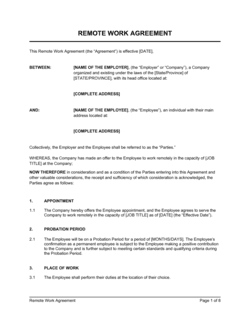
Strategies For Team Building When Employees Work At Home

Free Word download • Edit online • Save & share with Drive • Export to PDF

3 pages25–30 min to fillDifficulty: StandardSignature requiredLegal review recommended
Learn more ↓
FreeStrategies For Team Building When Employees Work At Home Template

At a glance

What it is
A Strategies for Team Building When Employees Work at Home document is a formal policy and agreement that establishes the employer's binding expectations, obligations, and structured programs for maintaining team cohesion, engagement, and productivity across a distributed workforce. This free Word download can be edited online and exported as PDF — covering communication protocols, virtual engagement activities, performance accountability, and employee well-being in a single signed document.
When you need it
Use it when transitioning a team to permanent or hybrid remote work, onboarding new remote employees, or formalizing informal practices that have evolved without written structure. It is also essential when employment law requires written remote-work terms or when managers need a consistent, enforceable framework to guide distributed teams.
What's inside
Scope and eligibility, communication standards and tools, scheduled virtual team-building activities, performance and accountability expectations, mental health and well-being commitments, data security and confidentiality obligations, dispute resolution, and governing law.

What is a Strategies for Team Building When Employees Work at Home Document?

A Strategies for Team Building When Employees Work at Home document is a formal, signed policy that establishes an employer's binding commitments and employee obligations for maintaining team cohesion, communication, engagement, and productivity across a distributed or work-from-home workforce. It goes beyond an informal guide by creating enforceable standards for communication tools and response times, scheduled virtual engagement activities, performance accountability, mental health support, data security at home, and expense reimbursement — all in a single document that both parties sign before remote work begins. Unlike a generic remote work agreement, this document focuses specifically on the cultural and operational infrastructure that prevents the isolation, misalignment, and disengagement that erode distributed teams over time.

Why You Need This Document

Without a written, signed strategy document, remote team-building practices exist only as informal habits that evaporate when a manager changes or headcount grows. Employees default to their own communication norms, core hours go undefined, and the absence of structured engagement activities accelerates the isolation that drives remote employee attrition — which runs measurably higher than in-office rates when no deliberate countermeasures are in place. There are also direct legal consequences to the gap: Ontario employers with 25 or more staff face fines for lacking a written disconnecting-from-work policy; UK employers must document remote-work particulars before day one; and EU employers operating without GDPR-compliant monitoring disclosures face regulatory action. A properly executed strategy document closes these compliance gaps while simultaneously giving managers and employees a shared framework that makes distributed teams function as cohesively as co-located ones.

Which variant fits your situation?

If your situation is…Use this template
Full-time permanent remote employees across multiple jurisdictionsRemote Work Employment Agreement
Hybrid team with fixed in-office days requiring attendance rulesHybrid Work Policy
Documenting home-office equipment and expense reimbursement termsRemote Work Expense Policy
Setting expectations for freelancers or contractors working remotelyIndependent Contractor Agreement
Establishing data security rules for employees on personal devicesIT and Acceptable Use Policy
Outlining mental health and wellness support for remote employeesEmployee Wellness Policy
Onboarding a new remote hire with structured 30-60-90 day goalsRemote Employee Onboarding Plan

Common mistakes to avoid

❌ Making all team-building activities mandatory

Why it matters: Requiring attendance at after-hours or social events can constitute unpaid work time in Canada, the UK, and several EU member states, creating wage liability and potential constructive dismissal claims.

Fix: Distinguish mandatory professional activities (e.g., quarterly all-hands) from encouraged social events, and schedule all mandatory events within contracted working hours.

❌ Using surveillance tools without written notice

Why it matters: Keystroke logging, screen capture, or continuous video monitoring without explicit written disclosure violates privacy law in Canada (PIPEDA), the UK (GDPR/UK GDPR), and all EU member states — exposing the employer to significant regulatory fines.

Fix: If any monitoring tool is used, describe it specifically in the data security clause, obtain written consent, and confirm the tool is permitted under the applicable jurisdiction's employment privacy law.

❌ Applying headquarters' core hours to all remote employees

Why it matters: Requiring a remote employee in London to be available during Pacific Time core hours may breach working-time regulations and creates resentment that undermines the engagement goals the policy is meant to achieve.

Fix: Define core hours in the employee's local time zone and limit mandatory overlap to a 2–4 hour window sufficient for team collaboration.

❌ No annual review clause

Why it matters: Remote work employment law has changed significantly since 2020 — GDPR monitoring guidance, Ontario's right-to-disconnect law, and the EU Platform Work Directive have all introduced new obligations. A static policy creates compliance gaps.

Fix: Include a mandatory annual review clause naming a responsible role and a review-by date, and update the policy before it exceeds 12 months from the last signed version.

❌ Vague reimbursement language with no cap or deadline

Why it matters: Open-ended reimbursement obligations — 'reasonable home office expenses will be covered' — have resulted in contested retroactive claims for thousands of dollars in several jurisdictions.

Fix: State a specific monthly or annual cap per expense category (e.g., internet: $60/month, equipment: $500 one-time) and require receipts submitted within 30 days of the expense.

❌ Governing law set to headquarters' state when employees work elsewhere

Why it matters: California, Ontario, and all EU member states apply local employment law regardless of a choice-of-law clause — a New York governing law clause does not override Ontario's Employment Standards Act minimum notice obligations or California's expense reimbursement statute.

Fix: Use the employee's work location as the governing jurisdiction, or include jurisdiction-specific addenda for employees in materially different locations.

The 10 key clauses, explained

Scope, Eligibility, and Effective Date

In plain language: Identifies which employees and roles are covered by the policy, the date it takes effect, and any eligibility criteria such as tenure, role type, or performance standing.

Sample language
This Policy applies to all employees of [COMPANY NAME] designated as remote or hybrid workers as of [EFFECTIVE DATE]. Employees in roles listed in Schedule A are eligible for remote work subject to manager approval and a minimum tenure of [X] months.

Common mistake: Applying the policy to 'all employees' without carving out roles that require physical presence. Ambiguity creates disputes when a role changes or a new position is created.

Communication Standards and Tools

In plain language: Specifies the approved platforms for internal communication, the expected response time for each channel, and the protocol for urgent or after-hours contact.

Sample language
Employees shall use [PLATFORM] for instant messaging and [PLATFORM] for video conferencing. Routine messages must be acknowledged within [X] business hours. Urgent matters flagged via [ESCALATION CHANNEL] require a response within [Y] hours.

Common mistake: Listing approved tools without specifying response-time expectations. Employees default to wildly different norms, creating friction between teams operating in different time zones.

Core Hours and Availability Protocol

In plain language: Defines the daily window when all remote employees must be reachable, how they signal availability, and how planned absences during core hours are communicated.

Sample language
All remote employees shall be available and responsive between [START TIME] and [END TIME] in their designated time zone, Monday through Friday. Employees must update their status in [PLATFORM] by [TIME] each morning and notify their manager of any unplanned absence within [X] minutes.

Common mistake: Setting core hours based on headquarters' time zone without acknowledging distributed employees in significantly different zones. This generates resentment and erodes engagement before team-building activities have any effect.

Scheduled Team-Building and Engagement Activities

In plain language: Commits the employer to a defined cadence of virtual team activities, including frequency, format, participation expectations, and the process for suggesting new activities.

Sample language
Company shall facilitate at minimum [X] virtual team-building activities per quarter, including [EXAMPLES: virtual social hours, cross-functional workshops, online skill-share sessions]. Participation is [mandatory / strongly encouraged]. Employees may submit activity proposals to [ROLE/TEAM] by the [DAY] of each month.

Common mistake: Framing all team-building activities as mandatory without distinguishing social events from professional ones. Mandatory social events expose the employer to claims of intrusion on personal time in several jurisdictions.

Performance Accountability and Check-In Schedule

In plain language: Sets the frequency and format of one-on-one check-ins between manager and employee, the metrics or OKRs used to measure productivity, and the process for raising performance concerns.

Sample language
Managers shall conduct one-on-one check-ins with each remote direct report no less than [weekly / bi-weekly]. Performance will be assessed against goals set in [PLATFORM / REVIEW CYCLE]. Formal performance concerns shall be documented within [X] business days of identification.

Common mistake: Conflating activity monitoring (time-tracking software, keystroke logging) with output-based accountability. Surveillance-style monitoring creates legal liability under privacy law in Canada, the UK, and the EU.

Mental Health, Well-being, and Isolation Prevention

In plain language: States the employer's commitment to employee well-being, including EAP access, mental health days, ergonomic support, and any programs specifically designed to address remote isolation.

Sample language
Company acknowledges that remote work may increase the risk of professional isolation. Employees have access to the Company's Employee Assistance Program at [CONTACT]. Employees may request up to [X] additional mental health days per year by notifying [ROLE] with [X] hours' notice.

Common mistake: Listing well-being resources without any commitment to reviewing or updating them. A static list of outdated resources signals that the policy was drafted once and filed — not maintained.

Data Security and Confidentiality Obligations

In plain language: Requires employees to follow the company's information security policy while working remotely, including rules for public Wi-Fi, VPN use, device encryption, and storage of confidential company data.

Sample language
Employees working remotely must connect to Company systems via the approved VPN at all times. Use of unsecured public Wi-Fi networks is prohibited without VPN. All work-related files must be stored in [APPROVED PLATFORM] and not on personal devices unless explicitly authorized by [ROLE].

Common mistake: Incorporating data security obligations by reference to an IT policy that employees have never seen. The security clause must stand independently or attach the policy as a named schedule.

Equipment, Expenses, and Home Office Standards

In plain language: Defines who provides work equipment, what home-office expenses the company reimburses, the process for claiming reimbursement, and minimum ergonomic or connectivity standards the employee must meet.

Sample language
Company shall provide [LIST OF EQUIPMENT]. Employees may claim reimbursement for home internet costs up to $[X] per month upon submission of receipts to [ROLE/SYSTEM] within [X] days. Employees are responsible for maintaining a workspace that meets the minimum standards set out in Schedule B.

Common mistake: Failing to specify a reimbursement cap or submission deadline. Open-ended reimbursement language creates financial exposure and is difficult to enforce retroactively.

Dispute Resolution and Policy Review

In plain language: Establishes how disagreements about policy interpretation or remote-work entitlements are raised and resolved, and commits the employer to reviewing the policy on a defined schedule.

Sample language
Disputes arising under this Policy shall first be raised with the employee's direct manager, then escalated to [HR ROLE] within [X] business days if unresolved. This Policy shall be reviewed no less than annually by [DATE] and updated to reflect changes in applicable law or company operations.

Common mistake: No review schedule. Employment law governing remote work is evolving rapidly — a policy that hasn't been updated since 2021 likely fails current standards in the UK, EU, and several Canadian provinces.

Governing Law and Acknowledgement

In plain language: States which jurisdiction's employment law governs the document and includes the employee acknowledgement and signature block confirming they have read, understood, and agreed to the policy.

Sample language
This Policy is governed by the laws of [STATE / PROVINCE / COUNTRY]. By signing below, Employee acknowledges receipt of this Policy and agrees to comply with its terms as a condition of continued remote-work eligibility. Employee: [SIGNATURE] [DATE]. Manager: [SIGNATURE] [DATE].

Common mistake: Choosing a governing law based on the company's headquarters rather than the employee's work location. Several jurisdictions — including California and EU member states — apply local employment law regardless of what the contract specifies.

How to fill it out

  1. 1

    Define the scope and eligible roles

    Enter the company's legal name, the effective date, and list which roles or departments are covered. Attach a Schedule A if certain roles are excluded from remote eligibility.

    💡 Update Schedule A whenever a new role is created or an existing role changes location requirements — stale role lists are the most common source of eligibility disputes.

  2. 2

    Set communication platforms and response-time standards

    List each approved tool by name (e.g., Slack, Microsoft Teams, Zoom) and assign a specific response-time expectation per channel. Distinguish between synchronous and asynchronous channels.

    💡 Differentiate expectations by urgency tier — routine queries, project updates, and emergency escalations should each have their own response window.

  3. 3

    Establish core hours adjusted for time zones

    Define the daily availability window in the employee's designated time zone, not the headquarters time zone. Document how employees signal availability and how planned absences are communicated.

    💡 For teams spanning more than two time zones, a 3-hour overlap window is typically sufficient for synchronous collaboration without penalizing employees in distant locations.

  4. 4

    Commit to a specific engagement cadence

    Enter the minimum number and type of team-building activities per quarter, the format (virtual social, workshop, learning session), and whether participation is mandatory or strongly encouraged.

    💡 Distinguish professional development events (which can be mandatory) from social events (which should be voluntary) to avoid constructive dismissal exposure in jurisdictions with strict working-time rules.

  5. 5

    Define performance metrics and check-in frequency

    State the one-on-one check-in schedule (weekly or bi-weekly is standard), the performance system used to track goals, and the documentation timeline for performance concerns.

    💡 Tie performance metrics to outputs and milestones rather than hours logged — output-based metrics are more defensible and less likely to trigger employee monitoring regulations.

  6. 6

    List well-being resources with contact details

    Include the EAP provider name and contact number, the number of mental health days available, and any stipends for ergonomic equipment or home-office setup.

    💡 Set a calendar reminder to verify EAP contact details and resource availability at the annual policy review — outdated contact information undermines employee trust.

  7. 7

    Attach the data security and equipment schedules

    Attach or reference the company's IT security policy as a named schedule. Enter the equipment list, the reimbursement cap, and the submission deadline for expense claims.

    💡 Require employees to confirm receipt of the IT policy separately — a single signature on the main document does not always satisfy data protection audit requirements in the EU or UK.

  8. 8

    Execute signatures before the remote work arrangement begins

    Both the employee and the signing manager must sign before remote work commences. File the executed copy in the employee's HR record and send a countersigned copy to the employee.

    💡 Use a timestamped e-signature platform to create an audit trail — particularly important if the employee later disputes their awareness of confidentiality or data security obligations.

Frequently asked questions

What is a remote team building strategy document?

A remote team building strategy document is a formal policy that defines how an employer will maintain team cohesion, communication, performance accountability, and employee well-being for a distributed or work-from-home workforce. Unlike an informal guide, a signed document creates binding obligations on both the employer and the employee, covering everything from approved communication tools and core hours to virtual engagement activities and data security obligations.

Is a remote team building policy legally required?

No jurisdiction currently mandates a document with this specific title, but several employment law obligations make a written policy effectively necessary. Ontario's Right to Disconnect legislation requires employers with 25 or more employees to have a written disconnecting-from-work policy. UK and EU employers must provide written particulars of remote working arrangements, including monitoring practices and working-time rules. A well-structured policy satisfies multiple overlapping obligations in a single document.

Can team-building activities be made mandatory for remote employees?

Professional development activities and scheduled team meetings held during contracted working hours can generally be made mandatory. Social or after-hours activities are a different matter — requiring attendance at events outside contracted hours may constitute unpaid work time in Canada, the UK, and the EU. The safest approach is to schedule all mandatory activities during core hours and clearly label social events as voluntary.

What communication tools should be specified in the policy?

Name each tool specifically rather than using generic categories. Include at minimum an instant messaging platform (e.g., Slack or Microsoft Teams), a video conferencing tool (e.g., Zoom or Google Meet), and an email system. Assign a response-time standard to each channel — for example, instant messages within 2 business hours, emails within 1 business day. Vague communication standards are the most common source of manager-employee conflict in distributed teams.

How should performance be measured for remote employees?

Output-based metrics — deliverables completed, milestones hit, OKRs tracked in a shared system — are both more effective and more legally defensible than activity-based monitoring such as time-tracking software or screen capture. Output metrics respect employee autonomy, reduce the risk of digital presenteeism, and avoid triggering employee monitoring regulations in Canada, the UK, and the EU.

Do remote employees have a right to disconnect from work?

Ontario, Canada enacted a Right to Disconnect law in 2022 requiring employers with 25 or more employees to maintain a written policy on disconnecting from work after hours. France, Spain, Portugal, Italy, and Belgium have similar legislative protections. Even where no explicit statute applies, failure to manage after-hours contact expectations can contribute to constructive dismissal claims or occupational health liability. A clear core-hours clause and an explicit statement that employees are not expected to respond outside those hours addresses this risk directly.

What expenses must an employer reimburse for remote employees?

This varies by jurisdiction. California Labor Code Section 2802 requires employers to reimburse all reasonable and necessary expenses, including home internet and phone costs. Ontario and most EU member states require reimbursement for equipment and connectivity costs necessary to perform the job. In the UK, employees can claim tax relief for home-working expenses; employers are not always legally required to reimburse directly but commonly do. Specifying a cap and a submission process in the policy prevents open-ended liability.

How often should a remote team building policy be updated?

At minimum annually, and immediately following any significant change in applicable employment law or company operations. Remote work legislation has evolved rapidly since 2020 — Ontario's disconnecting-from-work rules, the EU's updated telework guidance, and expanding GDPR enforcement on employee monitoring all require policy updates. Embedding an annual review clause naming a responsible role and a review-by date is the most reliable way to keep the policy current.

Does this policy need to be signed by employees?

Yes, and it should be signed before the remote work arrangement begins. An unsigned policy is difficult to enforce, particularly for confidentiality, data security, and equipment obligations. Use a timestamped e-signature platform to create a clear audit trail. File the countersigned copy in the employee's HR record and send a copy to the employee — this satisfies the written statement requirements applicable in the UK and most EU member states.

How this compares to alternatives

vs Remote Work Employment Agreement

A remote work employment agreement is a bilateral contract that amends an employee's terms of employment to reflect a remote arrangement — covering compensation, location, equipment, and termination rights. A team building strategy document focuses on the operational and cultural framework governing how distributed teams communicate, collaborate, and maintain engagement. Both documents are often used together: the agreement sets the legal terms, and the strategy document operationalizes the day-to-day expectations.

vs Employee Handbook

An employee handbook covers the full range of workplace policies — conduct, leave, benefits, and disciplinary procedures — for all employees. A remote team building strategy document is narrower and more actionable, focusing specifically on the structures and commitments that address the unique challenges of distributed work. A well-organized handbook will reference or incorporate the remote strategy document rather than duplicate it.

vs Independent Contractor Agreement

An independent contractor agreement governs a self-employed individual engaged for project-based work — it does not create an employment relationship or carry employer obligations around engagement, well-being, or team cohesion. A remote team building policy applies exclusively to employees. Using a contractor agreement as a substitute for employee remote-work documentation is a misclassification risk.

vs IT and Acceptable Use Policy

An IT and acceptable use policy governs how employees may use company systems, devices, and networks — it is a security and compliance document. A remote team building strategy document is primarily a people and culture document, though it incorporates data security obligations by reference. The two documents serve different purposes and should be maintained separately, with the remote strategy document cross-referencing the IT policy as an attached schedule.

Industry-specific considerations

Technology / SaaS

Distributed engineering and product teams require explicit asynchronous communication standards, overlap-hour rules across time zones, and strict BYOD and data security obligations covering source code and customer data.

Professional Services

Client confidentiality obligations extend into the home office environment, requiring VPN mandates, secure document handling rules, and engagement cadences that maintain billable team coordination without inflating meeting time.

Financial Services

Regulatory requirements from FINRA, FCA, and equivalent bodies govern remote supervision of licensed employees — the policy must address supervision protocols, secure communication channels, and audit trail obligations for client-facing staff.

Healthcare

HIPAA in the US and equivalent data protection rules in Canada and the EU require that remote employees handling patient records use encrypted connections, approved devices, and compliant storage platforms — all of which must be specified in the policy.

Education

Remote teaching and administrative staff need structured engagement cadences tied to academic calendars, clear availability protocols during student contact hours, and well-being provisions addressing the emotional demands of remote student support.

Retail / E-commerce

Back-office and customer service teams working from home require defined shift availability windows, performance metrics tied to ticket resolution and response times, and equipment standards for reliable connectivity during peak trading periods.

Jurisdictional notes

United States

No federal statute mandates a remote team building policy, but California Labor Code Section 2802 requires reimbursement of all necessary remote-work expenses. The FTC's guidance on employee monitoring and state-level biometric privacy laws (Illinois BIPA, Texas CUBI) apply to certain monitoring tools used on remote employees. Employers with workers in multiple states should include state-specific addenda addressing expense reimbursement, monitoring disclosure, and wage payment rules.

Canada

Ontario's Right to Disconnect legislation (Employment Standards Act, s. 21.1.1) requires employers with 25 or more employees to maintain a written disconnecting-from-work policy, which must be provided to employees within 30 days of hire or policy change. Most provincial privacy statutes (PIPEDA federally; Quebec Law 25) require explicit disclosure of any employee monitoring. Quebec's Law 25 imposes stricter consent and data handling requirements; remote policies for Quebec employees should be reviewed in French.

United Kingdom

UK employers must provide a written statement of employment particulars that includes the employee's place of work — a home-office arrangement must be reflected here. UK GDPR and the ICO's guidance on employee monitoring require that any remote monitoring tools be disclosed in writing, proportionate to the business need, and supported by a Data Protection Impact Assessment. The Working Time Regulations 1998 cap the working week at 48 hours (opt-out permitted) and apply equally to remote employees.

European Union

The EU's 2002 Framework Agreement on Telework and the 2020 European Social Partners' Framework Agreement on Digitalisation set baseline expectations for remote work conditions, including voluntary participation, cost coverage, and well-being protections. GDPR Article 88 permits member states to adopt specific rules on employee data processing — monitoring remote employees without explicit written notice and a documented legal basis is a common GDPR violation. Several member states (France, Spain, Belgium, Portugal) have enacted right-to-disconnect laws with financial penalties for non-compliance.

Template vs lawyer — what fits your deal?

PathBest forCostTime
Use the templateSmall businesses and single-jurisdiction employers formalizing remote work practices for the first timeFree1–2 hours
Template + legal reviewEmployers with remote workers in multiple provinces, states, or countries, or where employee monitoring tools are in use$300–$800 for an employment lawyer review2–5 days
Custom draftedEnterprises with large distributed workforces, regulated industries, or multi-jurisdictional operations requiring jurisdiction-specific addenda$1,500–$4,000+2–4 weeks

Glossary

Distributed Workforce
A group of employees who perform their work in different physical locations rather than a shared central office.
Asynchronous Communication
Work communication that does not require all parties to be present or respond at the same time — email and recorded video updates are common examples.
Virtual Team Building
Structured activities and programs designed to build trust, collaboration, and culture among employees who do not share a physical workspace.
Psychological Safety
A team environment where members feel safe to speak up, ask questions, and make mistakes without fear of negative consequences to their standing.
Core Hours
A defined window during the workday when all remote employees are expected to be available and responsive, regardless of their broader flexible schedule.
Availability Protocol
The agreed method and response-time standard by which remote employees signal their working status and respond to colleagues and managers.
Digital Presenteeism
The pressure remote employees feel to appear constantly online or responsive to compensate for not being physically visible in an office.
Engagement Cadence
The scheduled frequency of structured check-ins, team meetings, one-on-ones, and social activities that an employer commits to providing.
Well-being Provision
Employer-funded or employer-facilitated resources — such as EAP access, mental health days, or stipends for ergonomic equipment — that support remote employees' physical and psychological health.
Remote Work Policy
A formal document that sets the conditions, expectations, and rights governing employees who work outside the employer's physical premises.
BYOD (Bring Your Own Device)
A workplace policy allowing employees to use personal devices for work, typically subject to security and acceptable-use rules set by the employer.
Duty of Care
An employer's legal and ethical obligation to take reasonable steps to protect the health, safety, and well-being of employees — including those working remotely.

Part of your Business Operating System

This document is one of 3,000+ business & legal templates included in Business in a Box.

  • Fill-in-the-blanks — ready in minutes
  • 100% customizable Word document
  • Compatible with all office suites
  • Export to PDF and share electronically

Create your document in 3 simple steps.

From template to signed document — all inside one Business Operating System.
1
Download or open template

Access over 3,000+ business and legal templates for any business task, project or initiative.

2
Edit and fill in the blanks with AI

Customize your ready-made business document template and save it in the cloud.

3
Save, Share, Send, Sign

Share your files and folders with your team. Create a space of seamless collaboration.

Save time, save money, and create top-quality documents.

★★★★★

"Fantastic value! I'm not sure how I'd do without it. It's worth its weight in gold and paid back for itself many times."

Managing Director · Mall Farm
Robert Whalley
Managing Director, Mall Farm Proprietary Limited
★★★★★

"I have been using Business in a Box for years. It has been the most useful source of templates I have encountered. I recommend it to anyone."

Business Owner · 4+ years
Dr Michael John Freestone
Business Owner
★★★★★

"It has been a life saver so many times I have lost count. Business in a Box has saved me so much time and as you know, time is money."

Owner · Upstate Web
David G. Moore Jr.
Owner, Upstate Web

Run your business with a system — not scattered tools

Stop downloading documents. Start operating with clarity. Business in a Box gives you the Business Operating System used by over 250,000 companies worldwide to structure, run, and grow their business.

Start free · No credit card required