Request for Pickup of Repaired Merchandise Template

Free Word download β€’ Edit online β€’ Save & share with Drive β€’ Export to PDF

1 pageβ€’15–25 min to fillβ€’Difficulty: Standard
Learn more ↓
FreeRequest for Pickup of Repaired Merchandise Template

At a glance

What it is
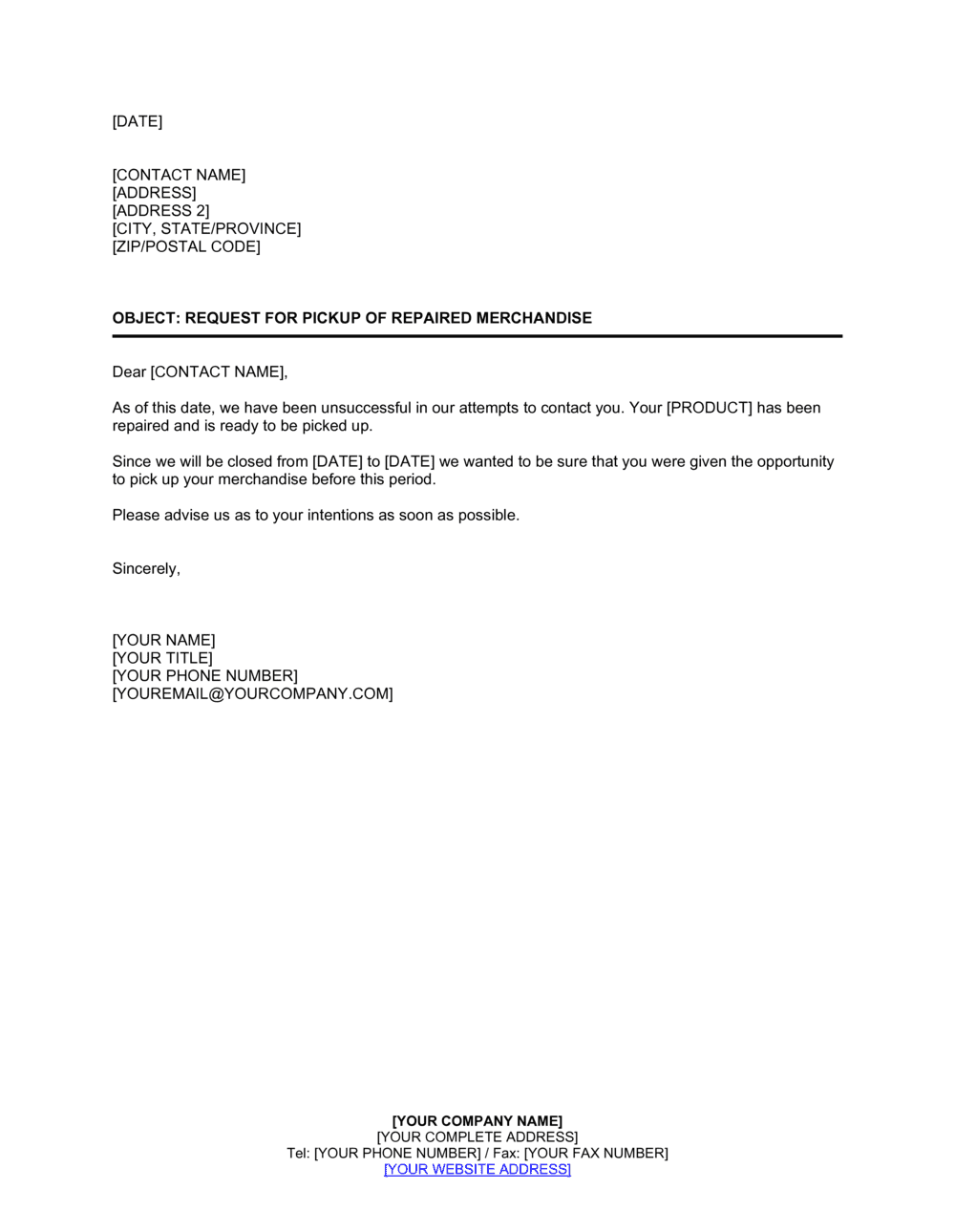
A Request for Pickup of Repaired Merchandise is a formal business letter sent to a customer notifying them that their item has been repaired and is available for collection. This free Word download gives you a ready-to-edit template you can personalize with the customer's name, item description, repair details, and pickup deadline, then export as PDF or send directly by email or mail.
When you need it
Use it whenever a repair job is complete and you need to formally notify the customer to collect their item. It is especially important when the item has been held for some time, a balance is due before release, or you need to set a deadline after which storage fees or disposal may apply.
What's inside
Sender and recipient details, a clear statement that the repair is complete, a description of the item and work performed, the balance due before pickup, the pickup deadline, and any storage or abandonment policy that applies after that date.

What is a Request for Pickup of Repaired Merchandise?

A Request for Pickup of Repaired Merchandise is a formal business letter sent by a repair business to a customer notifying them that their item has been serviced and is ready for collection. It documents the repair work completed, states any outstanding balance that must be settled before the item is released, sets a specific pickup deadline, and outlines any storage fees or abandonment policy that applies if the customer does not respond in time. Unlike a casual phone call or text message, a written pickup notice creates a dated, documented record of notification that supports any downstream action β€” such as charging storage fees or asserting a lien β€” if the customer fails to collect.

Why You Need This Document

Relying on phone calls alone to notify customers of completed repairs leaves your business exposed in two ways: there is no record that the customer was notified, and there is nothing in writing to enforce a pickup deadline or support a storage fee claim. Without a formal written notice, a customer who disputes a charge months later β€” or who claims they were never told the item was ready β€” has no written evidence to contradict. For high-value items, uncollected merchandise ties up limited storage space and working capital indefinitely. A clear, dated pickup letter starts the clock on your deadline, documents the balance owed, and gives you a paper trail to stand behind if you ever need to assert lien rights or report an item as abandoned. This template gives you a professional, ready-to-send letter you can complete in five minutes and adapt for any repair category.

Which variant fits your situation?

If your situation is…Use this template
Repair is complete and no outstanding balance is owedRequest for Pickup of Repaired Merchandise (Paid in Full)
Balance remains due and must be settled before item is releasedRequest for Pickup of Repaired Merchandise (Balance Due)
Customer has not responded and a second notice is neededSecond Notice β€” Repaired Merchandise Ready for Pickup
Item has been abandoned and formal disposal notice is requiredAbandoned Property Notice Letter
Repair could not be completed and item must be returned as-isReturn of Unrepaired Merchandise Letter
Item is ready but customer requested delivery instead of pickupShipment Notification Letter

Common mistakes to avoid

❌ Using an open-ended pickup deadline

Why it matters: Phrases like 'as soon as possible' or 'at your earliest convenience' create no urgency and give you no basis to charge storage fees or enforce an abandonment policy.

Fix: Always specify a calendar date β€” e.g., 'Please collect your item by June 15, 2026' β€” so both parties have a clear, documented expectation.
❌ Omitting the repair order number

Why it matters: Without a reference number, customers who have multiple items in for repair cannot identify which item the letter concerns, leading to confusion and delays at the counter.

Fix: Include the repair order number in the subject line and again in the body of the letter so it is impossible to miss.

❌ Not stating that the item is held pending payment

Why it matters: If you do not explicitly say the item will not be released until the balance is paid, customers may arrive expecting to collect first and pay later β€” or dispute the charge at the door.

Fix: Add a single clear sentence: 'This item will not be released until the full balance of $[AMOUNT] is settled at the time of pickup.'

❌ Sending the letter to the wrong contact or address

Why it matters: A pickup notice that never reaches the customer cannot create a valid deadline. If you later charge storage fees or dispose of the item, you may have no legal basis to do so.

Fix: Verify the customer's contact details against the original intake record before sending, and consider sending by both email and post for important or high-value items.

The 9 key clauses, explained

Sender and date block

In plain language: Business name, address, phone number, and the date the letter is issued β€” establishes who sent the notice and when.

Sample language
[BUSINESS NAME] | [ADDRESS] | [PHONE NUMBER] | [EMAIL] | Date: [DATE]

Common mistake: Omitting the date β€” without it there is no clear reference point for the pickup deadline, making the deadline unenforceable.

Recipient address block

In plain language: Customer's full name and mailing or email address, so the letter reaches the correct person and creates a delivery record.

Sample language
[CUSTOMER FULL NAME] | [ADDRESS LINE 1] | [CITY, STATE, ZIP]

Common mistake: Using only a first name. If the letter is ever needed to support a lien or small claims action, the full legal name and address are required.

Subject line

In plain language: A brief heading identifying the letter's purpose and linking it to the specific repair order for easy reference.

Sample language
Subject: Repair Completed β€” [ITEM DESCRIPTION] | Repair Order #[NUMBER]

Common mistake: Skipping the subject line entirely. Customers who receive multiple correspondence from a business cannot quickly identify which item the letter refers to.

Repair completion notice

In plain language: The opening statement confirming the repair is complete and the item is ready for collection β€” the core purpose of the letter.

Sample language
We are pleased to inform you that your [ITEM DESCRIPTION] has been fully repaired and is now ready for pickup at our location at [ADDRESS].

Common mistake: Adding apologetic or vague language like 'we believe the repair is complete.' State it plainly and affirmatively to avoid customer confusion.

Description of work performed

In plain language: A brief summary of what was repaired, replaced, or serviced so the customer knows exactly what was done to their item.

Sample language
The following service was completed: [DESCRIPTION OF REPAIR β€” e.g., replaced [PART], recalibrated [COMPONENT], cleaned and lubricated [MECHANISM]].

Common mistake: Leaving the work description blank or too vague. If the customer disputes the repair later, this line is the primary written record of what was agreed and delivered.

Balance due and payment terms

In plain language: States any amount owed for parts and labor, accepted payment methods, and confirms the item will not be released until the balance is settled.

Sample language
The total balance due for this repair is $[AMOUNT]. Payment is required at the time of pickup. We accept [PAYMENT METHODS]. The item will be held until full payment is received.

Common mistake: Omitting payment terms when a balance is owed. Customers who arrive unprepared to pay create disputes at the counter and delay turnover of your work queue.

Pickup deadline

In plain language: A specific calendar date by which the customer must collect the item, giving both parties a clear and documented expectation.
Sample language
Please arrange to collect your item by [SPECIFIC DATE β€” e.g., June 15, 2026]. Items not collected by this date may be subject to a storage fee of $[AMOUNT] per [DAY/WEEK].

Common mistake: Writing 'as soon as possible' instead of a specific date. An open-ended deadline creates no urgency and cannot support a storage fee or abandonment claim.

Storage fee and abandonment notice

In plain language: Explains the consequences of failing to collect by the deadline β€” daily storage charges and the business's right to dispose of the item after a further defined period.

Sample language
Items not collected within [X] days of the above deadline may be deemed abandoned and subject to disposal or resale in accordance with applicable law, with proceeds applied to the outstanding balance.

Common mistake: Threatening disposal without specifying the holding period. Courts and regulators in most jurisdictions require a minimum notice period before abandoned property can be disposed of β€” check your local rules.

Contact information and closing

In plain language: Provides a name, phone number, and hours for the customer to reach the business with questions or to arrange pickup.

Sample language
To schedule your pickup or if you have any questions, please contact [CONTACT NAME] at [PHONE NUMBER] during business hours [HOURS]. We look forward to hearing from you.

Common mistake: Providing only a general business number with no named contact or hours. Customers who cannot reach someone easily delay pickup further.

How to fill it out

  1. 1

    Fill in your business and contact details

    Enter your business name, full address, phone number, and email in the sender block at the top of the letter. Confirm the details match your official business records.

    πŸ’‘ Save a version with your business details pre-filled as a master template to reuse for every repair completion notice.

  2. 2

    Enter the customer's full name and address

    Add the customer's legal name and current mailing address. If you are sending by email, include both the postal address and email address for a complete record.

    πŸ’‘ Match the customer name exactly to the name used on the original repair intake form to prevent release disputes.

  3. 3

    Add the repair order number and item description

    Reference the specific repair order number and describe the item clearly β€” make, model, serial number if applicable, and color. Precise identification avoids any confusion about which item is being collected.

    πŸ’‘ Include the serial number or a unique identifier for high-value items. This protects you if ownership is disputed at pickup.

  4. 4

    Summarize the work performed

    Write a concise but specific description of what was repaired, replaced, or serviced. Pull this directly from your completed work order.

    πŸ’‘ Keep it factual and brief β€” two to three lines is enough. This line protects you if the customer later claims a different repair was agreed.

  5. 5

    State the balance due and accepted payment methods

    Enter the total amount owed and list every payment method you accept β€” cash, card, bank transfer, or digital payment. State clearly that the item will not be released until payment is complete.

    πŸ’‘ If the item was fully prepaid, replace this section with a confirmation that no balance is due β€” it removes friction at pickup.

  6. 6

    Set a specific pickup deadline date

    Choose a concrete calendar date β€” typically 7 to 14 days from the issue date β€” and enter it in the pickup deadline clause. Add your storage fee rate if one applies after that date.

    πŸ’‘ A 10-day deadline strikes the right balance: enough time for the customer to arrange collection without tying up your storage space indefinitely.

  7. 7

    Review, date, and send

    Read the completed letter once for accuracy β€” names, amounts, dates, and repair details. Export as PDF and send by email, post, or both for maximum delivery confirmation.

    πŸ’‘ Sending by email with a read receipt and following up by phone the same day cuts average pickup time significantly compared to mail alone.

Frequently asked questions

What is a request for pickup of repaired merchandise letter?

It is a formal written notice a business sends to a customer informing them that their item has been repaired and is ready for collection. It identifies the item and repair work completed, states any balance due before release, sets a specific pickup deadline, and outlines any storage or abandonment policy that applies if the item is not collected in time.

When should I send this letter?

Send it as soon as the repair is complete and the item is ready for collection. Prompt notification reduces the time items sit in your storage area and starts the clock on any pickup deadline you want to enforce. For high-value items or long-standing repair jobs, sending a written notice rather than relying solely on a phone call creates a documented record.

Do I need to sign this letter?

A signature is not required for this letter to be effective as a business notice. However, including the name and contact details of a specific person at your business adds professionalism and gives the customer a clear point of contact. For high-value items, printing on company letterhead and signing adds a layer of formality.

Can I charge a storage fee if the customer does not pick up on time?

In most jurisdictions, you can charge storage fees if your letter clearly states the fee amount, the rate (e.g., $5 per day), and the date from which it applies. The fee must be disclosed in writing before it accrues β€” a letter that mentions it for the first time after the deadline has passed is generally not enforceable. Consider noting your storage policy on the original repair intake form as well.

What happens if the customer never picks up the item?

After a defined holding period β€” which varies by jurisdiction and the type of item β€” unclaimed property may be treated as abandoned. Many states and provinces have specific unclaimed or abandoned property laws that govern how long you must hold the item, what notice you must give, and how proceeds from disposal or sale must be handled. Consult your local regulations before disposing of any unclaimed merchandise.

Should I send this letter by email or by post?

Sending by both email and postal mail gives you the strongest delivery record. Email provides speed and an instant timestamp; a mailed letter creates a physical record that is harder to dispute. For routine repairs of low value, email alone is typically sufficient. For high-value items or customers who have been unresponsive, certified mail with return receipt is the most defensible option.

What if the customer disputes the repair or the charge when they arrive?

A well-completed pickup letter β€” with the repair description drawn from the original work order and the balance stated in writing β€” is your primary documentation if a dispute arises. Keep copies of the letter, the original intake form, and the completed work order together in the customer's file. If a charge is disputed after payment, the written record confirms what was agreed and performed.

Can this letter be used for warranty repairs?

Yes. For warranty repairs where no balance is owed, simply remove or replace the payment clause with a confirmation that the repair was completed at no charge under the applicable warranty. The remaining structure β€” item description, work performed, pickup deadline, and contact details β€” remains fully relevant and useful.

How this compares to alternatives

vs Shipment notification letter

A shipment notification letter tells a customer their item has been dispatched to them by courier or post. A pickup request letter instructs the customer to come to your location to collect in person. Use a shipment notification when you are delivering the repaired item; use a pickup request when the customer must retrieve it themselves.

vs Repair invoice

A repair invoice is a billing document that itemizes parts, labor, and total charges. A pickup request letter is a customer communication that includes the balance due but focuses on notifying the customer the item is ready. Both documents should be issued together β€” the invoice details the charges; the letter requests action.

vs Abandoned property notice

An abandoned property notice is sent after the pickup deadline has passed and the customer has not responded to prior notices. A pickup request letter is the first formal contact after the repair is complete. The pickup letter starts the process; the abandonment notice is the final warning before disposal.

vs Customer complaint response letter

A complaint response letter addresses a customer's dissatisfaction with a product or service. A pickup request letter is a proactive operational notice with no complaint context. If a customer disputes the repair after receiving the pickup notice, a separate complaint response letter should be issued.

Industry-specific considerations

Automotive Services

Vehicle description includes make, model, year, VIN, and license plate; balance due covers parts and labor separately; lien rights over the vehicle may apply if the bill is unpaid.

Electronics and Appliance Repair

Serial number is essential for item identification; warranty repair versus paid repair must be clearly distinguished; short pickup windows are common due to limited storage space.

Jewelry and Luxury Goods

High-value items warrant certified mail delivery and a signed release on collection; detailed description of stones and metals protects against substitution disputes.

Tailoring, Alterations, and Dry Cleaning

High item volume and tight storage mean short deadlines of 7–10 days are standard; garment ticket number replaces repair order number as the key reference.

Template vs pro β€” what fits your needs?

PathBest forCostTime
Use the templateAny repair business notifying customers of routine completed repairsFree5 minutes per letter
Template + professional reviewBusinesses adding enforceable storage fees, lien language, or abandonment clauses for high-value items$50–$150 (paralegal or business advisor review)1–2 hours
Custom draftedRegulated industries or businesses handling high volumes of unclaimed property requiring jurisdiction-specific legal language$200–$500 (attorney review)1–3 days

Glossary

Repair Order Number
A unique reference number assigned to a repair job, used to track the item and associated costs in the shop's records.
Pickup Deadline
The specific date by which the customer must collect the repaired item before storage fees or other consequences apply.
Balance Due
The outstanding amount the customer owes for parts, labor, or service charges before the item can be released.
Storage Fee
A daily or weekly charge applied to items that remain uncollected after the stated pickup deadline.
Abandonment Policy
The business's stated procedure for disposing of, donating, or reselling unclaimed items after a defined holding period.
Work Order
An internal document detailing the scope of repairs performed, parts used, labor hours, and total cost.
Release Authorization
Confirmation β€” often a signature or payment receipt β€” that the item has been paid for and the customer has taken possession.
Lien
A legal claim a repair business may hold over an item until the outstanding service bill is paid, giving the business the right to retain the property.

Part of your Business Operating System

This document is one of 3,000+ business & legal templates included in Business in a Box.

  • Fill-in-the-blanks β€” ready in minutes
  • 100% customizable Word document
  • Compatible with all office suites
  • Export to PDF and share electronically

Create your document in 3 simple steps.

From template to signed document β€” all inside one Business Operating System.
1
Download or open template

Access over 3,000+ business and legal templates for any business task, project or initiative.

2
Edit and fill in the blanks with AI

Customize your ready-made business document template and save it in the cloud.

3
Save, Share, Send, Sign

Share your files and folders with your team. Create a space of seamless collaboration.

Save time, save money, and create top-quality documents.

β˜…β˜…β˜…β˜…β˜…

"Fantastic value! I'm not sure how I'd do without it. It's worth its weight in gold and paid back for itself many times."

Managing Director Β· Mall Farm
Robert Whalley
Managing Director, Mall Farm Proprietary Limited
β˜…β˜…β˜…β˜…β˜…

"I have been using Business in a Box for years. It has been the most useful source of templates I have encountered. I recommend it to anyone."

Business Owner Β· 4+ years
Dr Michael John Freestone
Business Owner
β˜…β˜…β˜…β˜…β˜…

"It has been a life saver so many times I have lost count. Business in a Box has saved me so much time and as you know, time is money."

Owner Β· Upstate Web
David G. Moore Jr.
Owner, Upstate Web

Run your business with a system β€” not scattered tools

Stop downloading documents. Start operating with clarity. Business in a Box gives you the Business Operating System used by over 250,000 companies worldwide to structure, run, and grow their business.

Start freeΒ Β·Β No credit card required