Notice of Dissolution_Partnership Template

Free Word download β€’ Edit online β€’ Save & share with Drive β€’ Export to PDF

1 pageβ€’20–25 min to fillβ€’Difficulty: Standard
Learn more ↓
FreeNotice of Dissolution_Partnership Template

At a glance

What it is
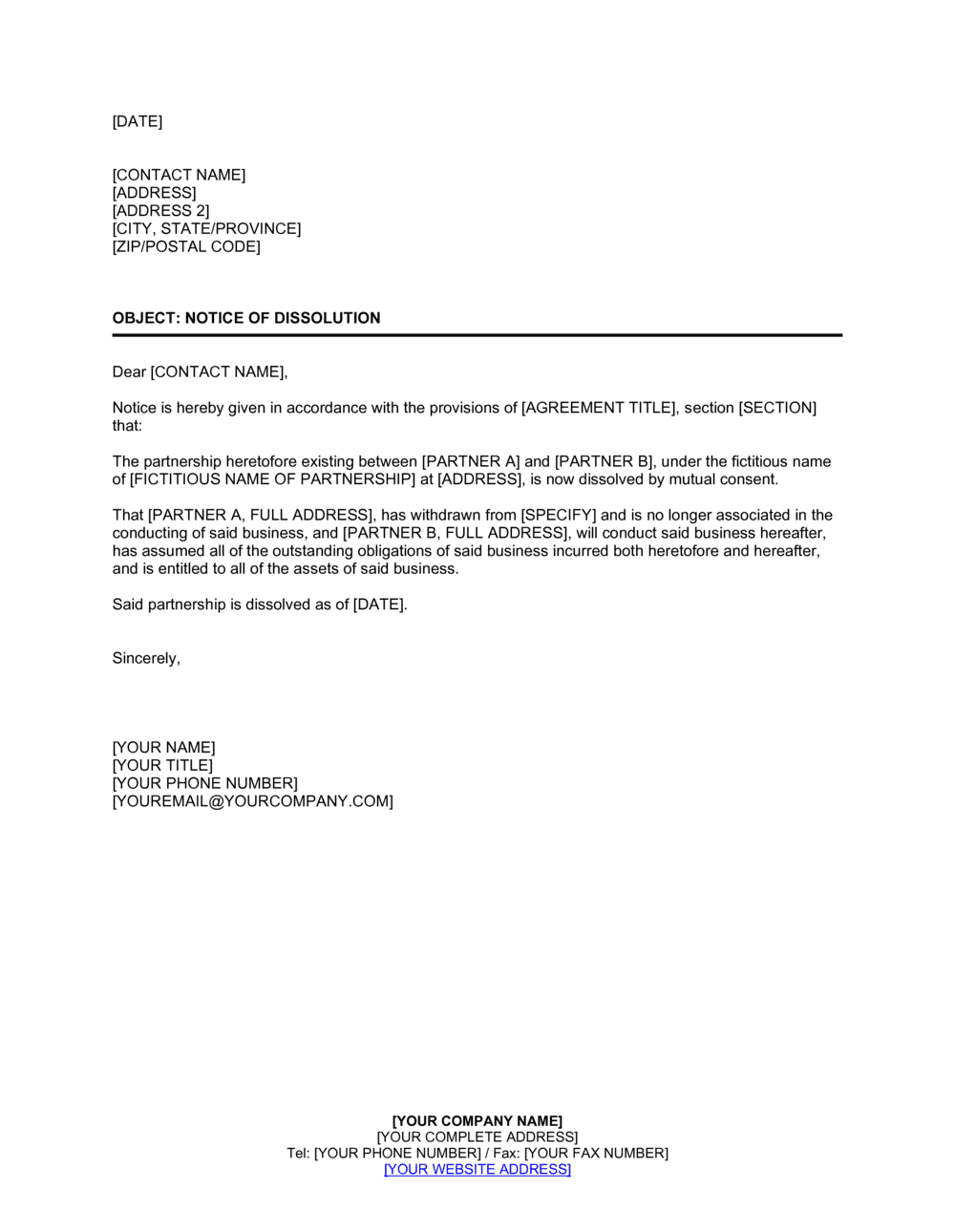
A Notice of Dissolution Partnership is a formal business letter that officially informs clients, suppliers, creditors, and other third parties that a partnership has ceased operations and is being dissolved. This free Word download gives you a ready-to-edit template you can tailor in minutes and export as PDF to send to everyone who needs to know.
When you need it
Use it as soon as the partners have agreed to dissolve β€” or when a statutory event such as a partner's death, bankruptcy, or expiration of the partnership term triggers automatic dissolution. Sending it promptly limits the partnership's exposure to new obligations incurred by a partner acting after dissolution.
What's inside
The notice covers the partnership's legal name and effective dissolution date, the identities of all partners, a statement that the partnership is no longer authorized to conduct business, instructions for settling outstanding obligations, and a designated contact for follow-up inquiries.

What is a Notice of Dissolution Partnership?

A Notice of Dissolution Partnership is a formal business letter that officially communicates to clients, suppliers, creditors, banks, and other third parties that a partnership has ended and is no longer authorized to conduct business. It identifies the partnership by its legal name, names the individual partners, states the effective dissolution date, and provides clear instructions for handling any outstanding invoices, claims, or account matters. Unlike the internal dissolution agreement the partners sign among themselves, this notice is an outward-facing document whose purpose is to put the outside world on legal notice β€” protecting former partners from liability for obligations incurred after the dissolution date by someone relying on the partnership's apparent authority.

Why You Need This Document

Without a written notice of dissolution sent to the relevant parties, a former partner could continue entering agreements in the partnership's name and bind all other partners to those obligations β€” even after everyone has agreed the business is over. The doctrine of apparent authority means that a supplier or client who had no notice of the dissolution can legitimately hold all partners responsible for a transaction they knew nothing about. Beyond liability protection, the notice triggers practical steps: creditors know where to submit claims, clients know who to contact for their accounts, and financial institutions know to freeze or close partnership accounts. A clear, dated, and delivered notice is the single most cost-effective action you can take to protect yourself and your former partners during a wind-down. This template gives you a professional, complete letter you can customize in under 30 minutes and send the same day.

Which variant fits your situation?

If your situation is…Use this template
Dissolving a general partnership with multiple active partnersNotice of Dissolution Partnership
Winding down a limited partnership with LP and GP interestsLimited Partnership Dissolution Agreement
Ending a two-person joint venture on a completed projectJoint Venture Termination Letter
Formally dissolving an LLC rather than a partnershipNotice of Dissolution LLC
Notifying employees of a business closureBusiness Closure Letter to Employees
Documenting the internal agreement to wind up partnership affairsPartnership Dissolution Agreement

Common mistakes to avoid

❌ No effective date specified

Why it matters: Without a clear effective date, third parties cannot determine when the partnership's authority ended, leaving the door open for claims based on actions taken after dissolution.

Fix: Always state a specific calendar date in both the subject line and the opening paragraph. Never use vague language like 'immediately' or 'as soon as possible.'
❌ Sending the notice only to some creditors

Why it matters: Creditors who do not receive actual notice may successfully argue they were entitled to rely on the partnership's apparent authority, exposing former partners to personal liability.

Fix: Compile a complete list of all creditors, suppliers, and counterparties before sending the notice and document that each one received it.

❌ Describing dissolution as a temporary suspension

Why it matters: Soft language like 'pausing operations' or 'going on hiatus' fails to put third parties on proper legal notice and can imply the partnership may resume business.

Fix: Use plain, direct language β€” 'the partnership has been dissolved' β€” in the opening sentence so the legal status is unambiguous.

❌ Omitting a named contact for outstanding claims

Why it matters: Creditors with unresolved balances will have no clear channel to submit their claims, prolonging the winding-up process and potentially resulting in missed obligations.

Fix: Name a specific individual with a direct email and phone number, and set a deadline by which claims must be submitted.

The 8 key clauses, explained

Header and Date

In plain language: The sender's business name and address, the date the letter is issued, and the recipient's name and address.

Sample language
[PARTNERSHIP LEGAL NAME] | [ADDRESS] | [CITY, STATE, ZIP] | [DATE] | To: [RECIPIENT NAME], [RECIPIENT COMPANY], [ADDRESS]

Common mistake: Using the sender's personal address rather than the partnership's registered business address, which can create ambiguity about which entity is dissolving.

Subject Line

In plain language: A concise one-line label that identifies the letter's purpose so the recipient can route and file it immediately.

Sample language
Re: Notice of Dissolution of [PARTNERSHIP LEGAL NAME], effective [EFFECTIVE DATE]

Common mistake: Omitting the effective date from the subject line, forcing the reader to scan the body for the most critical piece of information.

Opening Statement of Dissolution

In plain language: A direct statement confirming that the partnership is dissolving, naming all partners, and citing the basis for dissolution β€” mutual agreement, expiration of term, or statutory event.

Sample language
We write to inform you that [PARTNERSHIP LEGAL NAME], a [STATE] general partnership composed of [PARTNER 1 NAME] and [PARTNER 2 NAME], has been dissolved by mutual agreement, effective [EFFECTIVE DATE].

Common mistake: Describing the dissolution as a 'pause in operations' rather than a formal dissolution, which leaves third parties uncertain about the partnership's legal status.

Cessation of Business Authority

In plain language: Explicitly states that the partnership is no longer authorized to enter new contracts, accept orders, or incur obligations as of the effective date.

Sample language
As of [EFFECTIVE DATE], [PARTNERSHIP LEGAL NAME] is no longer authorized to conduct business, accept new orders, or enter into agreements on behalf of the partnership.

Common mistake: Failing to include this clause, which can expose the partnership to liability for obligations a third party believes were authorized after dissolution.

Settlement of Outstanding Obligations

In plain language: Instructs creditors and vendors on how to submit outstanding invoices or claims, including a contact person and submission deadline.

Sample language
Any outstanding invoices, claims, or obligations owed to or by [PARTNERSHIP LEGAL NAME] should be directed to [CONTACT NAME] at [EMAIL] or [PHONE] no later than [DATE].

Common mistake: Setting no deadline for submitting claims, which prolongs the winding-up process and delays final distribution to the partners.

Transfer or Continuation of Business

In plain language: Where applicable, identifies whether a successor entity or one of the former partners will continue servicing existing clients or contracts.

Sample language
Existing client engagements will be transitioned to [SUCCESSOR ENTITY / PARTNER NAME], who can be reached at [CONTACT DETAILS]. We will ensure continuity of service during the transition period ending [DATE].

Common mistake: Omitting this clause when a continuation exists, leaving clients uncertain about who now holds their account and delaying their own internal re-approvals.

Return of Property and Account Closure

In plain language: Notifies relevant parties to return partnership property and advises financial institutions and vendors to close or transfer accounts in the partnership's name.

Sample language
Any property, equipment, or materials belonging to [PARTNERSHIP LEGAL NAME] should be returned to [ADDRESS] by [DATE]. Please close or transfer all accounts held in the partnership's name effective [EFFECTIVE DATE].

Common mistake: Addressing this only verbally without including it in the written notice, which creates disputes about when the closure instruction was received.

Closing and Contact Information

In plain language: A brief professional closing that thanks the recipient for the business relationship and provides a named contact for follow-up questions.

Sample language
We sincerely appreciate the relationship we have shared and regret any inconvenience this transition may cause. For questions, please contact [NAME] at [EMAIL / PHONE]. Sincerely, [PARTNER SIGNATURES].

Common mistake: Using an impersonal generic sign-off with no named contact, which causes recipients to send follow-up inquiries to defunct inboxes or phone lines.

How to fill it out

  1. 1

    Enter the partnership's legal name and address

    Use the full registered name of the partnership exactly as it appears on your state or provincial filing. Enter the partnership's business address, not a personal address.

    πŸ’‘ Cross-check the name against your original partnership registration certificate to avoid discrepancies that could cause confusion with government records.

  2. 2

    Set and confirm the effective dissolution date

    Insert the specific date on which the partnership legally ceases operations. This date should align with the resolution passed by the partners or the date specified in your partnership agreement.

    πŸ’‘ Choose an effective date at least 10 business days in the future when possible β€” this gives recipients time to process the notice before it takes effect.

  3. 3

    List all partners by full legal name

    Name every partner in the opening statement so recipients have a complete and unambiguous record of who composed the partnership.

    πŸ’‘ If a partner has a trade name or common name different from their legal name, include the legal name and note the trade name in parentheses.

  4. 4

    State the reason for dissolution

    Select and insert the basis for dissolution: mutual agreement, expiration of partnership term, death or incapacity of a partner, or court order. Keep the language factual and neutral.

    πŸ’‘ Avoid assigning blame or describing internal disputes β€” the notice is a communication tool, not a legal proceeding record.

  5. 5

    Add the claims and obligations contact

    Name a specific person β€” not a generic inbox β€” who will handle outstanding invoices, refunds, and creditor inquiries. Include their direct email address and phone number.

    πŸ’‘ Set a claim submission deadline 60–90 days from the effective date to keep the winding-up process on a defined timeline.

  6. 6

    Address continuity or transition arrangements

    If one partner or a successor entity is taking over existing client relationships, name them clearly and provide their contact details. If no successor exists, state that clearly.

    πŸ’‘ Proactively notifying clients of their new point of contact reduces inbound inquiries to the dissolution contact and speeds up the transition.

  7. 7

    Customize and send to the appropriate recipients

    Prepare separate addressed copies for each client, supplier, creditor, and financial institution. Send via email with read receipt, or by certified mail for high-value or legally sensitive relationships.

    πŸ’‘ Keep a log of who received the notice, on what date, and by what method β€” this is your evidence of actual notice if a dispute arises later.

Frequently asked questions

What is a notice of dissolution partnership?

A notice of dissolution partnership is a formal letter that officially informs clients, suppliers, creditors, and other parties that a partnership has ended and is no longer authorized to conduct business. It identifies the partners, states the effective dissolution date, and provides instructions for handling outstanding obligations. Sending it promptly limits the risk that a former partner binds the dissolved entity to new commitments.

Who should receive a notice of dissolution?

Every party that has an active relationship with the partnership should receive one: clients, customers, suppliers, vendors, creditors, banks, and any government agencies or licensing bodies where the partnership holds a registration or permit. High-value or legally sensitive relationships warrant certified mail; routine vendors can be notified by email with delivery confirmation.

Is a notice of dissolution the same as a dissolution agreement?

No. A dissolution agreement is an internal document signed by the partners that governs how assets will be divided, debts settled, and the business wound up. A notice of dissolution is an external communication that informs third parties the partnership has ended. Both documents are typically needed β€” the agreement first, then the notice sent to relevant parties.

Do I need a lawyer to send a notice of dissolution?

For a straightforward general partnership with no major disputes, outstanding litigation, or complex asset distribution, a well-drafted template is sufficient. Engage a lawyer if the dissolution is contested, if there are significant creditor claims, if the partnership holds real property or government contracts, or if one partner is disputing the other's share of liabilities.

What happens if I do not send a notice of dissolution?

Without a notice, third parties who are unaware of the dissolution may continue dealing with a former partner as if the business is still active. Under the doctrine of apparent authority, contracts entered into by a partner after dissolution β€” with a party who had no notice β€” can still bind the former partners personally. The cost of not sending the notice can far exceed the few minutes it takes to prepare one.

Does the notice need to be signed by all partners?

Best practice is to have all partners sign the notice, as it demonstrates unanimous agreement and reduces the risk of a partner later claiming they were not part of the decision. If one partner is unreachable or uncooperative, the notice should be signed by the managing partner and reference the authority under which it is issued, such as a majority-vote provision in the partnership agreement.

Should the notice be filed with the state or government?

Many jurisdictions require a statement of dissolution or cancellation to be filed with the state business registry in addition to notifying private parties. This filing provides constructive notice to the public and typically triggers a creditor claim period. Check your state or provincial regulations β€” this template covers the private notice letter only and does not substitute for any required government filing.

How long should partners keep a copy of the notice?

Retain copies of the signed notice and proof of delivery for at least seven years after dissolution, or for the length of the applicable statute of limitations on contract claims in your jurisdiction β€” whichever is longer. These records are your primary evidence that proper notice was given if a creditor or former client raises a claim years later.

How this compares to alternatives

vs Partnership Dissolution Agreement

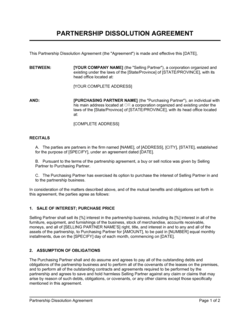
A partnership dissolution agreement is a private contract between the partners that governs asset division, debt allocation, and winding-up responsibilities. The notice of dissolution is an outward-facing communication to third parties. The agreement creates the dissolution; the notice announces it. Both are typically needed to fully close a partnership.

vs Partnership Agreement

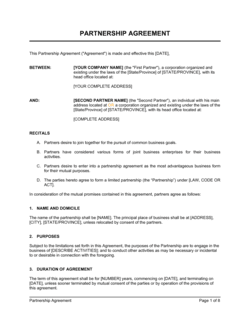
A partnership agreement establishes the partnership β€” defining each partner's role, profit share, and decision-making authority. The notice of dissolution ends it. If your partnership agreement includes a dissolution clause, review it before drafting the notice to ensure you follow the required procedure and notice period.

vs Business Closure Letter to Clients

A business closure letter to clients is a softer, relationship-focused communication that thanks clients and explains transition arrangements. A notice of dissolution is a formal legal notice that states the entity has ceased to exist. For partnership dissolutions, both letters may be needed β€” the notice for legal protection and the closure letter for client relationship management.

vs Notice of Withdrawal from Partnership

A notice of withdrawal informs third parties that one partner is leaving while the remaining partners continue operating under the same or a new partnership name. A notice of dissolution means the entire entity is ending. Sending the wrong notice can create serious confusion about whether the business continues to exist.

Industry-specific considerations

Professional Services

Law firms, accounting practices, and consulting partnerships must notify clients with active engagements and transfer files to a successor or returning them as required by professional conduct rules.

Construction and Trades

Construction joint ventures and contractor partnerships must notify project owners, subcontractors, and bonding companies, and address any outstanding lien rights or performance bond obligations.

Healthcare

Medical and dental partnerships must notify patients, insurers, and licensing boards, and ensure patient records are transferred or stored in compliance with HIPAA and state health regulations.

Retail and Wholesale

Retail partnerships must notify suppliers and distributors to stop shipments, reconcile open purchase orders, and arrange return or liquidation of remaining inventory.

Template vs pro β€” what fits your needs?

PathBest forCostTime
Use the templatePartners dissolving a small general partnership by mutual agreement with no major disputesFree15–30 minutes
Template + professional reviewDissolutions involving significant creditor balances, active contracts, or real property$150–$400 for a one-hour lawyer review1–2 days
Custom draftedContested dissolutions, regulated industries, government contracts, or litigation risk$500–$2,000+3–7 days

Glossary

Dissolution
The formal process of ending a partnership's legal existence and ceasing its authority to conduct business.
Winding Up
The post-dissolution process of settling debts, liquidating assets, and distributing remaining proceeds to partners before the partnership is fully terminated.
General Partnership
A business structure in which two or more individuals share management responsibilities and personal liability for the partnership's debts.
Effective Date
The specific calendar date on which the dissolution legally takes effect and the partnership stops incurring new obligations.
Actual Notice
Direct communication of the dissolution to a specific party β€” such as a client, supplier, or creditor β€” as opposed to a public announcement.
Constructive Notice
A public filing or announcement of dissolution that legally puts third parties on notice, even if they did not receive direct communication.
Liquidation
The conversion of partnership assets into cash to satisfy outstanding debts before any remaining balance is distributed to partners.
Partnership Agreement
The governing document that outlines each partner's rights, responsibilities, profit share, and the procedure for dissolution.
Successor Entity
A new business formed by one or more former partners to continue operations after the original partnership is dissolved.
Apparent Authority
The legal power a partner may still appear to have to bind the partnership to third parties who are unaware that dissolution has occurred.

Part of your Business Operating System

This document is one of 3,000+ business & legal templates included in Business in a Box.

  • Fill-in-the-blanks β€” ready in minutes
  • 100% customizable Word document
  • Compatible with all office suites
  • Export to PDF and share electronically

Create your document in 3 simple steps.

From template to signed document β€” all inside one Business Operating System.
1
Download or open template

Access over 3,000+ business and legal templates for any business task, project or initiative.

2
Edit and fill in the blanks with AI

Customize your ready-made business document template and save it in the cloud.

3
Save, Share, Send, Sign

Share your files and folders with your team. Create a space of seamless collaboration.

Save time, save money, and create top-quality documents.

β˜…β˜…β˜…β˜…β˜…

"Fantastic value! I'm not sure how I'd do without it. It's worth its weight in gold and paid back for itself many times."

Managing Director Β· Mall Farm
Robert Whalley
Managing Director, Mall Farm Proprietary Limited
β˜…β˜…β˜…β˜…β˜…

"I have been using Business in a Box for years. It has been the most useful source of templates I have encountered. I recommend it to anyone."

Business Owner Β· 4+ years
Dr Michael John Freestone
Business Owner
β˜…β˜…β˜…β˜…β˜…

"It has been a life saver so many times I have lost count. Business in a Box has saved me so much time and as you know, time is money."

Owner Β· Upstate Web
David G. Moore Jr.
Owner, Upstate Web

Run your business with a system β€” not scattered tools

Stop downloading documents. Start operating with clarity. Business in a Box gives you the Business Operating System used by over 250,000 companies worldwide to structure, run, and grow their business.

Start freeΒ Β·Β No credit card required