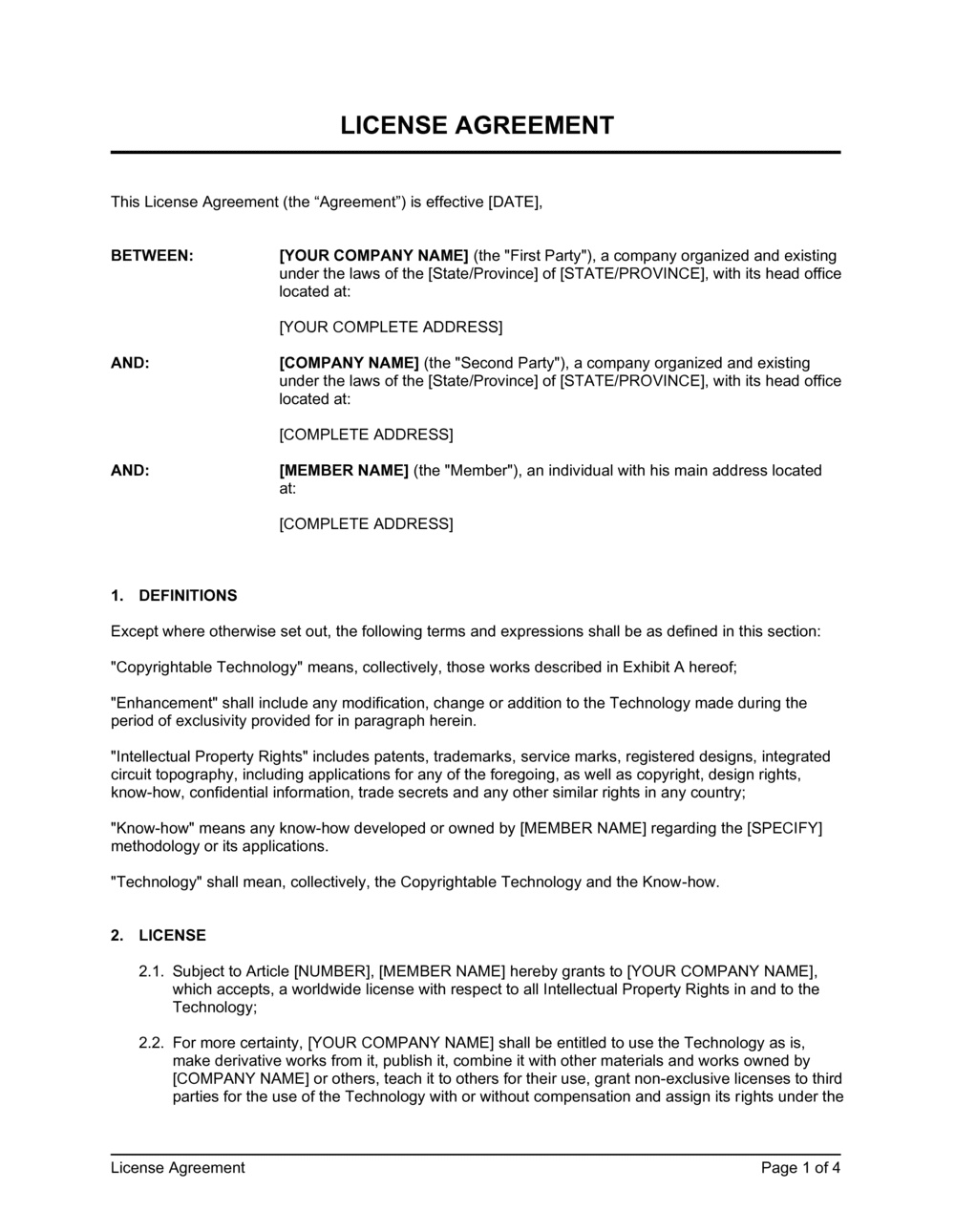
License Agreement Multi Users Template

Free Word download • Edit online • Save & share with Drive • Export to PDF

4 pages25–35 min to fillDifficulty: ComplexSignature requiredLegal review recommended
Learn more ↓
FreeLicense Agreement Multi Users Template

At a glance

What it is
A Multi-User License Agreement is a legally binding contract between a software or digital-product licensor and a licensee organization that grants a defined number of authorized users — or an unlimited number within a named entity — the right to access and use the licensed product under specific conditions. This free Word download covers user-count thresholds, permitted use, IP ownership, restrictions, confidentiality, warranty disclaimers, liability limits, and termination in a single enforceable document you can edit online and export as PDF.
When you need it
Use it whenever you sell, distribute, or deploy software, SaaS, or digital content to a business client whose employees or contractors will access the product. It is also the correct document when an organization purchases licenses for an internal deployment covering multiple seats, departments, or locations.
What's inside
Grant of license with authorized-user definition and seat count, permitted and prohibited uses, intellectual property ownership and reservation of rights, confidentiality obligations, warranty disclaimer and limitation of liability, audit rights, payment and renewal terms, and termination with data-return provisions.

What is a Multi-User License Agreement?

A Multi-User License Agreement is a legally binding contract between a licensor — the individual or company that owns a software product or digital asset — and a licensee organization that grants a defined number of authorized users the right to access and use the licensed product under specified conditions. Unlike a single-user end-user license agreement, it addresses the organizational complexity of enterprise deployment: how many employees or contractors may use the product, whether access is tied to named individuals or concurrent sessions, how seat overages are detected and remedied, and how the agreement is renewed or terminated. Crucially, the agreement transfers no ownership of the software or underlying intellectual property — all IP rights remain with the licensor, and the licensee pays for access rights only.

Why You Need This Document

Deploying software or digital content across an organization without a signed multi-user license agreement exposes both parties to serious legal and commercial risk. For licensors, the absence of a written agreement means no enforceable user limits, no audit rights to detect over-deployment, and no contractual basis to collect fees for unauthorized seats — leaving material revenue unrecovered for the life of the deployment. For licensees, operating without a signed license creates uncertainty about permitted use, data handling obligations, and what happens to their access and data if the relationship ends. A well-drafted multi-user license agreement eliminates that uncertainty: it defines exactly who may use the product, under what conditions, for how long, and at what cost — and it gives both parties a clear, enforceable framework for resolving the disputes that inevitably arise in enterprise software relationships.

Which variant fits your situation?

If your situation is…Use this template
Licensing to a single named individual, not an organizationEnd User License Agreement (EULA)
Distributing open-source software with public access rightsOpen Source License Agreement
Licensing proprietary content — fonts, images, or media — to multiple usersContent License Agreement
Granting rights to a reseller to sub-license to end customersSoftware Reseller Agreement
Licensing a patent or technology to a manufacturing partnerTechnology License Agreement
Granting perpetual rights with no ongoing support or maintenancePerpetual Software License Agreement
Covering software access alongside professional services deliveryMaster Services Agreement with License Addendum

Common mistakes to avoid

❌ Leaving 'Authorized User' undefined or vague

Why it matters: Without a clear definition, licensees extend access to contractors, affiliates, and partner organizations without paying for additional seats — and the licensor has no contractual basis to charge for the overage.

Fix: Define Authorized User explicitly in the Definitions section, specifying exactly which categories of personnel are included and which require a separate license.

❌ No audit rights clause

Why it matters: Without the right to inspect usage, the licensor has no contractual mechanism to detect or remedy over-deployment — meaning seat violations go uncompensated for the life of the agreement.

Fix: Include an annual audit right with reasonable notice, a cost-reimbursement trigger when violations exceed a defined threshold, and an obligation to purchase additional seats within 30 days of an audit finding.

❌ Warranty disclaimer in lowercase or body text

Why it matters: In the US under the UCC, and in several other jurisdictions, a warranty disclaimer must be conspicuous to be effective against a commercial buyer. A buried lowercase clause may be unenforceable.

Fix: Render the warranty disclaimer and limitation-of-liability clause in all-caps or bold text so conspicuousness is beyond dispute.

❌ Auto-renewal without a notice window or conspicuous disclosure

Why it matters: Enterprise procurement teams operating under purchase-order cycles often miss renewal dates, leading to disputed charges, chargebacks, and contract terminations that could have been avoided.

Fix: Set a clear non-renewal notice period — 30 to 60 days — and require the licensor to send a renewal reminder at least 45 days before the renewal date.

❌ No survival clause for key provisions

Why it matters: Without explicit survival language, IP ownership, confidentiality, and limitation-of-liability obligations may be construed as expiring with the agreement — eliminating post-termination protections that are critical to the licensor.

Fix: Add a dedicated survival clause listing every section that continues in force after termination: IP ownership, confidentiality, limitation of liability, audit rights for the contract period, and dispute resolution.

❌ Omitting a prohibition on AI training and benchmarking use

Why it matters: Licensees are increasingly feeding licensed software outputs and datasets into machine-learning pipelines or publishing competitive benchmark results — uses the licensor almost certainly did not intend to grant.

Fix: Add explicit prohibitions on using the software or its outputs to train AI models, develop competing products, or publish performance benchmarks without written consent.

The 10 key clauses, explained

Grant of license and authorized users

In plain language: Defines the scope of the license — what the licensee may do with the product, how many users are covered, and whether the license is exclusive or non-exclusive.

Sample language
Licensor hereby grants Licensee a non-exclusive, non-transferable license to use [PRODUCT NAME] for Licensee's internal business purposes for up to [NUMBER] Authorized Users during the License Term.

Common mistake: Failing to define 'Authorized User' with sufficient precision — leaving open whether contractors, affiliates, or temporary workers are included, which creates disputes when the licensor runs a compliance audit.

License type and term

In plain language: States whether the license is perpetual or subscription-based, the start date, renewal mechanics, and what happens at the end of the term.

Sample language
The License Term commences on [START DATE] and continues for [12] months, renewing automatically for successive one-year periods unless either party provides [30] days' written notice of non-renewal.

Common mistake: Using automatic renewal without a notice-of-non-renewal window — licensees often discover renewal charges after the fact and dispute them, leading to chargebacks and strained relationships.

Permitted use and restrictions

In plain language: Lists what the licensee is explicitly allowed to do and, equally importantly, what is prohibited — including reverse engineering, sublicensing, and exceeding user limits.

Sample language
Licensee shall not: (a) sublicense, sell, or transfer the Software; (b) reverse engineer, decompile, or disassemble the Software; (c) permit access by more than [NUMBER] Authorized Users concurrently; or (d) use the Software for the benefit of third parties.

Common mistake: Omitting a prohibition on using the software to provide services to third parties — without it, a licensee may commercially exploit the product as a bureau service without additional fees.

Intellectual property ownership

In plain language: Confirms that all IP in the licensed product — including updates and derivative works — remains the licensor's sole property, and that the grant confers use rights only.

Sample language
All right, title, and interest in and to the Software, including all intellectual property rights therein, remain exclusively with Licensor. This Agreement does not transfer any ownership interest to Licensee.

Common mistake: Including IP assignment language — even inadvertently — in a clause intended only to grant a use right. Any language suggesting the licensee 'owns' anything beyond the license right undermines the licensor's IP position.

Fees, payment, and taxes

In plain language: States the license fee, payment schedule, late-payment consequences, and which party bears responsibility for applicable taxes such as VAT or sales tax.

Sample language
Licensee shall pay the License Fee of $[AMOUNT] per year, invoiced on [DATE]. Amounts unpaid after [30] days accrue interest at [1.5]% per month. All fees are exclusive of applicable taxes, which Licensee shall pay in addition.

Common mistake: Not specifying who bears tax responsibility in a cross-border agreement — resulting in disputes over VAT, GST, or withholding tax obligations that neither party budgeted for.

Confidentiality

In plain language: Requires both parties to protect non-public information exchanged under the agreement — including the software itself, pricing, and technical documentation — for a defined period.

Sample language
Each party agrees to hold the other's Confidential Information in strict confidence and not to disclose it to any third party without prior written consent. This obligation survives termination for [3] years.

Common mistake: Excluding the software's source code, pricing, and documentation from the definition of Confidential Information — allowing the licensee to share technical details with competitors without any contractual remedy.

Warranty disclaimer and limitation of liability

In plain language: Excludes implied warranties and caps the licensor's total financial liability — typically at the fees paid in the most recent 12-month period — protecting the licensor from disproportionate claims.

Sample language
THE SOFTWARE IS PROVIDED 'AS IS.' LICENSOR DISCLAIMS ALL WARRANTIES, EXPRESS OR IMPLIED. IN NO EVENT SHALL LICENSOR'S AGGREGATE LIABILITY EXCEED THE FEES PAID BY LICENSEE IN THE [12] MONTHS PRECEDING THE CLAIM.

Common mistake: Failing to write the disclaimer in all-caps or conspicuous formatting. In the US and several other jurisdictions, a warranty disclaimer must be conspicuous to be enforceable against a commercial counterparty.

Audit rights

In plain language: Gives the licensor the right to audit the licensee's actual usage — typically once per year with advance notice — to verify compliance with user-count and deployment limits.

Sample language
Licensor may, upon [30] days' written notice and no more than once per calendar year, audit Licensee's use of the Software. Licensee shall provide reasonable access to relevant records and systems. If an audit reveals underpayment exceeding [5]%, Licensee shall reimburse audit costs.

Common mistake: Not including a cost-reimbursement trigger for audits revealing material underpayment — without it, the licensor bears the full cost of discovering violations with no recovery mechanism.

Termination and effect of termination

In plain language: Specifies the conditions allowing termination — material breach, insolvency, non-payment — and what happens afterward: cessation of use, data return or deletion, and which clauses survive.

Sample language
Either party may terminate for material breach upon [30] days' written notice if the breach is not cured within that period. Upon termination, Licensee shall immediately cease use and destroy or return all copies of the Software. Sections [IP, Confidentiality, Liability] survive termination.

Common mistake: Not listing which clauses survive termination. Confidentiality, IP ownership, limitation of liability, and dispute resolution must survive — without explicit language, a court may hold they expire with the agreement.

Governing law and dispute resolution

In plain language: Designates which jurisdiction's law governs the contract and how disputes are resolved — litigation, arbitration, or escalating mediation-then-arbitration — including the venue.

Sample language
This Agreement is governed by the laws of [STATE/COUNTRY], without regard to conflict-of-law principles. Disputes shall be resolved by binding arbitration administered by [AAA/JAMS/ICC] in [CITY], except either party may seek injunctive relief in any competent court.

Common mistake: Choosing a governing law with no connection to either party's actual location. Courts in several jurisdictions — particularly in the EU and Canada — will apply local mandatory consumer or IP protection laws regardless of what the contract states.

How to fill it out

  1. 1

    Identify both parties with full legal entity names

    Enter the licensor's and licensee's full registered legal names, business addresses, and — if applicable — company registration numbers. Avoid using trade names or DBAs as the contracting parties.

    💡 Confirm the licensee's exact legal name from their corporate registry or signed purchase order — mismatches between the contract name and invoice name complicate enforcement.

  2. 2

    Define authorized users precisely

    Decide whether the license covers named users, concurrent users, or all employees within a named entity. Define explicitly whether contractors, temporary staff, affiliates, and subsidiaries are included or excluded.

    💡 Named-user licenses are easier to audit and enforce than concurrent-user models but require more administrative upkeep when staff turns over.

  3. 3

    Set the user count and deployment scope

    Enter the exact number of authorized users or seats. If the license covers multiple sites or a global deployment, specify which entities and locations are included. Attach a Schedule A listing authorized entities if the deployment is complex.

    💡 Build in a contractual process for adding seats mid-term — for example, additional users billed at a pro-rated daily rate — to avoid leaving revenue on the table when the licensee grows.

  4. 4

    Choose license type and term

    Select perpetual or subscription. For subscription, enter the start date, initial term length, and auto-renewal mechanics. Confirm the notice period required to prevent renewal — 30 to 60 days is standard.

    💡 For enterprise clients, a 2- or 3-year initial term with locked pricing is often more attractive than annual renewal and reduces your own churn risk.

  5. 5

    Complete the fees, payment schedule, and tax clause

    Enter the annual or one-time license fee, the invoice date, the payment due date, and the late-payment interest rate. Specify whether fees are exclusive of VAT, GST, or sales tax and which party bears those obligations.

    💡 State the currency explicitly — USD, CAD, GBP, or EUR — for any cross-border agreement. Ambiguous currency references generate disputes at renewal.

  6. 6

    Tailor permitted use and restriction clauses

    Review the prohibited-use list and add any industry-specific restrictions — for example, prohibiting use in safety-critical systems, competitive benchmarking, or AI training data extraction. Remove any restrictions that are genuinely not applicable to your product.

    💡 A prohibition on using the software to train AI or machine-learning models is increasingly standard and worth including proactively.

  7. 7

    Set the limitation of liability cap

    Confirm the liability cap amount — typically the fees paid in the prior 12 months. Decide whether to exclude consequential, indirect, and punitive damages from the cap or list them as uncapped exceptions.

    💡 Mutual liability caps — capping the licensee's liability for IP infringement claims as well — are more likely to be accepted by enterprise procurement teams and can accelerate deal close.

  8. 8

    Select governing law and dispute resolution method

    Choose a governing jurisdiction connected to your primary place of business. Select binding arbitration for a private, faster process or court litigation if injunctive relief is likely. Confirm the chosen arbitration body (AAA, JAMS, ICC) and seat city.

    💡 For international licensees, ICC arbitration in a neutral city (e.g., New York or London) is more enforceable across borders than US domestic AAA arbitration.

Frequently asked questions

What is a multi-user license agreement?

A multi-user license agreement is a legally binding contract between a software or digital-product licensor and a business customer that grants a defined number of authorized users — or all users within a named organization — the right to access and use the licensed product under specified conditions. Unlike a single-user EULA, it addresses user-count limits, seat management, audit rights, and organizational deployment scope in a single enforceable document.

What is the difference between a named-user license and a concurrent-user license?

A named-user license grants access to specific, identified individuals by name or username, regardless of how many are logged in simultaneously. A concurrent-user license allows any user within the organization to access the software, but caps the number of simultaneous active sessions. Named-user models are easier to audit and enforce; concurrent-user models offer more flexibility for organizations whose employees don't all use the software at the same time. The right model depends on your product's usage patterns and the customer's staffing structure.

Is a multi-user license agreement legally binding?

Yes — a multi-user license agreement is generally enforceable as a binding contract when it is properly executed with signatures from both parties, includes adequate consideration (the license fee), and meets the basic contract formation requirements of the governing jurisdiction. Clickwrap or shrink-wrap formats may also be enforceable for lower-value deployments, but a signed agreement is standard for enterprise deals and provides a clearer evidentiary record for dispute resolution.

Does a multi-user license transfer ownership of the software?

No. A license grants the right to use the software under defined conditions but does not transfer ownership of the underlying code, IP, or product. The licensor retains full title and all intellectual property rights. This is the critical distinction between a license agreement and an asset sale — the licensee is paying for access, not ownership.

How do audit rights work in a software license agreement?

Audit rights give the licensor the contractual right to inspect the licensee's systems or records — typically once per calendar year with 30 days' advance notice — to verify that actual usage complies with the agreed user count and deployment scope. If an audit reveals underpayment or over-deployment, the agreement typically requires the licensee to pay for additional seats retroactively plus, if the shortfall exceeds a threshold (commonly 5%), to reimburse the licensor's audit costs.

What happens when a multi-user license agreement is terminated?

Upon termination, the licensee must immediately stop using the software, destroy or return all copies and documentation, and certify in writing that it has done so. Key provisions — including IP ownership, confidentiality, limitation of liability, and dispute resolution — typically survive termination for their stated durations. The licensor's obligation to refund prepaid fees for unused periods depends on whether termination was for cause or for convenience and should be addressed explicitly in the agreement.

Should a multi-user license include a limitation of liability clause?

Yes — a limitation-of-liability clause is essential for software licensors. Without it, the licensor could theoretically be held responsible for the full downstream economic consequences of a software defect — lost profits, data loss, business interruption — which could dwarf the license fee many times over. A typical cap sets the licensor's total liability at the fees paid in the prior 12 months and excludes consequential, indirect, and punitive damages. The disclaimer must be conspicuous — typically all-caps — to be enforceable in most jurisdictions.

Do I need a lawyer to draft a multi-user license agreement?

For standard B2B software deployments, a high-quality template reviewed for your specific product and jurisdiction is sufficient. Engage a lawyer when the deal involves significant revenue (typically above $50,000 per year), when the licensee is in a regulated industry with specific compliance requirements, when the agreement involves cross-border IP or data protection obligations, or when the licensee's procurement team has submitted a heavily redlined counterproposal that changes material terms.

How does this agreement interact with a privacy or data processing agreement?

A multi-user license agreement governs software access rights and IP — it is not a data processing agreement. If the licensed software processes personal data belonging to the licensee's employees or customers, a separate Data Processing Agreement (DPA) is required under GDPR, the UK Data Protection Act 2018, and CCPA. The license agreement should reference the DPA and confirm that both documents together form the complete agreement governing the parties' relationship for data-related matters.

How this compares to alternatives

vs End User License Agreement (EULA)

A EULA governs a single individual's right to use software, typically accepted via clickwrap during installation. A multi-user license agreement is a negotiated B2B contract covering an organization's entire user population, with explicit seat counts, audit rights, and commercial payment terms. EULAs are appropriate for consumer or single-seat deployments; multi-user agreements are required whenever a business purchases access for multiple employees.

vs Software Reseller Agreement

A reseller agreement governs the right of a channel partner to market and sub-license the software to end customers. A multi-user license is granted directly to the end-customer organization. If you are structuring a channel distribution model, you need both: a reseller agreement with the channel partner and a form of multi-user license the partner delivers to each end customer.

vs Technology License Agreement

A technology license agreement is typically used to license patents, trade secrets, or underlying technology for integration into a third party's own products — covering sub-licensing, royalties, and development rights. A multi-user license covers end-use of a finished software product within a single organization. The technology license is the right document when the licensee will embed or redistribute the technology; the multi-user license governs internal deployment only.

vs Master Service Agreement

A Master Service Agreement (MSA) governs the overall commercial relationship between a vendor and a client — covering professional services, deliverables, and general terms. A multi-user license is a focused agreement specifically for software access rights. When a software vendor also provides implementation, support, or consulting, both documents are needed: the MSA for services and the license agreement for product access rights, either as separate documents or as the MSA plus a software license addendum.

Industry-specific considerations

SaaS / Technology

Seat-based or concurrent-user pricing models, automatic renewal tied to SaaS billing cycles, and data processing addenda required for GDPR-covered deployments.

Financial Services

Regulatory compliance use-restriction clauses, SOC 2 and ISO 27001 certification references, and enhanced audit rights aligned with internal controls frameworks.

Healthcare

HIPAA Business Associate Agreement required alongside the license when the software processes protected health information; access controls tied to credentialed staff roles.

Education

Site licenses covering all students and faculty at a named institution, FERPA compliance requirements, and discounted multi-year terms aligned to academic budget cycles.

Manufacturing

Deployment across multiple plant locations covered under a single enterprise license, with per-site user schedules attached and ERP integration use-rights addressed explicitly.

Professional Services

User counts fluctuate with project staffing; agreements often include a floating-user pool and a contractual process for adding seats at a pre-agreed per-seat rate.

Jurisdictional notes

United States

Software licenses are governed by contract law rather than the UCC Article 2 (goods) in most jurisdictions, though courts are split. Warranty disclaimers must be conspicuous under UCC §2-316 to be enforceable. California's CCPA may require a DPA alongside the license for software processing personal data. Non-compete clauses incorporated by reference into software agreements are unenforceable in California and several other states.

Canada

Canadian courts treat software licenses as contracts of service rather than goods sales, so consumer protection statutes rarely apply to B2B software agreements. Quebec's Act Respecting the Legal Publicity of Enterprises requires certain contracts with Quebec enterprises to be available in French. PIPEDA and provincial privacy laws (notably Quebec Law 25) may require a data processing agreement when the software handles personal information.

United Kingdom

The Unfair Contract Terms Act 1977 and the Consumer Rights Act 2015 apply to limitation-of-liability clauses — in B2B agreements, liability caps must satisfy a reasonableness test. Post-Brexit, the UK GDPR (retained EU law) applies independently of EU GDPR and requires a separate DPA for any personal data processing. IP assignment and license terms are interpreted under the Copyright, Designs and Patents Act 1988.

European Union

EU GDPR Article 28 requires a Data Processing Agreement whenever the licensed software processes personal data of EU data subjects — this is mandatory and cannot be waived by contract. The EU Software Directive (2009/24/EC) grants licensees certain non-waivable rights including the right to make a backup copy and observe the software's functioning. Limitation-of-liability clauses are subject to member-state mandatory rules and may not exclude liability for gross negligence or wilful misconduct in several countries including Germany and France.

Template vs lawyer — what fits your deal?

PathBest forCostTime
Use the templateSaaS vendors and software companies licensing to SMB clients with straightforward seat-based deployments under $25,000 per yearFree30–45 minutes
Template + legal reviewEnterprise deals above $25,000, cross-border deployments, regulated industries, or where the licensee has submitted significant redlines$500–$1,500 for a technology lawyer review2–5 business days
Custom draftedHigh-value enterprise licenses, complex IP portfolios, global deployments with multi-jurisdiction data obligations, or OEM arrangements$2,500–$8,000+2–4 weeks

Glossary

Authorized User
A specific individual — typically an employee or contractor of the licensee — permitted to access the licensed product under the agreement.
Concurrent User
A licensing model counting the maximum number of users accessing the software at the same time, regardless of total registered users.
Named User
A licensing model tying the right to use the product to identified individuals by name or username, irrespective of simultaneous access.
Seat
A single unit of access under a license, typically corresponding to one authorized user or one installed instance of the software.
Grant of License
The contractual clause in which the licensor formally gives the licensee permission to use the product under defined conditions, without transferring ownership.
Perpetual License
A license with no end date, granting the licensee the right to use the specific licensed version indefinitely after a one-time payment.
Subscription License
A time-limited license granting access for a defined period — typically monthly or annually — with access terminating upon non-renewal or non-payment.
Intellectual Property Reservation
A clause explicitly stating that all IP rights in the licensed product remain with the licensor and are not transferred by the grant of license.
Audit Right
A contractual right allowing the licensor to inspect the licensee's systems or records to verify compliance with user-count limits and usage restrictions.
Warranty Disclaimer
A clause in which the licensor explicitly excludes implied warranties — such as merchantability and fitness for a particular purpose — limiting exposure for software defects.
Limitation of Liability
A clause capping the licensor's maximum financial exposure to the licensee, typically set at the fees paid in the prior 12 months.
Acceptable Use Policy
A set of rules attached to or incorporated in the license defining permitted and prohibited uses of the product by authorized users.

Part of your Business Operating System

This document is one of 3,000+ business & legal templates included in Business in a Box.

  • Fill-in-the-blanks — ready in minutes
  • 100% customizable Word document
  • Compatible with all office suites
  • Export to PDF and share electronically

Create your document in 3 simple steps.

From template to signed document — all inside one Business Operating System.
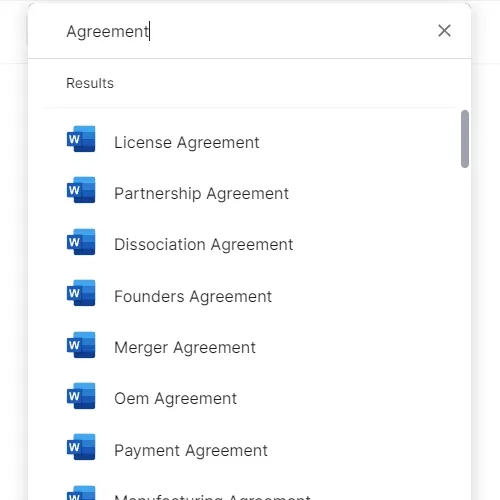
1
Download or open template

Access over 3,000+ business and legal templates for any business task, project or initiative.

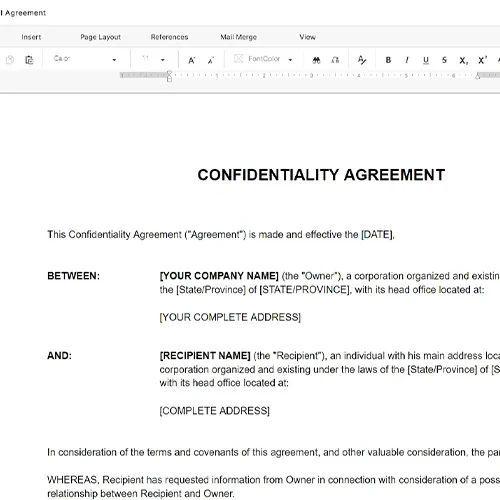
2
Edit and fill in the blanks with AI

Customize your ready-made business document template and save it in the cloud.

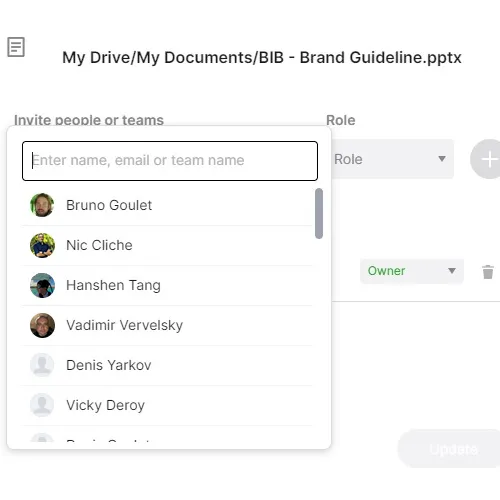
3
Save, Share, Send, Sign

Share your files and folders with your team. Create a space of seamless collaboration.

Save time, save money, and create top-quality documents.

★★★★★

"Fantastic value! I'm not sure how I'd do without it. It's worth its weight in gold and paid back for itself many times."

Managing Director · Mall Farm
Robert Whalley
Managing Director, Mall Farm Proprietary Limited
★★★★★

"I have been using Business in a Box for years. It has been the most useful source of templates I have encountered. I recommend it to anyone."

Business Owner · 4+ years
Dr Michael John Freestone
Business Owner
★★★★★

"It has been a life saver so many times I have lost count. Business in a Box has saved me so much time and as you know, time is money."

Owner · Upstate Web
David G. Moore Jr.
Owner, Upstate Web

Run your business with a system — not scattered tools

Stop downloading documents. Start operating with clarity. Business in a Box gives you the Business Operating System used by over 250,000 companies worldwide to structure, run, and grow their business.

Free Forever Plan · No credit card required