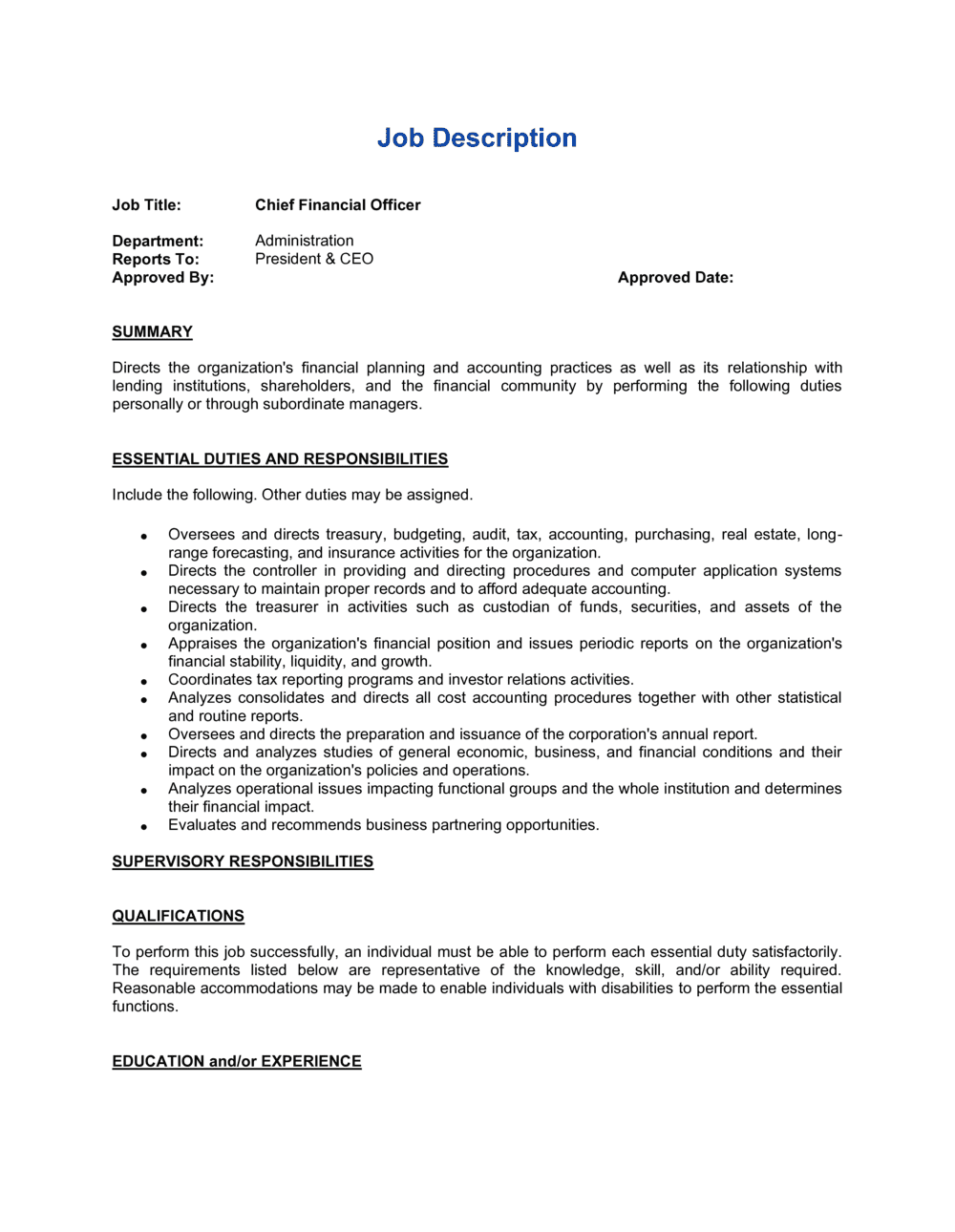
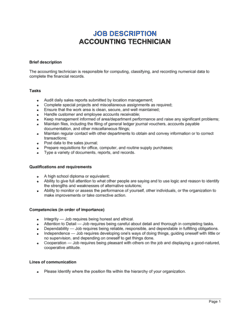
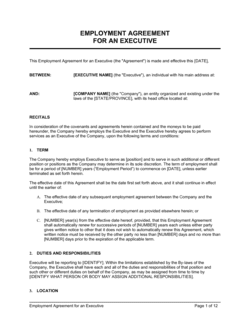
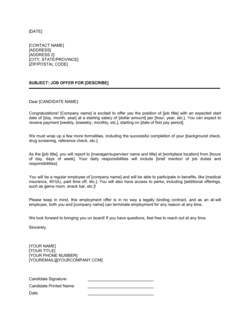
Job Description_Example for CFO Template

Free Word download β€’ Edit online β€’ Save & share with Drive β€’ Export to PDF

2 pagesβ€’20–30 min to fillβ€’Difficulty: Standardβ€’Signature requiredβ€’Legal review recommended
Learn more ↓
FreeJob Description_Example for CFO Template

At a glance

What it is
A CFO Job Description is a formal document that defines the Chief Financial Officer's scope of authority, core responsibilities, reporting structure, required qualifications, and compensation framework. This free Word download gives you a structured, legally sound starting point you can edit online and export as PDF β€” ready to attach to an offer letter, post on job boards, or incorporate into an executive employment agreement.
When you need it
Use it when recruiting or promoting a CFO, when formalizing an existing executive's role during a restructuring, or when establishing a defined scope of authority for a newly created finance function. It is also referenced whenever disputes arise about executive duties or compensation.
What's inside
Position summary, reporting structure, core financial duties, compliance and governance obligations, required and preferred qualifications, compensation and benefits framework, performance expectations, and confidentiality acknowledgment β€” organized so it can stand alone or attach directly to an executive employment agreement.

What is a CFO Job Description?

A CFO Job Description is a formal document that defines the Chief Financial Officer's scope of authority, core responsibilities, reporting structure, required qualifications, signing authority limits, and compensation framework. It functions as the authoritative reference for the role throughout the employment relationship β€” from recruiting and onboarding through performance management and, if necessary, termination. When attached to or referenced by an executive employment agreement, it carries legal weight: courts and regulators treat a signed, detailed CFO job description as evidence of the parties' mutual understanding of the role's obligations, fiduciary duties, and limits of independent authority.

Unlike a generic job posting, a CFO job description used in the context of an executive hire is a structured governance document. It names the compliance frameworks the CFO is personally accountable for β€” GAAP, IFRS, SOX, or applicable local equivalents β€” defines the dollar thresholds within which the CFO may act independently, and cross-references the confidentiality and IP obligations in the governing employment agreement. Its specificity is what makes it enforceable and useful.

Why You Need This Document

Without a formally documented CFO job description, four things break down simultaneously. First, performance management becomes a negotiation rather than a reference β€” without specific duties and measurable outputs in writing, there is no agreed baseline for evaluating whether the CFO met expectations or fell short. Second, signing authority disputes arise: CFOs who execute contracts or draw on credit facilities without a defined authority matrix can expose the company to unauthorized obligations and themselves to personal liability. Third, termination for cause becomes legally fragile β€” courts in the US, Canada, the UK, and the EU consistently demand documented evidence that the employee understood the specific duties they allegedly failed to perform. Fourth, investor and board confidence erodes when governance documents are absent or vague, particularly during due diligence for capital raises or acquisitions.

A properly executed CFO job description, signed before the executive's first day and attached to the employment agreement, closes all four gaps. This template gives you the structure to define the role precisely, the authority matrix to protect the company, and the cross-reference language to ensure it works as a legal document β€” not just a hiring checklist.

Which variant fits your situation?

If your situation is…Use this template
Startup hiring its first full-time CFO post-Series ACFO Job Description β€” Startup / Growth Stage
Public company or pre-IPO business needing SEC and SOX compliance focusCFO Job Description β€” Public Company
Nonprofit organization appointing a financial executiveCFO Job Description β€” Nonprofit
Hiring a part-time or fractional CFO for a small businessFractional CFO Agreement
Formalizing the full executive employment terms alongside the job descriptionExecutive Employment Agreement
Defining responsibilities for a VP of Finance rather than a CFOVP of Finance Job Description
Posting the role externally and needing a condensed recruitment-facing versionCFO Job Posting Template

Common mistakes to avoid

❌ Treating the job description as a standalone employment contract

Why it matters: In several jurisdictions, a detailed job description with compensation terms has been treated by courts as an implied employment agreement, creating tenure expectations and limiting the employer's ability to terminate at will.

Fix: Include an explicit disclaimer stating that the job description does not constitute an employment contract and that employment terms are governed solely by the separate executive employment agreement.

❌ Omitting the authority and delegation matrix

Why it matters: Without defined signing authority, CFOs may execute contracts or draw on credit facilities beyond their intended mandate β€” exposing the company to unauthorized obligations and the CFO to personal liability.

Fix: Insert specific dollar thresholds for each authority category and cross-reference the company's delegation-of-authority policy. Review and update these thresholds annually.

❌ Using generic, non-specific responsibility language

Why it matters: Phrases like 'oversee all financial matters' provide no basis for performance evaluation, create ambiguity in disputes about role scope, and give candidates an unrealistic picture of the actual role.

Fix: Write each responsibility with a specific action verb and a measurable output β€” for example, 'prepare and present monthly financial statements to the Board within 10 business days of month-end.'

❌ Embedding equity vesting schedules inside the job description

Why it matters: Equity terms change with each funding round, and a job description is referenced long after signing. Conflicts between the job description and the separate equity agreement create legal ambiguity that is expensive to resolve.

Fix: Reference equity participation by citing the separate equity incentive agreement by date and leave vesting, cliff, and acceleration details exclusively in that document.

❌ Signing the job description after the CFO's start date

Why it matters: Restrictive covenants and IP acknowledgments signed after employment begins may be unenforceable in common-law jurisdictions without fresh consideration, leaving the company exposed on confidentiality and non-compete obligations.

Fix: Execute the signed job description β€” along with the employment agreement and NDA β€” before or on the first day of employment. If signing must occur later, provide a documented benefit as consideration.

❌ Failing to tailor qualifications to the role's actual requirements

Why it matters: Copying a generic CFO qualification list that includes credentials irrelevant to the company's stage or industry can create disparate-impact exposure and produce a misaligned hire.

Fix: Review the qualification requirements against the three most critical competencies the incoming CFO must demonstrate in their first 12 months and ensure the requirements reflect those needs.

The 10 key clauses, explained

Position Identification and Reporting Structure

In plain language: States the official job title, the department or function the CFO leads, and the direct reporting line β€” typically to the CEO β€” along with any dotted-line accountability to the board's audit committee.

Sample language
The Chief Financial Officer ('CFO') reports directly to the Chief Executive Officer and maintains a dotted-line reporting relationship to the Audit Committee of the Board of Directors of [COMPANY NAME].

Common mistake: Omitting the board or audit committee reporting line. When internal controls or fraud issues arise, unclear reporting structure complicates governance investigations and can expose the company to regulatory liability.

Position Summary and Purpose

In plain language: A 3–5 sentence overview of the CFO's strategic and operational mandate β€” why the role exists, what it owns, and the business context.

Sample language
The CFO is responsible for the financial strategy, planning, reporting, and risk management of [COMPANY NAME]. In this role, the CFO partners with the CEO and leadership team to support strategic decision-making, capital allocation, and stakeholder reporting across [REVENUE STAGE / INDUSTRY].

Common mistake: Writing a generic summary that could apply to any company. A position summary tailored to the company's stage, industry, and capital structure gives candidates and courts a clear picture of intended scope.

Core Financial Responsibilities

In plain language: Enumerates the primary duties: financial reporting, budgeting, forecasting, treasury, tax, audit oversight, and investor relations. This is the most referenced section in performance reviews and disputes.

Sample language
Core responsibilities include: (a) preparing and presenting monthly, quarterly, and annual financial statements in accordance with [GAAP / IFRS]; (b) leading the annual budget and quarterly reforecast process; (c) managing cash flow, banking relationships, and debt covenants; (d) overseeing external audit and tax compliance; and (e) serving as the primary financial contact for investors and lenders.

Common mistake: Listing duties at such a high level of abstraction that the clause provides no guidance on performance or accountability. Specific verbs ('prepare', 'present', 'manage') with measurable outputs prevent disputes about whether a duty was actually performed.

Strategic and Advisory Duties

In plain language: Defines the CFO's role as a business partner to the CEO β€” M&A evaluation, capital raises, board presentations, and strategic planning.

Sample language
The CFO shall advise the CEO and Board on capital structure, financing alternatives, and M&A opportunities; lead financial due diligence for acquisitions or divestitures; and present strategic financial analysis at quarterly Board meetings.

Common mistake: Treating strategic duties as optional or informal. If the CFO's strategic advisory role is not documented, departing executives have claimed compensation for 'unspecified additional work' beyond the documented scope.

Compliance, Governance, and Internal Controls

In plain language: Assigns ownership of regulatory compliance (tax filings, statutory accounts, SOX if applicable), internal audit, risk management policy, and insurance oversight.

Sample language
The CFO shall maintain a system of internal controls sufficient to ensure accurate financial reporting, comply with all applicable federal, state, and local tax and regulatory filing requirements, and report material control deficiencies to the Audit Committee within [5] business days of identification.

Common mistake: Referencing 'all applicable laws' without specifying the primary compliance frameworks relevant to the company's jurisdiction and industry. Vague compliance language does not create clear accountability and may be unenforceable in a termination-for-cause scenario.

Qualifications and Credentials

In plain language: States required education (typically a bachelor's or master's in finance or accounting), professional designations (CPA, CFA, CMA), and minimum years of relevant experience.

Sample language
Minimum qualifications: (a) Bachelor's degree in Finance, Accounting, or a related field; (b) CPA, CFA, or equivalent professional designation required; (c) [X] or more years of progressive financial leadership experience, including at least [Y] years in a CFO or equivalent role; (d) demonstrated experience with [GAAP / IFRS / SOX] compliance.

Common mistake: Setting credential requirements that are either too narrow (excluding qualified candidates without a specific designation) or too broad (listing every possible qualification regardless of materiality to the role). Either extreme creates hiring risk or discrimination exposure.

Authority and Delegation Limits

In plain language: Defines the CFO's independent signing authority β€” the dollar thresholds and categories within which the CFO may execute contracts, approve expenditures, and draw on credit facilities without additional board approval.

Sample language
The CFO is authorized to execute contracts and approve expenditures up to $[AMOUNT] per transaction without additional approval. Expenditures exceeding $[AMOUNT] or any debt financing, equity issuance, or acquisition of assets require prior written approval from the CEO and/or Board.

Common mistake: Leaving signing authority undefined or relying on an informal verbal understanding. Without a written authority matrix, unauthorized transactions can expose the company to liability and the CFO to personal risk.

Compensation, Bonus, and Equity Framework

In plain language: References base salary, bonus target, equity grants, and benefits β€” without embedding specific plan terms that would require a contract amendment to update.

Sample language
The CFO's compensation consists of: (a) an annual base salary of $[AMOUNT], reviewed annually; (b) eligibility for an annual performance bonus of up to [X]% of base salary, based on targets established by the Board; and (c) equity participation as set out in the separate Equity Incentive Agreement dated [DATE].

Common mistake: Detailing vesting schedules or benefit plan specifics inside the job description. These terms change with each funding round or annual renewal, and embedding them creates amendment obligations or conflicting obligations if the equity agreement differs.

Confidentiality and IP Acknowledgment

In plain language: Confirms that the CFO acknowledges their access to sensitive financial and strategic information and their obligations not to disclose or misuse it β€” during or after employment.

Sample language
By signing this Job Description, [CFO NAME] acknowledges that the role requires access to highly sensitive Confidential Information including non-public financial data, investor information, and strategic plans, and confirms their obligations under the Confidentiality and IP provisions of the [EMPLOYMENT AGREEMENT / NDA] dated [DATE].

Common mistake: Treating the job description as a standalone confidentiality agreement. The acknowledgment clause should cross-reference a separately executed NDA or employment agreement rather than attempting to recreate full confidentiality terms.

Performance Review and Termination Reference

In plain language: States the cadence of formal performance reviews, the metrics on which the CFO is evaluated, and a cross-reference to the termination and severance terms in the governing employment agreement.

Sample language
The CFO's performance shall be reviewed annually by the CEO and Audit Committee against targets set each January, including [SPECIFIC KPIs]. This Job Description does not create an employment contract; terms of employment, termination, and severance are governed exclusively by the [EXECUTIVE EMPLOYMENT AGREEMENT] dated [DATE].

Common mistake: Failing to clarify that the job description is not itself an employment contract. Without this disclaimer, courts in several jurisdictions have treated detailed job descriptions as implied employment agreements with enforceable tenure expectations.

How to fill it out

  1. 1

    Identify the company's stage and the CFO's primary mandate

    Before filling in any details, decide whether this CFO role is primarily operational (managing accounting and compliance), strategic (capital raises, M&A), or transitional (preparing for IPO or exit). The mandate drives every subsequent section.

    πŸ’‘ Investor-backed companies should align the CFO mandate with the board's stated objectives for the next 18–24 months β€” fundraise, profitability, or exit readiness.

  2. 2

    Enter the company's legal name and reporting structure

    Use the full registered legal entity name. Define the direct reporting line (CEO) and any dotted-line relationship to the audit committee or board. Specify whether the CFO has a seat on the executive leadership team.

    πŸ’‘ If the company has subsidiaries, note whether the CFO's authority extends to all entities or only the parent β€” ambiguity here creates governance gaps.

  3. 3

    Define core financial responsibilities with specific verbs and outputs

    List each duty using action verbs ('prepare', 'present', 'manage', 'oversee') and tie each to a measurable output β€” monthly financial statements, quarterly board packages, annual audit completion, or specific compliance filings.

    πŸ’‘ Five to eight well-defined responsibilities outperform a list of twenty vague bullet points in both recruiting and performance management.

  4. 4

    Set the authority and delegation matrix

    Insert specific dollar thresholds for independent signing authority, expense approval, and credit facility drawdowns. Reference the company's existing delegation-of-authority policy if one exists.

    πŸ’‘ Align the thresholds with your bank's signing-authority requirements β€” mismatches between the job description and the banking mandate create operational friction.

  5. 5

    Specify required qualifications accurately

    List only credentials and experience that are genuinely required for the role, not aspirational wish lists. Note whether a CPA or CFA is required or preferred, and state the minimum years of experience in a CFO or equivalent role.

    πŸ’‘ Overstating requirements can limit your candidate pool unnecessarily and may raise disparate-impact concerns in some jurisdictions.

  6. 6

    Complete the compensation and equity reference block

    Enter the base salary and bonus target percentage. Reference β€” but do not reproduce β€” the equity incentive agreement. Confirm that all bonus references are marked as discretionary unless guaranteed.

    πŸ’‘ If the equity agreement is not yet finalized, reference 'an equity grant to be agreed upon in writing' rather than leaving the field blank or entering a placeholder number.

  7. 7

    Add the confidentiality acknowledgment and cross-references

    Include the acknowledgment clause referencing the executed NDA or executive employment agreement by date. Both parties should initial this section separately to confirm it was reviewed.

    πŸ’‘ Have legal counsel confirm that the cross-referenced documents are consistent β€” conflicting confidentiality definitions across multiple documents are a common source of disputes.

  8. 8

    Execute before the CFO's start date and store with the employment agreement

    Both the company's authorized signatory and the CFO must sign before the first day of employment. File the signed job description alongside the executed employment agreement in a secure HR record.

    πŸ’‘ In common-law jurisdictions, a job description signed after employment begins may require fresh consideration β€” a raise, bonus, or equity grant β€” to be enforceable.

Frequently asked questions

What is a CFO job description?

A CFO job description is a formal document that defines the Chief Financial Officer's scope of responsibilities, reporting structure, required qualifications, signing authority, and compensation framework. It serves as a reference during recruiting, a baseline for performance management, and β€” when attached to or referenced by an executive employment agreement β€” a legally relevant record of the role's intended scope.

What are the main responsibilities of a CFO?

A CFO's core responsibilities typically include preparing and presenting financial statements, leading the annual budget and reforecast cycle, managing treasury and banking relationships, overseeing external audit and tax compliance, maintaining internal controls, reporting to the board and investors, and advising the CEO on capital structure and M&A. The balance between operational and strategic duties shifts significantly based on the company's size, stage, and capital structure.

Is a CFO job description a legally binding document?

A job description on its own is generally not a binding employment contract, but courts in several jurisdictions have treated detailed job descriptions containing compensation terms as implied employment agreements. To avoid this, include an explicit disclaimer stating that the document does not create an employment contract and that binding terms are governed by a separately executed executive employment agreement.

What qualifications should a CFO have?

A CFO typically holds a bachelor's degree in finance, accounting, or a related field and carries a CPA, CFA, or CMA designation. Most CFO roles require a minimum of 10–15 years of progressive financial leadership experience, with at least 3–5 years in a CFO or equivalent role. Public companies and PE-backed businesses additionally look for demonstrated experience with SOX compliance, investor reporting, and capital raise processes.

How does a CFO job description differ from a CFO employment contract?

A job description defines the scope, duties, and qualifications for the role. An employment contract creates binding legal obligations β€” governing compensation, IP assignment, confidentiality, non-compete, termination, and severance. The job description is typically attached to or referenced by the employment contract, but the contract is the authoritative governing document. Relying solely on a job description leaves significant legal exposure on restrictive covenants and termination terms.

What signing authority should a CFO have?

Typical CFO signing authority ranges from $50,000 to $500,000 per transaction for operational expenditures, depending on company size. Debt financing, equity issuances, and acquisitions above a defined threshold generally require CEO and board approval regardless of amount. The exact thresholds should be set in the job description and cross-referenced with the company's delegation-of-authority policy and bank mandate to avoid conflicts.

Should I use this template for a fractional or part-time CFO?

This template is designed for a full-time employed CFO. A fractional or part-time CFO engaged as an independent contractor should be covered by a separate fractional CFO agreement or independent contractor agreement, which sets different terms around IP ownership, tax treatment, confidentiality, and scope of engagement. Misclassifying a fractional CFO as an employee β€” or vice versa β€” can create significant tax and benefits liability.

Do CFO job descriptions need to comply with local employment law?

Yes. While the job description itself is primarily a scope document, any compensation references must comply with applicable pay-transparency laws (required in Colorado, New York, and several other US states), and qualification requirements must not inadvertently create discriminatory barriers under EEOC guidelines in the US or equivalent rules in Canada, the UK, and the EU. Legal review is recommended before posting externally or attaching to an employment contract in a new jurisdiction.

How often should a CFO job description be updated?

The job description should be reviewed whenever the CFO's mandate changes materially β€” after a capital raise, acquisition, entry into a new market, or regulatory change. As a baseline, annual review alongside the performance review cycle ensures the documented scope reflects what the CFO is actually being held accountable for. An outdated job description used in a termination-for-cause action is frequently challenged as not reflecting the actual role.

How this compares to alternatives

vs Executive Employment Agreement

An executive employment agreement is the binding legal contract governing the CFO's compensation, IP assignment, confidentiality, non-compete, and termination terms. A job description defines the scope and duties of the role. The job description is typically attached to the employment agreement as a schedule; neither document is complete without the other. Start with the job description, then execute the employment agreement before day one.

vs VP of Finance Job Description

A VP of Finance typically manages accounting operations, financial reporting, and FP&A under the direction of a CFO or CEO. A CFO carries board-level accountability, fiduciary duties, investor relations responsibilities, and strategic advisory authority that a VP of Finance role does not include. Use the VP of Finance description for senior finance roles that do not carry C-suite authority or external stakeholder accountability.

vs Independent Contractor Agreement (Fractional CFO)

A fractional CFO engaged as a contractor is covered by an independent contractor agreement β€” not an employment-based job description. The contractor agreement sets project scope, fees, IP ownership, and termination terms without employment entitlements. Misclassifying a fractional CFO as an employee using an employment-style job description triggers payroll tax, benefits liability, and worker classification penalties.

vs Job Offer Letter

A job offer letter confirms the role and compensation to secure candidate acceptance but is not a comprehensive legal document β€” it lacks detailed duties, authority matrix, compliance obligations, and performance expectations. The CFO job description provides that depth and is referenced throughout the employment relationship. Issue the offer letter first to secure acceptance, then execute the job description and employment agreement before the start date.

Industry-specific considerations

Technology / SaaS

CFO responsibilities emphasize ARR reporting, SaaS unit economics (CAC, LTV, NRR), and Series B/C fundraise readiness alongside standard GAAP compliance.

Financial Services

Regulatory capital requirements, SEC or FCA reporting obligations, and enhanced internal controls over client funds add compliance-specific duties beyond standard CFO scope.

Healthcare

Reimbursement coding, CMS compliance, revenue cycle management, and HIPAA-related financial reporting create a specialized compliance overlay for CFOs in this sector.

Manufacturing

Inventory costing, cost of goods sold analysis, capital expenditure planning, and supply-chain financing are central to the CFO mandate in manufacturing environments.

Jurisdictional notes

United States

Several US states β€” including Colorado, New York, California, and Washington β€” require salary ranges to be disclosed in job postings. EEOC guidelines prohibit qualification requirements that create unjustified disparate impact. SOX Section 302 and 906 impose personal certification obligations on CFOs of public companies, making the compliance duties clause particularly important. Non-compete restrictions for CFOs vary sharply by state; California bans most post-employment restrictions entirely.

Canada

Canadian employment standards acts impose mandatory minimums for notice and severance that override any contractual terms providing less β€” the job description must cross-reference an employment agreement that meets provincial floors. Quebec employers must provide French-language documentation to Quebec-based employees. CFOs at federally regulated employers are subject to Canada Labour Code provisions. Pay transparency requirements are expanding in British Columbia and Ontario.

United Kingdom

UK employers must provide a written statement of employment particulars on or before day one β€” the CFO job description attached to an employment agreement typically satisfies this requirement if it covers the required statutory particulars. FCA-regulated entities must ensure CFO duties align with the Senior Managers and Certification Regime (SM&CR), which imposes personal accountability on named senior managers. Post-employment non-solicitation and non-compete clauses must be reasonable in scope and duration to be enforceable.

European Union

The EU Transparent and Predictable Working Conditions Directive requires written employment terms within seven days of hire. GDPR considerations apply when the CFO's duties include handling employee or customer financial data β€” the job description should reference applicable data protection obligations. Several member states β€” including France, Germany, and the Netherlands β€” require post-employment non-competes to be compensated at 25–100% of base salary to be enforceable. Financial reporting requirements may reference IFRS rather than GAAP.

Template vs lawyer β€” what fits your deal?

PathBest forCostTime
Use the templatePrivate companies making a straightforward CFO hire in a single jurisdiction with a standard finance mandateFree30–60 minutes
Template + legal reviewMulti-jurisdiction hires, PE-backed companies, pre-IPO businesses, or roles with complex signing authority and equity terms$300–$8002–4 days
Custom draftedPublic companies, regulated financial institutions, or CFO hires with material severance, clawback, or governance exposure$1,500–$4,000+1–3 weeks

Glossary

Fiduciary Duty
A legal obligation requiring the CFO to act in the best financial interests of the company and its shareholders, placing those interests above personal gain.
Signing Authority
The defined dollar threshold or category of contracts and financial instruments a CFO is authorized to execute on behalf of the company without additional board approval.
SOX Compliance
Obligations under the Sarbanes-Oxley Act requiring public companies to maintain accurate financial records and establish internal controls over financial reporting.
GAAP
Generally Accepted Accounting Principles β€” the standard framework of accounting rules used to prepare financial statements in the United States.
IFRS
International Financial Reporting Standards β€” the accounting framework used in over 140 countries, including the UK, Canada (for public companies), and EU member states.
Treasury Management
Oversight of a company's liquidity, cash flow, banking relationships, investments, and debt instruments to ensure the business meets its obligations.
EBITDA
Earnings Before Interest, Taxes, Depreciation, and Amortization β€” a commonly used measure of operating performance that the CFO is typically responsible for reporting.
Cap Table Management
Maintenance of the equity ownership schedule tracking all shareholders, option holders, and convertible instruments, including dilution effects of future rounds.
Internal Controls
Policies and procedures the CFO establishes and oversees to prevent fraud, ensure accurate financial reporting, and comply with regulatory requirements.
Board Reporting
Regular formal presentation of financial results, forecasts, and strategic analysis to the board of directors, typically on a monthly or quarterly cadence.
Key Performance Indicators (KPIs)
Quantifiable metrics β€” such as gross margin, burn rate, or cash conversion cycle β€” that the CFO tracks and reports to measure financial health against targets.

Part of your Business Operating System

This document is one of 3,000+ business & legal templates included in Business in a Box.

  • Fill-in-the-blanks β€” ready in minutes
  • 100% customizable Word document
  • Compatible with all office suites
  • Export to PDF and share electronically

Create your document in 3 simple steps.

From template to signed document β€” all inside one Business Operating System.
1
Download or open template

Access over 3,000+ business and legal templates for any business task, project or initiative.

2
Edit and fill in the blanks with AI

Customize your ready-made business document template and save it in the cloud.

3
Save, Share, Send, Sign

Share your files and folders with your team. Create a space of seamless collaboration.

Save time, save money, and create top-quality documents.

β˜…β˜…β˜…β˜…β˜…

"Fantastic value! I'm not sure how I'd do without it. It's worth its weight in gold and paid back for itself many times."

Managing Director Β· Mall Farm
Robert Whalley
Managing Director, Mall Farm Proprietary Limited
β˜…β˜…β˜…β˜…β˜…

"I have been using Business in a Box for years. It has been the most useful source of templates I have encountered. I recommend it to anyone."

Business Owner Β· 4+ years
Dr Michael John Freestone
Business Owner
β˜…β˜…β˜…β˜…β˜…

"It has been a life saver so many times I have lost count. Business in a Box has saved me so much time and as you know, time is money."

Owner Β· Upstate Web
David G. Moore Jr.
Owner, Upstate Web

Run your business with a system β€” not scattered tools

Stop downloading documents. Start operating with clarity. Business in a Box gives you the Business Operating System used by over 250,000 companies worldwide to structure, run, and grow their business.

Start freeΒ Β·Β No credit card required