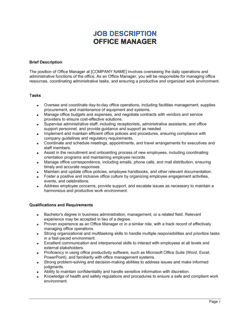
Executive Secretary Job Description Template

Free Word download • Edit online • Save & share with Drive • Export to PDF

2 pages20–30 min to fillDifficulty: StandardSignature requiredLegal review recommended
Learn more ↓
FreeExecutive Secretary Job Description Template

At a glance

What it is
An Executive Secretary Job Description is a formal employment document that defines the scope, duties, qualifications, reporting structure, and conditions of employment for an executive secretary role. This free Word download lets you customize the position title, responsibilities, required skills, and compensation range, then export as PDF for posting or inclusion in an employment contract package.
When you need it
Use it when creating a new executive secretary position, backfilling a vacancy, or standardizing the role across multiple departments or office locations. It is also required as a supporting document in most employment contracts and offer letters for senior administrative roles.
What's inside
Position overview and reporting structure, a detailed duties and responsibilities section, required and preferred qualifications, competency and skills requirements, compensation and benefits summary, working conditions, and a signature block for employer and employee acknowledgment.

What is an Executive Secretary Job Description?

An Executive Secretary Job Description is a formal employment document that defines the duties, qualifications, reporting structure, compensation range, and working conditions of an executive-level administrative support role. It establishes the authoritative record of what the position requires — from managing an executive's correspondence and calendar to handling confidential board-level documentation — and serves as the foundation for legally compliant hiring, onboarding, performance management, and, where necessary, termination. Unlike a casual posting or informal role summary, a properly drafted executive secretary job description identifies essential functions for ADA accommodation purposes, states FLSA classification, and documents the competencies and behavioral expectations the employer will use to evaluate performance.

Why You Need This Document

Operating without a documented executive secretary job description creates compounding legal and operational risk. Without clearly defined essential functions, accommodation requests under the ADA become difficult to evaluate and defend. Without a documented salary range, employers in an increasing number of US states and Canadian provinces face pay transparency violations before a single candidate applies. Without a signed acknowledgment, the employer has no record that the employee understood what the role required — a gap that surfaces immediately in performance disputes and wrongful termination claims. A thorough job description also filters misaligned candidates before the interview stage, reducing time-to-hire and early voluntary turnover. This template gives you a structured, jurisdiction-aware starting point that covers every required element — from position title and reporting line to physical requirements and signature block — so you can move from role definition to compliant posting in under an hour.

Which variant fits your situation?

If your situation is…Use this template
Hiring an executive-level personal assistant with travel and lifestyle management dutiesExecutive Assistant Job Description
Defining an administrative support role for a board of directorsBoard Secretary Job Description
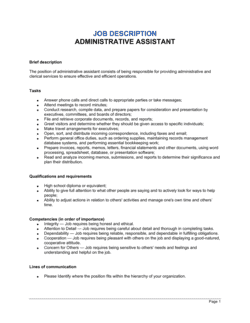
Creating a junior administrative role reporting to mid-level managementAdministrative Assistant Job Description
Hiring a combined receptionist and secretary for a small officeOffice Manager Job Description
Engaging an independent contractor for secretarial supportIndependent Contractor Agreement
Formalizing the role into a binding employment agreementEmployment Contract
Documenting performance standards and review criteria for an existing secretaryEmployee Performance Review

Common mistakes to avoid

❌ Omitting FLSA exempt or non-exempt classification

Why it matters: Misclassifying an executive secretary as exempt when the role does not meet the duties or salary-level tests exposes the employer to back overtime pay, penalties, and class-action liability under the FLSA.

Fix: Confirm the classification with an HR professional or employment lawyer before the posting goes live. Document the basis for the classification in the job description file.

❌ Listing every possible task as an essential function

Why it matters: Under the ADA, every documented duty is presumptively essential. An over-inclusive list makes it nearly impossible to accommodate a qualified employee with a disability without asserting undue hardship.

Fix: Limit essential functions to tasks the position exists to perform and that cannot reasonably be redistributed. Move secondary or occasional tasks to a separate 'other duties as assigned' line.

❌ Publishing a fixed salary rather than a salary range

Why it matters: Colorado, New York City, California, and several Canadian provinces require salary ranges in job postings. A fixed figure may violate pay transparency laws and attract regulatory scrutiny.

Fix: Research applicable pay transparency requirements in the posting jurisdiction and publish a salary range that reflects your actual compensation band for the role.

❌ Relying on the signed job description as the employment agreement

Why it matters: A job description acknowledgment confirms the employee read the document — it does not create binding obligations on confidentiality, IP assignment, non-solicitation, or termination notice.

Fix: Always pair the job description with a separately executed employment contract that contains the enforceable legal terms. Have both documents signed before the start date.

❌ Using personal names instead of titles in the reporting structure

Why it matters: When the named supervisor leaves or changes roles, the job description becomes immediately inaccurate — creating confusion about authority and requiring a document amendment.

Fix: Reference titles only in the reporting structure (e.g., 'reports to the Chief Executive Officer'). Names belong in the employment contract or onboarding forms, not the job description.

❌ Omitting a physical requirements section

Why it matters: If a physical demand is not documented, the employer cannot later cite it as a basis for an accommodation request determination — and the omission can be used to argue the requirement was not genuinely necessary.

Fix: Document all physical requirements, including standard ones like prolonged sitting, computer use, and occasional lifting, even if they seem obvious for an office role.

The 10 key clauses, explained

Position title and department

In plain language: States the official job title, the department or division the role sits within, and the employment status (full-time, part-time, or contract).

Sample language
Position: Executive Secretary | Department: Office of the [TITLE, e.g., Chief Executive Officer] | Employment Type: Full-Time, Exempt

Common mistake: Using an informal working title instead of the official HR-registered title. Mismatches between the job description and payroll records create classification and benefits eligibility disputes.

Reporting structure

In plain language: Identifies the direct supervisor, any dotted-line reporting relationships, and whether the role has direct reports of its own.

Sample language
The Executive Secretary reports directly to [EXECUTIVE TITLE]. The role has no direct reports but may coordinate the work of [JUNIOR STAFF / CONTRACTORS] on an ad hoc basis.

Common mistake: Omitting dotted-line relationships entirely. When an executive secretary supports multiple senior leaders, undefined reporting creates conflicting priorities and accountability gaps.

Position summary

In plain language: A 2–4 sentence overview of why the role exists, its primary purpose, and its contribution to the organization's goals.

Sample language
The Executive Secretary provides high-level administrative support to the [TITLE], enabling efficient executive operations through management of schedules, correspondence, and confidential information.

Common mistake: Writing the summary as a list of tasks rather than a statement of purpose. A task-list summary fails to attract qualified candidates and provides no basis for performance evaluation.

Duties and responsibilities

In plain language: A structured list of the role's primary functions, expressed as action-based statements, distinguishing essential functions from secondary duties.

Sample language
Essential Functions: (1) Manage and maintain [EXECUTIVE NAME]'s calendar, scheduling appointments, meetings, and travel with [X]-hour turnaround. (2) Prepare correspondence, reports, and presentations as directed. (3) Screen and route incoming calls and emails, prioritizing urgent matters.

Common mistake: Listing more than 12–15 duties without separating essential from secondary functions. Overloaded lists create ADA accommodation disputes because every listed task may be treated as essential.

Required qualifications

In plain language: The minimum education, experience, certifications, and skills an applicant must possess to be considered for the role.

Sample language
Required: Associate's or Bachelor's degree in Business Administration or related field, or equivalent work experience; minimum [X] years of executive-level administrative experience; proficiency in [SOFTWARE SUITE, e.g., Microsoft Office 365].

Common mistake: Setting degree requirements that are not genuinely necessary for the role. In many jurisdictions, unnecessary degree mandates constitute indirect discrimination and expose the employer to disparate-impact claims.

Preferred qualifications

In plain language: Additional credentials or experience that would strengthen a candidate's application but are not disqualifying if absent.

Sample language
Preferred: Certified Administrative Professional (CAP) designation; experience supporting C-suite in a [INDUSTRY] environment; proficiency in [SPECIFIC TOOL, e.g., Salesforce, SAP].

Common mistake: Framing preferred qualifications as effectively required by weighting them identically to mandatory criteria in the screening process — this undermines the legal distinction and narrows the applicant pool unnecessarily.

Competencies and behavioral expectations

In plain language: Defines the measurable skills and behavioral standards expected of the role — communication, discretion, time management, and judgment.

Sample language
Required Competencies: (1) Demonstrated ability to handle confidential information with discretion. (2) Strong written and verbal communication in [LANGUAGE(S)]. (3) Ability to manage competing priorities with minimal supervision.

Common mistake: Using vague competency language like 'team player' or 'results-oriented' without behavioral indicators. These terms add no evaluative value and are legally meaningless in a performance or termination dispute.

Compensation and benefits summary

In plain language: States the salary range or hourly rate, FLSA classification, bonus eligibility, and a reference to the full benefits program.

Sample language
Salary Range: $[MINIMUM]–$[MAXIMUM] annually, [Exempt / Non-Exempt] under FLSA. Eligible for the Company's standard benefits program including [HEALTH / DENTAL / VISION / RETIREMENT] as amended from time to time.

Common mistake: Publishing a single salary figure instead of a range. Several US states (Colorado, New York, California) and Canadian provinces now require salary ranges in job postings — a fixed figure may constitute non-compliance.

Working conditions and physical requirements

In plain language: Describes the work environment (office, remote, hybrid), expected hours, travel requirements, and any physical demands required for ADA compliance.

Sample language
Work Environment: [In-office / Hybrid — X days on-site per week]. Standard hours: [X:XX AM – X:XX PM], Monday–Friday, with occasional evening availability required. Physical Requirements: Ability to sit for extended periods; lift up to [X] lbs as needed.

Common mistake: Omitting physical requirements entirely. If a physical demand exists and is not documented, the employer cannot later use its absence as a basis for accommodation decisions or performance management.

Acknowledgment and signature block

In plain language: Confirms that the employee has received, reviewed, and understood the job description, and provides space for employer and employee signatures with dates.

Sample language
I acknowledge that I have received and reviewed this Job Description and understand that it may be amended from time to time at the employer's discretion. Employee Signature: _______________ Date: _____ | Employer Representative: _______________ Date: _____

Common mistake: Using the acknowledgment signature as the sole employment agreement. A signed job description alone does not establish non-compete, IP assignment, or confidentiality obligations — those require a separate employment contract.

How to fill it out

  1. 1

    Enter the position title and department

    Use the exact job title registered in your HR system and identify the specific executive office or department the role supports. Confirm FLSA exempt or non-exempt status with your HR or payroll team before publishing.

    💡 Align the title precisely with your payroll system — even minor title discrepancies create headaches during benefits enrollment and background checks.

  2. 2

    Define the reporting structure clearly

    Name the direct supervisor by title (not by personal name, which will require updates on turnover). Note any dotted-line reporting relationships, and clarify whether the executive secretary coordinates any junior or support staff.

    💡 If the role supports more than one executive, list each by title and specify how priority conflicts are resolved — for example, 'primary support to the CEO; secondary support to the CFO as directed.'

  3. 3

    Write a concise position summary

    Draft 2–4 sentences that explain why the role exists and how it contributes to the executive's effectiveness. Avoid listing tasks here — save those for the duties section.

    💡 A strong summary attracts better candidates because it explains impact, not just activity. 'Enables the CEO to focus on strategic priorities' outperforms 'manages calendar and correspondence.'

  4. 4

    List duties with essential functions clearly marked

    Write each duty as an action statement beginning with a verb. Separate essential functions — those that cannot be removed or reassigned — from secondary duties. Limit the total list to 10–15 items.

    💡 Under ADA, essential functions are those the position exists to perform. Documenting them here creates the legal foundation for reasonable accommodation decisions.

  5. 5

    Set qualifications using genuine job-relatedness criteria

    List only the education, experience, and skills that are genuinely required to perform the essential functions. Separate required qualifications from preferred ones with clear headers.

    💡 Avoid setting a degree requirement if equivalent experience is acceptable — unnecessarily strict educational requirements have been found to constitute indirect discrimination in multiple jurisdictions.

  6. 6

    Complete the compensation and benefits section

    Enter the salary range (minimum and maximum), FLSA classification, and a general reference to the benefits program. Where state or provincial law requires a salary range in postings, confirm the range meets disclosure requirements.

    💡 Never commit to a specific bonus amount in the job description — use 'eligible for a discretionary annual bonus' to preserve flexibility.

  7. 7

    Document working conditions and physical requirements

    Specify whether the role is in-office, hybrid, or remote, and state standard hours and any travel expectations. List all physical requirements, even minor ones, to support ADA-compliant accommodation decisions.

    💡 If the role will transition to hybrid after an initial on-site period, note it here — surprises about remote work eligibility are a leading cause of early voluntary turnover.

  8. 8

    Obtain signatures before the start date

    Have both the employer representative and the new hire sign and date the acknowledgment block before the first day of employment. File the signed copy in the employee's personnel record.

    💡 Pair the signed job description with a full employment contract signed on the same date — the job description alone does not create enforceable restrictions on confidentiality or non-solicitation.

Frequently asked questions

What is an executive secretary job description?

An executive secretary job description is a formal employment document that defines the duties, qualifications, reporting structure, compensation range, and working conditions for an executive-level administrative role. It serves as the authoritative record of what the position requires, supports legally compliant hiring and performance management, and is typically incorporated by reference into the employee's employment contract or offer letter.

What is the difference between an executive secretary and an executive assistant?

An executive secretary typically focuses on formal administrative and correspondence management functions — drafting communications, managing records, coordinating meetings, and supporting document workflows. An executive assistant role often encompasses broader strategic support, including project coordination, travel management, and acting as a proxy for the executive in meetings. The distinction varies by organization, but the job description should define the actual scope clearly regardless of title.

What duties should be listed in an executive secretary job description?

Core duties typically include managing the executive's calendar and correspondence, preparing reports and presentations, screening calls and emails, coordinating travel and logistics, maintaining filing and records systems, and handling confidential information with discretion. The description should list only duties the role will genuinely perform and distinguish essential functions from secondary responsibilities to support ADA compliance.

Does an executive secretary job description need to be signed?

A signature is not always legally required, but having the employee sign an acknowledgment before their first day is strongly recommended. The signature confirms receipt and understanding of the role's requirements. It does not, by itself, create enforceable contractual obligations — those require a separately executed employment contract or offer letter.

What qualifications should be required for an executive secretary?

Typical minimum qualifications include an associate's or bachelor's degree in business administration or a related field, or equivalent work experience; three to five years of executive-level administrative experience; proficiency in productivity software such as Microsoft Office 365 or Google Workspace; and demonstrated ability to handle confidential information. Preferred qualifications may include a Certified Administrative Professional (CAP) designation or experience in a specific industry. Avoid setting degree requirements that are not genuinely necessary for the role.

Is an executive secretary considered an exempt or non-exempt employee?

Classification depends on the specific duties performed and the salary paid. In the US, an executive secretary may qualify as exempt under the FLSA administrative exemption if the role involves office or non-manual work directly related to management or general business operations, the exercise of discretion and independent judgment on significant matters, and a salary of at least $684 per week as of 2024. Roles primarily performing routine clerical tasks are typically non-exempt. Classification should be confirmed with an HR professional or employment lawyer.

Do I need to include a salary range in the job description?

In an increasing number of jurisdictions — including Colorado, New York City, California, Washington State, and several Canadian provinces — employers are legally required to disclose a salary range in job postings. Even where not required, including a range reduces time-to-hire by filtering out misaligned candidates early and is considered a best practice for equitable compensation. Always confirm the current pay transparency requirements in the jurisdiction where the role is posted.

Can I modify this job description template after the employee starts?

Employers can typically amend job descriptions to reflect evolving role requirements, provided the changes are reasonable and the employee is given adequate notice. In Canada and the UK, significant changes to duties or compensation may constitute constructive dismissal if made unilaterally without the employee's consent. Including language in the description noting it is subject to amendment helps, but substantive changes to core duties should be discussed and documented with the employee.

How does a job description protect the employer legally?

A well-drafted job description establishes the documented basis for hiring decisions, reducing disparate-impact discrimination exposure. It defines essential functions for ADA accommodation purposes, supports FLSA classification decisions, and provides the benchmark for performance management and termination for cause. Courts and regulators frequently examine job descriptions in employment disputes — a vague or outdated description weakens the employer's position in almost every type of claim.

How this compares to alternatives

vs Executive Assistant Job Description

An executive assistant job description typically covers broader strategic support — project oversight, stakeholder liaison, and acting as a proxy for the executive. An executive secretary job description focuses on formal administrative functions: correspondence, records, scheduling, and documentation. The distinction matters for FLSA classification and compensation benchmarking. Use the executive assistant template when the role involves material decision-making support; use this template for primarily administrative roles.

vs Administrative Assistant Job Description

An administrative assistant job description covers general office support for a department or team. An executive secretary job description is specific to supporting a senior executive, with higher confidentiality requirements, greater autonomy, and typically a higher compensation range. The executive secretary role is also more likely to involve board-level correspondence and external stakeholder management.

vs Employment Contract

A job description defines the role — its duties, qualifications, and expectations. An employment contract creates binding legal obligations — compensation, IP assignment, confidentiality, non-compete, and termination terms. A job description is often incorporated by reference into the employment contract but cannot replace it. Both documents should be signed before the employee's first day.

vs Offer Letter

An offer letter confirms compensation and start date to secure a candidate's acceptance. A job description defines the full scope of the role in operational detail. The offer letter references the job description but does not duplicate it. Together, they form the pre-employment documentation package — the employment contract provides the legally binding terms that follow.

Industry-specific considerations

Financial services

Confidentiality obligations cover client data and trading information; FINRA and SEC compliance awareness is often listed as a preferred qualification.

Legal and professional services

Document management and attorney-client privilege handling are essential functions; conflicts-of-interest screening may be included as a duty.

Healthcare

HIPAA-compliant information handling is an essential function; credentialing support and regulatory correspondence management are common duties.

Technology / SaaS

Remote and hybrid work arrangements are standard; proficiency in project management tools (Asana, Slack, Notion) and NDA obligations covering proprietary technology are typical requirements.

Jurisdictional notes

United States

FLSA exempt or non-exempt classification must be determined before posting — misclassification exposes employers to back overtime liability. Colorado, California, New York, and Washington State require salary ranges in job postings. ADA mandates that essential functions be clearly identified to support accommodation determinations. Several states restrict the use of degree requirements not demonstrably tied to job performance.

Canada

Pay equity and pay transparency legislation varies by province — British Columbia, Ontario, and Prince Edward Island have enacted transparency requirements. Human Rights Codes in each province prohibit job requirements that have a discriminatory effect without a bona fide occupational justification. Quebec requires all employment documents for provincially regulated employers to be available in French. Unilaterally amending a job description to significantly change duties may constitute constructive dismissal under common law.

United Kingdom

Job descriptions form part of the written particulars employers must provide within two months of hire under the Employment Rights Act 1996. Equality Act 2010 requires that job requirements be justifiable and not indirectly discriminatory on protected grounds. Pay transparency is increasingly expected following gender pay gap reporting obligations for employers with 250 or more employees. Significant changes to a job description without employee consent may amount to a breach of contract.

European Union

The EU Pay Transparency Directive (2023/970) requires member states to implement salary disclosure rules for job postings by 2026, with varying national timelines. GDPR applies to the processing of candidate and employee data referenced in or collected through the hiring process. Works council consultation may be required before introducing new role definitions in Germany, France, the Netherlands, and other member states. Non-discrimination rules under the Equal Treatment Directive apply to all qualification and competency requirements.

Template vs lawyer — what fits your deal?

PathBest forCostTime
Use the templateHR teams and small business owners creating or refreshing an executive secretary role at a single domestic locationFree30–60 minutes
Template + legal reviewOrganizations in jurisdictions with pay transparency laws, ADA-sensitive duty classifications, or multi-state postings$200–$500 (HR consultant or employment lawyer review)1–3 days
Custom draftedRegulated industries (financial services, healthcare), roles with material confidentiality exposure, or employers operating across multiple jurisdictions with conflicting employment law requirements$500–$2,000+3–7 days

Glossary

Job Description
A formal document that outlines the duties, qualifications, reporting relationships, and terms attached to a specific employment position.
Reporting Structure
The defined chain of command specifying who the employee reports to directly and, where applicable, who reports to the employee.
Essential Functions
The core tasks that are fundamental to a position — those for which a reasonable accommodation may be required under disability law.
Preferred Qualifications
Skills or credentials that are desirable but not required for the role, used to differentiate candidates without excluding otherwise qualified applicants.
At-Will Employment
An employment arrangement, common in most US states, where either party may end the relationship at any time for any lawful reason without advance notice.
ADA (Americans with Disabilities Act)
US federal law requiring employers with 15 or more employees to provide reasonable accommodations for qualified individuals with disabilities, including in job descriptions.
FLSA Classification
Designation under the Fair Labor Standards Act as exempt or non-exempt, determining whether an employee is entitled to overtime pay for hours worked beyond 40 per week.
Acknowledgment Signature
A signed statement by the employee confirming they have received, read, and understood the job description — not an acceptance of contractual terms unless incorporated into a contract.
Discretionary Bonus
A bonus payment the employer may award based on performance or company results, with no guaranteed obligation to pay unless separately contracted.
Confidentiality Obligation
A duty, stated in the job description or a linked agreement, preventing the employee from disclosing sensitive company information to unauthorized parties.

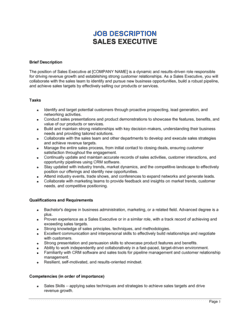
Part of your Business Operating System

This document is one of 3,000+ business & legal templates included in Business in a Box.

  • Fill-in-the-blanks — ready in minutes
  • 100% customizable Word document
  • Compatible with all office suites
  • Export to PDF and share electronically

Create your document in 3 simple steps.

From template to signed document — all inside one Business Operating System.
1
Download or open template

Access over 3,000+ business and legal templates for any business task, project or initiative.

2
Edit and fill in the blanks with AI

Customize your ready-made business document template and save it in the cloud.

3
Save, Share, Send, Sign

Share your files and folders with your team. Create a space of seamless collaboration.

Save time, save money, and create top-quality documents.

★★★★★

"Fantastic value! I'm not sure how I'd do without it. It's worth its weight in gold and paid back for itself many times."

Managing Director · Mall Farm
Robert Whalley
Managing Director, Mall Farm Proprietary Limited
★★★★★

"I have been using Business in a Box for years. It has been the most useful source of templates I have encountered. I recommend it to anyone."

Business Owner · 4+ years
Dr Michael John Freestone
Business Owner
★★★★★

"It has been a life saver so many times I have lost count. Business in a Box has saved me so much time and as you know, time is money."

Owner · Upstate Web
David G. Moore Jr.
Owner, Upstate Web

Run your business with a system — not scattered tools

Stop downloading documents. Start operating with clarity. Business in a Box gives you the Business Operating System used by over 250,000 companies worldwide to structure, run, and grow their business.

Free Forever Plan · No credit card required