Exclusive Right to Sell Template

Free Word download • Edit online • Save & share with Drive • Export to PDF

2 pages20–30 min to fillDifficulty: StandardSignature requiredLegal review recommended
Learn more ↓
FreeExclusive Right to Sell Template

At a glance

What it is
An Exclusive Right to Sell Agreement is a legally binding contract between a property or business owner (the seller) and a licensed broker or agent that grants the broker the sole right to market and sell the asset during a defined listing period. Regardless of who ultimately procures the buyer — the broker, another agent, or even the seller directly — the listing broker is entitled to the agreed commission. This free Word download covers all essential terms and can be edited online and exported as PDF in minutes.
When you need it
Use it when a property owner or business seller retains a broker to exclusively represent their interests in a sale transaction. It is the standard listing form in residential and commercial real estate, and is equally applicable when engaging a business broker to sell a company or franchise location.
What's inside
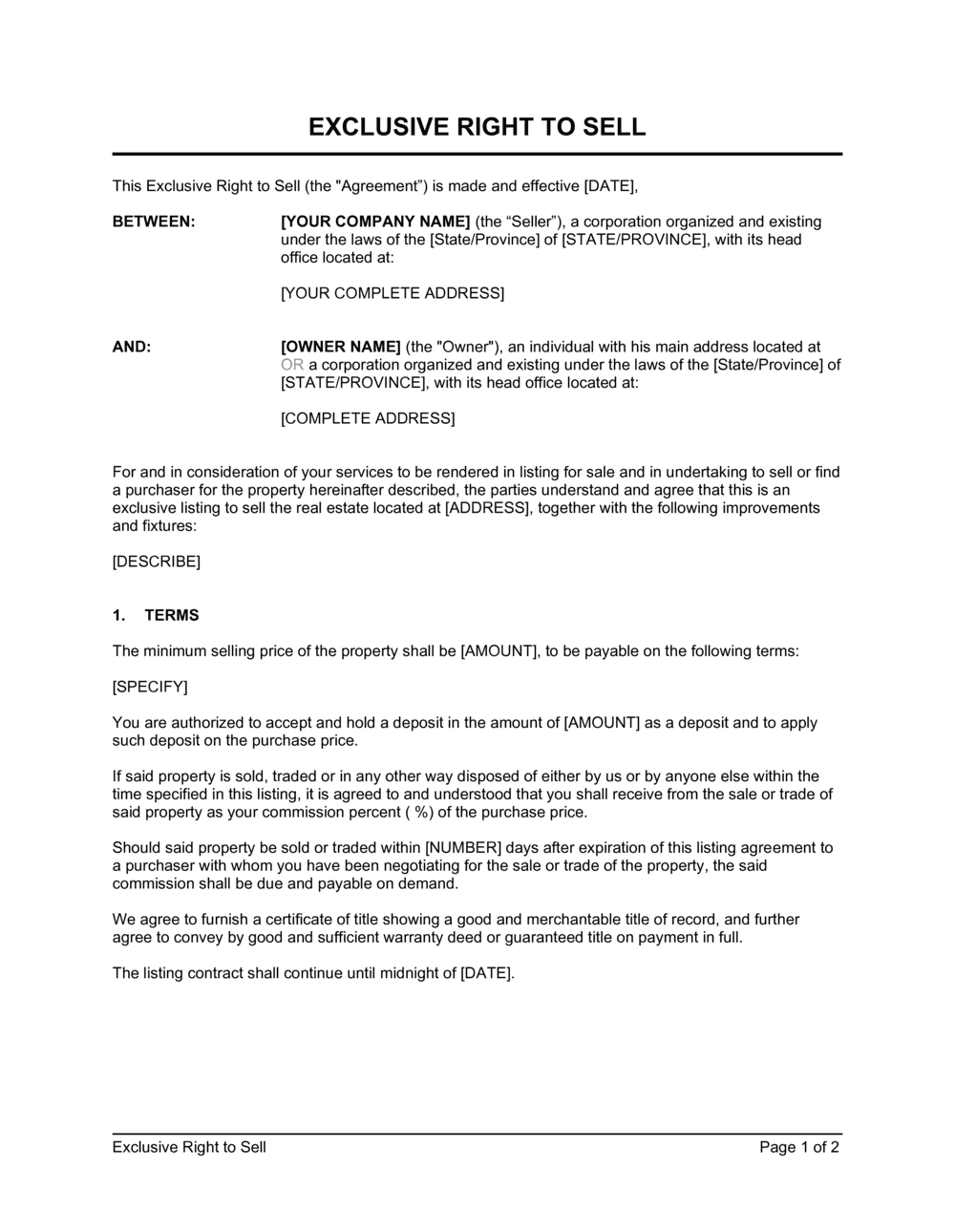
Parties and property description, listing period, commission rate and triggers, broker duties and marketing obligations, seller representations, cooperation and MLS participation, protection period, dispute resolution, and governing law.

What is an Exclusive Right to Sell Agreement?

An Exclusive Right to Sell Agreement is a legally binding contract between a property or business owner and a licensed broker that grants the broker the sole authority to market and sell the asset during a defined listing period. The defining feature is its commission trigger: unlike other listing structures, the exclusive right to sell entitles the broker to the agreed commission regardless of who ultimately procures the buyer — whether that is the listing broker, a cooperating buyer's agent, or the seller acting independently. This unconditional commission protection gives brokers the incentive to invest in professional photography, MLS entry, digital advertising, and active buyer outreach that less protected listing types rarely generate.

Why You Need This Document

Without a signed exclusive right to sell agreement, neither party has enforceable obligations: the broker can walk away from a marketing investment with no recourse, and the seller can bypass the broker to avoid paying a commission they verbally agreed to. The consequences are asymmetric and serious. A seller who proceeds without a written listing agreement may find themselves in a commission dispute when a buyer the broker quietly introduced resurfaces months later. A broker who begins marketing without a signed agreement has no legal basis to recover their costs or commission if the seller cancels, accepts a private offer, or relists elsewhere. Beyond dispute prevention, this agreement defines the seller's disclosure obligations, the broker's marketing duties, and the protection-period rules that determine post-expiration liability — details that an informal arrangement leaves dangerously ambiguous. This template gives both parties a clear, enforceable framework from day one, closing the gaps that most listing disputes exploit.

Which variant fits your situation?

If your situation is…Use this template
Granting one broker full exclusive sale rights regardless of who finds the buyerExclusive Right to Sell Agreement
Allowing the seller to find their own buyer without paying commissionExclusive Agency Listing Agreement
Listing with multiple brokers on a non-exclusive basisOpen Listing Agreement
Engaging a broker to find a buyer for a business rather than real propertyBusiness Broker Agreement
Authorizing a broker to find a tenant rather than a buyerExclusive Leasing Agreement
Setting co-brokerage and commission split terms with a buyer's agentCooperating Broker Agreement
Extending an expired listing period with the same brokerListing Agreement Extension Addendum

Common mistakes to avoid

❌ No fixed listing period end date

Why it matters: An open-ended or automatically renewing listing locks the seller into an exclusive arrangement indefinitely, making it extremely difficult to switch brokers even if performance is poor.

Fix: Always set a specific calendar end date. Most state real estate commissions recommend 90 to 180 days for residential listings; negotiate shorter initial terms with extension options.

❌ Vague commission payment trigger

Why it matters: If the contract says commission is due 'upon sale' without defining what that means, disputes arise when a deal falls through after a purchase agreement is signed but before closing.

Fix: Define the trigger precisely — specify whether commission is earned at executed purchase agreement, at closing, or upon a ready-willing-and-able buyer being produced, and address earnest-money-forfeiture scenarios.

❌ Omitting the protection period buyer list requirement

Why it matters: Without a written list of introduced buyers delivered at expiration, sellers relisting with a new broker have no way to know which prospects are subject to the prior broker's protection period — leading to double-commission liability.

Fix: Add a clause requiring the listing broker to deliver a written list of all introduced buyers no later than the agreement expiration date, and limit the protection period to named buyers on that list.

❌ Skipping the dual agency consent clause

Why it matters: Dual agency without explicit informed written consent violates real estate licensing laws in most US states and Canadian provinces, exposing the broker to license suspension and the seller to voidable transactions.

Fix: Include a clearly worded dual agency disclosure and consent block, and have the seller initial it separately at signing — not just sign the overall agreement.

❌ No broker marketing obligations beyond 'best efforts'

Why it matters: A 'best efforts' marketing clause is practically unenforceable. Sellers have no recourse if the broker fails to enter the listing on MLS, skips open houses, or delays professional photography.

Fix: Enumerate specific deliverables with timelines — MLS entry within 3 business days, professional photography within 7 days, minimum of one open house per month — and attach the broker's marketing plan as a contract exhibit.

❌ No early termination provision

Why it matters: Without a termination clause, a seller who is dissatisfied with broker performance is locked into the agreement until expiration, and the broker may claim full commission on any sale that occurs regardless of their contribution.

Fix: Include a mutual termination option triggered by material breach with a cure period, and cap the seller's termination liability to documented, out-of-pocket marketing expenses.

The 9 key clauses, explained

Parties and property description

In plain language: Identifies the seller(s) by legal name, confirms their authority to sell, and provides a precise legal description of the property or business being listed.

Sample language
This Exclusive Right to Sell Agreement is entered into on [DATE] between [SELLER FULL LEGAL NAME] ('Seller') and [BROKERAGE LEGAL NAME], represented by [AGENT NAME] ('Broker'). The Property is described as [LEGAL DESCRIPTION / ADDRESS], [CITY], [STATE/PROVINCE], [ZIP/POSTAL CODE].

Common mistake: Using a street address alone instead of the full legal property description. If the legal description and the address don't match on title, closing can be delayed or voided.

Listing period

In plain language: Sets the exact start and end dates of the broker's exclusive authority, creating a clear expiration after which the seller may relist with any broker or sell independently.

Sample language
The listing period commences on [START DATE] and expires at 11:59 PM on [END DATE] ('Listing Period'). Either party may extend the Listing Period by written addendum signed by both parties.

Common mistake: Leaving the listing period open-ended or rolling. Without a fixed end date, sellers have no clear right to terminate or relist, and disputes over ongoing commission obligations are common.

Commission rate and payment trigger

In plain language: States the commission percentage or flat fee, and the specific events that obligate the seller to pay — a signed purchase agreement, a completed closing, or both.

Sample language
Seller agrees to pay Broker a commission of [X]% of the gross sale price ('Commission') upon the earlier of: (a) execution of a binding purchase agreement during the Listing Period; or (b) closing of title to a ready, willing, and able buyer.

Common mistake: Tying commission solely to closing without addressing what happens when a buyer defaults after a signed purchase agreement. If the seller keeps the buyer's earnest money, the broker may be entitled to a portion under this clause.

Broker's duties and marketing obligations

In plain language: Specifies what the broker commits to do — MLS entry, marketing activities, open houses, showing coordination — and the timeline for performance.

Sample language
Broker shall: (a) list the Property on [MLS NAME] within [X] business days of the commencement date; (b) develop and implement a written marketing plan; (c) present all offers to Seller promptly; and (d) cooperate with other licensed brokers to procure qualified buyers.

Common mistake: Omitting specific marketing commitments. A vague 'best efforts' obligation is unenforceable — specifying MLS entry timing, digital advertising, and open-house scheduling gives the seller recourse if the broker underperforms.

Seller's obligations and representations

In plain language: Requires the seller to cooperate with showings, maintain the property in reasonable condition, disclose known defects, and warrant that they have clear authority to sell.

Sample language
Seller represents and warrants that: (a) Seller holds marketable title to the Property free of undisclosed encumbrances; (b) Seller has full authority to enter this Agreement; and (c) Seller will provide reasonable access for showings upon [X] hours' notice.

Common mistake: No representations about title or encumbrances. If an undisclosed lien surfaces at closing, both the sale and the commission obligation can unravel.

Protection period

In plain language: Extends the broker's commission rights for a defined number of days after the listing expires if the property is sold to a buyer the broker introduced during the listing period.

Sample language
If, within [60] days after the expiration of the Listing Period, the Property is sold to or under contract with any person to whom Broker submitted or introduced the Property during the Listing Period, Seller shall pay Broker the full Commission.

Common mistake: Setting the protection period without requiring the broker to deliver a written list of introduced buyers before or at expiration. Without a written list, the seller cannot determine who qualifies and disputes are nearly inevitable.

Dual agency and conflict-of-interest disclosure

In plain language: Discloses whether the broker may represent both seller and buyer in the same transaction, and what consent is required before dual agency can proceed.

Sample language
Broker may represent both Seller and a potential buyer ('Dual Agency') only with the prior written informed consent of both parties. In a dual agency, Broker shall act as a neutral party and shall not disclose either party's confidential information to the other.

Common mistake: Burying the dual-agency consent in fine print or omitting it entirely. Most US states and Canadian provinces require explicit, informed written consent for dual agency — failing to obtain it can void the transaction and expose the broker to license sanctions.

Termination and early cancellation

In plain language: Describes the conditions under which either party may terminate the agreement before expiration — material breach, mutual written consent, or seller incapacity — and the consequences for each.

Sample language
Either party may terminate this Agreement for material breach upon [X] days' written notice if the breach is not cured within that period. Seller may cancel by mutual written agreement subject to payment of Broker's documented marketing expenses not to exceed $[AMOUNT].

Common mistake: No termination clause at all, or a clause that requires only one party's written notice with no compensation mechanism. Sellers who cancel freely deprive brokers of marketing-cost recovery; brokers who refuse to release uncooperative sellers expose their reputation.

Governing law and dispute resolution

In plain language: Specifies which jurisdiction's real estate and contract law governs the agreement, and whether disputes go to arbitration, mediation, or court.

Sample language
This Agreement shall be governed by the laws of [STATE / PROVINCE]. Any dispute arising out of or relating to this Agreement shall be submitted first to non-binding mediation, and if unresolved within [30] days, to binding arbitration under the rules of [AAA / LOCAL REAL ESTATE ARBITRATION BODY].

Common mistake: No dispute resolution clause. Real estate commission disputes are among the most litigated brokerage issues — a mandatory mediation step before arbitration resolves most disputes faster and cheaper than litigation.

How to fill it out

  1. 1

    Identify all parties with their full legal names

    Enter the seller's legal name exactly as it appears on the property deed or business ownership records. For brokerage entities, use the registered firm name followed by the individual agent's name and license number.

    💡 If the property is held in a trust or LLC, the signatory must be the trustee or authorized member — confirm this before execution or the agreement may be unenforceable.

  2. 2

    Insert the complete property or business description

    Use the full legal description from the most recent deed or title report, not just the street address. For a business sale, include the business name, entity type, and EIN.

    💡 Pull the legal description directly from the county assessor or land registry record — copy-pasting from memory or a prior listing introduces errors that can surface at closing.

  3. 3

    Set specific listing period start and end dates

    Enter a concrete start date (typically the agreement signing date) and an end date that reflects your market — 90 to 180 days is standard for residential; 6 to 12 months for commercial and business sales.

    💡 Avoid calendar year-end expiration dates in active markets; they create pressure to accept below-market offers rather than relist.

  4. 4

    Define the commission rate and payment trigger

    State the commission as a percentage of gross sale price or as a flat fee. Specify whether commission is earned on execution of a binding purchase agreement, at closing, or both. Address the earnest-money-forfeiture scenario explicitly.

    💡 If you are offering a cooperating broker's commission to buyer's agents through the MLS, state the split here or in an attached MLS input form to avoid disputes with cooperating brokers.

  5. 5

    List the broker's specific marketing commitments

    Enumerate the marketing activities the broker agrees to perform — MLS entry within a specific number of days, professional photography, digital advertising platforms, open houses, and showing-management protocol.

    💡 Attach the broker's written marketing plan as an exhibit. It becomes part of the contract and gives the seller a concrete benchmark for performance.

  6. 6

    Set the protection period and require a buyer introduction list

    Enter the number of days for the post-expiration protection period — 30 to 90 days is typical. Add a clause requiring the broker to deliver a written list of introduced buyers to the seller on or before the expiration date.

    💡 Cap the protection period at 60 days unless the broker can demonstrate that active negotiations with a specific buyer are underway at expiration.

  7. 7

    Address dual agency consent and disclosures

    Choose whether dual agency is permitted, prohibited, or permitted only with advance written consent. If permitted, include a clear disclosure of what dual agency means in your jurisdiction and have both parties initial the section.

    💡 In states or provinces where designated agency is available, consider it as an alternative to full dual agency — it reduces conflicts while keeping the transaction in-house.

  8. 8

    Sign before marketing begins

    Both the seller and the authorized broker representative must sign and date the agreement before any marketing activity commences, including MLS entry, signage, or digital advertising.

    💡 Use a timestamped eSign solution and retain the fully executed copy in a secure document vault — MLS compliance audits and commission disputes both require a dated, signed original.

Frequently asked questions

What is an exclusive right to sell agreement?

An exclusive right to sell agreement is a listing contract between a property or business owner and a licensed broker that grants the broker the sole right to market and sell the asset during a defined period. The broker earns the agreed commission regardless of who ultimately finds the buyer — the broker, a cooperating agent, or even the seller themselves. It is the most common listing structure in residential and commercial real estate because it gives the broker the strongest incentive to invest in marketing.

What is the difference between exclusive right to sell and exclusive agency?

Under an exclusive right to sell, the broker earns commission no matter who procures the buyer, including the seller acting independently. Under an exclusive agency listing, the seller retains the right to find their own buyer and avoid paying a commission — but only one broker is authorized to list and market the property. Exclusive agency listings are less common because they reduce the broker's incentive to invest in marketing.

What commission rate is standard in an exclusive right to sell agreement?

Commission rates are not legally fixed and are always negotiable between the seller and the broker. In US residential real estate, total commissions have historically ranged from 5% to 6% of the gross sale price, often split between the listing broker and a cooperating buyer's agent. Following the 2024 NAR settlement, commission structures have become more variable and buyer-agent compensation is increasingly negotiated separately. Commercial and business broker commissions vary widely, typically ranging from 5% to 10% depending on transaction size.

What is the protection period in a listing agreement?

The protection period — sometimes called the safety clause or holdover clause — is a defined window of time after the listing expires during which the broker remains entitled to commission if the property is sold to a buyer the broker introduced during the active listing period. Typical protection periods run 30 to 90 days. To qualify, the broker must usually have delivered a written list of introduced buyers to the seller on or before the expiration date.

Can a seller cancel an exclusive right to sell agreement?

Cancellation rights depend entirely on what the agreement says. Most listing agreements do not include a unilateral seller cancellation right — the seller is bound for the listing period unless the broker consents in writing or has materially breached its obligations. Some agreements allow early cancellation subject to reimbursement of the broker's documented marketing expenses. Sellers should negotiate a cancellation clause before signing rather than after a dispute arises.

Does an exclusive right to sell agreement need to be notarized?

Notarization is generally not required for a listing agreement to be valid and enforceable in most US states or Canadian provinces. However, some state real estate commission regulations require listing agreements to be in writing and signed by the seller and a licensed broker representative. Check the specific requirements of the governing jurisdiction — a licensed real estate attorney or broker can confirm local formalities.

What happens if the property doesn't sell before the listing expires?

If the property does not sell within the listing period, the exclusive right to sell agreement expires and the seller is free to relist with any broker or pursue a private sale — subject to the protection period clause for buyers already introduced by the broker. No commission is owed simply because the property failed to sell, unless the broker produced a ready, willing, and able buyer at the seller's listed price and the seller refused the offer.

What is dual agency, and should I allow it in my listing agreement?

Dual agency occurs when the same broker or brokerage represents both the seller and the buyer in the same transaction. It creates an inherent conflict because the broker cannot fully advocate for both parties simultaneously. Most jurisdictions permit dual agency only with explicit, informed written consent from both parties. Sellers who allow dual agency may gain a faster sale when the listing broker has an in-house buyer, but they typically receive less aggressive price negotiation. Many sellers prefer designated agency — separate agents within the same brokerage — as a less conflicted alternative.

Is an exclusive right to sell agreement used for business sales as well as real estate?

Yes. Business brokers commonly use an exclusive right to sell agreement — sometimes called an exclusive listing or business broker engagement letter — when representing a business owner in the sale of their company, franchise, or commercial operation. The structure is similar to real estate: the broker earns a commission (often 8% to 12% for smaller businesses) regardless of who finds the buyer, for the duration of the engagement period. Business sale listings typically run 6 to 18 months given longer transaction timelines.

How this compares to alternatives

vs Exclusive Agency Listing Agreement

An exclusive agency listing allows the seller to find their own buyer without paying commission — only the broker is excluded from competing for that fee. An exclusive right to sell requires commission regardless of who procures the buyer. Brokers prefer the exclusive right to sell because it justifies higher marketing investment; sellers may prefer exclusive agency when they already have a prospect in mind.

vs Open Listing Agreement

An open listing authorizes multiple brokers simultaneously, with commission going only to the one who closes the deal. It offers maximum seller flexibility but minimal broker incentive — most agents decline to invest in marketing without exclusive protection. An exclusive right to sell produces more active, better-resourced marketing in exchange for the seller's exclusivity commitment.

vs Buyer Representation Agreement

A buyer representation agreement creates an exclusive relationship between a buyer and their agent — the mirror image of a listing agreement. The exclusive right to sell governs the seller-broker relationship; the buyer representation agreement governs the buyer-broker relationship. Both define duties, compensation, and term, but for opposite sides of the same transaction.

vs Property Management Agreement

A property management agreement engages a manager to operate an income-producing property on an ongoing basis — collecting rent, coordinating maintenance, and managing tenants. An exclusive right to sell is a time-limited engagement to sell the property. The two documents may overlap when a manager is also given authority to sell, but they should be kept as separate agreements with distinct scopes.

Industry-specific considerations

Residential Real Estate

Standard MLS entry requirements, cooperating broker commission splits, seller disclosure obligations, and state-specific listing agreement forms issued by local REALTOR associations.

Commercial Real Estate

Longer listing periods of 6 to 12 months, exclusive brokerage rights covering both sale and lease, co-brokerage arrangements with tenant-rep firms, and commission structures based on NOI multiples.

Business Brokerage

Engagement periods of 12 to 18 months, success fees tied to total enterprise value including assumed liabilities, confidentiality requirements during buyer outreach, and franchisor approval conditions.

Franchise and Retail

Franchisor right-of-first-refusal clauses that affect commission timing, transfer fee coordination, and buyer qualification requirements set by the franchisor rather than the seller.

Jurisdictional notes

United States

Listing agreements are governed by state real estate commission regulations, which vary significantly. Most states require written listing agreements with a definite expiration date — open-ended listings are prohibited in many jurisdictions. The 2024 NAR settlement introduced new rules requiring buyer-agent compensation to be negotiated separately rather than through the MLS, affecting how cooperating broker commissions are structured in listing agreements. California, Texas, and Florida each publish state-specific listing forms through their REALTOR associations.

Canada

Real estate is provincially regulated in Canada. The Ontario Real Estate Association (OREA), the British Columbia Real Estate Association (BCREA), and equivalent bodies in other provinces publish standard listing forms that satisfy provincial licensing requirements. Listing agreements in Quebec must comply with the Broker Act (Loi sur le courtage immobilier) and are typically administered through the Chambre immobilière du Québec; French-language documentation is required for provincially regulated transactions in Quebec.

United Kingdom

Estate agents in England and Wales are regulated under the Estate Agents Act 1979, which requires written terms of engagement before marketing commences. The Consumer Protection from Unfair Trading Regulations 2008 imposes disclosure obligations on agents. Scotland operates under a separate solicitor-based conveyancing system where solicitor estate agents are common, and Home Reports are mandatory before listing. Commission is typically a percentage of the achieved sale price, negotiated at instruction.

European Union

Real estate agency regulation varies significantly across EU member states — there is no harmonized EU framework for listing agreements. Germany, France, and Spain each have distinct agency law and commission-disclosure requirements. In France, the Loi Hoguet strictly regulates mandates (listing agreements) and requires a written mandat exclusif for exclusive listings. GDPR applies to all personal data collected during the marketing process, requiring sellers and brokers to maintain a lawful basis for processing prospective buyer information.

Template vs lawyer — what fits your deal?

PathBest forCostTime
Use the templateResidential sellers and agents using standard state association listing forms with customized termsFree15–30 minutes
Template + legal reviewCommercial property listings, business sales, or any transaction exceeding $500K in value$300–$8001–3 days
Custom draftedComplex commercial or multi-property portfolios, cross-border transactions, or listings involving trusts, estates, or regulated entities$1,500–$5,000+1–2 weeks

Glossary

Exclusive Right to Sell
A listing arrangement in which the broker earns the agreed commission if the property sells during the listing period, regardless of who procures the buyer.
Listing Period
The defined start and end dates during which the broker has the exclusive right to market and sell the property.
Commission Rate
The percentage of the final sale price — or a fixed fee — that the seller agrees to pay the listing broker upon a completed transaction.
Protection Period
A defined window after the listing expires during which the broker is still entitled to commission if the property is sold to a buyer the broker introduced during the listing period.
MLS (Multiple Listing Service)
A shared database of listed properties operated by real estate associations that cooperating agents use to locate properties for buyer clients.
Cooperating Broker
A broker representing the buyer who works with the listing broker and typically receives a portion of the total commission upon a successful sale.
Dual Agency
A situation in which the same broker or brokerage represents both the seller and the buyer in the same transaction, creating a potential conflict of interest.
Seller's Representations
The seller's written warranties in the listing agreement confirming ownership, authority to sell, and the absence of undisclosed liens or encumbrances.
Net Proceeds
The amount the seller receives from the sale after deducting commissions, closing costs, outstanding mortgage balances, and other transaction expenses.
Earnest Money
A deposit made by the prospective buyer to demonstrate serious intent, held in escrow and typically applied toward the purchase price at closing.
Encumbrance
Any claim, lien, mortgage, or restriction that affects the seller's ability to convey clear title to a buyer.

Part of your Business Operating System

This document is one of 3,000+ business & legal templates included in Business in a Box.

  • Fill-in-the-blanks — ready in minutes
  • 100% customizable Word document
  • Compatible with all office suites
  • Export to PDF and share electronically

Create your document in 3 simple steps.

From template to signed document — all inside one Business Operating System.
1
Download or open template

Access over 3,000+ business and legal templates for any business task, project or initiative.

2
Edit and fill in the blanks with AI

Customize your ready-made business document template and save it in the cloud.

3
Save, Share, Send, Sign

Share your files and folders with your team. Create a space of seamless collaboration.

Save time, save money, and create top-quality documents.

★★★★★

"Fantastic value! I'm not sure how I'd do without it. It's worth its weight in gold and paid back for itself many times."

Managing Director · Mall Farm
Robert Whalley
Managing Director, Mall Farm Proprietary Limited
★★★★★

"I have been using Business in a Box for years. It has been the most useful source of templates I have encountered. I recommend it to anyone."

Business Owner · 4+ years
Dr Michael John Freestone
Business Owner
★★★★★

"It has been a life saver so many times I have lost count. Business in a Box has saved me so much time and as you know, time is money."

Owner · Upstate Web
David G. Moore Jr.
Owner, Upstate Web

Run your business with a system — not scattered tools

Stop downloading documents. Start operating with clarity. Business in a Box gives you the Business Operating System used by over 250,000 companies worldwide to structure, run, and grow their business.

Free Forever Plan · No credit card required