Exclusive Importation and Sales Agreement Template

Free Word download • Edit online • Save & share with Drive • Export to PDF

4 pages25–35 min to fillDifficulty: ComplexSignature requiredLegal review recommended
Learn more ↓
FreeExclusive Importation and Sales Agreement Template

At a glance

What it is
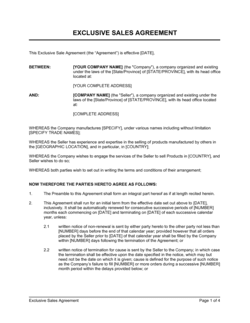
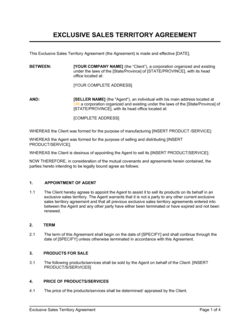
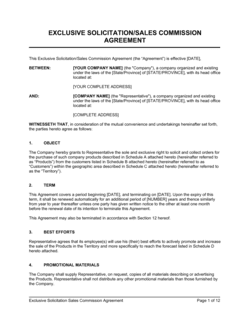
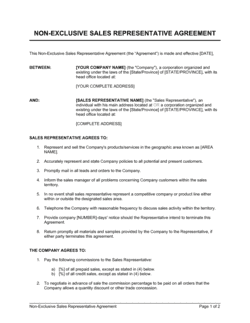
An Exclusive Importation and Sales Agreement is a legally binding contract between a foreign supplier and a local importer that grants the importer the sole right to bring the supplier's goods into a defined territory and sell them there. This free Word download covers exclusivity scope, territory, minimum purchase obligations, pricing, IP licensing, and termination in a single ready-to-edit document.
When you need it
Use it when a manufacturer or exporter wants a single trusted partner to handle all importation and distribution within a specific country or region, or when an importer needs written confirmation of exclusivity before investing in warehousing, marketing, and regulatory compliance for a foreign product.
What's inside
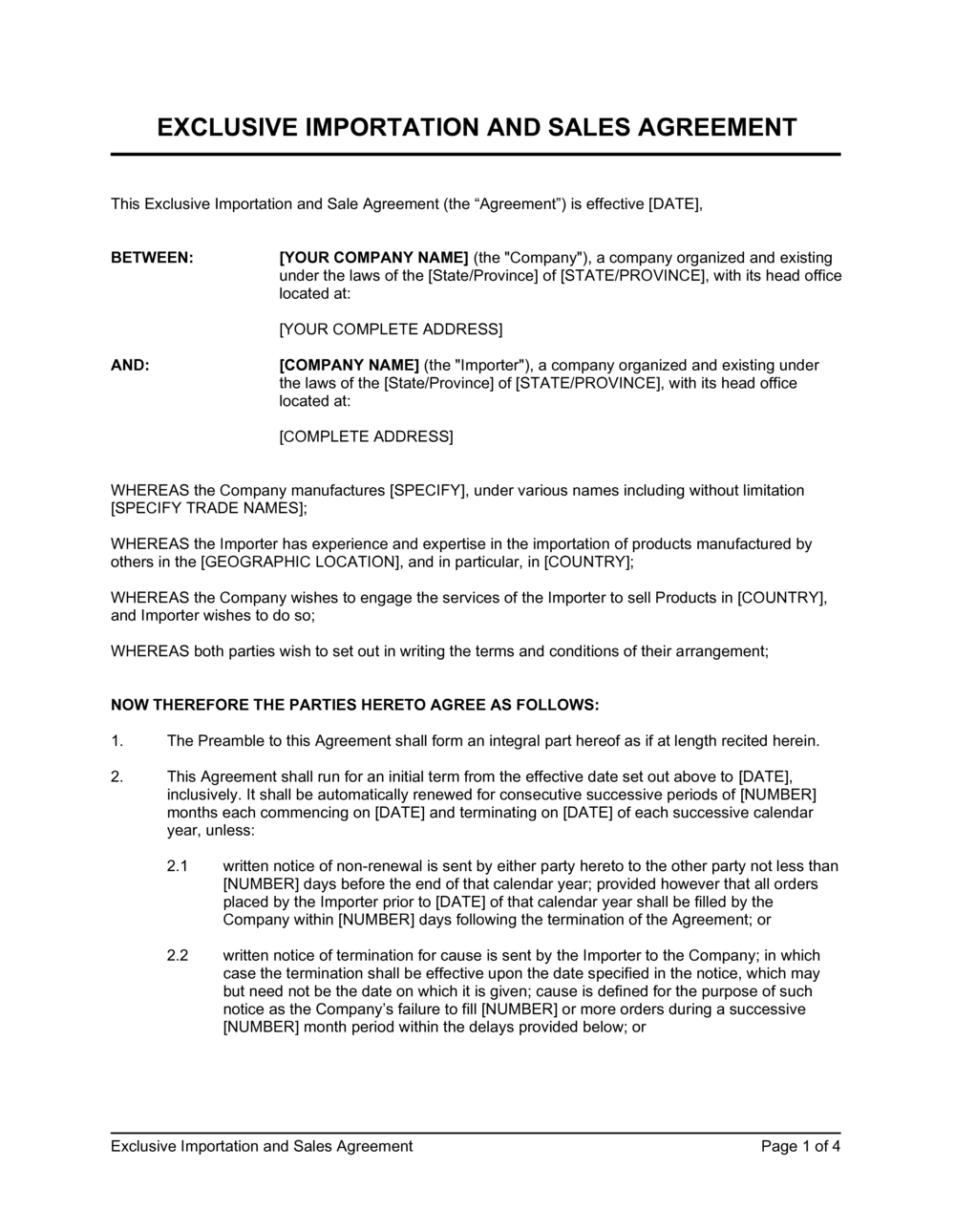
Exclusivity grant and territory definition, product scope, minimum purchase commitments, pricing and payment terms, intellectual property and trademark licensing, customs and regulatory compliance obligations, term and termination provisions, and governing law.

What is an Exclusive Importation and Sales Agreement?

An Exclusive Importation and Sales Agreement is a legally binding contract between a foreign supplier and a local importer that grants the importer the sole right to bring specified products into a defined territory and sell them there. Unlike a standard purchase order or a non-exclusive supply arrangement, this agreement creates a long-term commercial framework: the supplier commits not to appoint any competing importer in the territory, and the importer commits to purchasing minimum volumes, managing customs clearance, obtaining local regulatory approvals, and actively marketing the supplier's brand. The agreement typically covers the entire import-to-sale chain — from the moment goods leave the supplier's facility, through customs, and into the hands of local buyers.

Why You Need This Document

Without a written exclusivity agreement, both parties operate on assumptions that diverge the moment a commercial tension arises. An importer who invests in warehouse infrastructure, regulatory registration, and a local sales team has no contractual protection if the supplier later appoints a second importer, launches a competing channel, or simply declines to renew. A supplier who grants verbal exclusivity has no mechanism to reclaim it if the importer underperforms — and no documented basis for termination. The financial exposure is concrete: regulatory registration for medical devices or food products can take 12 to 36 months and cost tens of thousands of dollars, all of which is at risk without a written term and sell-off protection. A properly drafted exclusive importation and sales agreement closes these gaps, defines each party's obligations with measurable benchmarks, and provides an enforceable framework for resolving the disputes that almost always arise in cross-border distribution relationships.

Which variant fits your situation?

If your situation is…Use this template
Granting exclusivity for distribution within a country but not importation logisticsExclusive Distribution Agreement
Appointing a sales agent who earns commission but does not take title to goodsSales Agent Agreement
Non-exclusive importation with multiple local distributors allowedNon-Exclusive Distribution Agreement
Reselling a foreign software product or SaaS platform locallyReseller Agreement
Supplying goods across borders without exclusivity restrictionsInternational Sale of Goods Agreement
Manufacturing a product locally under license from a foreign brand ownerManufacturing License Agreement
Granting rights to a specific product category within a defined retail channel onlyExclusive Supply Agreement

Common mistakes to avoid

❌ Defining the exclusive territory ambiguously

Why it matters: Vague territory definitions — 'Southeast Asia' or 'the Middle East' — allow the supplier to appoint a second importer in an adjacent country that the first importer considers part of their market, triggering costly disputes.

Fix: List every country or territory by name in Schedule A. If online sales cross borders, address e-commerce channel rights and geographic restrictions explicitly.

❌ No minimum purchase obligation or an MPO with no cure period

Why it matters: Without an MPO, the supplier has no contractual basis to reclaim exclusivity from an underperforming importer. An MPO with no cure period allows automatic termination at the first shortfall, which courts in many jurisdictions treat as unreasonable.

Fix: Set a commercially realistic MPO with a tiered ramp-up over the first two years and a 30-day written cure period before any exclusivity conversion or termination takes effect.

❌ Omitting a trademark non-registration restriction

Why it matters: In several jurisdictions — including China, Indonesia, and the UAE — a local importer can register the supplier's trademark in their own name and then demand payment to transfer it back upon termination.

Fix: Include an express prohibition on the importer registering any of the supplier's marks, trade names, or domain names, and require immediate assignment of any inadvertently registered rights back to the supplier at no cost.

❌ No sell-off period or stock repurchase obligation on termination

Why it matters: A terminated importer holding months of purchased inventory with no right to sell or return it faces direct financial loss — one of the most common causes of post-termination litigation in distribution relationships.

Fix: Include a minimum 90-day sell-off window after termination and a supplier obligation to repurchase unsold, undamaged inventory at a stated percentage of invoice price.

❌ Choosing an unenforceable governing law or arbitration seat

Why it matters: Selecting the supplier's home country law without confirming that judgments or awards are enforceable in the importer's country can render the entire dispute resolution clause useless.

Fix: Choose a neutral arbitration seat in a country that has ratified the New York Convention (e.g., Singapore, Switzerland, or the UK) and confirm that arbitral awards from that seat are enforceable in both parties' jurisdictions.

❌ No price adjustment mechanism for a multi-year term

Why it matters: A fixed price over three to five years exposes the supplier to input-cost inflation and exchange-rate movements, creating pressure to informally reduce quality or supply inferior substitutes rather than breach the contract.

Fix: Include a price review clause allowing annual adjustments with 90 days' notice and either a cap tied to CPI or an FX adjustment formula based on a published exchange-rate index.

The 10 key clauses, explained

Exclusivity grant and territory

In plain language: Defines the exclusive right granted to the importer, the precise geographic scope of that right, and any carve-outs — such as direct sales to government buyers or online channels.

Sample language
[SUPPLIER NAME] hereby grants [IMPORTER NAME] the exclusive right to import and sell the Products listed in Schedule A within [TERRITORY] during the Term. This exclusivity excludes direct sales by [SUPPLIER NAME] to [CARVE-OUT CUSTOMERS / CHANNELS], if any.

Common mistake: Defining the territory too broadly — e.g., 'Asia Pacific' — without listing the specific countries included. Ambiguous territory definitions produce disputes when the supplier later appoints a second importer in an adjacent market.

Product scope and specification

In plain language: Lists the exact products covered by the agreement by SKU, model number, or description, and states whether new products launched during the term are automatically included.

Sample language
The Products covered by this Agreement are set out in Schedule A. New products introduced by [SUPPLIER NAME] during the Term shall be offered to [IMPORTER NAME] for inclusion under this Agreement within [30] days of launch, subject to written amendment.

Common mistake: Omitting a process for adding new products. Without it, the supplier can launch line extensions in the territory through a third party and the importer has no contractual recourse.

Minimum purchase obligations

In plain language: States the minimum order quantity or dollar value the importer must purchase per contract year to maintain exclusivity, and what happens if they fall short.

Sample language
[IMPORTER NAME] shall purchase a minimum of [QUANTITY / VALUE] of Products per [CONTRACT YEAR]. Failure to meet the MPO entitles [SUPPLIER NAME] to convert the arrangement to non-exclusive upon [30] days' written notice, or to terminate this Agreement.

Common mistake: Setting an MPO without a cure period. Automatically converting to non-exclusive the moment an MPO is missed — with no notice or opportunity to cure — is commercially aggressive and often unenforceable in buyer-friendly jurisdictions.

Pricing, payment terms, and currency

In plain language: Sets the purchase price (or the mechanism for calculating it), payment deadline, currency, and the process for price adjustments.

Sample language
Products shall be invoiced at the prices set out in Schedule B, denominated in [CURRENCY]. [SUPPLIER NAME] may adjust prices no more than once per calendar year with [90] days' written notice. Payment is due [NET 30] from invoice date.

Common mistake: Agreeing on a fixed price with no adjustment mechanism. Raw material cost inflation or exchange-rate swings over a multi-year term can make the fixed price commercially unworkable for the supplier, triggering informal pressure to renegotiate or simply supply inferior substitutes.

Intellectual property and trademark license

In plain language: Grants the importer a limited, non-transferable license to use the supplier's trademarks, logos, and marketing materials in the territory solely for selling the products, with restrictions on sublicensing and modification.

Sample language
[SUPPLIER NAME] grants [IMPORTER NAME] a non-exclusive, non-transferable license to use [SUPPLIER NAME]'s trademarks and marketing materials in [TERRITORY] solely to promote and sell the Products. [IMPORTER NAME] shall not modify, sublicense, or register the trademarks without [SUPPLIER NAME]'s prior written consent.

Common mistake: Omitting a restriction on the importer registering the supplier's trademark locally. In several jurisdictions — including China, UAE, and parts of Latin America — a local party can register a foreign brand's trademark and hold the brand owner hostage.

Customs, regulatory compliance, and import permits

In plain language: Allocates responsibility between the parties for obtaining import licenses, product certifications, and customs clearance, and states which party bears customs duties and compliance costs.

Sample language
[IMPORTER NAME] is solely responsible for obtaining all import permits, product registrations, and regulatory approvals required in [TERRITORY]. Customs duties, import taxes, and compliance costs shall be borne by [IMPORTER NAME]. [SUPPLIER NAME] shall provide all required documentation, including certificates of origin and product safety data, within [10] business days of request.

Common mistake: Leaving compliance responsibility ambiguous. When a product is detained at customs or fails a local safety certification, an unclear allocation of responsibility results in both parties pointing at the other while inventory sits in a bonded warehouse accruing storage fees.

Marketing and promotional obligations

In plain language: Sets the importer's minimum marketing spend or activity obligations, defines approval rights for advertising using the supplier's trademarks, and allocates co-op marketing funds if any.

Sample language
[IMPORTER NAME] shall spend no less than [X]% of annual net sales on marketing and promotion of the Products in [TERRITORY]. All advertising materials referencing [SUPPLIER NAME]'s trademarks are subject to prior written approval by [SUPPLIER NAME], not to be unreasonably withheld.

Common mistake: No marketing obligation at all. An importer who locks in exclusivity but then makes minimal promotional effort starves the brand of growth — and the supplier has no contractual lever to demand better performance.

Term, renewal, and termination

In plain language: States the initial contract period, renewal conditions (automatic or by notice), and termination rights — both for cause (breach, insolvency) and, if included, for convenience with notice.

Sample language
This Agreement commences on [START DATE] and continues for an initial term of [X] years. It shall automatically renew for successive [1]-year periods unless either party provides [90] days' written notice of non-renewal. Either party may terminate for cause upon [30] days' written notice if a material breach is not cured within that period.

Common mistake: No automatic renewal clause and no minimum term aligned to the importer's investment horizon. An importer who spends six figures on warehouse setup and regulatory registration on a one-year rolling agreement can find their exclusivity terminated before they recoup the investment.

Sell-off period and inventory on termination

In plain language: Gives the importer a defined window after termination to sell existing inventory, and states whether the supplier is obligated to repurchase unsold stock.

Sample language
Upon termination or expiry of this Agreement, [IMPORTER NAME] shall have [90] days to sell remaining inventory of Products in the ordinary course of business. At [IMPORTER NAME]'s election, [SUPPLIER NAME] shall repurchase unsold inventory at [X]% of the original invoice price within [30] days of written notice.

Common mistake: No sell-off period at all. A terminated importer with six months of inventory on hand and no right to sell or return it faces a direct financial loss — making this one of the most litigated provisions in distribution termination disputes.

Governing law and dispute resolution

In plain language: Specifies which country's law governs the agreement and how disputes are resolved — arbitration, mediation, or litigation — including the seat and language of any arbitral proceedings.

Sample language
This Agreement is governed by the laws of [GOVERNING JURISDICTION]. Any dispute shall be finally resolved by binding arbitration under the [ICC / UNCITRAL] Rules, with the seat of arbitration in [CITY], conducted in [LANGUAGE]. Each party irrevocably submits to such jurisdiction.

Common mistake: Choosing the supplier's home jurisdiction as governing law without considering enforceability in the importer's country. An arbitral award or judgment obtained under foreign law may be difficult or impossible to enforce locally if the jurisdiction has not ratified the New York Convention on arbitral awards.

How to fill it out

  1. 1

    Identify both parties with their full legal entity names

    Enter the supplier's and importer's full registered legal names, jurisdiction of incorporation, and principal business addresses. Avoid using trade names — use the exact name on the corporate registration.

    💡 Request a certificate of incorporation or company extract from your counterpart before signing — confirming legal name and good standing takes 10 minutes and prevents enforceability arguments later.

  2. 2

    Define the territory precisely

    List every country or sub-national region included in the exclusive territory. If the territory is a customs union or trade bloc, name the member states explicitly rather than relying on the bloc name.

    💡 If online sales are relevant, specify whether the territory restriction applies to e-commerce — and whether the importer has exclusive rights to ship from their territory to customers located outside it.

  3. 3

    Complete Schedule A with the full product list

    List every product covered by exclusivity with its SKU or model number, description, and any applicable regulatory classification code. Attach the current product catalog as a separate exhibit.

    💡 Include a clause stating that new product introductions within the same category are offered to the exclusive importer first — otherwise the supplier can launch variants through a competing channel.

  4. 4

    Set the minimum purchase obligation and cure period

    Negotiate and enter the annual MPO in quantity or value terms. Include a 30-day cure period before any conversion to non-exclusive or termination takes effect.

    💡 Tie the first year's MPO to a realistic ramp-up projection — an aggressive Year 1 MPO that cannot be met due to regulatory lead times will trigger a dispute before the relationship has had a chance to develop.

  5. 5

    Agree on pricing, currency, and adjustment mechanics

    Enter the initial product prices in Schedule B, state the invoicing currency, and define the notice period and cap for annual price adjustments.

    💡 For multi-year agreements, include an FX adjustment clause or peg the price to a publicly available index to prevent currency depreciation from eroding either party's margin.

  6. 6

    Complete the IP and trademark license section

    List the specific trademarks, logos, and brand assets the importer is licensed to use. Include an express prohibition on the importer registering any of the supplier's marks locally.

    💡 In trademark-sensitive markets (China, UAE, Turkey), the supplier should independently register their mark in the importer's country before or alongside execution of the agreement.

  7. 7

    Allocate customs and regulatory compliance responsibilities

    Specify which party obtains import licenses, product certifications, and safety approvals, and which party bears the associated costs and timelines.

    💡 Attach a compliance checklist as Schedule C listing every known regulatory requirement in the territory — this protects the supplier from claims that they failed to provide adequate product documentation.

  8. 8

    Set the term, renewal, and termination provisions

    Enter the initial term length, automatic renewal conditions, notice periods for non-renewal, and the cure period for material breaches. Confirm the sell-off period and stock repurchase obligation.

    💡 Align the initial term to the importer's payback horizon. If the importer is investing six to twelve months in regulatory registration, an initial term of at least three years is a reasonable minimum.

Frequently asked questions

What is an exclusive importation and sales agreement?

An exclusive importation and sales agreement is a legally binding contract between a foreign supplier and a local importer that grants the importer the sole right to bring the supplier's products into a defined territory and sell them there. The exclusivity means the supplier cannot appoint any other importer or distributor in that territory during the contract term. In exchange, the importer typically commits to minimum purchase obligations and marketing activities.

What is the difference between an exclusive importation agreement and an exclusive distribution agreement?

An exclusive importation and sales agreement covers both the act of importing — customs clearance, regulatory compliance, and logistics — and the subsequent sale of goods within the territory. An exclusive distribution agreement typically begins after goods have already cleared customs and focuses on the wholesale or retail distribution chain. If your importer is also responsible for customs and regulatory registration, use the importation agreement; if a separate logistics provider handles import and your partner only handles local sales, a distribution agreement may be more appropriate.

Is a minimum purchase obligation enforceable?

Yes, minimum purchase obligations are generally enforceable in most jurisdictions when they are clearly stated in the contract, commercially reasonable, and accompanied by a cure period before any penalty or exclusivity conversion takes effect. Courts in the EU and Canada have struck down MPOs that were set so aggressively that they were impossible to meet, treating them as penalty clauses. A tiered ramp-up structure in the first two years reduces enforceability risk considerably.

Who is responsible for customs duties — the supplier or the importer?

Under most Incoterms structures used for exclusive importation agreements, the importer bears customs duties, import taxes, and local regulatory compliance costs once goods arrive at the agreed delivery point. This should be stated explicitly in the agreement. The supplier's obligation is typically to provide all necessary documentation — certificates of origin, product safety data sheets, and export licenses — within a defined timeframe after each shipment.

Can the importer sublicense exclusivity to a sub-distributor?

Only if the agreement explicitly permits it. Most exclusive importation agreements prohibit sublicensing of exclusivity without the supplier's prior written consent. If the importer needs to appoint regional sub-distributors, this right should be negotiated and documented in the agreement — including whether sub-distributors are bound by the same obligations and whether the importer remains primarily liable for their compliance.

What happens to unsold inventory when the agreement is terminated?

The agreement should include a sell-off period — typically 60 to 90 days after termination — during which the importer can sell remaining inventory through normal channels. Many agreements also include a supplier obligation to repurchase undamaged, unsold inventory at a percentage of the original invoice price. Without these provisions, the importer can be left holding significant stock with no contractual recourse, which is one of the most common sources of post-termination disputes.

What governing law and arbitration seat should I choose?

For cross-border agreements, a neutral governing law and arbitration seat is generally preferable to either party's home jurisdiction. Singapore, Switzerland, and England are widely used because their courts and arbitral institutions are experienced in international commercial disputes and awards are enforceable in most countries under the New York Convention. Confirm that arbitral awards from your chosen seat are enforceable in both the supplier's and importer's countries before finalizing the clause.

Do I need a lawyer to draft or review this agreement?

For straightforward single-country importation arrangements with an established counterpart, a well-structured template reviewed by a trade lawyer is typically sufficient. Legal review is strongly recommended when the territory spans multiple countries with different regulatory regimes, the investment in regulatory registration or infrastructure exceeds $50,000, the agreement involves significant IP or trademark licensing, or when either party is in a jurisdiction with restrictions on foreign distribution arrangements — such as China, Saudi Arabia, or several EU member states with commercial agency protection laws.

Can the supplier sell directly into the exclusive territory?

Not unless the agreement explicitly reserves that right. Common carve-outs include direct sales to government or military buyers, sales through the supplier's own global e-commerce platform subject to a price floor, and existing accounts grandfathered before the agreement was signed. Any reserved channels must be clearly listed in the agreement — a general 'supplier may sell direct' carve-out with no limitations defeats the commercial value of the exclusivity grant entirely.

What protections does the importer have against parallel imports?

The agreement should include an obligation on the supplier not to supply the products to any party the supplier knows or ought to know will divert them into the exclusive territory. The supplier should also commit to cooperating with the importer in taking action against parallel importers, including providing evidence of authorized sales channels. Note that in the EU, parallel imports within the EEA cannot be blocked once the supplier has placed goods on the market there — this is a legal limitation, not a contractual one.

How this compares to alternatives

vs Exclusive Distribution Agreement

An exclusive distribution agreement governs the local sale and distribution of goods that have already cleared customs — it does not cover importation logistics or regulatory compliance. An exclusive importation and sales agreement begins at the border, assigning responsibility for customs clearance, import permits, and product registration to the importer. Use the importation agreement when your partner is the legal importer of record; use a distribution agreement when a separate party handles the import and your partner only manages downstream sales.

vs Sales Representative Agreement

A sales representative agreement appoints an agent who solicits orders on behalf of the supplier but never takes title to the goods and earns a commission on sales. An exclusive importation and sales agreement transfers title and risk to the importer, who then resells at their own margin. The distinction matters for tax, customs, and liability — an importer assumes inventory risk; an agent does not.

vs International Sale of Goods Agreement

An international sale of goods agreement governs a single or recurring cross-border transaction without conferring any territorial exclusivity. An exclusive importation and sales agreement is a relationship document that grants ongoing exclusivity, sets performance obligations, and governs the entire distribution relationship over a multi-year term. If you need exclusivity and a long-term framework, use the importation agreement; if you are executing a one-time or non-exclusive purchase, use the sale of goods agreement.

vs Reseller Agreement

A reseller agreement is typically used for digital products, software, or services sold under the original supplier's brand within a defined channel — usually without exclusivity and without customs or physical logistics obligations. An exclusive importation and sales agreement is designed for physical goods crossing international borders with full exclusivity, regulatory compliance obligations, and minimum purchase commitments. Choose the reseller agreement for software or services; choose the importation agreement for physical goods requiring customs management.

Industry-specific considerations

Consumer Goods and FMCG

Importers typically commit to annual volume targets by SKU, manage local retail listings, and bear product registration costs with national food safety or standards authorities.

Medical Devices and Healthcare

Regulatory approval timelines (FDA, CE mark, local health ministry) can run 12 to 36 months, making minimum purchase obligations in Year 1 commercially unrealistic without a ramp-up schedule.

Manufacturing and Industrial Equipment

Agreements typically include after-sales service and spare parts obligations, authorized repair center requirements, and warranty pass-through provisions from manufacturer to end customer.

Food and Beverage

Importers must navigate country-of-origin labeling, ingredient disclosure rules, and halal or kosher certification requirements, all of which should be allocated explicitly between the parties.

Technology and Electronics

Product life cycles are short, making new-product inclusion clauses critical; agreements also address firmware update obligations, warranty repair logistics, and compliance with local electromagnetic compatibility standards.

Luxury and Fashion

Brand protection provisions are paramount — importers typically commit to authorized retail channel lists, minimum retail price floors, and anti-grey-market cooperation obligations.

Jurisdictional notes

United States

US antitrust law (Sherman Act, Clayton Act) scrutinizes exclusive territorial restrictions and minimum resale price maintenance. Vertical exclusivity arrangements are evaluated under the 'rule of reason' standard — generally permissible unless they substantially foreclose competition. State franchise and dealership laws in states like California, New Jersey, and Wisconsin can restrict the supplier's right to terminate a distribution relationship, even with contractual termination provisions.

Canada

Canada's Competition Act prohibits exclusive dealing arrangements that substantially lessen competition, though most standard bilateral exclusivity agreements between parties without dominant market positions are permissible. Provincial consumer protection legislation may affect minimum resale price terms. Quebec importers operating under French-language requirements must ensure that all product labeling and marketing materials comply with the Charter of the French Language.

United Kingdom

Post-Brexit, the UK operates its own vertical agreements block exemption (VABEO), which permits exclusive territorial restrictions in most commercial distribution arrangements subject to a 30% market share threshold. Parallel imports between the UK and EU can no longer be freely blocked after Brexit, but restrictions on imports from outside the UK are generally enforceable. UK commercial agents are protected by the Commercial Agents Regulations 1993, which provide mandatory compensation rights on termination — confirm the importer is not legally classified as an agent.

European Union

The EU Vertical Block Exemption Regulation (VBER 2022) permits exclusive territorial restrictions where the supplier's market share does not exceed 30%. Under the principle of exhaustion of rights, parallel imports of genuine goods within the EEA cannot be blocked once the supplier has placed them on the market there. Several EU member states — including Germany, France, and Belgium — have mandatory commercial agent protection laws that apply when the importer functions more like an agent than an independent buyer, entitling them to goodwill compensation on termination regardless of the contract.

Template vs lawyer — what fits your deal?

PathBest forCostTime
Use the templateEstablished trading partners entering a straightforward single-country exclusivity arrangement for standard consumer goodsFree1–2 hours to complete
Template + legal reviewMulti-country territories, regulated product categories (food, medical, electronics), or agreements where the importer is investing more than $50,000 in regulatory registration or infrastructure$600–$1,500 for a trade lawyer review3–7 days
Custom draftedHigh-value product lines, jurisdictions with commercial agency protection laws, or arrangements involving significant IP licensing and trademark risk$3,000–$8,000+2–4 weeks

Glossary

Exclusivity Grant
A contractual right giving the importer the sole authority to import and sell specified products within a defined territory, preventing the supplier from appointing any other importer in that territory.
Territory
The geographic area — typically a country, group of countries, or defined region — within which the importer's exclusive rights apply.
Minimum Purchase Obligation (MPO)
A contractually required minimum quantity or value of goods the importer must order in each contract period to retain their exclusive rights.
Parallel Imports
Goods manufactured by the same supplier that enter the exclusive territory through a third party outside the official distribution channel, often undercutting the exclusive importer's pricing.
Incoterms
Standardized International Chamber of Commerce trade terms (e.g., FOB, CIF, DDP) that define which party bears cost and risk at each stage of international shipment.
Customs Duty
A tax levied by the importing country's government on goods crossing its border, typically calculated as a percentage of the declared customs value.
Trademark License
A permission granted by the supplier to the importer to use the supplier's brand name, logo, and trademarks solely for the purpose of marketing and selling the licensed products in the territory.
Right of First Refusal
A clause entitling the importer to match any third-party offer before the supplier can appoint a replacement or terminate exclusivity.
Sell-Off Period
A defined window after contract termination during which the importer is permitted to sell remaining inventory purchased under the agreement.
Force Majeure
A clause excusing a party from performance obligations when extraordinary events beyond their control — such as natural disasters, war, or government embargo — prevent fulfillment.
Anti-Dumping Regulation
Government measures that impose additional import duties when foreign goods are priced below their normal market value in a way that harms domestic industry.

Part of your Business Operating System

This document is one of 3,000+ business & legal templates included in Business in a Box.

  • Fill-in-the-blanks — ready in minutes
  • 100% customizable Word document
  • Compatible with all office suites
  • Export to PDF and share electronically

Create your document in 3 simple steps.

From template to signed document — all inside one Business Operating System.
1
Download or open template

Access over 3,000+ business and legal templates for any business task, project or initiative.

2
Edit and fill in the blanks with AI

Customize your ready-made business document template and save it in the cloud.

3
Save, Share, Send, Sign

Share your files and folders with your team. Create a space of seamless collaboration.

Save time, save money, and create top-quality documents.

★★★★★

"Fantastic value! I'm not sure how I'd do without it. It's worth its weight in gold and paid back for itself many times."

Managing Director · Mall Farm
Robert Whalley
Managing Director, Mall Farm Proprietary Limited
★★★★★

"I have been using Business in a Box for years. It has been the most useful source of templates I have encountered. I recommend it to anyone."

Business Owner · 4+ years
Dr Michael John Freestone
Business Owner
★★★★★

"It has been a life saver so many times I have lost count. Business in a Box has saved me so much time and as you know, time is money."

Owner · Upstate Web
David G. Moore Jr.
Owner, Upstate Web

Run your business with a system — not scattered tools

Stop downloading documents. Start operating with clarity. Business in a Box gives you the Business Operating System used by over 250,000 companies worldwide to structure, run, and grow their business.

Free Forever Plan · No credit card required