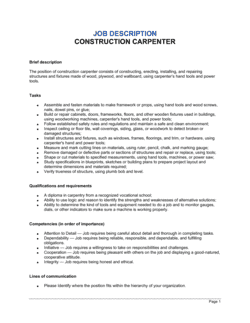
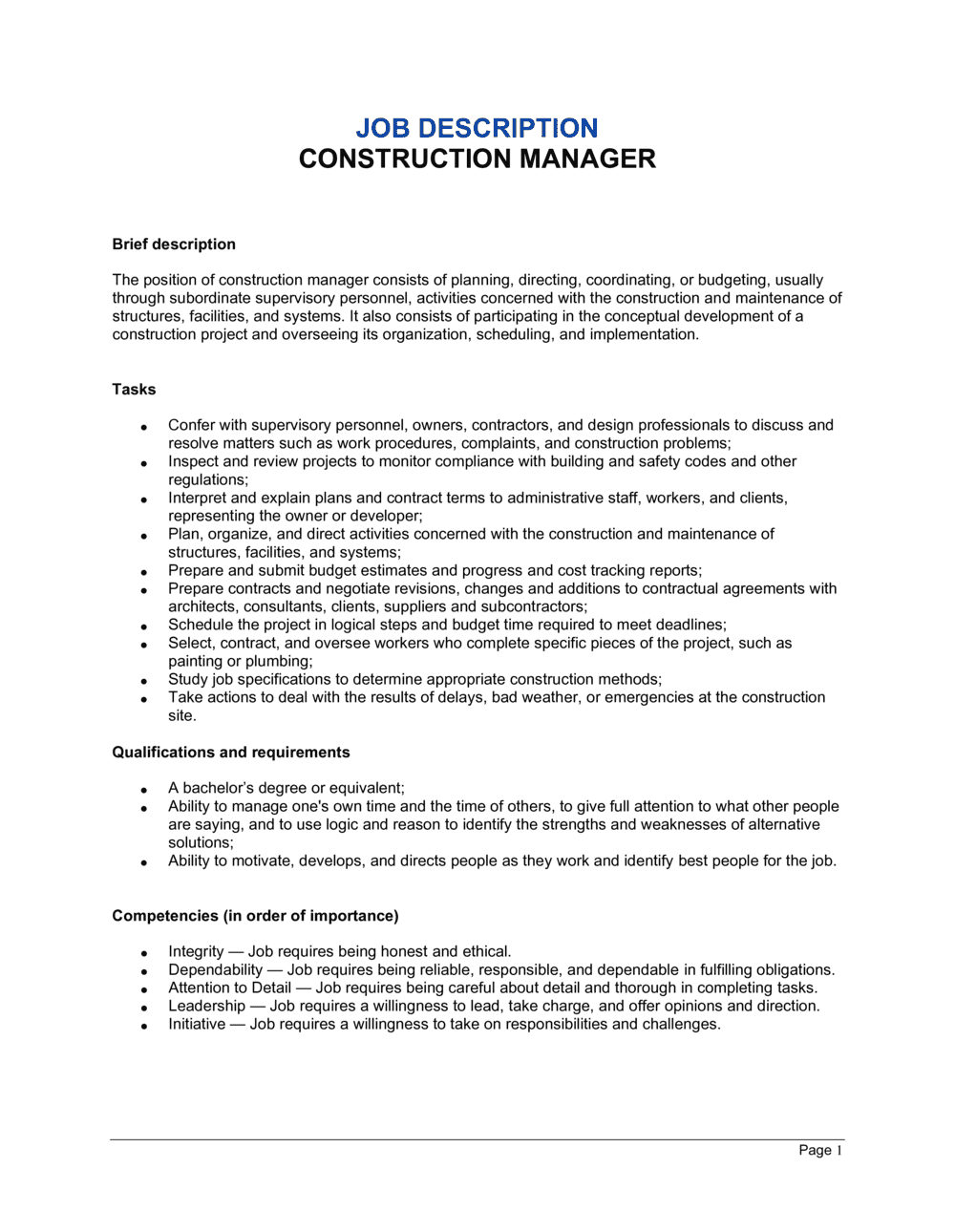
Construction Manager Job Description Template

Free Word download • Edit online • Save & share with Drive • Export to PDF

2 pages20–30 min to fillDifficulty: StandardSignature requiredLegal review recommended
Learn more ↓
FreeConstruction Manager Job Description Template

At a glance

What it is
A Construction Manager Job Description is a formal document that defines the scope of a construction manager's role within an organization — covering duties, reporting structure, required qualifications, compensation range, and performance expectations. This free Word download gives you a structured, enforceable starting point you can edit online and export as PDF to share with candidates, HR systems, or include as an exhibit in an employment contract.
When you need it
Use it when hiring a new construction manager, restructuring an existing role, or establishing documented expectations before an employment agreement is signed. It also serves as the foundation for performance reviews and disciplinary proceedings tied to defined responsibilities.
What's inside
Role overview and reporting structure, detailed duties and responsibilities, required and preferred qualifications, technical skills and certifications, compensation and benefits summary, physical and travel requirements, and an acknowledgment block for the employee to sign confirming they have read and accepted the role expectations.

What is a Construction Manager Job Description?

A Construction Manager Job Description is a formal document that defines the scope, responsibilities, qualifications, compensation range, and reporting structure of a construction manager role within an organization. It functions as the authoritative record of what the employer expects from the position — used in recruiting, onboarding, performance reviews, and disciplinary proceedings — and is typically attached as a binding exhibit to the employment contract. Unlike a casual job posting, a properly drafted job description creates a documented baseline of role expectations that both parties acknowledge in writing before employment begins.

Why You Need This Document

Without a written construction manager job description, disputes over authority, accountability, and performance expectations become credibility contests rather than contract interpretation. A construction manager who was never given a documented list of responsibilities cannot be objectively evaluated against a performance standard — and a termination decision unsupported by documented expectations is significantly harder to defend in an employment tribunal or wrongful dismissal claim. In jurisdictions with pay transparency laws, posting a role without a salary range carries regulatory fines of up to $250,000 per violation. Failing to document physical requirements leaves the employer unable to objectively assess ADA accommodation requests or support workers' compensation classifications. This template gives you a legally sound, editable foundation that closes those gaps in under an hour, while leaving room for a brief employment attorney review on senior hires or cross-border engagements where the stakes warrant it.

Which variant fits your situation?

If your situation is…Use this template
Hiring a senior construction manager overseeing multiple project managersSenior Construction Manager Job Description
Recruiting a project-specific construction manager on a fixed-term basisFixed-Term Construction Manager Job Description
Engaging a construction manager as an independent contractorIndependent Contractor Agreement
Defining responsibilities for a site supervisor below management levelConstruction Site Supervisor Job Description
Hiring a construction manager for a government or public infrastructure projectPublic Sector Construction Manager Job Description
Onboarding a construction manager who will also hold a signing authorityExecutive Employment Agreement
Combining role definition with a full binding employment contractEmployment Agreement (At-Will Employee)

Common mistakes to avoid

❌ Using vague duty language with no measurable scope

Why it matters: Phrases like 'oversees construction activities' give managers no clear accountability baseline and make performance improvement plans legally difficult to defend.

Fix: Attach scope markers to every duty — budget dollar thresholds, project count, team size, reporting frequency — so performance expectations are objective and documentable.

❌ Publishing a fixed salary instead of a range in pay-transparency jurisdictions

Why it matters: California, Colorado, New York, and Illinois require salary ranges in job postings. Violations carry fines of up to $250,000 per incident in some jurisdictions and expose the company to civil claims.

Fix: Always publish a salary range. If internal equity prevents disclosure, consult an employment attorney about jurisdiction-specific exemptions before posting.

❌ Omitting the physical requirements clause

Why it matters: Without documented physical requirements, employers cannot objectively assess ADA accommodation requests or support workers' compensation classifications — both of which can result in significant liability.

Fix: Complete the physical requirements section with specific, measurable demands: lifting weight, standing hours, percentage of outdoor work, and travel frequency.

❌ Allowing the acknowledgment block to imply a contract

Why it matters: Language such as 'I agree to perform these duties' or 'as long as I fulfill these responsibilities' has been interpreted by courts in several US states as creating an implied employment contract, negating at-will status.

Fix: Include an explicit disclaimer in the acknowledgment block: 'This document is not an employment contract and does not alter the at-will nature of my employment.'

❌ Naming individuals instead of role titles in the reporting structure

Why it matters: When the named supervisor leaves, the job description becomes inaccurate, creates confusion about authority, and must be formally amended — a compliance burden that accumulates across dozens of job descriptions.

Fix: Use role titles throughout: 'Reports to: Director of Construction Operations' rather than 'Reports to: John Smith.'

❌ Copying a generic EEO statement without jurisdiction-specific additions

Why it matters: Several US states, cities, and EU member states require protected classes beyond the federal baseline — omitting them exposes the employer to EEOC complaints and local regulatory action.

Fix: Maintain a jurisdiction-specific EEO addendum that layers in required protected classes for every state or country where you actively recruit.

The 9 key clauses, explained

Role Overview and Position Title

In plain language: States the official job title, employment classification (exempt or non-exempt), employment type (full-time, part-time, fixed-term), and a two- to three-sentence summary of the role's primary purpose.

Sample language
Position Title: Construction Manager | Classification: Exempt, Full-Time | The Construction Manager is responsible for planning, coordinating, and supervising all phases of construction projects from pre-construction through project closeout, ensuring delivery on schedule, within budget, and in compliance with all applicable codes and safety regulations.

Common mistake: Using a working title (e.g., 'Site Lead') instead of the legal job title that will appear in the employment contract and payroll system, creating a mismatch that complicates HR records and overtime classification.

Reporting Structure

In plain language: Identifies the direct supervisor the construction manager reports to and lists the roles that report to the construction manager, establishing the organizational chain of command.

Sample language
Reports to: [VP OF CONSTRUCTION / DIRECTOR OF OPERATIONS]. Direct reports include: Site Supervisors, Assistant Project Managers, and on-site Subcontractor Leads as assigned.

Common mistake: Omitting the downward reporting structure entirely, which later causes disputes over whether the construction manager has authority to direct subcontractors or issue stop-work orders.

Duties and Responsibilities

In plain language: Lists the specific, recurring tasks the construction manager is accountable for — project scheduling, budget oversight, subcontractor management, safety compliance, and client communication.

Sample language
Duties include: (a) developing and maintaining project schedules using [SCHEDULING SOFTWARE]; (b) managing project budgets up to $[AMOUNT]; (c) supervising and coordinating all subcontractor activities; (d) conducting daily site safety inspections in compliance with OSHA standards; (e) preparing and delivering weekly progress reports to [STAKEHOLDER].

Common mistake: Writing duties so broadly that the list reads as 'all tasks required by management' — courts and HR tribunals treat vague duty clauses as unenforceable and they undermine performance management.

Required Qualifications

In plain language: States the minimum education, years of experience, licensure, and certifications a candidate must hold to be eligible for the role.

Sample language
Minimum qualifications: Bachelor's degree in Construction Management, Civil Engineering, or a related field; [X] years of progressive construction management experience including at least [Y] years in a supervisory capacity; valid [STATE] contractor's license; OSHA 30 certification required.

Common mistake: Setting qualification thresholds that screen out protected classes without a documented business necessity — e.g., requiring a four-year degree for a role where demonstrated experience is equally sufficient, which can trigger disparate impact claims.

Preferred Qualifications and Technical Skills

In plain language: Lists desirable but non-mandatory credentials, software proficiencies, and competencies that differentiate stronger candidates.

Sample language
Preferred: CCM designation; experience with [SCHEDULING SOFTWARE, e.g., Procore, MS Project]; LEED AP credential; bilingual (English/Spanish); experience managing projects valued at $[X]M or more.

Common mistake: Framing preferred qualifications as requirements in interviews or offer letters, creating an implied contractual obligation that the original job description does not support.

Compensation and Benefits

In plain language: States the salary range or pay structure, bonus eligibility, and a summary reference to the benefits program — without locking in specific plan details.

Sample language
Salary Range: $[MIN] – $[MAX] annually, commensurate with experience. Eligible for annual performance bonus of up to [X]% of base salary at the discretion of management. Benefits: participation in the Company's standard benefits program as in effect from time to time, including health, dental, vision, and 401(k).

Common mistake: Publishing a single fixed salary rather than a range in jurisdictions with pay transparency laws (CA, NY, CO, IL), which can trigger regulatory complaints and expose the company to fines.

Physical Requirements and Work Conditions

In plain language: Documents the physical demands of the role — standing, lifting, outdoor exposure, travel — which is required for ADA compliance and supports accurate workers' compensation classification.

Sample language
Regularly required to stand, walk, and work on active construction sites for extended periods; ability to lift up to [X] lbs; exposure to outdoor weather conditions and construction site noise; travel to project sites required up to [X]% of working time.

Common mistake: Omitting this clause entirely for office-based HR job postings, then being unable to deny an accommodation request or support a workers' comp classification because there is no documented baseline of physical expectations.

Equal Employment Opportunity Statement

In plain language: A required affirmative statement confirming the employer does not discriminate on the basis of protected characteristics, satisfying federal and state posting requirements.

Sample language
[COMPANY NAME] is an Equal Opportunity Employer. All qualified applicants will receive consideration for employment without regard to race, color, religion, sex, national origin, disability, veteran status, or any other characteristic protected by applicable law.

Common mistake: Copying a generic EEO statement without checking whether the applicable jurisdiction requires additional protected classes (e.g., sexual orientation, gender identity, or source of income are mandated additions in several US states and the EU).

Acknowledgment and Signature Block

In plain language: A section where the employee signs and dates to confirm they have received, read, and understood the job description — creating a documented record for performance management and disciplinary proceedings.

Sample language
I acknowledge that I have received, read, and understood the foregoing Job Description for the position of Construction Manager. I understand that this document does not constitute an employment contract and that my employment remains [at-will / subject to the terms of my Employment Agreement]. Employee Signature: _______________ Date: _______________

Common mistake: Including language that implies a guarantee of continued employment in the acknowledgment block — e.g., 'as long as I perform these duties' — which courts have interpreted as an implied employment contract in at-will jurisdictions.

How to fill it out

  1. 1

    Enter the company name and position details

    Add the full registered company name, the official job title as it will appear in payroll and the employment contract, the FLSA classification (exempt or non-exempt), and the employment type (full-time, fixed-term, or part-time).

    💡 Confirm the FLSA classification with payroll before publishing — misclassifying a construction manager as exempt when they earn below the $684/week salary threshold triggers overtime liability.

  2. 2

    Define the reporting structure

    Identify the specific role title the construction manager reports to and list all roles that will report to them. Avoid naming individuals — use titles so the document remains valid after personnel changes.

    💡 If the construction manager has authority to issue stop-work orders or approve change orders, state that authority explicitly here to prevent disputes on site.

  3. 3

    Write specific, measurable duties

    List 8–12 core responsibilities using action verbs (manage, coordinate, inspect, prepare, approve). Attach dollar thresholds to budget responsibilities and frequency markers to reporting duties.

    💡 Include a catch-all final duty ('performs other duties as reasonably assigned') to preserve flexibility without undermining specificity in the core list.

  4. 4

    Set legally defensible qualification thresholds

    List minimum education, experience, and certification requirements that are genuinely necessary for the role. Document the business justification for each threshold in your HR files, separate from the posted description.

    💡 Check whether your jurisdiction limits degree requirements for roles where demonstrated experience is an equally valid substitute — several US states have moved to skills-based hiring mandates for public employers.

  5. 5

    Enter the compensation range and benefits reference

    Insert a salary range rather than a fixed number. Reference benefits by category only and note that they are subject to the plan in effect from time to time.

    💡 California, Colorado, New York, and Illinois require employers to disclose pay ranges in job postings — publishing a range proactively satisfies requirements in all four states simultaneously.

  6. 6

    Complete the physical requirements and travel section

    Document lifting requirements, standing duration, weather exposure, and the estimated percentage of time spent traveling to project sites. Use objective, measurable terms rather than subjective ones.

    💡 Consult with your workers' compensation insurer — an accurate physical requirements clause can directly affect your classification code and premium.

  7. 7

    Verify and insert the EEO statement

    Use the standard federal EEO statement as the base and add any additional protected classes required by the states or countries where you are hiring.

    💡 If hiring in New York City, add 'criminal history' to the protected classes list — the NYC Fair Chance Act restricts when and how employers may inquire about criminal records.

  8. 8

    Obtain a signed acknowledgment before the first day

    Have the employee sign the acknowledgment block before or on day one. Store the signed copy in their personnel file alongside the employment contract.

    💡 Keep the job description and the employment contract as separate documents — the job description defines the role; the contract creates the binding obligations. Merging them creates amendment obligations every time duties change.

Frequently asked questions

What is a construction manager job description?

A construction manager job description is a formal document that defines the scope of a construction manager's role — including duties, reporting structure, required qualifications, compensation range, and physical requirements. It serves as the baseline for recruiting, onboarding, performance management, and disciplinary proceedings, and is typically attached as an exhibit to the employment contract or stored separately in the employee's personnel file.

What duties should a construction manager job description include?

Core duties typically include project scheduling and budget oversight, subcontractor coordination, daily site safety inspections, permit and code compliance management, progress reporting to senior leadership or clients, change order review and approval, and closeout documentation. Each duty should include a scope marker — budget thresholds, team size, reporting frequency — to make performance expectations measurable and defensible.

Is a construction manager job description legally binding?

A job description is generally not a binding employment contract on its own, but courts in several jurisdictions have found that specific language in job descriptions — particularly in acknowledgment blocks — can create implied contractual obligations. Including an explicit disclaimer stating that the document does not constitute an employment contract and does not alter at-will status is standard practice and reduces that risk.

What qualifications should I require for a construction manager role?

Typical minimum qualifications include a bachelor's degree in construction management or a related field, 5–10 years of progressive experience with at least 2–3 years in a supervisory role, a valid contractor's license where required by state law, and OSHA 30 certification. Preferred qualifications often include a CCM designation, Procore or MS Project proficiency, and LEED AP credentials for sustainability-focused projects. Thresholds should be calibrated to the role and documented as business necessities to withstand disparate impact scrutiny.

Do I need to disclose the salary in a construction manager job posting?

In California, Colorado, New York, Illinois, and a growing number of US states, pay transparency laws require employers to disclose a salary range in job postings. Federal law does not currently mandate disclosure, but the trend is toward broader requirements. Publishing a range proactively satisfies current multi-state requirements, reduces negotiation friction, and is considered a best practice even where not legally mandated.

What is the difference between a construction manager and a construction project manager?

The titles are often used interchangeably, but in larger organizations, a construction project manager typically owns a single project's schedule, budget, and client relationship, while a construction manager may oversee multiple project managers across several simultaneous builds. The job description should reflect the actual scope — managing managers versus managing projects directly — to avoid classification confusion and ensure accurate compensation benchmarking.

Should I include an OSHA 30 certification as a requirement or a preference?

For any role involving direct oversight of an active construction site, list OSHA 30 as a minimum requirement rather than a preference. OSHA regulations hold employers liable for site safety failures, and a construction manager without current safety training is an identifiable gap in your compliance posture. Some states and federal contract programs require OSHA 30 as a condition of permit issuance or contract award.

Can I use a job description as the basis for a performance improvement plan?

Yes — and it is one of the primary reasons to invest in a well-drafted job description. A PIP grounded in specific duties and measurable expectations drawn directly from the signed job description is far more defensible in a wrongful termination claim than one based on informal standards. The employee's signed acknowledgment confirms they received and understood the expectations before any performance issue arose.

How often should a construction manager job description be updated?

Review it annually and update it whenever the role's scope materially changes — new reporting relationships, expanded budget authority, added certification requirements, or new pay transparency obligations in states where you recruit. Have the employee sign an updated acknowledgment each time a material change is made. Outdated job descriptions that no longer reflect the actual role undermine performance management and can create implied promotion or compensation claims.

How this compares to alternatives

vs Employment Contract

An employment contract creates the binding legal relationship — compensation, IP assignment, non-compete, termination, and severance. A job description defines the role's scope and expectations. The two documents work together: the job description is typically attached as an exhibit to the contract. Relying on the job description alone leaves the employer without enforceable restrictive covenants or a documented termination framework.

vs Independent Contractor Agreement

An independent contractor agreement engages a construction manager as a self-employed vendor with no employment entitlements. A job description is appropriate only for employees — using one for a contractor can be used as evidence of employer control, which supports worker misclassification claims. If the engagement is contractor-based, use a statement of work or scope-of-services document instead.

vs Executive Employment Agreement

An executive employment agreement is appropriate for a VP of Construction or Chief Operating Officer with equity, enhanced severance, and change-of-control provisions. A standard construction manager job description covers site-level and project-level managers without equity or material severance exposure. Use the executive agreement when the hire has signing authority over contracts above $1M or sits on the senior leadership team.

vs Offer Letter

An offer letter confirms the role, compensation, and start date to secure candidate acceptance. It is not a comprehensive legal document and typically attaches the job description as a reference rather than repeating duties in full. The job description defines what the role requires; the offer letter triggers acceptance; the employment contract governs the ongoing relationship.

Industry-specific considerations

Commercial Construction

Budget thresholds in the $5M–$100M+ range, multi-subcontractor coordination, tenant improvement scopes, and city permit compliance requirements are standard additions to the duties clause.

Residential and Home Building

Production homebuilders emphasize cycle-time metrics, trade partner scheduling, warranty management duties, and HOA compliance — all of which should appear as named responsibilities.

Infrastructure and Civil Engineering

Prevailing wage compliance, Davis-Bacon Act obligations on federally funded projects, and certified payroll reporting duties are critical role-specific additions for public infrastructure work.

Real Estate Development

Owner's representative functions, design team coordination, budget-to-actual reporting to investor groups, and lender draw request management define the construction manager's scope in development contexts.

Jurisdictional notes

United States

FLSA classification — exempt versus non-exempt — directly affects overtime eligibility and must be determined before the job description is finalized. Construction managers earning above $684/week and exercising genuine supervisory authority typically qualify as exempt executive employees. Pay transparency laws in California, Colorado, New York, and Illinois require salary ranges in postings. OSHA 29 CFR 1926 governs construction site safety responsibilities that should be reflected in the duties clause.

Canada

Each province sets its own employment standards for notice, termination, and workplace safety — job descriptions that define the scope of authority are used in constructive dismissal claims when duties are later reduced without consent. In Quebec, job descriptions and postings for provincially regulated employers must be available in French. The Canada Labour Code governs federally regulated construction projects, which carry additional safety and hours-of-work documentation requirements.

United Kingdom

Under the Employment Rights Act 1996, employers must provide a written statement of particulars — which references or incorporates the job description — on or before day one of employment. Construction managers on UK sites must typically hold a valid CSCS (Construction Skills Certification Scheme) card; this credential should appear in the required qualifications clause. Health and safety duties must reflect CDM (Construction Design and Management) Regulations 2015 obligations for the role.

European Union

The EU Transparent and Predictable Working Conditions Directive requires employers to provide written terms covering the role's tasks, reporting structure, and compensation within seven days of hire. GDPR considerations apply when collecting and processing candidate personal data during recruitment — include a brief data processing notice in the application materials accompanying the job description. Member states including Germany, France, and the Netherlands impose works council consultation requirements before publishing or materially amending job descriptions for existing roles.

Template vs lawyer — what fits your deal?

PathBest forCostTime
Use the templateSmall construction firms hiring a site-level construction manager in a single US state or Canadian provinceFree30–45 minutes
Template + legal reviewMulti-state or cross-border hires, roles with signing authority over large contracts, or jurisdictions with active pay transparency or EEO enforcement$200–$500 for an employment attorney review1–3 days
Custom draftedLarge general contractors, publicly funded infrastructure projects with prevailing wage obligations, or executive-level construction leadership roles$800–$2,500+1–2 weeks

Glossary

Job Description
A formal document listing the duties, required qualifications, compensation range, and reporting structure for a specific role — used in hiring, performance management, and employment contracts.
Essential Functions
The core duties that define a role and cannot be removed without fundamentally changing the job — relevant to ADA accommodation assessments in the US.
Reporting Structure
The chain of command defining who the construction manager reports to (e.g., VP of Construction) and who reports to them (e.g., site supervisors, subcontractors).
Scope of Work
A defined boundary of tasks and responsibilities assigned to a role or project, used to prevent overlap and clarify accountability.
ADA (Americans with Disabilities Act)
US federal law requiring employers to provide reasonable accommodations for qualified employees with disabilities — job descriptions must accurately list physical requirements to support ADA compliance.
At-Will Employment
A US employment doctrine allowing either party to end the relationship at any time for any lawful reason — job descriptions used in at-will contexts must not imply a guaranteed term.
Certification (Construction)
A credential issued by a recognized body — such as the PMP, CCM, or OSHA 30 — confirming that an individual meets a defined standard of knowledge or competency.
CCM (Certified Construction Manager)
A credential awarded by the Construction Management Association of America (CMAA) to professionals who meet experience, education, and examination standards.
OSHA 30
A 30-hour safety training program from the Occupational Safety and Health Administration covering construction site hazard recognition and regulatory compliance.
Lien Waiver
A document in which a contractor or subcontractor relinquishes their right to file a mechanics lien against a property in exchange for payment — construction managers often coordinate lien waiver collection.
Prevailing Wage
A government-mandated minimum wage for specific trade and management roles on publicly funded construction projects, set by geographic area and job classification.

Part of your Business Operating System

This document is one of 3,000+ business & legal templates included in Business in a Box.

  • Fill-in-the-blanks — ready in minutes
  • 100% customizable Word document
  • Compatible with all office suites
  • Export to PDF and share electronically

Create your document in 3 simple steps.

From template to signed document — all inside one Business Operating System.
1
Download or open template

Access over 3,000+ business and legal templates for any business task, project or initiative.

2
Edit and fill in the blanks with AI

Customize your ready-made business document template and save it in the cloud.

3
Save, Share, Send, Sign

Share your files and folders with your team. Create a space of seamless collaboration.

Save time, save money, and create top-quality documents.

★★★★★

"Fantastic value! I'm not sure how I'd do without it. It's worth its weight in gold and paid back for itself many times."

Managing Director · Mall Farm
Robert Whalley
Managing Director, Mall Farm Proprietary Limited
★★★★★

"I have been using Business in a Box for years. It has been the most useful source of templates I have encountered. I recommend it to anyone."

Business Owner · 4+ years
Dr Michael John Freestone
Business Owner
★★★★★

"It has been a life saver so many times I have lost count. Business in a Box has saved me so much time and as you know, time is money."

Owner · Upstate Web
David G. Moore Jr.
Owner, Upstate Web

Run your business with a system — not scattered tools

Stop downloading documents. Start operating with clarity. Business in a Box gives you the Business Operating System used by over 250,000 companies worldwide to structure, run, and grow their business.

Start free · No credit card required