Congratulations on a Job Well Done Template

Free Word download β€’ Edit online β€’ Save & share with Drive β€’ Export to PDF

1 pageβ€’20–25 min to fillβ€’Difficulty: Standardβ€’Signature requiredβ€’Legal review recommended
Learn more ↓
FreeCongratulations on a Job Well Done Template

At a glance

What it is
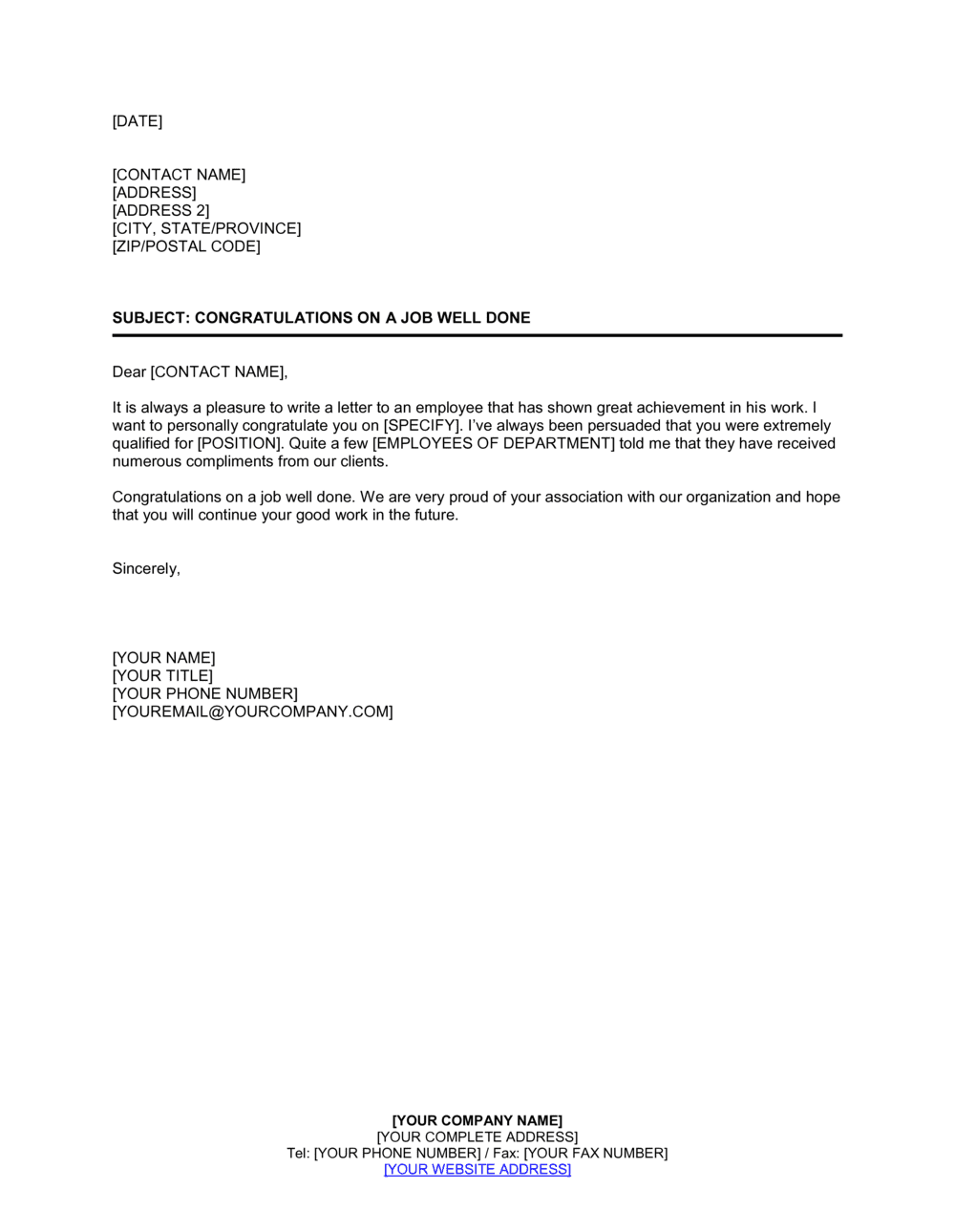
A Congratulations On A Job Well Done letter is a formal written communication from an employer or manager to an employee recognizing a specific achievement, exceptional performance, or successful completion of a project. This free Word download gives you a professionally structured letter you can edit online and export as PDF in minutes, creating a documented record of recognition that supports performance reviews and HR files.
When you need it
Use it immediately after an employee completes a significant project, exceeds a performance target, demonstrates exceptional initiative, or receives notable recognition from clients or stakeholders. Timely written recognition reinforces positive behavior and creates a paper trail that supports promotion decisions and annual reviews.
What's inside
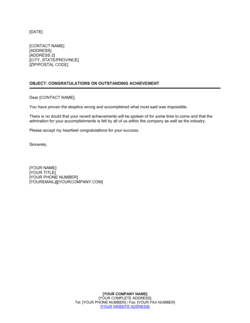
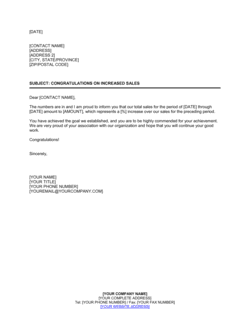
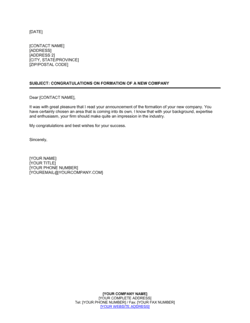
A formal salutation, a specific description of the achievement or conduct being recognized, the business impact of that achievement, an expression of appreciation from the organization, a forward-looking statement of confidence in the employee's continued contributions, and a signed closing from the issuing manager or executive.

What is a Congratulations On A Job Well Done Letter?

A Congratulations On A Job Well Done letter is a formal written communication issued by an employer, manager, or executive to recognize a specific employee achievement, project completion, or demonstration of exceptional performance. Unlike informal verbal praise, a properly drafted recognition letter creates a documented record β€” signed, dated, and filed in the employee's personnel file β€” that can be referenced in annual performance reviews, promotion decisions, and succession planning conversations. It identifies the achievement with precision, states its measurable impact on the business or client, names the specific qualities the employee demonstrated, and expresses the organization's genuine appreciation and confidence in the employee's continued contributions.

Why You Need This Document

Verbal recognition disappears from the record the moment it is spoken. Without a formal written letter, even the most significant employee achievement leaves no documented evidence to support a promotion case, justify a compensation adjustment, or counter a future performance dispute. Managers who rely exclusively on memory during annual reviews consistently underweight contributions made early in the year β€” a phenomenon known as recency bias β€” and employees who feel their work goes unacknowledged are significantly more likely to disengage or leave. A signed, specific congratulations letter filed in the personnel file closes these gaps simultaneously: it motivates the recipient, reinforces the behaviors the organization wants repeated, and creates a concrete, authenticated record that strengthens every HR decision downstream. This template gives you a professionally structured format you can complete in under 15 minutes, ensuring that no significant achievement goes undocumented.

Which variant fits your situation?

If your situation is…Use this template
Recognizing completion of a major client-facing projectCongratulations On A Job Well Done
Formally acknowledging an employee who exceeded sales targetsEmployee Appreciation Letter
Recognizing an employee who has been promoted as a result of performanceJob Promotion Letter
Providing structured written feedback following an annual reviewEmployee Performance Review
Thanking a team for collective effort on a completed initiativeEmployee Thank You Letter
Recognizing an employee who is completing a long tenure with the companyService Award Letter
Acknowledging an employee nominated for an industry or internal awardAward Nomination Letter

Common mistakes to avoid

❌ Vague achievement language

Why it matters: A letter that says 'thank you for your great work' provides no useful detail for performance reviews, promotion decisions, or the employee's own professional development record.

Fix: Name the specific project, date, and outcome. One precise sentence β€” 'your management of the Q1 product launch delivered the feature set on schedule and under budget' β€” is worth more than a paragraph of generic praise.

❌ Language that implies a compensation or promotion commitment

Why it matters: Phrases like 'this will be recognized in your next review' or 'you have earned a raise' can be construed as contractual promises, exposing the employer to a claim if the pay increase does not materialize.

Fix: Remove any language linking the recognition to a specific future reward. If a bonus or promotion is intended, document it in a separate compensation letter with legal review.

❌ Sending without a signature

Why it matters: An unsigned letter cannot be authenticated and carries limited evidentiary weight if the employee later disputes the contents or the employer relies on it in a disciplinary or promotion proceeding.

Fix: Always sign before sending β€” handwritten or via a timestamped eSign tool. File the signed copy in the personnel file immediately.

❌ Issuing the letter weeks or months after the achievement

Why it matters: Late recognition signals that the acknowledgment is procedural rather than genuine, reducing its motivational impact and calling into question whether the achievement was actually observed at the time.

Fix: Set an internal policy to issue recognition letters within 10 business days of the achievement. Assign a calendar reminder at the time of the event.

❌ Addressing the letter to the wrong department or job title

Why it matters: Incorrect role information in a personnel file creates discrepancies that complicate employment verification, promotion documentation, and legal proceedings.

Fix: Verify the employee's current official title and department in your HRIS before drafting the letter, especially for employees who have recently changed roles.

❌ Copying recognition language verbatim across multiple employees

Why it matters: Employees compare letters, and identical language signals that recognition is formulaic rather than earned β€” actively undermining the morale benefit the letter is intended to create.

Fix: Customize the achievement description and business impact statement for each individual. The template provides structure; the specific details must be original for every letter.

The 8 key clauses, explained

Sender and recipient identification

In plain language: Identifies the issuing party (name, title, company) and the recipient (employee name, job title, department) at the top of the letter.

Sample language
[SENDER FULL NAME] | [TITLE] | [COMPANY NAME] | [DATE] | To: [EMPLOYEE FULL NAME], [JOB TITLE], [DEPARTMENT]

Common mistake: Using an informal name or nickname instead of the employee's full legal name. If the letter is placed in the personnel file, a nickname creates a matching problem during audits or legal proceedings.

Formal salutation

In plain language: Opens the letter with a professional greeting that sets a respectful and sincere tone.

Sample language
Dear [EMPLOYEE FULL NAME],

Common mistake: Using 'Hi [First Name]' in a letter intended for the personnel file. Informal salutations undermine the document's standing as a formal record.

Achievement description

In plain language: Identifies the specific accomplishment, project, or behavior being recognized β€” with enough detail that the letter is meaningful outside of the immediate context.

Sample language
I am writing to formally congratulate you on the successful completion of [PROJECT/ACHIEVEMENT NAME], delivered on [DATE/PERIOD], which [SPECIFIC OUTCOME β€” e.g., came in 12% under budget and two weeks ahead of schedule].

Common mistake: Writing a vague achievement statement such as 'your great work recently.' Vague praise has no evidentiary value in a performance review and fails to reinforce the specific behaviors the organization wants repeated.

Business impact statement

In plain language: Explains how the employee's achievement benefited the company, client, or team β€” ideally with a measurable outcome.

Sample language
Your contribution directly resulted in [MEASURABLE OUTCOME β€” e.g., securing a contract renewal worth $[X] / reducing processing time by [X]% / receiving a 5-star client satisfaction rating on the [PROJECT NAME] engagement].

Common mistake: Omitting the impact statement entirely. Without it, the letter reads as personal praise rather than a documented business record, weakening its value in promotion or compensation discussions.

Expression of organizational appreciation

In plain language: States clearly that the recognition comes from the organization as a whole, not just the individual manager β€” reinforcing that the achievement was broadly noticed.

Sample language
On behalf of [COMPANY NAME] and the entire [DEPARTMENT/TEAM] leadership, I want to express our sincere appreciation for your dedication, professionalism, and the standard you set for those around you.

Common mistake: Writing only on behalf of the individual manager without referencing the organization. This limits the letter's weight as an institutional record and reduces its motivational impact on the employee.

Specific qualities or behaviors recognized

In plain language: Names the particular skills, values, or behaviors β€” such as initiative, problem-solving, leadership, or client focus β€” that made the achievement possible.

Sample language
This outcome reflects your [QUALITY β€” e.g., exceptional attention to detail / client-first mindset / ability to lead under pressure / creative problem-solving] and your consistent commitment to [COMPANY VALUE OR STANDARD].

Common mistake: Listing generic virtues like 'hard work' and 'dedication' without tying them to the specific achievement. Generic language reduces reinforcement effectiveness and adds no useful information to the personnel file.

Forward-looking confidence statement

In plain language: Expresses confidence in the employee's future contributions to the organization, reinforcing their value without making specific promises of promotion, pay increases, or continued employment.

Sample language
We have every confidence that you will continue to bring this same level of commitment and excellence to your future work at [COMPANY NAME], and we look forward to seeing the impact you will make in the months and years ahead.

Common mistake: Phrasing the forward-looking statement as a promise of promotion, bonus, or job security β€” for example, 'this work will be reflected in your next compensation review.' Such language can create contractual expectations the employer is not prepared to meet.

Closing and signature block

In plain language: Closes the letter professionally with a complimentary close, the sender's handwritten or electronic signature, printed name, title, and date.

Sample language
Sincerely, [HANDWRITTEN OR ESIGN SIGNATURE] | [SENDER FULL NAME] | [TITLE] | [COMPANY NAME] | Date: [DATE]

Common mistake: Sending the letter without a physical or electronic signature. An unsigned letter has reduced standing as a formal document and cannot be authenticated if the employee disputes the record later.

How to fill it out

  1. 1

    Enter sender and recipient details

    Fill in your full legal name, job title, and company name in the sender block. Enter the employee's full legal name, exact job title, and department in the recipient block. Use the name as it appears in the employee's HR records.

    πŸ’‘ Cross-check the employee's job title against your HRIS before printing β€” outdated titles on formal letters create confusion in personnel files.

  2. 2

    Set the date

    Use the date you are issuing the letter, not the date of the achievement itself. If significant time has passed since the achievement, acknowledge the achievement date separately in the body.

    πŸ’‘ Issue recognition letters within 5–10 business days of the achievement. Letters issued weeks later lose motivational impact and can read as afterthoughts.

  3. 3

    Write a specific achievement description

    Name the project, task, or behavior being recognized. Include the timeframe, the outcome, and enough context that someone reading the letter two years from now understands exactly what was accomplished.

    πŸ’‘ If you struggle to write a specific description, ask yourself: what would I say about this employee if they were nominated for an internal award? Use that language.

  4. 4

    Add a measurable business impact statement

    Quantify the impact where possible β€” cost savings, revenue generated, time saved, client satisfaction score, or error rate reduction. If a hard number is not available, describe the qualitative impact on the team, client relationship, or organizational goal.

    πŸ’‘ Even one number β€” 'completed three weeks ahead of schedule' or 'received positive feedback from all four client stakeholders' β€” elevates a good letter to a great one.

  5. 5

    Name the specific qualities demonstrated

    List two or three specific skills or behaviors the employee demonstrated β€” not generic praise. Tie each quality to the company's stated values or competency framework if one exists.

    πŸ’‘ Referencing your company's core values by name (e.g., 'This reflects our value of Client First') makes the letter feel institutionally intentional rather than personally spontaneous.

  6. 6

    Draft the forward-looking statement carefully

    Express genuine confidence in the employee's future contributions without making specific commitments to promotion, salary increases, or continued employment. Keep this paragraph to two to three sentences.

    πŸ’‘ Have your HR lead or legal counsel review the forward-looking language for any phrasing that could be read as a contractual promise before you sign.

  7. 7

    Sign the letter and file a copy

    Sign the letter with a handwritten or legally valid electronic signature. Send the original to the employee, file a copy in the personnel file, and email a digital copy to HR for the record.

    πŸ’‘ Use Business in a Box eSign to timestamp execution and maintain an authenticated copy in BIB Drive alongside the employee's other HR documents.

Frequently asked questions

What is a congratulations on a job well done letter?

A congratulations on a job well done letter is a formal written communication from an employer or manager to an employee recognizing a specific achievement, project completion, or demonstration of exceptional performance. It serves as both a motivational tool and a documented record that can be referenced in performance reviews, promotion discussions, and the employee's personnel file.

Why should recognition letters be formal and documented?

Informal verbal praise is valuable in the moment but disappears from the record. A formal written letter creates a documented history of the employee's contributions that managers, HR teams, and executives can reference during annual reviews, promotion cycles, and succession planning. It also gives the employee a tangible record of achievement they can include in their own professional portfolio.

Should a congratulations letter be signed?

Yes. A signed letter β€” handwritten or via a legally valid electronic signature β€” carries significantly more weight as a formal document than an unsigned one. The signature authenticates the issuer, establishes the date, and ensures the letter can be referenced reliably in a personnel file or legal proceeding.

How specific should the achievement description be?

Specific enough that someone reading the letter two years from now understands exactly what was accomplished and why it mattered. Include the project or task name, the relevant timeframe, and at least one measurable or observable outcome. Vague praise like 'your great work this quarter' has no evidentiary value and reduces the letter's motivational impact on the recipient.

How soon after an achievement should I send a recognition letter?

Within 5 to 10 business days of the achievement wherever possible. Recognition loses motivational force the longer it is delayed, and a letter issued months after the fact can read as a compliance exercise rather than genuine acknowledgment. Set a calendar prompt at the time the achievement occurs so the letter is not deprioritized under day-to-day workload.

Does the letter need to go in the employee's personnel file?

Best practice is yes. Filing a signed copy in the personnel file creates a positive performance record that managers can reference during reviews, promotion decisions, and β€” if ever needed β€” employment dispute proceedings. Many HR professionals consider recognition letters the most overlooked component of a complete personnel file.

Can a recognition letter be sent by email instead of as a formal document?

An email can supplement formal recognition, but it should not replace a signed document for significant achievements. Emails are easily deleted, difficult to authenticate, and carry less institutional weight in a personnel file. For major achievements, issue a signed formal letter and send the email as a cover note attaching the PDF version.

What is the difference between a recognition letter and a performance review?

A performance review is a structured, scheduled evaluation covering the full range of an employee's performance across multiple competencies over a defined period β€” typically quarterly or annually. A recognition letter is a targeted, event-driven acknowledgment of a single specific achievement. Both belong in the personnel file, and recognition letters written throughout the year provide concrete evidence that makes the annual review more accurate and less reliant on recency bias.

How this compares to alternatives

vs Employee Performance Review

A performance review is a scheduled, comprehensive evaluation of an employee's full range of competencies over a defined period. A congratulations letter is a targeted, event-driven recognition of one specific achievement. Both belong in the personnel file, and recognition letters written throughout the year reduce recency bias in the annual review by providing concrete documented evidence of contributions.

vs Job Promotion Letter

A promotion letter formally communicates a change in title, responsibilities, and compensation. A congratulations letter recognizes an achievement without conferring a new role or pay change. If an achievement is being recognized as the basis for a promotion, both documents should be issued β€” the recognition letter first, then the promotion letter confirming the resulting change.

vs Employee Thank You Letter

A thank you letter expresses general gratitude for ongoing contributions or team effort. A congratulations letter recognizes a specific, discrete achievement with documented business impact. Thank you letters are typically shorter and less formal; congratulations letters are intended for the personnel file and carry greater weight in performance and promotion discussions.

vs Award Nomination Letter

An award nomination letter advocates for an employee to receive a formal internal or external award, written to a selection committee or panel. A congratulations letter is issued directly to the employee after an achievement has already occurred. The two documents are complementary β€” a congratulations letter provides ready-made evidence for a subsequent award nomination.

Industry-specific considerations

Professional Services

Recognition letters for client-facing project outcomes, billing milestones, or exceptional client feedback scores provide documented evidence for partner-track promotion decisions.

Technology / SaaS

Product launches, sprint completions, and critical bug resolutions are prime recognition triggers; letters citing specific release metrics or system uptime improvements carry weight in engineering performance files.

Healthcare

Patient satisfaction achievements, accreditation contributions, or safety improvements are recognized formally to support credentialing, licensing renewals, and regulatory compliance records.

Retail / Hospitality

High-turnover environments benefit disproportionately from formal written recognition; letters tied to customer satisfaction scores or sales performance benchmarks reduce voluntary attrition.

Jurisdictional notes

United States

Recognition letters in at-will employment states do not typically create contractual obligations, but language implying a guaranteed reward can give rise to promissory estoppel claims. Avoid any phrasing that links the recognition to a specific future pay adjustment or promotion. In California, written documents referencing compensation adjustments may be treated as part of the employment agreement regardless of at-will status.

Canada

Canadian courts have used employer correspondence β€” including recognition letters β€” to establish implied terms of employment, particularly when the letter references compensation expectations. Quebec employers drafting letters for francophone employees should issue the letter in French or bilingual format to comply with the Charter of the French Language. Ensure the forward-looking language does not imply just-cause protection or guaranteed tenure.

United Kingdom

In the UK, a recognition letter that references a bonus or pay review in sufficiently specific terms may be treated as a variation of the employment contract under general contract principles. Ensure the letter is issued by an authorized signatory and that any reference to future rewards is clearly marked as discretionary. Letters should be retained as part of the employee's personnel file in compliance with UK GDPR data retention policies.

European Union

EU member states impose strict data protection requirements under GDPR for any personal data held in employee records, including recognition letters. Retention periods for personnel file documents vary by member state β€” typically 3 to 10 years after employment ends. In jurisdictions such as France and Germany, where works councils or employee representatives have oversight roles, recognition letters that reference compensation expectations may require consultation before issuance.

Template vs lawyer β€” what fits your deal?

PathBest forCostTime
Use the templateManagers and HR teams issuing standard recognition letters for routine achievements at any company sizeFree10–15 minutes per letter
Template + legal reviewRecognition letters that reference specific compensation outcomes, equity, or promotion commitments, or letters tied to a sensitive HR situation$100–$300 for an HR advisor or employment lawyer review1–2 business days
Custom draftedExecutive-level recognition tied to complex compensation arrangements, equity vesting events, or regulatory compliance milestones in a heavily regulated industry$500–$1,500+3–7 business days

Glossary

Recognition Letter
A formal written communication from an employer to an employee that documents specific praise for an achievement and becomes part of the employment record.
Performance Documentation
Written records β€” including recognition letters, performance reviews, and disciplinary notices β€” that form an employee's HR file and support employment decisions.
Business Impact Statement
A sentence or paragraph in a recognition letter that quantifies or describes how the employee's achievement benefited the organization, client, or team.
Positive Reinforcement
A management technique where desired behaviors are explicitly acknowledged and rewarded, increasing the likelihood the employee repeats them.
Personnel File
The official collection of documents maintained by an employer relating to an individual employee's employment history, performance, and conduct.
At-Will Employment
Employment that either party may end at any time for any lawful reason β€” recognition letters in at-will contexts do not create entitlements to continued employment or bonus.
Discretionary Bonus
A bonus payment made at the employer's sole discretion, not guaranteed by contract β€” recognition letters should avoid language that implies a bonus commitment unless one is intended.
Constructive Feedback Loop
A documented cycle of recognition and improvement guidance that managers use to develop employees over time, with each letter contributing a data point.
Chain of Custody (HR)
The documented path a personnel record follows from creation through filing, ensuring it is signed, dated, and stored in a way that is retrievable for audits or disputes.
Goodwill Statement
Language in a letter expressing general confidence in the employee's future contributions β€” valuable for morale but must not be drafted as a promise of continued employment or future compensation.

Part of your Business Operating System

This document is one of 3,000+ business & legal templates included in Business in a Box.

  • Fill-in-the-blanks β€” ready in minutes
  • 100% customizable Word document
  • Compatible with all office suites
  • Export to PDF and share electronically

Create your document in 3 simple steps.

From template to signed document β€” all inside one Business Operating System.
1
Download or open template

Access over 3,000+ business and legal templates for any business task, project or initiative.

2
Edit and fill in the blanks with AI

Customize your ready-made business document template and save it in the cloud.

3
Save, Share, Send, Sign

Share your files and folders with your team. Create a space of seamless collaboration.

Save time, save money, and create top-quality documents.

β˜…β˜…β˜…β˜…β˜…

"Fantastic value! I'm not sure how I'd do without it. It's worth its weight in gold and paid back for itself many times."

Managing Director Β· Mall Farm
Robert Whalley
Managing Director, Mall Farm Proprietary Limited
β˜…β˜…β˜…β˜…β˜…

"I have been using Business in a Box for years. It has been the most useful source of templates I have encountered. I recommend it to anyone."

Business Owner Β· 4+ years
Dr Michael John Freestone
Business Owner
β˜…β˜…β˜…β˜…β˜…

"It has been a life saver so many times I have lost count. Business in a Box has saved me so much time and as you know, time is money."

Owner Β· Upstate Web
David G. Moore Jr.
Owner, Upstate Web

Run your business with a system β€” not scattered tools

Stop downloading documents. Start operating with clarity. Business in a Box gives you the Business Operating System used by over 250,000 companies worldwide to structure, run, and grow their business.

Start freeΒ Β·Β No credit card required