Commendation and Refusal of Request for Raise Template

Free Word download • Edit online • Save & share with Drive • Export to PDF

1 page20–30 min to fillDifficulty: StandardSignature requiredLegal review recommended
Learn more ↓
FreeCommendation and Refusal of Request for Raise Template

At a glance

What it is
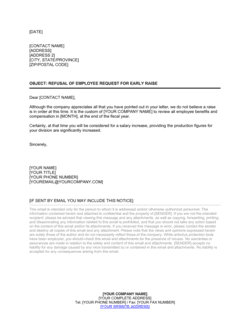
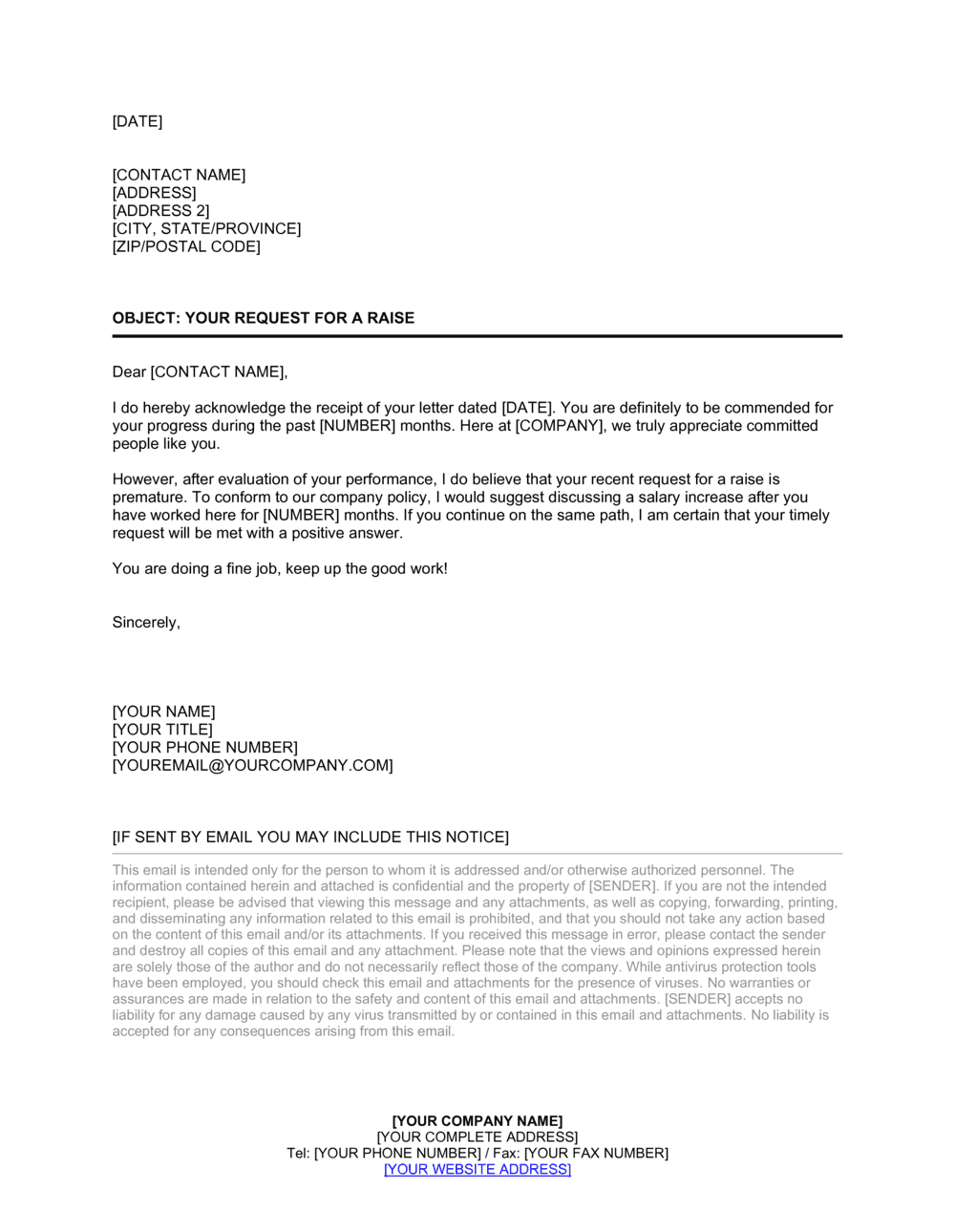
A Commendation and Refusal of Request for Raise is a formal written communication from an employer to an employee that acknowledges the employee's contributions and performance while declining their request for a salary increase. This free Word download gives you a professionally structured letter you can edit online and export as PDF — balancing genuine recognition with a clear, documented refusal that reduces the risk of misunderstanding or legal dispute.
When you need it
Use it whenever an employee submits a formal or informal request for a pay raise and the employer cannot or chooses not to approve it at that time — whether due to budget constraints, timing, compensation band limits, or performance thresholds not yet met. Having a written record protects both parties and keeps the employment relationship intact.
What's inside
The letter covers the employee's name and role, a genuine acknowledgment of their performance and contributions, the clear refusal of the raise request with a stated rationale, a forward-looking statement about when or under what conditions the request may be reconsidered, and the manager's or authorized signatory's signature.

What is a Commendation and Refusal of Request for Raise?

A Commendation and Refusal of Request for Raise is a formal written letter from an employer to an employee that simultaneously recognizes the employee's performance and clearly declines their request for a salary increase. The document serves a dual purpose: the commendation section protects the employment relationship by demonstrating that the refusal is driven by business or structural factors — not dissatisfaction with the employee — while the refusal section creates an unambiguous, dated record that the request was considered and not approved. Unlike a verbal conversation or an informal email, this letter establishes a defensible paper trail in the employee's personnel file that can be referenced if the decision is later challenged through a grievance process, pay equity review, or employment tribunal.

Why You Need This Document

Refusing a raise request without written documentation exposes the employer to a range of avoidable risks. Without a dated letter in the personnel file, an employee can credibly claim they were verbally promised a raise, that no decision was ever communicated, or that the refusal was discriminatory — claims that are difficult and expensive to disprove without written evidence. In jurisdictions with pay equity legislation, the absence of a documented, objective rationale can shift the burden of proof onto the employer in any subsequent complaint. Beyond legal risk, an unstructured verbal refusal — with no commendation and no path forward — is one of the most reliable triggers for employee disengagement and voluntary turnover, both of which carry their own direct costs. This template gives managers and HR professionals a structured, legally defensible letter they can complete in under thirty minutes, preserving both the employment relationship and the organization's compliance posture.

Which variant fits your situation?

If your situation is…Use this template
Employee is high-performing but budget is frozen for the cycleCommendation and Refusal of Request for Raise (Budget Freeze)
Employee performance does not yet meet the threshold for a raisePerformance Improvement Plan
Raise is being deferred to a specific future date rather than refused outrightSalary Deferral Letter
Employee is being offered a non-monetary benefit instead of a raiseEmployee Benefits Offer Letter
Employee is being promoted with a salary adjustmentPromotion Letter
Employee's raise request leads to a formal compensation reviewCompensation Review Letter
Raise refusal is accompanied by a performance review documentEmployee Performance Review

Common mistakes to avoid

❌ Using ambiguous refusal language

Why it matters: Phrases like 'not at this time' or 'we'll revisit this soon' can be interpreted as a conditional approval, leading the employee to believe a raise is imminent. This creates expectation management problems and potential claims of false promise.

Fix: Write one declarative sentence: 'The Company is unable to approve the requested salary increase at this time.' Follow with the rationale in a separate sentence.

❌ Promising a specific future raise amount

Why it matters: Any dollar figure or percentage mentioned as a future possibility can be construed as a contractual commitment, particularly in jurisdictions where oral and written representations to employees carry legal weight.

Fix: Use conditional language exclusively: 'compensation may be reviewed,' 'subject to Company performance and budget availability,' and 'based on continued performance against [CRITERIA].'

❌ Omitting the commendation section entirely

Why it matters: A refusal letter without acknowledgment of merit signals to the employee — and any later reviewer — that the decision may be punitive or discriminatory rather than business-driven. This elevates legal and morale risk simultaneously.

Fix: Always include at least two to three sentences of specific, genuine recognition before the refusal. If the employee has genuine performance concerns, address those through a separate performance management process.

❌ Including an unenforceable confidentiality clause

Why it matters: In the US, the National Labor Relations Act generally protects employees' rights to discuss their own pay with colleagues. In the UK and EU, pay secrecy clauses are increasingly restricted by law. An overbroad clause can itself create a compliance violation.

Fix: Limit confidentiality language to the specific figures in this letter and frame it as a company preference rather than a prohibition. Remove any language that could be read as prohibiting all pay discussions.

❌ Having an unauthorized person sign the letter

Why it matters: If the decision is challenged through a grievance or employment tribunal, the employer's position is weakened if the letter was signed by someone without authority over compensation decisions.

Fix: Confirm the signatory has delegated authority in the company's HR policy before issuing. For small businesses, the owner or CEO should sign directly if no formal delegation exists.

❌ Failing to retain a signed copy in the personnel file

Why it matters: Without a dated, signed copy on file, the employer cannot demonstrate that the refusal was formally communicated if the employee later claims they were promised a raise or never told it was refused.

Fix: File the original signed letter in the employee's personnel file on the day of issue. If using electronic records, attach a PDF to the employee's HR system profile with the delivery date logged.

The 10 key clauses, explained

Parties and Role Identification

In plain language: Names the employer entity, the employee, and their current job title and department so the letter is unambiguous as to who it concerns.

Sample language
This letter is addressed to [EMPLOYEE FULL NAME], [JOB TITLE], [DEPARTMENT], employed by [EMPLOYER LEGAL NAME] ('the Company') as of [DATE].

Common mistake: Using only a first name or informal title — if the letter enters a personnel file or legal proceeding, vague identification makes it difficult to establish the document's authority.

Acknowledgment of Raise Request

In plain language: States that the employee's request for a salary increase has been received, reviewed, and is being formally responded to.

Sample language
We acknowledge receipt of your request, dated [REQUEST DATE], for a salary increase from your current base of $[CURRENT SALARY] to $[REQUESTED SALARY].

Common mistake: Omitting the date and specific figures of the original request. Without this, the letter fails to create a clear record tying it to the specific request being refused.

Commendation of Employee Performance

In plain language: Provides genuine, specific recognition of the employee's contributions, skills, or achievements to demonstrate that the refusal is not a reflection of dissatisfaction.

Sample language
The Company sincerely commends [EMPLOYEE NAME] for [SPECIFIC ACHIEVEMENT OR CONTRIBUTION], which has meaningfully contributed to [TEAM / PROJECT / COMPANY GOAL].

Common mistake: Using generic praise like 'you are a valued employee.' Vague commendations ring hollow and can actually increase resentment — specificity makes the recognition credible.

Clear Statement of Refusal

In plain language: States plainly that the salary increase is not being approved at this time, leaving no ambiguity about the outcome of the request.

Sample language
After careful consideration, the Company is unable to approve the requested salary increase at this time.

Common mistake: Softening the refusal with ambiguous language like 'we are not in a position to move forward right now' — ambiguity invites the employee to interpret a deferral as a near-future approval.

Rationale for the Decision

In plain language: Explains the specific reason the raise is being declined — budget constraints, compensation band limits, timing, or performance thresholds — so the employee understands the basis of the decision.

Sample language
This decision reflects [SPECIFIC REASON: e.g., current budget constraints across all departments / your current compensation being at the top of the established salary band for your role / the Company's scheduled compensation review cycle, which next occurs in [MONTH/YEAR]].

Common mistake: Citing multiple shifting reasons in the same letter — if each reason could stand alone, choose the most accurate one. Multiple reasons can suggest the employer is searching for justification and weaken the decision's credibility.

Forward-Looking Reconsideration Statement

In plain language: Outlines the conditions or timeline under which the employee's compensation will be reconsidered, giving them a constructive path forward.

Sample language
The Company anticipates revisiting compensation for all eligible employees during the [NEXT REVIEW PERIOD — e.g., Q1 YEAR] cycle. We encourage [EMPLOYEE NAME] to continue demonstrating [SPECIFIC BEHAVIORS OR MILESTONES] ahead of that review.

Common mistake: Promising a specific raise amount or percentage at the next review. This creates a contractual expectation — use conditional language ('may be reconsidered,' 'subject to business conditions') consistently.

Invitation for Discussion

In plain language: Invites the employee to meet with their manager or HR to discuss the decision, the rationale, and their development path — reducing the risk of disengagement.

Sample language
We welcome the opportunity to discuss this decision with you further. Please contact [MANAGER NAME / HR CONTACT] at [EMAIL / PHONE] to arrange a meeting at your convenience.

Common mistake: Skipping the invitation entirely. A letter with no avenue for follow-up conversation is more likely to result in disengagement or a formal grievance than one that leaves the door open.

Confidentiality Statement

In plain language: Reminds the employee that compensation information is confidential and should not be shared with colleagues, in line with company policy.

Sample language
As a reminder, compensation information is confidential. The Company respectfully requests that the contents of this letter not be shared with other employees, in accordance with the Company's compensation confidentiality policy.

Common mistake: Including an overly broad confidentiality clause that restricts the employee from discussing pay with anyone — in many jurisdictions, employees have statutory rights to discuss their own compensation and such clauses are unenforceable.

Governing Policy Reference

In plain language: References the applicable internal compensation policy or employee handbook section that governs how pay decisions are made, anchoring the refusal in documented company procedure.

Sample language
This decision has been made in accordance with the Company's Compensation and Salary Review Policy, as set out in Section [X] of the Employee Handbook dated [DATE].

Common mistake: Referencing a policy that has not been formally communicated to the employee or that contradicts the actual reasons given — inconsistency between the letter and the handbook creates grounds for a grievance.

Signature and Authorization Block

In plain language: Identifies the authorized signatory — typically the employee's direct manager or an HR representative — and includes the date of issue and space for both parties to sign as acknowledgment of receipt.

Sample language
Signed on behalf of [EMPLOYER LEGAL NAME]: [SIGNATORY NAME], [TITLE] | Date: [DATE] | Employee Acknowledgment of Receipt: [EMPLOYEE SIGNATURE] | Date: [DATE]

Common mistake: Having a junior team member sign a letter of this nature without delegated authority — in a dispute, the employer's ability to enforce the decision depends partly on it being issued by someone with appropriate standing.

How to fill it out

  1. 1

    Identify the parties and confirm the request details

    Enter the employee's full legal name, job title, department, and the employer's registered entity name. Include the date of the original raise request and the specific figures the employee requested.

    💡 Pull the exact figures from the employee's written request or from any HR system record — inconsistencies between the letter and the file create problems if the decision is challenged.

  2. 2

    Draft a specific, genuine commendation

    Reference one or two concrete achievements, projects, or behaviors the employee has demonstrated. Avoid generic phrases — name the project, metric, or quality directly.

    💡 If you have a recent performance review on file, lift specific language from it for the commendation. Consistency between the review and this letter reinforces credibility.

  3. 3

    State the refusal clearly in one sentence

    Write a single, unambiguous sentence confirming the salary increase is not approved. Do not embed it in softening language that obscures the outcome.

    💡 Read the refusal sentence in isolation — if it could be interpreted as a deferral or a partial approval, revise it.

  4. 4

    Select and state one primary rationale

    Choose the single most accurate reason for the refusal — budget freeze, salary band ceiling, timing of the compensation cycle, or performance criteria not yet met. State it briefly and factually.

    💡 Do not mix rationales. If budget is the real reason, lead with budget — adding a performance comment alongside a budget freeze can be misread as a performance criticism.

  5. 5

    Add a conditional forward-looking statement

    State when compensation will next be reviewed and what the employee can do to strengthen their position. Use conditional language throughout: 'may be reconsidered,' 'subject to business conditions,' 'based on performance.'

    💡 Set the next review date to the actual scheduled cycle — do not invent a date to placate the employee, as this creates an expectation the Company must then manage.

  6. 6

    Include the invitation for discussion and HR contact

    Add the name and contact details of the manager or HR representative the employee should approach for a follow-up conversation. Make the tone welcoming rather than procedural.

    💡 Scheduling a brief follow-up meeting proactively — rather than waiting for the employee to reach out — significantly reduces the risk of disengagement after a raise refusal.

  7. 7

    Reference the applicable compensation policy

    Cite the specific section of your employee handbook or compensation policy that governs salary reviews. Confirm the policy was distributed to the employee before this letter.

    💡 If your compensation policy has not been formally communicated, do not reference it in the letter — referencing an undisclosed policy can itself become a grievance issue.

  8. 8

    Obtain authorized signatures and file the acknowledgment copy

    Have the letter signed by the manager or HR representative with delegated authority. Provide the employee with a copy and obtain their signature on the acknowledgment line. File the original in the employee's personnel file.

    💡 If the employee refuses to sign the acknowledgment, note the date of delivery and the employee's refusal in writing — this preserves the record without requiring the employee's cooperation.

Frequently asked questions

What is a commendation and refusal of request for raise letter?

It is a formal written communication from an employer to an employee that does two things simultaneously: acknowledges the employee's performance and contributions in specific terms, and clearly declines their request for a salary increase. The combination of recognition and refusal is deliberate — it demonstrates that the decision is business-driven rather than a reflection of dissatisfaction, which reduces the risk of disengagement, grievance, or legal challenge.

Is a written refusal of a raise request legally required?

In most jurisdictions, no law specifically requires an employer to issue a written response to a raise request. However, written documentation is strongly advisable from a risk management standpoint. A dated, signed letter creates a clear record that the request was received, considered, and refused on stated grounds — which is essential if the employee later brings a pay discrimination claim, wrongful dismissal claim, or constructive dismissal allegation.

Can refusing a raise request constitute constructive dismissal?

Refusing a raise request generally does not constitute constructive dismissal on its own, provided the refusal is communicated professionally and the employee's existing compensation terms are not changed. Constructive dismissal typically requires a unilateral reduction in pay or a significant worsening of employment conditions. However, if an employer repeatedly refuses raises while significantly increasing the employee's workload, a claim could potentially be made — legal advice is recommended in borderline situations.

What reasons can an employer give for refusing a raise?

Common and defensible reasons include: current compensation already at the top of the established salary band for the role, an organization-wide budget freeze affecting all departments, the timing not aligning with the scheduled compensation review cycle, or the employee not yet meeting defined performance thresholds for a merit increase. The reason given should be accurate, specific, and consistent with how similar decisions have been communicated to other employees.

Can a raise refusal letter be used as evidence in a discrimination claim?

Yes — a poorly drafted letter can be introduced as evidence in a pay discrimination claim if, for example, the stated rationale is inconsistent with decisions made for similarly situated employees of a different protected class. A well-drafted letter that cites an objective, consistently applied reason — such as a salary band ceiling or a budget freeze applied across all departments — is far more defensible than one that implies performance criticism without a formal review to support it. Consider having HR or legal counsel review the letter before issuing it to a protected-class employee in a sensitive situation.

Should the employee sign the raise refusal letter?

Having the employee sign an acknowledgment of receipt is best practice in most jurisdictions. The signature confirms the letter was delivered and reviewed — it does not require the employee to agree with the decision. If an employee refuses to sign, note the date and method of delivery and the refusal in writing, and keep that record in the personnel file alongside the original letter.

How should a manager follow up after issuing a raise refusal letter?

A brief one-on-one conversation after the letter is issued is strongly recommended. The meeting should allow the employee to ask questions, give the manager an opportunity to reiterate the commendation, and establish clear milestones or a timeline for when the compensation question will be revisited. Managers who only issue the letter without a follow-up conversation see higher rates of disengagement and voluntary turnover.

Does a raise refusal letter differ from a performance improvement plan?

Yes — these are distinct documents with different purposes. A raise refusal letter declines a salary increase request and may or may not involve a performance concern. A performance improvement plan (PIP) documents specific performance deficiencies and sets formal targets the employee must meet to avoid further action. If the raise is being refused because of performance gaps, the two documents should be issued separately to avoid conflating a compensation decision with a disciplinary process.

Can an employer refuse a raise if it was verbally promised?

This depends on jurisdiction and the specific facts. In many jurisdictions, a verbal promise of a raise — particularly if made by an authorized person and relied upon by the employee — may be enforceable as a contractual commitment or under promissory estoppel principles. If a verbal commitment has been made and circumstances have changed, seek legal advice before issuing a refusal letter. The letter should not simply ignore the prior commitment without addressing it.

How this compares to alternatives

vs Performance Improvement Plan

A Performance Improvement Plan documents specific performance deficiencies and sets formal targets with consequences for non-improvement — it is a disciplinary tool. A raise refusal letter declines a compensation request and may commend the employee. The two should never be combined into one document; conflating them creates legal ambiguity about whether the letter is a disciplinary record.

vs Promotion Letter

A Promotion Letter confirms an advancement in role and typically includes a salary increase. A raise refusal letter declines a salary increase while keeping the employee's role unchanged. Use the promotion letter when the decision is affirmative; use this template when the decision is a refusal, even if the employee is otherwise high-performing.

vs Employee Performance Review

An Employee Performance Review is a structured evaluation of an employee's work over a defined period, covering goals, competencies, and development areas. A raise refusal letter is a narrow response to a specific compensation request. The performance review may inform the raise refusal, but the two documents serve different functions and should be issued separately to avoid mixing evaluative and administrative records.

vs Employment Contract Amendment

An Employment Contract Amendment formally modifies existing compensation terms — including approving a salary increase — and requires both parties' signatures to take effect. A raise refusal letter declines to amend compensation terms and does not alter the existing contract. If the raise is ultimately approved in a future cycle, an amendment or new offer letter is the appropriate follow-up document.

Industry-specific considerations

Technology / SaaS

Frequent raise requests from engineers and product staff in competitive hiring markets make documented refusals essential for maintaining pay equity and preventing claims of selective treatment.

Professional Services

Salary band structures and billable utilization targets are common refusal rationales; letters must reference these benchmarks precisely to withstand partner-level scrutiny.

Retail / Hospitality

High turnover and minimum-wage proximity make raise refusals legally sensitive; documentation must clearly distinguish budget-based refusals from performance-based ones to avoid minimum-wage compliance questions.

Healthcare

Union agreements and regulated pay scales in many healthcare settings mean refusal letters must explicitly reference the applicable collective agreement or regulatory salary schedule to be defensible.

Jurisdictional notes

United States

The National Labor Relations Act generally protects employees' rights to discuss their own wages with coworkers — confidentiality clauses that broadly prohibit pay discussions are unenforceable and may constitute an unfair labor practice. Pay equity laws in states including California, New York, and Massachusetts require that compensation decisions be defensible against same-job pay comparisons. At-will employment allows broad employer discretion on raises, but documented rationales are essential in discrimination-sensitive contexts.

Canada

Provincial employment standards legislation does not mandate pay raises, but refusals that disproportionately affect protected groups under the Canadian Human Rights Act or provincial human rights codes can attract scrutiny. Quebec employers must issue all employee communications in French under the Charter of the French Language. Pay transparency laws are advancing in British Columbia and Ontario, making documentation of compensation rationale increasingly important.

United Kingdom

The Equality Act 2010 prohibits pay secrecy clauses that prevent employees from discussing pay to establish whether pay differences are related to a protected characteristic. Employers must be able to demonstrate that a raise refusal is not influenced by gender, race, age, or other protected characteristics. Employment tribunals may treat repeated raise refusals alongside increased workload as evidence contributing to a constructive unfair dismissal claim.

European Union

The EU Pay Transparency Directive (2023/970), which member states must implement by June 2026, requires employers to provide objective, gender-neutral criteria for pay decisions and give employees the right to request information about pay levels for comparable roles. Raise refusal letters issued after implementation must align with these criteria. Several member states — including Germany and France — have additional works council consultation requirements before individual compensation decisions are communicated.

Template vs lawyer — what fits your deal?

PathBest forCostTime
Use the templateHR managers and small business owners handling standard raise refusals due to budget or compensation band limitsFree15–30 minutes
Template + legal reviewRefusals involving protected-class employees, prior verbal commitments, or employees who have expressed intent to file a grievance$150–$400 for a one-hour employment lawyer review1–2 business days
Custom draftedComplex situations involving discrimination claims, collective agreements, executive-level employees, or jurisdictions with stringent pay equity legislation$500–$2,000+3–7 business days

Glossary

Commendation
Formal written recognition of an employee's positive contributions, skills, or conduct, included to acknowledge merit before delivering an unfavorable decision.
Salary Band
A defined range of pay for a specific job level or role, used by employers to ensure compensation is internally equitable and externally competitive.
Compensation Review Cycle
A scheduled period — typically annual or semi-annual — during which an organization formally evaluates and adjusts employee pay.
Budget Freeze
A temporary organizational policy prohibiting new or increased expenditures, including salary increases, usually in response to financial constraints.
Constructive Dismissal
A legal concept where an employer's unilateral and significant change to employment terms — including pay — may be treated as forcing the employee to resign, with the same legal consequences as termination.
At-Will Employment
An employment arrangement, common in most US states, where either party may end the relationship at any time for any lawful reason — but compensation changes still require proper documentation.
Pay Equity
The principle that employees performing the same or substantially similar work should receive equal pay regardless of gender, race, or other protected characteristics.
Merit Increase
A salary raise awarded based on an employee's individual performance rating, distinct from cost-of-living adjustments or market corrections.
Written Acknowledgment
A signed confirmation from the employee that they have received and understood the contents of a letter or document, creating a dated record in their personnel file.
Grievance Procedure
A formal internal process allowing an employee to challenge or appeal a workplace decision, including compensation outcomes, through defined escalation steps.

Part of your Business Operating System

This document is one of 3,000+ business & legal templates included in Business in a Box.

  • Fill-in-the-blanks — ready in minutes
  • 100% customizable Word document
  • Compatible with all office suites
  • Export to PDF and share electronically

Create your document in 3 simple steps.

From template to signed document — all inside one Business Operating System.
1
Download or open template

Access over 3,000+ business and legal templates for any business task, project or initiative.

2
Edit and fill in the blanks with AI

Customize your ready-made business document template and save it in the cloud.

3
Save, Share, Send, Sign

Share your files and folders with your team. Create a space of seamless collaboration.

Save time, save money, and create top-quality documents.

★★★★★

"Fantastic value! I'm not sure how I'd do without it. It's worth its weight in gold and paid back for itself many times."

Managing Director · Mall Farm
Robert Whalley
Managing Director, Mall Farm Proprietary Limited
★★★★★

"I have been using Business in a Box for years. It has been the most useful source of templates I have encountered. I recommend it to anyone."

Business Owner · 4+ years
Dr Michael John Freestone
Business Owner
★★★★★

"It has been a life saver so many times I have lost count. Business in a Box has saved me so much time and as you know, time is money."

Owner · Upstate Web
David G. Moore Jr.
Owner, Upstate Web

Run your business with a system — not scattered tools

Stop downloading documents. Start operating with clarity. Business in a Box gives you the Business Operating System used by over 250,000 companies worldwide to structure, run, and grow their business.

Free Forever Plan · No credit card required