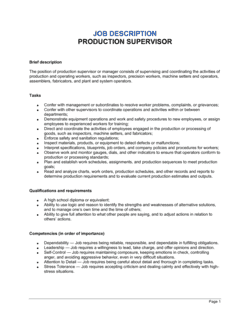
First-Line Supervisor or Manager, Administrative Support Job Description Template

Free Word download • Edit online • Save & share with Drive • Export to PDF

2 pages20–30 min to fillDifficulty: StandardSignature requiredLegal review recommended
Learn more ↓
FreeFirst-Line Supervisor or Manager, Administrative Support Job Description Template

At a glance

What it is
A First Line Supervisor or Manager Administrative Support Job Description is a formal, binding document that defines the scope of authority, core duties, performance expectations, and qualification requirements for a supervisory role overseeing administrative and clerical support staff. This free Word download can be edited online and exported as PDF, giving HR teams and hiring managers a legally defensible role definition ready for offer letters, employment contracts, and performance management.
When you need it
Use it whenever you are hiring, promoting, or restructuring an administrative supervisory role — whether creating the position for the first time or updating an outdated description that no longer reflects actual duties. It is also essential when managing ADA accommodation requests, FLSA exemption classifications, or disciplinary actions that reference job duties.
What's inside
The document covers job title and department, reporting structure, a detailed list of supervisory and administrative duties, FLSA exemption classification, required and preferred qualifications, physical and environmental conditions, and an acknowledgment block for employee and employer signatures. It also includes an equal opportunity statement and an at-will disclaimer where applicable.

What is a First Line Supervisor or Manager Administrative Support Job Description?

A First Line Supervisor or Manager Administrative Support Job Description is a formal document that defines the scope of authority, essential functions, reporting structure, FLSA classification, and qualification requirements for a supervisory role responsible for directing and coordinating administrative support staff. It is not a job posting — it is an internal, signed record that travels with the employee's personnel file and is referenced throughout the employment lifecycle for performance management, compensation benchmarking, ADA accommodation analysis, and regulatory compliance. The document establishes a mutual understanding between employer and employee about what the role entails before the first day of work, making it a foundational element of a defensible hire.

Why You Need This Document

Operating without a written, signed job description for a supervisory administrative role creates compounding risk across four distinct exposure areas. First, an undocumented FLSA classification — common when titles like "supervisor" are assigned informally — leaves employers open to back-pay claims of up to three years if the role is later found to be non-exempt. Second, without documented essential functions, employers have no objective basis for evaluating ADA accommodation requests, creating litigation exposure under a statute where the burden shifts quickly to the employer. Third, undefined duty boundaries make performance management nearly impossible to defend — disciplinary actions without a written standard of expected performance routinely fail in employment tribunals and unemployment hearings. Fourth, job descriptions that never existed or were never updated to reflect actual duties undermine compensation benchmarking, leaving supervisory roles either over- or underpaid relative to market. This template gives HR teams and hiring managers a legally structured starting point that closes all four gaps, with signature blocks to confirm mutual acknowledgment before day one.

Which variant fits your situation?

If your situation is…Use this template
Hiring a supervisor over a large clerical or data-entry team in a corporate officeAdministrative Services Manager Job Description
Defining a working supervisor role where the incumbent also performs hands-on admin tasksLead Administrative Assistant Job Description
Creating a description for a remote or hybrid administrative team leadRemote Administrative Supervisor Job Description
Documenting a department head role with P&L and budget authorityOffice Manager Job Description
Defining an executive assistant who manages junior staff and workflowsExecutive Administrative Assistant Job Description
Staffing a government or public-sector administrative supervisor positionPublic Administration Supervisor Job Description
Filling a temporary or contract supervisory role through an agencyTemporary Supervisor Job Description

Common mistakes to avoid

❌ Misclassifying the role as FLSA exempt based on title alone

Why it matters: The word 'supervisor' or 'manager' in a title does not automatically qualify a role for overtime exemption. Courts and the DOL apply the actual duties test — an incorrect classification exposes the employer to back wages, liquidated damages, and attorney fees for up to three years of pay violations.

Fix: Apply both the salary level test and the duties test before classifying. Document the exemption basis in the job description itself and have an employment attorney confirm the classification for any borderline role.

❌ Setting education requirements with no job-relatedness documentation

Why it matters: Requiring a bachelor's degree for a role that does not genuinely require degree-level reasoning has been found to produce disparate impact on protected classes under Title VII, exposing employers to discrimination claims even without discriminatory intent.

Fix: Audit each required qualification against the actual duties of the role. If the work can be performed by someone with an associate's degree or equivalent experience, document that equivalency in the required qualifications clause.

❌ Omitting percentage-of-time estimates for duty clusters

Why it matters: Without time allocation data, regulators cannot verify that supervisory work constitutes the 'primary duty' for FLSA exemption purposes, and the job description is less defensible in disciplinary or performance disputes.

Fix: Add an approximate percentage of time beside each duty cluster — e.g., 'Supervisory and people management: 55%; Administrative task execution: 30%; Reporting and compliance: 15%.' These estimates do not need to be exact but must reflect actual work.

❌ Using an EEO statement that lists only federal protected classes

Why it matters: States including California, New York, Illinois, and Washington protect categories — sexual orientation, gender identity, marital status, and others — not covered by federal law. An incomplete EEO statement exposes the employer to state-law discrimination claims and signals non-compliance in audits.

Fix: Maintain a jurisdiction-specific EEO statement library and pull the correct version for each posting location. At minimum, add 'and any other characteristic protected by applicable state or local law' as a catch-all.

❌ Collecting only the employee's signature on the acknowledgment block

Why it matters: A document signed only by the employee can be challenged as a unilateral imposition of terms rather than a mutual acknowledgment. In disputes over whether a duty was part of the role, the absence of a manager signature weakens the employer's position.

Fix: Require both the employee's and hiring manager's signatures on the acknowledgment block and retain the fully executed copy in the personnel file before or on day one.

❌ Using language implying a permanent or fixed-term role

Why it matters: Phrases like 'permanent position,' 'long-term opportunity,' or 'duties will remain consistent' have been cited by employees as evidence of an implied employment contract, undermining the at-will relationship the employer intended.

Fix: Include an explicit at-will disclaimer and add the statement 'Duties may be modified by management at any time to meet business needs' to preserve operational flexibility without creating contract-like expectations.

The 10 key clauses, explained

Job Title, Department, and Reporting Structure

In plain language: Identifies the exact job title, the department the role belongs to, the position it reports to, and how many direct reports it supervises.

Sample language
Job Title: First Line Supervisor, Administrative Support | Department: [DEPARTMENT NAME] | Reports To: [MANAGER TITLE] | Direct Reports: [NUMBER] Administrative Support Staff

Common mistake: Using a working title that differs from the payroll system title. Mismatches between the job description and payroll records create complications during FLSA audits and workers' compensation claims.

Position Summary

In plain language: A 3–5 sentence overview of the role's primary purpose, the team it leads, and the business function it supports.

Sample language
The First Line Supervisor, Administrative Support, is responsible for coordinating and overseeing the day-to-day activities of [NUMBER] administrative support staff within [DEPARTMENT]. The incumbent ensures accurate and timely completion of clerical, scheduling, and records management functions in support of [BUSINESS UNIT] operations.

Common mistake: Writing a position summary that reads as a recruitment advertisement rather than a functional role definition. Superlatives like 'dynamic' or 'passionate' add no legal or operational value and can make the document harder to use in performance management.

Essential Duties and Supervisory Responsibilities

In plain language: Lists the core tasks the incumbent must perform — both supervisory functions (scheduling, performance reviews, coaching) and any administrative tasks performed directly.

Sample language
1. Assign and review the work of [NUMBER] administrative support employees on a daily basis. 2. Conduct quarterly performance evaluations and document findings in [HRIS PLATFORM]. 3. Approve timesheets, PTO requests, and shift changes for direct reports. 4. Maintain office supply inventory within a budget of $[AMOUNT] per quarter.

Common mistake: Omitting a percentage-of-time estimate beside each duty cluster. Without time allocation, FLSA auditors cannot verify that supervisory duties constitute the 'primary duty' required for the administrative or executive exemption.

FLSA Classification and Overtime Status

In plain language: States whether the role is classified as exempt or non-exempt under the Fair Labor Standards Act and, for salaried roles, the minimum salary threshold.

Sample language
Classification: [EXEMPT / NON-EXEMPT] | Basis: [SALARY / HOURLY] | FLSA Exemption Basis (if exempt): Administrative Exemption — primary duty is directly related to management or general business operations, with exercise of discretion and independent judgment on matters of significance.

Common mistake: Classifying the role as exempt based on job title alone. The FLSA exemption test is based on actual duties and salary level — not the word 'manager' or 'supervisor' in the title. An incorrect classification exposes the employer to back-pay claims for up to three years.

Required Qualifications (KSAO)

In plain language: Defines the minimum education, years of experience, technical skills, and certifications an applicant must have to be considered for the role.

Sample language
Education: Associate's degree or higher in Business Administration, Office Management, or a related field, or equivalent combination of education and experience. Experience: Minimum [X] years of progressively responsible administrative experience, including at least [X] years in a supervisory or lead capacity. Skills: Proficiency in Microsoft Office 365 (Word, Excel, Outlook); experience with [HRIS/SCHEDULING SOFTWARE].

Common mistake: Setting education requirements that are not demonstrably job-related. Courts have found that requiring a bachelor's degree for a role that does not actually require degree-level reasoning can constitute disparate impact discrimination under Title VII.

Preferred Qualifications

In plain language: Lists additional credentials, skills, or experience that strengthen a candidate's application but are not disqualifying if absent.

Sample language
Preferred: Certified Administrative Professional (CAP) designation; experience managing administrative teams of [NUMBER] or more; bilingual proficiency in [LANGUAGE]; familiarity with [INDUSTRY-SPECIFIC SOFTWARE].

Common mistake: Listing preferred qualifications that are indistinguishable from required qualifications. If a candidate without the 'preferred' credential would not realistically be hired, it belongs in the required section — otherwise the distinction creates confusion in offer-letter disputes.

Physical Requirements and Working Conditions

In plain language: Documents the physical demands of the role — lifting, sitting, visual acuity, travel — and the work environment, for ADA compliance and workers' compensation purposes.

Sample language
This position requires the ability to sit for extended periods (up to [X] hours per day), operate standard office equipment, and occasionally lift up to [X] pounds. The work environment is a standard office setting with [REMOTE / HYBRID / ON-SITE] schedule. Reasonable accommodations may be made to enable individuals with disabilities to perform the essential functions.

Common mistake: Omitting physical requirements entirely for 'desk jobs.' If the role requires any physical activity — even occasional lifting of files or standing for extended meetings — documenting it protects the employer when accommodation requests arise.

Equal Opportunity and Non-Discrimination Statement

In plain language: States the employer's commitment to equal employment opportunity and affirms that the job description does not constitute a contract of employment.

Sample language
[COMPANY NAME] is an equal opportunity employer. All qualified applicants will receive consideration for employment without regard to race, color, religion, sex, national origin, disability, veteran status, or any other characteristic protected by applicable law. This job description is not a contract of employment and may be revised at any time.

Common mistake: Using a generic EEO boilerplate that names only federally protected classes but omits state or local protected categories applicable to the employer's location — such as sexual orientation, marital status, or source of income.

At-Will Disclaimer (where applicable)

In plain language: Confirms that the job description does not alter the at-will nature of employment and that duties may be modified by the employer.

Sample language
Employment at [COMPANY NAME] is at-will, meaning either party may terminate the employment relationship at any time, with or without cause or notice, unless otherwise required by applicable law. The duties described herein may be modified by management at any time to meet business needs.

Common mistake: Including language that implies a fixed term of employment or that duties will remain static — phrases like 'permanent position' or 'duties will not change' have been used by employees to argue implied contract claims.

Acknowledgment and Signature Block

In plain language: Records that the employee has received, read, and understood the job description, with signature lines for both the employee and the hiring manager or HR representative.

Sample language
I have read and understand the responsibilities and requirements described in this job description. I acknowledge that this document does not constitute a contract of employment. Employee Signature: _______________ Date: ___ | Printed Name: _______________ | Manager Signature: _______________ Date: ___

Common mistake: Collecting the employee's signature but not the manager's. A dual-signature block creates a clear record that both parties acknowledged the role scope — important when disputes arise over whether a duty was ever part of the job.

How to fill it out

  1. 1

    Enter the job title, department, and reporting hierarchy

    Use the exact job title that appears in your payroll system. Identify the department, the title of the direct supervisor, and the number of direct reports the role oversees.

    💡 Cross-check the title against your organizational chart and payroll system before finalizing — inconsistencies trigger complications in FLSA audits and workers' compensation filings.

  2. 2

    Write the position summary

    Draft 3–5 sentences describing the role's primary purpose, the team it leads, and the business function it supports. Keep it factual and functional — this is a legal document, not a job advertisement.

    💡 Start the summary with the job title and a present-tense action verb: 'The First Line Supervisor, Administrative Support, coordinates and oversees...' This structure makes the document easier to reference in performance management.

  3. 3

    List essential duties with approximate time allocations

    Enumerate the core responsibilities in order of importance and assign a percentage of time to each duty cluster. Supervisory duties should account for the majority of time if you intend to classify the role as FLSA exempt.

    💡 If supervisory duties represent less than 50% of the incumbent's time, consult an employment attorney before classifying the role as exempt — misclassification back-pay exposure runs up to three years under the FLSA.

  4. 4

    Select and document the FLSA classification

    Choose exempt or non-exempt based on the salary level test (currently $684/week as of 2024 — verify the current threshold) and the duties test. Document the specific exemption basis in the classification clause.

    💡 The administrative exemption requires that the primary duty involves work directly related to management or general business operations AND the exercise of discretion and independent judgment on matters of significance — both prongs must be met.

  5. 5

    Define required and preferred qualifications separately

    List required qualifications that are genuinely necessary for the role and preferred qualifications that add value but are not disqualifying. Ensure that every required qualification can be directly tied to a duty in the essential functions list.

    💡 Have your legal counsel or an I-O psychologist conduct a job relatedness review of education and experience requirements before posting — unvalidated requirements are a disparate impact liability.

  6. 6

    Document physical requirements and working conditions

    Identify every physical activity the role requires, including sedentary work, lifting, travel, and screen time. Specify whether the role is on-site, hybrid, or remote. Include the ADA reasonable accommodation statement.

    💡 Be specific about lifting weights and frequency (e.g., 'occasionally lift up to 20 pounds, up to 3 times per shift') — vague physical requirements are difficult to rely on when evaluating accommodation requests.

  7. 7

    Add the EEO statement and at-will disclaimer

    Insert the company's standard equal opportunity statement, ensuring it covers both federal and applicable state/local protected classes. Add the at-will disclaimer if the role is in an at-will jurisdiction and the company uses at-will employment.

    💡 Review the EEO statement against the protected classes recognized in every state where the company employs workers — California, New York, and Illinois each recognize categories beyond the federal minimum.

  8. 8

    Collect dual signatures before or on the first day

    Have the employee and the hiring manager sign and date the acknowledgment block before or on the employee's first day of work. Retain a signed copy in the employee's personnel file.

    💡 In jurisdictions where employment contracts signed after the start date require fresh consideration to be enforceable, a signed job description doubles as evidence that the employee was informed of their duties from day one.

Frequently asked questions

What is a First Line Supervisor Administrative Support job description?

A First Line Supervisor Administrative Support job description is a formal document that defines the duties, qualifications, reporting structure, and legal classification of a supervisory role overseeing clerical and administrative staff. It serves as the authoritative reference for hiring, performance management, compensation benchmarking, and FLSA classification. Unlike a job posting, it is a binding internal document that travels with the employee's personnel file and is referenced throughout the employment lifecycle.

Is a job description a legally binding document?

A job description is not typically a contract of employment on its own, but it carries significant legal weight. Courts have relied on job descriptions to adjudicate FLSA misclassification claims, ADA essential functions disputes, and Title VII disparate impact cases. An acknowledgment signature block reinforces the document's standing as evidence of mutual understanding without converting it into a contract — which is why the at-will disclaimer and 'not a contract' language are essential inclusions.

What is the difference between a First Line Supervisor and an Office Manager?

A First Line Supervisor directly oversees and coordinates the daily work of administrative support employees — assigning tasks, reviewing output, and conducting performance evaluations. An Office Manager typically has broader authority over facilities, vendor relationships, budgets, and operational policy, and may not have direct reports at all. The key distinction is supervisory authority over specific staff versus operational management of the office environment. The FLSA also treats these roles differently under the executive and administrative exemptions.

How do I determine if this role qualifies for FLSA overtime exemption?

The FLSA administrative exemption applies when the employee's primary duty is office or non-manual work directly related to management or general business operations, and the role requires the exercise of discretion and independent judgment on matters of significance. The employee must also earn at least $684 per week (as of 2024 — verify the current threshold at dol.gov). The executive exemption applies when the primary duty is managing two or more employees and the incumbent has authority over hiring or firing. Both prongs of the applicable test must be met — title alone is insufficient.

What physical requirements should I include in an administrative supervisor job description?

At minimum, document sedentary work requirements (hours of continuous sitting), computer and screen use, any lifting or carrying demands (including filing boxes or office supplies), and the frequency of each. Include travel requirements, if any, and specify whether the role is on-site, hybrid, or remote. The ADA requires employers to identify essential physical functions so that accommodation evaluations are grounded in documented business necessity rather than assumption.

Can I use the same job description for multiple supervisory hires across locations?

You can use a single template as the foundation, but you must customize the FLSA classification, EEO statement, and at-will disclaimer for each jurisdiction where the role is filled. California, New York, and Illinois, for example, have additional protected classes, different overtime rules, and restrictions on at-will language that differ from federal defaults. A single generic description used across states without jurisdiction-specific edits creates compliance gaps in each non-default state.

When should I update a First Line Supervisor job description?

Update the description whenever the role's duties change materially — such as gaining or losing direct reports, taking on new software systems, or shifting from on-site to hybrid work. Reviews should also happen before each hiring cycle, during annual compensation benchmarking, and whenever an ADA accommodation request requires an essential functions analysis. An outdated job description that no longer reflects actual work undermines both performance management and legal defensibility.

Should the employee sign the job description?

Yes. A signed acknowledgment block creates a documented record that the employee received and understood the role's requirements and that the document does not constitute a contract of employment. Both the employee and the hiring manager should sign and date the acknowledgment block before or on the first day of work. Retain the signed original in the personnel file and provide a copy to the employee.

What happens if job duties change after the description is signed?

The description should be updated, reviewed with the employee, and re-signed. In at-will jurisdictions, the employer generally has the right to modify duties with appropriate notice, but documenting the change with an updated signed description protects both parties. Failing to update the description when duties change substantially can weaken the employer's position in FLSA reclassification audits and ADA accommodation analyses that rely on documented essential functions.

How this compares to alternatives

vs Office Manager Job Description

An Office Manager description covers facilities management, vendor contracts, budget oversight, and operational policy — often without direct supervisory authority over a defined headcount. A First Line Supervisor Administrative Support description focuses specifically on people management: assigning work, evaluating performance, and coaching a defined team of clerical staff. The FLSA exemption analysis also differs — office managers are more likely to qualify under the administrative exemption while first line supervisors may qualify under the executive exemption.

vs Administrative Assistant Job Description

An Administrative Assistant description covers task execution — scheduling, correspondence, filing, and data entry — with no supervisory authority. The First Line Supervisor description adds a formal management layer: the incumbent directs others' work rather than only performing it. This distinction is critical for FLSA classification, compensation benchmarking, and organizational chart accuracy.

vs Executive Administrative Assistant Job Description

An Executive Administrative Assistant provides high-level support to a single executive — managing calendars, travel, board materials, and confidential communications. The First Line Supervisor role is horizontally focused, managing a team of support staff across a department rather than supporting one individual vertically. The two roles have different KSAOs, salary bands, and FLSA exemption analyses.

vs Employment Contract

A job description defines the scope, duties, and qualifications of a role and travels with the employee's personnel file as a reference document. An employment contract governs the terms of the working relationship — compensation, benefits, IP, non-compete, and termination. Both documents are needed for a complete, legally defensible hire: the job description establishes what the employee does; the employment contract establishes the legal framework under which they do it.

Industry-specific considerations

Healthcare

Healthcare administrative supervisors manage medical records clerks, scheduling staff, and patient intake coordinators — HIPAA confidentiality obligations and credentialing compliance must be reflected in the duties clause.

Financial Services

Administrative supervisors in banks and insurance firms often oversee staff handling regulated data, requiring the description to reference applicable compliance frameworks such as FINRA, SOX, or state insurance regulations.

Government and Public Sector

Public-sector administrative supervisors are subject to civil service classification codes and union agreements, making precise duty enumeration and FLSA classification documentation especially critical for position reclassification hearings.

Professional Services

Law firms, consulting firms, and accounting practices rely on administrative supervisors to manage high-volume document workflows, client scheduling, and billing support — confidentiality obligations related to client matters should be embedded in the duties and qualifications clauses.

Jurisdictional notes

United States

The FLSA sets the federal framework for overtime exemption — the administrative and executive exemption tests both require a duties analysis and the $684/week salary threshold (verify current figure at dol.gov). State laws in California, New York, and Alaska impose higher salary thresholds and stricter duties tests. California additionally prohibits many non-compete clauses and requires specific language in EEO statements. At-will disclaimers are essential in all 49 at-will states; Montana requires cause for termination after a probationary period.

Canada

Canadian employment standards legislation varies by province — federally regulated industries follow the Canada Labour Code, while others follow provincial ESAs. There is no equivalent of the US FLSA administrative exemption; overtime eligibility is determined by hours worked and sector. Ontario's Employment Standards Act requires written job duties to support accommodation analyses under the Ontario Human Rights Code. Quebec employers must provide job descriptions in French for provincially regulated workplaces.

United Kingdom

UK employers must provide a written statement of particulars — including job title and description of duties — on or before the first day of employment under the Employment Rights Act 1996. Job descriptions support the reasonable adjustments process under the Equality Act 2010, which covers disability, age, sex, race, and other protected characteristics. There is no at-will employment doctrine; termination requires a fair reason and, after two years of service, a formal process. Duty descriptions should be drafted to allow reasonable flexibility under the 'custom and practice' doctrine.

European Union

The EU Transparent and Predictable Working Conditions Directive (2019/1152) requires employers to provide written information about job duties, working conditions, and applicable collective agreements within seven days of the start date. Job descriptions that document personal data handling responsibilities must reflect GDPR obligations where the role involves processing employee or customer data. Member states including Germany, France, and the Netherlands require works council consultation before introducing or materially changing standardized job descriptions for covered employee groups.

Template vs lawyer — what fits your deal?

PathBest forCostTime
Use the templateHR teams hiring for standard domestic administrative supervisory roles with straightforward FLSA classificationFree30–60 minutes
Template + legal reviewRoles in California, New York, or Illinois; borderline FLSA exempt/non-exempt classifications; or positions subject to union agreements$200–$500 for an employment attorney review1–3 days
Custom draftedPublic-sector positions subject to civil service codes, heavily regulated industries (healthcare, financial services), or multi-jurisdiction employers standardizing descriptions across 10+ states$500–$2,000 for custom HR counsel or compensation consultant engagement1–2 weeks

Glossary

First Line Supervisor
The lowest tier of management directly responsible for overseeing day-to-day work of non-managerial employees, typically without authority to set company-wide policy.
Essential Functions
The core duties of a position that an employee must be able to perform, with or without reasonable accommodation, as defined under the Americans with Disabilities Act.
FLSA Exemption
A classification under the Fair Labor Standards Act that determines whether an employee is entitled to overtime pay — exempt employees are not; non-exempt employees are.
Span of Control
The number of direct reports a supervisor manages, which affects workload, organizational structure, and compensation benchmarking.
At-Will Employment
An employment arrangement in most US states where either the employer or employee may end the relationship at any time for any lawful reason without advance notice.
ADA Reasonable Accommodation
A modification to a job's duties, schedule, or environment that allows a qualified individual with a disability to perform the essential functions of the role.
KSAO Framework
Knowledge, Skills, Abilities, and Other characteristics — the standard structure used to define minimum and preferred qualifications in a job description.
Bona Fide Occupational Qualification (BFOQ)
A qualification that is essential to the nature of the job and legally permits requirements that might otherwise appear discriminatory.
Exempt Administrative Exemption
An FLSA classification applying to employees whose primary duty is office work directly related to management or general business operations, exercising discretion and independent judgment.
Position Control
An HR budgeting practice that assigns each approved role a unique identifier so headcount and compensation data can be tracked across payroll, finance, and talent systems.
Working Supervisor
A supervisor who both manages direct reports and performs non-managerial tasks alongside the team, common in small offices or lean administrative departments.

Part of your Business Operating System

This document is one of 3,000+ business & legal templates included in Business in a Box.

  • Fill-in-the-blanks — ready in minutes
  • 100% customizable Word document
  • Compatible with all office suites
  • Export to PDF and share electronically

Create your document in 3 simple steps.

From template to signed document — all inside one Business Operating System.
1
Download or open template

Access over 3,000+ business and legal templates for any business task, project or initiative.

2
Edit and fill in the blanks with AI

Customize your ready-made business document template and save it in the cloud.

3
Save, Share, Send, Sign

Share your files and folders with your team. Create a space of seamless collaboration.

Save time, save money, and create top-quality documents.

★★★★★

"Fantastic value! I'm not sure how I'd do without it. It's worth its weight in gold and paid back for itself many times."

Managing Director · Mall Farm
Robert Whalley
Managing Director, Mall Farm Proprietary Limited
★★★★★

"I have been using Business in a Box for years. It has been the most useful source of templates I have encountered. I recommend it to anyone."

Business Owner · 4+ years
Dr Michael John Freestone
Business Owner
★★★★★

"It has been a life saver so many times I have lost count. Business in a Box has saved me so much time and as you know, time is money."

Owner · Upstate Web
David G. Moore Jr.
Owner, Upstate Web

Run your business with a system — not scattered tools

Stop downloading documents. Start operating with clarity. Business in a Box gives you the Business Operating System used by over 250,000 companies worldwide to structure, run, and grow their business.

Free Forever Plan · No credit card required