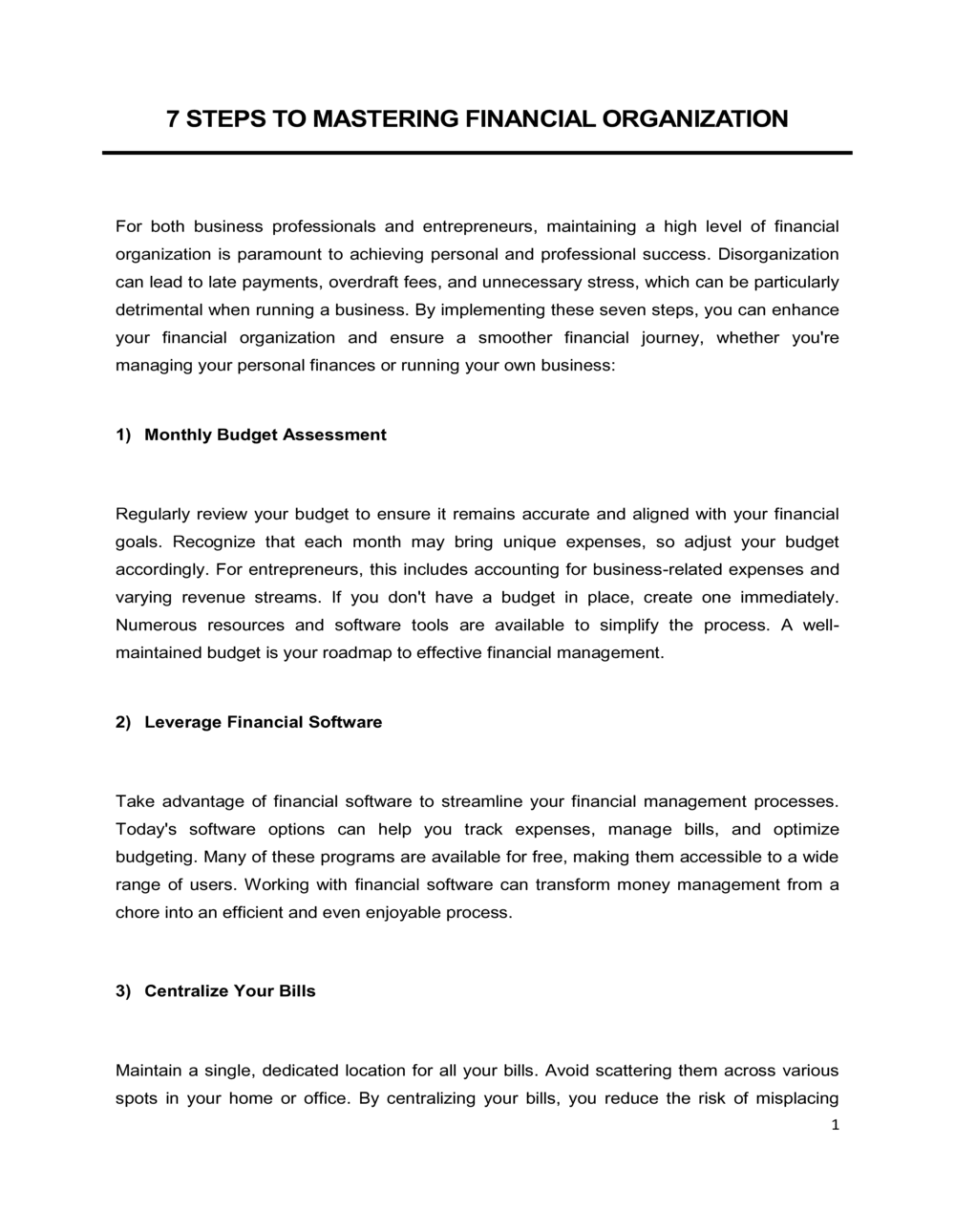
7 Steps To Mastering Financial Organization

Free to read β€’ Save or share with one click

Free7 Steps To Mastering Financial Organization Template

At a glance

What it is
7 Steps To Mastering Financial Organization is a structured Word template that walks business owners and finance teams through a seven-step framework for setting up and maintaining disciplined financial systems β€” from separating accounts and building a chart of accounts to establishing monthly close routines and tracking key performance indicators. This free download gives you a ready-to-edit guide you can customize to your business and export as PDF to share with your team or accountant.
When you need it
Use it when launching a new business that needs financial systems from day one, when an existing business has grown past the point where informal recordkeeping is sufficient, or when preparing for a loan application, audit, or investor due diligence that requires clean, organized financials.
What's inside
The template covers account separation, chart of accounts setup, expense categorization, cash flow tracking, monthly reconciliation, financial reporting, and KPI monitoring β€” with actionable instructions, checklists, and placeholder fields for each step.

What is 7 Steps To Mastering Financial Organization?

7 Steps To Mastering Financial Organization is a structured operational guide that walks business owners, finance managers, and bookkeepers through a seven-step framework for building and maintaining disciplined financial systems. It covers the full operational lifecycle of business finance β€” from separating accounts and establishing a chart of accounts, through consistent transaction recording and proactive cash flow management, to monthly reconciliation, financial reporting, and KPI tracking. Available as a free Word download, the template provides editable instructions, placeholder fields, and a step-by-step structure you can customize to your business and distribute to your team or accountant.

Why You Need This Document

Disorganized finances are one of the most common and preventable causes of small business failure β€” not because the underlying business model is broken, but because the owners cannot see clearly enough to steer. Without a documented financial system, tax deductions get missed, loan applications stall due to missing records, cash flow crises arrive without warning, and month-end close becomes a scramble that produces unreliable numbers. Lenders require at least 12 months of organized financial statements before approving any meaningful credit facility; investors expect clean books as a baseline before any due diligence conversation. This template gives you the system β€” not just the tools β€” to produce accurate, timely financial information every month, so that when a growth opportunity or a cash squeeze arrives, you already have the data to respond decisively.

Which variant fits your situation?

If your situation is…Use this template
Tracking income and expenses on a month-by-month basisMonthly Budget Template
Projecting revenue and costs for the next 12 monthsFinancial Projections (12 Months)
Monitoring and managing day-to-day cash availabilityCash Flow Statement
Preparing a complete financial picture for investors or lendersBusiness Plan
Tracking and categorizing business expenses for tax or audit purposesExpense Report
Setting annual financial targets and measuring performance against themAnnual Budget Plan
Reviewing financial health as part of a year-end close processBalance Sheet

Common mistakes to avoid

❌ Commingling personal and business transactions

Why it matters: Mixed accounts make it impossible to produce accurate financial statements, complicate tax filings, and can void liability protection for incorporated entities.

Fix: Open dedicated business accounts before any transactions occur and set a hard policy that no personal expenses route through business accounts.
❌ Batching all bookkeeping to the week before tax deadlines

Why it matters: Bulk entry errors accumulate, receipts go missing, and the resulting statements are too unreliable to use for management decisions or loan applications.

Fix: Record transactions within three business days of occurrence and reconcile accounts within five business days of each month end.

❌ Tracking cash balance instead of cash flow

Why it matters: A bank balance that looks healthy can mask a cash flow crisis if large payables, payroll, or loan payments are due within two weeks.

Fix: Maintain a rolling 13-week cash flow forecast updated weekly, and set a minimum reserve threshold that triggers action before a shortfall occurs.

❌ Producing financial reports but never reviewing them

Why it matters: Reports that sit unread provide no value β€” the signals for margin compression, rising AR days, or slowing revenue are invisible until they become a crisis.

Fix: Schedule a monthly financial review meeting within eight business days of month end, with a standing agenda that connects each report to a specific business decision.

The 8 key sections, explained

Step 1 β€” Separate business and personal finances

Step 2 β€” Build and maintain a chart of accounts

Step 3 β€” Categorize and record every transaction

Step 4 β€” Manage cash flow proactively

Step 5 β€” Reconcile accounts monthly

Step 6 β€” Produce and review monthly financial reports

Step 7 β€” Track KPIs and adjust course

Supporting tools and software recommendations

How to fill it out

  1. 1

    Enter your business name and reporting period

    Replace all [BUSINESS LEGAL NAME] placeholders with your registered business name and specify the fiscal year start date that governs your financial calendar.

    πŸ’‘ If your fiscal year doesn't align with the calendar year, note that explicitly β€” it affects how you configure your accounting software and schedule tax deadlines.

  2. 2

    Customize the chart of accounts to your industry

    Review the default account numbering scheme in Step 2 and add, remove, or relabel accounts to match your actual income streams and expense categories. Service businesses typically need fewer inventory accounts; product businesses need more COGS detail.

    πŸ’‘ Align your chart of accounts with the categories your accountant or tax preparer uses β€” this eliminates reclassification work at year end.

  3. 3

    Assign an owner and deadline to each step

    Every step has a [NAME / ROLE] and [DATE] placeholder. Fill these in with actual team members and calendar dates before distributing the document.

    πŸ’‘ If you are a solo operator, assign all steps to yourself but set calendar reminders β€” ownership without deadlines defaults to never.

  4. 4

    Set your cash reserve threshold and review cadence

    In Step 4, enter the minimum cash balance your business must maintain and the day of the week you will review the 13-week forecast. Base the reserve on 4–8 weeks of average operating expenses.

    πŸ’‘ Businesses with lumpy revenue β€” project-based, seasonal, or government-contract-dependent β€” should hold 8–12 weeks of reserve rather than the standard 4–6.

  5. 5

    Specify reconciliation deadlines and escalation thresholds

    Set the monthly reconciliation completion date (typically the 5th business day after month end) and the dollar threshold above which discrepancies must be escalated immediately.

    πŸ’‘ A $50 threshold sounds low, but unresolved small discrepancies are almost always data-entry errors that take 5 minutes to fix now and 2 hours to trace 6 months later.

  6. 6

    Configure your KPI dashboard targets

    In Step 7, replace the bracketed target values with numbers tied to your actual business model β€” gross margin targets for a product business are typically 40–60%, while a services business targets 50–70%.

    πŸ’‘ Set KPI targets based on your prior 12 months of actuals, not industry averages β€” benchmarks are useful context, but your business's trend line is what drives decisions.

  7. 7

    Save a master copy and distribute to your team

    Export the completed template as a PDF for distribution and retain the editable Word file as your master. Schedule an annual review to update thresholds, owners, and software references.

    πŸ’‘ Attach the completed document to your accounting software's notes or your shared drive so your accountant or bookkeeper can reference it during onboarding or audits.

Frequently asked questions

What is a financial organization system for a business?

A financial organization system is a structured set of processes, accounts, and reporting routines that ensure every business transaction is captured, categorized, reconciled, and reviewed on a defined schedule. It typically covers account separation, a chart of accounts, expense categorization, cash flow management, monthly reconciliation, financial reporting, and KPI tracking. Without a system, businesses rely on informal practices that break down as transaction volume grows.

Why do small businesses need formal financial organization?

Small businesses without organized financials routinely miss tax deductions, fail loan applications due to missing documentation, and discover cash flow problems only after they become critical. Lenders, investors, and government grant programs all require organized financial records as a baseline. Beyond compliance, clean financials are the foundation for any meaningful business decision about hiring, pricing, or expansion.

What is the difference between bookkeeping and financial organization?

Bookkeeping is the process of recording individual transactions accurately. Financial organization is the broader system that defines how those transactions are structured, reviewed, and acted on β€” including the chart of accounts, reconciliation cadence, reporting schedule, and KPI framework. Good bookkeeping without financial organization produces data that nobody uses; financial organization without good bookkeeping produces reports built on unreliable inputs.

How often should a small business reconcile its accounts?

Monthly reconciliation is the minimum standard for any business with more than a handful of transactions. Businesses processing more than 50 transactions per month benefit from weekly reconciliation to catch errors while the context is still fresh. The reconciliation should be completed within five business days of each month end so financial reports can be distributed by the eighth business day.

What financial KPIs should a small business track?

The four most universally applicable KPIs are gross margin (revenue minus cost of goods sold, as a percentage), operating cash flow, accounts receivable days outstanding, and burn rate or monthly net cash change. Service businesses add utilization rate and revenue per employee; product businesses add inventory turnover and gross margin per SKU. Start with four KPIs that tie directly to decisions you make monthly β€” not a dashboard of 20 metrics nobody reviews.

What accounting software works best with this template?

The template is software-agnostic and works with any accounting platform. QuickBooks Online and Xero are the most widely used options for small businesses; Wave is a free alternative suitable for sole proprietors and very early-stage companies. The most important factor is that your chosen platform supports bank feeds (automatic transaction import), matches your chart of accounts structure, and can export the P&L and balance sheet formats your accountant or lender requires.

Can this template be used by a sole proprietor or freelancer?

Yes β€” the template scales down to a one-person operation by simplifying the chart of accounts, assigning all ownership roles to the sole proprietor, and reducing the KPI set to three or four metrics. The most important steps for freelancers are account separation (Steps 1 and 2) and consistent transaction recording (Step 3), which together make tax preparation straightforward and support accurate quarterly estimated tax payments.

How does financial organization help with a loan or investment application?

Banks and investors require at minimum 12–24 months of organized financial statements β€” P&L, balance sheet, and cash flow β€” before approving a loan or committing capital. Businesses that have maintained a structured financial system can produce these in hours; businesses without one often spend weeks reconstructing records, introducing errors that raise red flags during underwriting. Organized financials also support a higher credit limit and better loan terms by demonstrating management competence.

How long does it take to implement a financial organization system?

Initial setup β€” opening accounts, building the chart of accounts, and configuring accounting software β€” typically takes four to eight hours for a simple business. The first full monthly close under the new system takes two to three times longer than steady state as you resolve legacy data issues and refine the workflow. By the third month, a well-designed system reduces monthly close time to two to four hours for a business with under 200 transactions per month.

How this compares to alternatives

vs Cash Flow Statement

A cash flow statement is a point-in-time financial report showing money in and money out over a specific period. This financial organization template is a process framework that defines how to produce, review, and act on that report β€” and six other financial management practices β€” on a recurring basis. The statement is an output; this template is the system that generates it consistently.

vs Annual Budget Plan

An annual budget sets revenue and expense targets for the year ahead. A financial organization framework defines the operational routines β€” transaction coding, reconciliation, reporting, and KPI review β€” that keep actual results trackable against that budget. Without financial organization, a budget is a plan with no feedback loop.

vs Financial Projections (12 Months)

A financial projections template models forward-looking revenue, expenses, and cash flow based on assumptions. This financial organization template builds the historical recordkeeping system that makes those projections credible and the actual-versus-forecast comparison meaningful. Projections built on disorganized records routinely misstate the baseline by 20–40%.

vs Business Plan

A business plan is an external-facing document that presents market opportunity, strategy, and financial projections to investors or lenders. This financial organization template is an internal operational guide. The business plan describes where you are going; financial organization is the system that tracks whether you are getting there.

Industry-specific considerations

Professional Services

Billable hours tracking, client expense reimbursement categorization, and WIP (work-in-progress) revenue recognition make structured financial organization particularly critical.

Retail and E-commerce

Inventory valuation, COGS per SKU, sales tax across multiple jurisdictions, and payment processor reconciliation require a more detailed chart of accounts than service businesses.

Construction and Trades

Job-costing by project, progress billing, subcontractor payments, and equipment depreciation tracking demand a project-level financial organization layer above the standard framework.

Freelance and Creative

Separating project income streams, tracking deductible home-office and equipment expenses, and managing quarterly estimated tax payments are the three highest-value financial organization priorities.

Template vs pro β€” what fits your needs?

PathBest forCostTime
Use the templateSole proprietors, freelancers, and small businesses with under $1M in annual revenue setting up or overhauling their financial systemsFree4–8 hours for initial setup; 2–4 hours per month ongoing
Template + professional reviewGrowing businesses preparing for a loan application, first audit, or investor due diligence$300–$800 for a one-time review session with a bookkeeper or accountant1–2 weeks
Custom draftedMulti-entity businesses, regulated industries, or companies with complex multi-currency or multi-location reporting requirements$1,500–$5,000 for a fractional CFO engagement or accounting firm setup2–6 weeks

Glossary

Chart of Accounts
A numbered list of all the financial accounts used in a business's general ledger, organized by category β€” assets, liabilities, equity, income, and expenses.
Bank Reconciliation
The process of comparing a company's internal financial records against its bank statements to identify and resolve discrepancies.
Accounts Receivable
Money owed to the business by customers for goods delivered or services rendered but not yet paid.
Accounts Payable
Money the business owes to suppliers or vendors for goods and services already received but not yet paid.
Cash Flow
The net movement of money into and out of a business over a defined period β€” distinct from profit, which includes non-cash items.
Accrual Accounting
An accounting method that records income when earned and expenses when incurred, regardless of when cash actually changes hands.
General Ledger
The master record of all financial transactions in a business, organized by account, from which financial statements are prepared.
Month-End Close
A recurring process of reconciling accounts, reviewing transactions, and preparing financial statements at the end of each calendar month.
KPI (Key Performance Indicator)
A measurable financial metric β€” such as gross margin, burn rate, or AR days outstanding β€” used to monitor business performance against targets.
Working Capital
Current assets minus current liabilities β€” a measure of short-term liquidity and the business's ability to cover near-term obligations.

Part of your Business Operating System

This document is one of 3,000+ business & legal templates included in Business in a Box.

  • Fill-in-the-blanks β€” ready in minutes
  • Compatible with all office suites
  • Export to PDF and share electronically

Create your document in 3 simple steps.

From template to signed document β€” all inside one Business Operating System.
1
Download or open template

Access over 3,000+ business and legal templates for any business task, project or initiative.

2
Edit and fill in the blanks with AI

Customize your ready-made business document template and save it in the cloud.

3
Save, Share, Send, Sign

Share your files and folders with your team. Create a space of seamless collaboration.

Save time, save money, and create top-quality documents.

β˜…β˜…β˜…β˜…β˜…

"Fantastic value! I'm not sure how I'd do without it. It's worth its weight in gold and paid back for itself many times."

Managing Director Β· Mall Farm
Robert Whalley
Managing Director, Mall Farm Proprietary Limited
β˜…β˜…β˜…β˜…β˜…

"I have been using Business in a Box for years. It has been the most useful source of templates I have encountered. I recommend it to anyone."

Business Owner Β· 4+ years
Dr Michael John Freestone
Business Owner
β˜…β˜…β˜…β˜…β˜…

"It has been a life saver so many times I have lost count. Business in a Box has saved me so much time and as you know, time is money."

Owner Β· Upstate Web
David G. Moore Jr.
Owner, Upstate Web

Run your business with a system β€” not scattered tools

Stop downloading documents. Start operating with clarity. Business in a Box gives you the Business Operating System used by over 250,000 companies worldwide to structure, run, and grow their business.

Free Forever PlanΒ Β·Β No credit card required