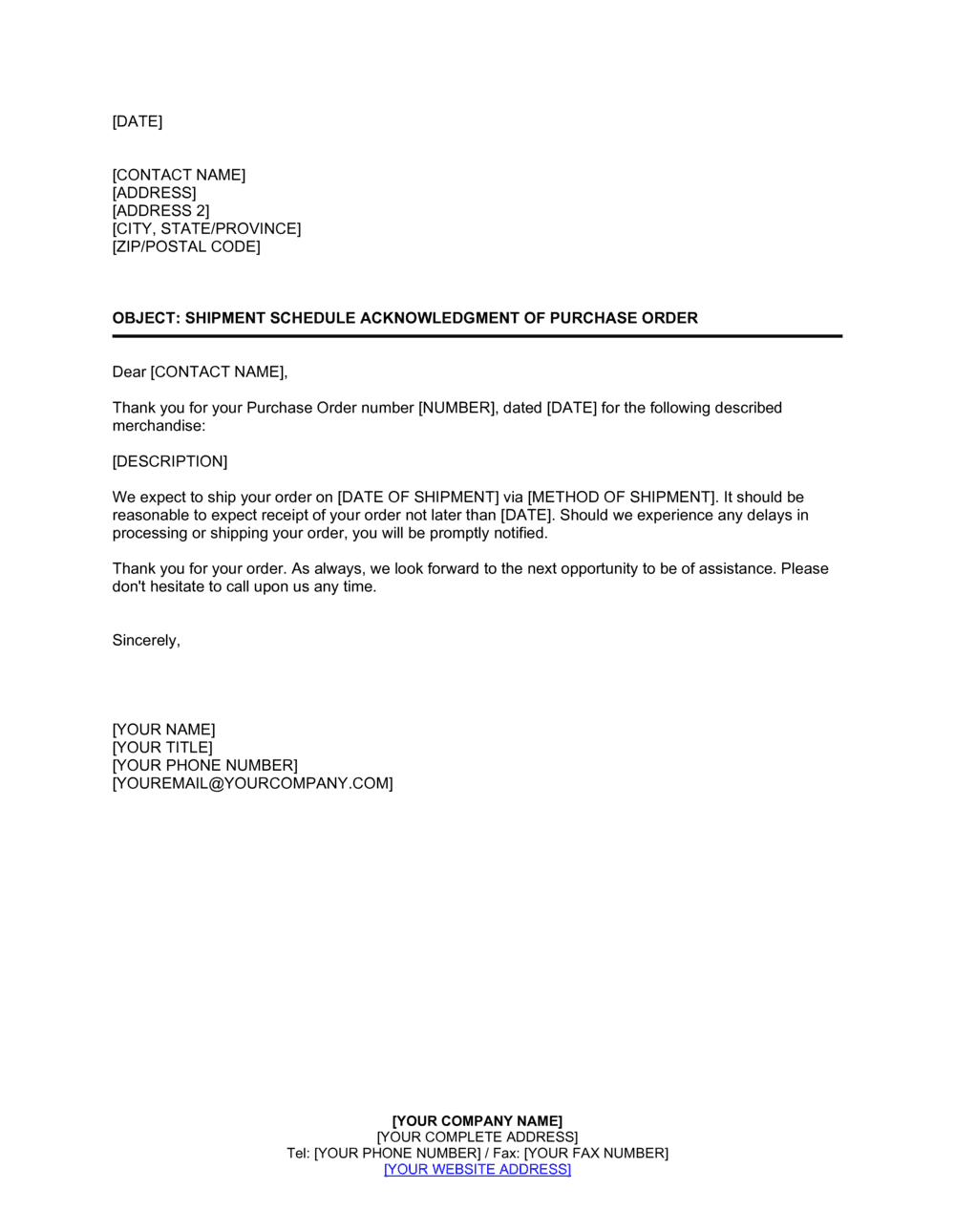
Shipment Schedule Acknowldgement of Purchase Order Template

Free Word download β€’ Edit online β€’ Save & share with Drive β€’ Export to PDF

1 pageβ€’20–30 min to fillβ€’Difficulty: Standardβ€’Signature requiredβ€’Legal review recommended
Learn more ↓
FreeShipment Schedule Acknowldgement of Purchase Order Template

At a glance

What it is
A Shipment Schedule Acknowledgement of Purchase Order is a legally binding written confirmation from a seller to a buyer that formally accepts a purchase order and commits to a specific shipment schedule β€” including delivery dates, quantities, and any agreed conditions. This free Word download gives you a professional, editable template you can tailor to each order and export as PDF for immediate use.
When you need it
Use it when a buyer issues a purchase order and the seller needs to confirm acceptance, lock in delivery commitments, and document any deviations from the original order β€” such as partial shipments, revised lead times, or substituted items β€” before fulfillment begins.
What's inside
Buyer and seller identification, original purchase order reference, itemized shipment schedule with dates and quantities, shipping terms and carrier details, payment terms, exception and deviation clauses, and signature blocks for both parties.

What is a Shipment Schedule Acknowledgement of Purchase Order?

A Shipment Schedule Acknowledgement of Purchase Order is a legally binding document issued by a seller to formally accept a buyer's purchase order and commit to a specific, itemized delivery timetable. It records the confirmed ship dates, quantities, shipping terms, applicable incoterms, and any deviations from the original order β€” such as partial shipments, revised lead times, or substituted specifications β€” in a single signed instrument. Once executed by both parties, it forms part of the enforceable purchase contract governing that transaction and serves as the primary reference point for resolving any shipment disputes that arise before, during, or after delivery.

Why You Need This Document

Without a signed shipment schedule acknowledgement, sellers and buyers operate on different assumptions about what was agreed β€” and those assumptions tend to diverge precisely when a shipment is late, a quantity is short, or a product is substituted. A buyer who never received a written acknowledgement can treat a delayed delivery as a breach of the original PO terms and claim damages for production downtime, lost sales, or emergency sourcing costs. Sellers who ship without confirmed acceptance of their deviations face rejection of goods on arrival with no recourse. This document closes that gap: it locks in the delivery commitment, documents every exception in a signed schedule, and defines inspection and rejection rights so both parties know exactly where they stand before a single carton leaves the warehouse. For international shipments especially, a properly executed acknowledgement also satisfies documentation requirements for letters of credit, customs clearance, and cargo insurance claims.

Which variant fits your situation?

If your situation is…Use this template
Acknowledging a purchase order with a single delivery dateShipment Schedule Acknowledgement of Purchase Order
Confirming acceptance of a purchase order without shipment detailPurchase Order Acknowledgement Letter
Notifying a buyer of a delay or partial shipment deviationOrder Change Notice
Issuing a formal offer to supply before a purchase order is raisedSales Quotation
Documenting the complete terms of a recurring supply relationshipSupply Agreement
Confirming delivery of goods on arrival at the buyer's locationDelivery Receipt
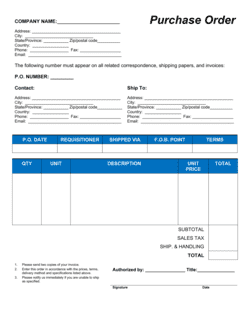
Creating the original purchase order the supplier will acknowledgePurchase Order

Common mistakes to avoid

❌ Accepting deviations without buyer sign-off

Why it matters: If the seller changes quantities, substitutes items, or shifts delivery dates without the buyer's written acceptance, the buyer can reject the shipment on arrival and claim the seller is in breach of the original PO.

Fix: List every deviation in a separate Schedule A and require the buyer's countersignature on that schedule before the shipment leaves the facility.

❌ Using relative dates instead of calendar dates

Why it matters: Phrases like 'shipment within 30 days of PO receipt' create disputes about when the clock started β€” especially if the PO was received by a different team member or department.

Fix: State the specific calendar date for every shipment event: 'Scheduled ship date: June 15, 2026' leaves no room for interpretation.

❌ Omitting the named location from the incoterm

Why it matters: An incoterm without a named point β€” 'FOB' with no city β€” is legally incomplete, leaving risk-of-loss and insurance responsibility undefined between carrier pickup and buyer delivery.

Fix: Always pair the incoterm with a specific location: 'FOB Seller's Warehouse, Dallas, TX 75201' or 'CIF Port of Los Angeles, CA.'

❌ Conflicting governing-law clauses across documents

Why it matters: When the purchase order designates New York law and the acknowledgement designates California law, courts must first resolve which jurisdiction governs β€” adding cost and unpredictability before the underlying dispute is addressed.

Fix: Review the governing-law clause in the buyer's original PO before completing this field, and either adopt the same jurisdiction or negotiate a single governing law in writing before signing.

❌ No rejection or inspection window

Why it matters: Without a defined acceptance window, buyers in many jurisdictions have a judicially determined 'reasonable time' to reject goods β€” which can be weeks or months, leaving the seller holding returned goods they can no longer resell.

Fix: State a specific business-day window β€” typically 5 to 10 days β€” within which any rejection must be communicated in writing, with the specific defect identified.

❌ Signing the acknowledgement after shipping

Why it matters: A post-shipment acknowledgement cannot modify the buyer's original PO terms retroactively in most jurisdictions, meaning the seller may be bound by terms they intended to negotiate β€” particularly on payment and returns.

Fix: Execute the acknowledgement before goods leave the facility. If circumstances require shipping first, use a standalone delivery notice and execute the acknowledgement within 24 hours of shipment.

The 9 key clauses, explained

Parties and Purchase Order Reference

In plain language: Identifies the seller and buyer by full legal name and address, and references the original purchase order by its PO number and date.

Sample language
This Shipment Schedule Acknowledgement ('Acknowledgement') is issued by [SELLER LEGAL NAME] ('Seller') to [BUYER LEGAL NAME] ('Buyer') in response to Purchase Order No. [PO NUMBER] dated [DATE].

Common mistake: Using a trade name instead of the registered legal entity name. If the entity on this document differs from the entity that signed the original purchase order, enforcing delivery obligations or damages becomes legally complicated.

Acceptance of Purchase Order Terms

In plain language: States that the seller formally accepts the purchase order, either unconditionally or subject to any deviations listed elsewhere in the acknowledgement.

Sample language
Seller hereby accepts Purchase Order No. [PO NUMBER] in accordance with the terms stated herein. Acceptance is subject to the deviations, if any, set out in Schedule A.

Common mistake: Accepting the PO without noting deviations in a separate schedule. Unaddressed deviations are read as full acceptance of the buyer's original terms β€” including pricing and delivery dates the seller cannot meet.

Itemized Shipment Schedule

In plain language: Lists each line item from the purchase order with the confirmed ship date, quantity, and any partial-shipment breakdown for staggered deliveries.

Sample language
Item: [PRODUCT NAME / SKU] | PO Quantity: [X UNITS] | Confirmed Ship Quantity: [X UNITS] | Scheduled Ship Date: [DATE] | Shipping Point: [LOCATION].

Common mistake: Providing a single aggregate ship date for a multi-item order without specifying which items ship on which date. When one item is delayed, the entire schedule becomes ambiguous and disputes arise over whether the seller is in breach.

Shipping Terms and Carrier Details

In plain language: Specifies the applicable incoterm (e.g., FOB Origin, CIF Destination), the named carrier, and the shipping point or destination port.

Sample language
Shipment shall be made [FOB / CIF / DAP] [NAMED LOCATION] via [CARRIER NAME]. Risk of loss and title transfer to Buyer upon [CONDITION β€” e.g., delivery to carrier at Seller's facility].

Common mistake: Omitting the named location from the incoterm. 'FOB' without a named point is commercially meaningless and leaves risk-of-loss allocation undefined in the event of damage or loss in transit.

Payment Terms

In plain language: States when and how the buyer must pay β€” tied to the shipment date, invoice date, or delivery confirmation.

Sample language
Payment is due [NET 30 / NET 60] from the date of invoice. Invoices will be issued on or after the scheduled ship date for each shipment. Late payments bear interest at [X]% per month.

Common mistake: Conflicting payment terms between the purchase order and the acknowledgement without explicitly stating which document controls. Courts in most jurisdictions treat the last document signed as governing β€” but not all parties realize this.

Deviations and Exceptions

In plain language: Documents any differences between what the buyer ordered and what the seller has agreed to supply β€” including quantity adjustments, substituted specifications, or revised delivery windows.

Sample language
Seller is unable to fulfill the following items as originally ordered: [ITEM / SKU] β€” [REASON]. Seller proposes the following substitution / revised delivery date: [DETAIL]. Buyer's written acceptance of this deviation is required within [X] business days.

Common mistake: Noting deviations but not requiring the buyer's written acknowledgement of them. Without buyer sign-off, the seller risks delivering something the buyer did not agree to accept, and disputes over rejection or return costs follow.

Force Majeure

In plain language: Excuses either party from performance if an extraordinary event beyond their reasonable control β€” such as a natural disaster, strike, or government restriction β€” prevents fulfillment.

Sample language
Neither party shall be liable for delays in shipment caused by events beyond their reasonable control, including acts of God, labor disputes, port closures, or government orders, provided the affected party gives written notice within [X] days of the triggering event.

Common mistake: Listing force majeure events too broadly β€” including foreseeable supply chain risks like supplier shortages or raw material price increases that courts typically do not treat as qualifying events.

Inspection and Rejection Rights

In plain language: States the buyer's right to inspect goods upon delivery and the timeframe within which rejection must be communicated to the seller.

Sample language
Buyer shall have [X] business days following delivery to inspect goods. Any rejection must be made in writing stating the specific basis. Goods not rejected within [X] days are deemed accepted.

Common mistake: Not specifying a rejection window. Without one, buyers in some jurisdictions have a 'reasonable time' to reject β€” which courts have interpreted as weeks or months, leaving the seller unable to resell or re-route goods.

Governing Law and Dispute Resolution

In plain language: Specifies which jurisdiction's law governs the acknowledgement and how disputes between the parties will be resolved.

Sample language
This Acknowledgement shall be governed by the laws of [STATE / PROVINCE / COUNTRY]. Any dispute arising hereunder shall be resolved by [binding arbitration / litigation] in [VENUE], and the parties consent to exclusive jurisdiction in that forum.

Common mistake: Choosing a governing law that conflicts with the governing-law clause already in the original purchase order. When documents in the same transaction point to different jurisdictions, courts must first resolve that conflict before addressing the underlying dispute β€” adding cost and delay.

How to fill it out

  1. 1

    Enter both parties' full legal names and addresses

    Use the seller's and buyer's registered legal entity names exactly as they appear on their corporate registration documents. Include mailing address, contact name, and email for the responsible representative on each side.

    πŸ’‘ Cross-check the buyer's entity name against the purchase order itself. Mismatches between the PO and the acknowledgement are among the most common causes of payment disputes.

  2. 2

    Reference the original purchase order precisely

    Enter the buyer's PO number, the PO issue date, and the date you received it. If the buyer uses an internal reference system, note both the PO number and any release number.

    πŸ’‘ Some buyers issue blanket purchase orders with release numbers for each shipment β€” treat the release number as the operative reference, not just the master PO.

  3. 3

    Complete the itemized shipment schedule

    For each line item on the PO, enter the product name or SKU, the confirmed ship quantity, and the specific scheduled ship date. If you are making partial shipments, create a separate row for each shipment tranche.

    πŸ’‘ Use calendar dates β€” not relative terms like 'in 30 days' β€” to avoid ambiguity about when the clock starts.

  4. 4

    Specify shipping terms and carrier

    Enter the applicable incoterm with its named location (e.g., 'FOB Chicago, IL'), the carrier name and account number if applicable, and the expected transit time to the buyer's destination.

    πŸ’‘ If the buyer has a preferred or contracted carrier, use that carrier's name even if you have a lower-cost alternative β€” deviating without notice can make you liable for the cost difference.

  5. 5

    Confirm payment terms and invoice timing

    State the payment terms clearly β€” Net 30, Net 60, or payment in advance β€” and specify whether invoices are issued at time of shipment or on delivery confirmation. Note any early-payment discounts.

    πŸ’‘ If the buyer's PO states different payment terms than your standard terms, address the conflict explicitly in the deviations clause rather than silently overriding it.

  6. 6

    Document all deviations in Schedule A

    List every item, quantity, specification, or delivery date that differs from the original PO. For each deviation, state the reason briefly and your proposed resolution. Leave space for the buyer's written acceptance signature.

    πŸ’‘ Never bury deviations in the body text of the acknowledgement β€” use a clearly labeled schedule so the buyer cannot later claim they missed it.

  7. 7

    Review force majeure and inspection clauses

    Confirm the force majeure events listed are genuinely unforeseeable for your industry and supply chain. Set a specific rejection window β€” typically 5 to 10 business days β€” in the inspection clause.

    πŸ’‘ If you are supplying perishable goods, shorten the inspection window to 24–48 hours and state this explicitly to avoid disputes about condition at time of delivery.

  8. 8

    Obtain signatures before shipping

    Both parties should sign and date the acknowledgement before goods leave the seller's facility. File the executed copy alongside the original purchase order in your accounts-receivable records.

    πŸ’‘ Use an eSign tool to timestamp execution and create an audit trail β€” especially for international transactions where physical signatures can delay shipment by days.

Frequently asked questions

What is a shipment schedule acknowledgement of purchase order?

A shipment schedule acknowledgement of purchase order is a formal written document the seller issues to the buyer to confirm acceptance of a purchase order and commit to a specific delivery timetable. It records the agreed shipment dates, quantities, shipping terms, and any deviations from the original order. Once signed by both parties, it is legally binding and forms part of the overall purchase contract.

Is a purchase order acknowledgement legally binding?

Yes, in most jurisdictions a signed purchase order acknowledgement is legally binding on both parties. It constitutes acceptance of the offer contained in the purchase order and, together with the PO, forms the contract of sale. If the acknowledgement contains material deviations from the original PO β€” different quantities, prices, or delivery dates β€” it may be treated as a counteroffer rather than an acceptance, which the buyer must then accept in writing before a binding contract is formed.

What is the difference between a purchase order and a purchase order acknowledgement?

A purchase order is issued by the buyer to authorize a purchase from the seller. A purchase order acknowledgement is the seller's written response confirming that the order has been received and accepted on specified terms. The PO represents the buyer's offer; the acknowledgement represents the seller's acceptance. Together they create the enforceable contract governing the transaction.

When should a seller send a shipment schedule acknowledgement?

Ideally within 24 to 72 hours of receiving the purchase order, and always before goods are packed or shipped. Early acknowledgement gives both parties time to resolve deviations, confirm shipping instructions, and arrange financing or insurance. Sending it after shipment reduces its contractual value and limits the seller's ability to negotiate terms.

What happens if the seller cannot meet the original shipment date?

The seller should document the revised shipment date in the deviations schedule of the acknowledgement and obtain the buyer's written acceptance before the original date passes. If the delay arises after the acknowledgement is signed, the seller should issue a separate written deviation notice immediately, citing the reason and the new expected ship date. Undisclosed delays that breach the confirmed schedule can expose the seller to claims for consequential damages β€” lost sales, storage costs, or production downtime β€” depending on the governing law and contract terms.

Do I need a lawyer to prepare a shipment schedule acknowledgement?

For straightforward domestic transactions with established trading partners, a well-drafted template is generally sufficient. Consider engaging a lawyer when the transaction involves cross-border shipments with complex incoterms, high-value goods where a breach could trigger significant damages, industry- specific regulations (food safety, hazardous materials), or a buyer whose standard PO terms are unusually onerous. A brief legal review typically costs $200–$500 and is worthwhile for transactions above $50,000.

Can a purchase order acknowledgement change the original PO terms?

It can propose changes β€” such as revised delivery dates or substituted items β€” but those changes only become binding if the buyer accepts them in writing. Under the UCC in the US (and similar statutes elsewhere), an acknowledgement that introduces material new terms is treated as a counteroffer. The buyer's signature on the deviations schedule is the cleanest way to confirm acceptance of any modification.

What shipping terms should I use in an acknowledgement?

The most common incoterms for domestic US shipments are FOB Origin (risk transfers at the seller's dock) and FOB Destination (risk transfers at the buyer's dock). For international shipments, CIF (Cost, Insurance, Freight) and DAP (Delivered at Place) are widely used. Always name the specific location alongside the incoterm and confirm whether the buyer's original PO specified a preferred term β€” deviating from the buyer's stated shipping terms without notice is a common source of freight cost disputes.

How does this document interact with a supply agreement?

A supply agreement is a master contract that sets the ongoing terms of a supplier relationship β€” pricing frameworks, quality standards, liability caps, and dispute resolution. Individual purchase orders and acknowledgements operate under the supply agreement as transaction-level documents. If there is a conflict between the two, the supply agreement typically governs unless the acknowledgement explicitly states otherwise and the buyer consents.

How this compares to alternatives

vs Purchase Order

A purchase order is the buyer's document β€” it initiates the transaction by authorizing a purchase at stated terms. A shipment schedule acknowledgement is the seller's response β€” it accepts the order and commits to a specific delivery timetable. The PO creates the offer; the acknowledgement creates the acceptance. Both documents together form the binding purchase contract.

vs Sales Order Confirmation

A sales order confirmation is generated internally by the seller's order management system to record an accepted order for fulfillment. A shipment schedule acknowledgement is an external bilateral document signed by both buyer and seller that specifically commits to delivery dates and documents deviations. The confirmation is an internal record; the acknowledgement is a contractual instrument.

vs Delivery Receipt

A delivery receipt is issued at the end of the shipment process to confirm goods physically arrived at the buyer's location. A shipment schedule acknowledgement is issued at the beginning of the process to confirm the seller accepts the order and commits to a ship date. The acknowledgement governs what will happen; the receipt confirms what did happen.

vs Supply Agreement

A supply agreement is a master contract establishing the ongoing terms of a supplier relationship β€” pricing frameworks, quality standards, liability caps, and dispute resolution β€” across multiple transactions. A shipment schedule acknowledgement is a transaction-level document for a single purchase order. Supply agreements govern the relationship; acknowledgements govern individual orders placed under it.

Industry-specific considerations

Manufacturing

Multi-line shipment schedules tied to production runs, with partial-shipment tranches linked to assembly milestones and raw-material lead times.

Retail and E-commerce

Seasonal inventory replenishment with strict ship-by windows; late delivery clauses tied to markdown penalties or chargeback provisions common in retail PO terms.

Food and Beverage

Short inspection windows (24–48 hours), temperature and condition requirements at delivery, and regulatory compliance certifications attached to each shipment.

Import and Export / International Trade

Incoterm precision is critical for customs clearance and insurance; force majeure clauses must address port delays, customs holds, and government export restrictions.

Jurisdictional notes

United States

US sales of goods are governed by Article 2 of the Uniform Commercial Code (UCC) in all states except Louisiana. Under the UCC's 'battle of the forms' doctrine (Β§2-207), an acknowledgement that contains additional or different terms from the buyer's PO may still create a binding contract on the original terms, with the new terms subject to specific acceptance rules. Sellers should expressly state that acceptance is conditional on buyer agreement to any deviations to avoid inadvertently accepting unfavorable PO terms.

Canada

Canadian sale-of-goods law is provincially governed, primarily under provincial Sale of Goods Acts modeled on the UK's 1893 statute. There is no UCC equivalent, so the common-law offer-and-acceptance framework applies strictly β€” a materially different acknowledgement is a counteroffer, not an acceptance. Quebec transactions involving commercial sales are governed by the Civil Code of Quebec, which has distinct rules on contract formation and seller obligations.

United Kingdom

UK commercial sales are governed by the Sale of Goods Act 1979 and the Late Payment of Commercial Debts (Interest) Act 1998, which implies a statutory right to interest on overdue invoices at 8% above base rate. The battle-of-the-forms issue is resolved under common-law offer and acceptance β€” the last document signed before performance generally prevails. Post-Brexit, UK and EU transactions are distinct and may require additional customs and import documentation in the acknowledgement.

European Union

Cross-border EU transactions between business parties may be governed by the UN Convention on Contracts for the International Sale of Goods (CISG), which applies automatically unless explicitly excluded. CISG Article 19 treats a materially different acknowledgement as a rejection and counteroffer. EU Late Payment Directive 2011/7/EU sets a statutory maximum of 60 days for B2B payment terms, and sellers can claim statutory interest and recovery costs on overdue invoices without a specific contract clause.

Template vs lawyer β€” what fits your deal?

PathBest forCostTime
Use the templateDomestic transactions with known trading partners under $50,000 with standard shipping termsFree15–30 minutes per acknowledgement
Template + legal reviewHigh-value orders, first-time buyers, cross-border shipments, or buyers with onerous standard PO terms$200–$500 for a one-time legal review1–2 business days
Custom draftedOngoing supply relationships with complex multi-party logistics, regulated goods, or international trade programs requiring customs documentation$1,000–$3,000+1–2 weeks

Glossary

Purchase Order (PO)
A buyer's formal written document authorizing a purchase from a supplier at specified prices, quantities, and terms.
PO Acknowledgement
The seller's written acceptance of a purchase order, confirming they have received it and intend to fulfill it on stated terms.
Shipment Schedule
A line-by-line timetable specifying which goods will be shipped, in what quantities, and on which dates β€” including partial or staggered deliveries.
Incoterms
Standardized international trade terms (e.g., FOB, CIF, DAP) that define where the risk and cost of a shipment transfers from seller to buyer.
FOB (Free On Board)
An incoterm specifying that the seller's responsibility ends when goods are loaded onto the carrier at the named shipping point.
Lead Time
The number of calendar or business days between order placement and the goods being ready to ship.
Partial Shipment
Fulfillment of a purchase order in multiple separate deliveries rather than a single consolidated shipment.
Force Majeure
A clause excusing a party from performance obligations when extraordinary events outside their control β€” such as natural disasters or port strikes β€” prevent fulfillment.
Carrier
The company or individual responsible for physically transporting goods from the seller's location to the buyer's destination.
Bill of Lading
A transport document issued by the carrier that serves as a receipt for shipped goods and evidence of the contract of carriage.
Net Payment Terms
The number of days after invoice date or shipment by which the buyer must remit full payment β€” e.g., Net 30 means payment due within 30 days.
Deviation Notice
Written notification from the seller to the buyer that one or more terms of the original purchase order β€” quantity, specification, or delivery date β€” cannot be met as stated.
Part of your Business Operating System

This document is one of 3,000+ business & legal templates included in Business in a Box.

  • Fill-in-the-blanks β€” ready in minutes
  • 100% customizable Word document
  • Compatible with all office suites
  • Export to PDF and share electronically

Create your document in 3 simple steps.

From template to signed document β€” all inside one Business Operating System.
1
Download or open template

Access over 3,000+ business and legal templates for any business task, project or initiative.

2
Edit and fill in the blanks with AI

Customize your ready-made business document template and save it in the cloud.

3
Save, Share, Send, Sign

Share your files and folders with your team. Create a space of seamless collaboration.

Save time, save money, and create top-quality documents.

β˜…β˜…β˜…β˜…β˜…

"Fantastic value! I'm not sure how I'd do without it. It's worth its weight in gold and paid back for itself many times."

Managing Director Β· Mall Farm
Robert Whalley
Managing Director, Mall Farm Proprietary Limited
β˜…β˜…β˜…β˜…β˜…

"I have been using Business in a Box for years. It has been the most useful source of templates I have encountered. I recommend it to anyone."

Business Owner Β· 4+ years
Dr Michael John Freestone
Business Owner
β˜…β˜…β˜…β˜…β˜…

"It has been a life saver so many times I have lost count. Business in a Box has saved me so much time and as you know, time is money."

Owner Β· Upstate Web
David G. Moore Jr.
Owner, Upstate Web

Run your business with a system β€” not scattered tools

Stop downloading documents. Start operating with clarity. Business in a Box gives you the Business Operating System used by over 250,000 companies worldwide to structure, run, and grow their business.

Free Forever PlanΒ Β·Β No credit card required