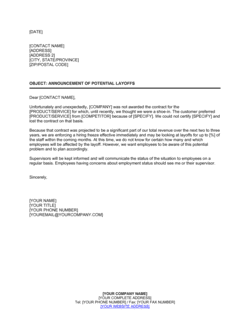
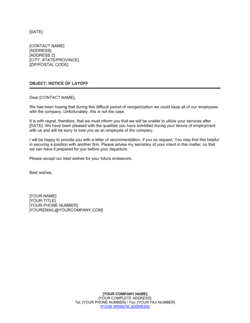
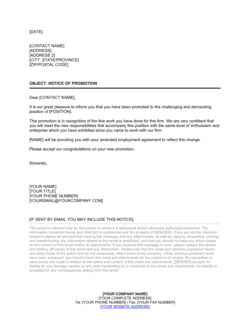
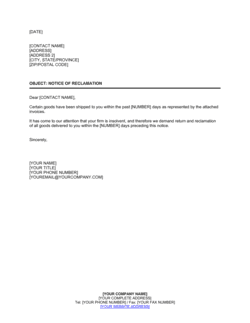
Notice of Intention to Foreclose Template

Free Word download β€’ Edit online β€’ Save & share with Drive β€’ Export to PDF

1 pageβ€’15–20 min to fillβ€’Difficulty: Standard
Learn more ↓
FreeNotice of Intention to Foreclose Template

At a glance

What it is
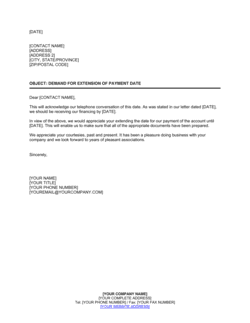
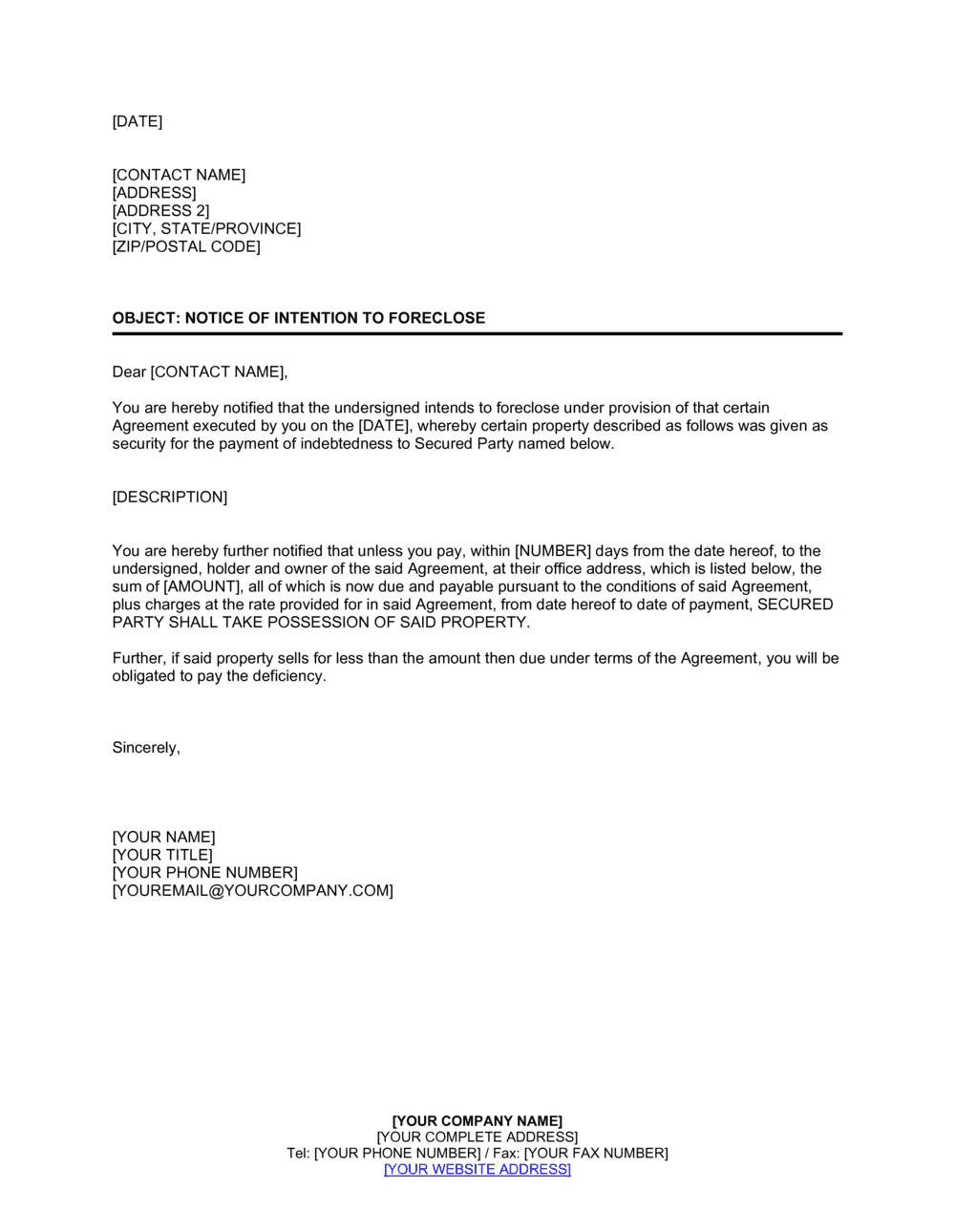
A Notice of Intention to Foreclose is a formal written letter a lender sends to a defaulting borrower declaring the lender's intent to commence foreclosure proceedings on the secured property. This free Word download gives you a structured, statute-ready template you can edit online and send by certified mail to satisfy the pre-foreclosure notice requirements found in most jurisdictions.
When you need it
Use it as soon as a borrower has missed the number of payments β€” or breached a loan covenant β€” that triggers the foreclosure-notice requirement under the governing loan agreement or applicable statute. Sending this letter before commencing any foreclosure action is a mandatory prerequisite in most US states and Canadian provinces.
What's inside
Lender and borrower identification, a statement of the default with the exact amount owed, the property description, a cure period and payoff deadline, a declaration of intent to foreclose, and instructions for the borrower on how to respond or seek assistance.

What is a Notice of Intention to Foreclose?

A Notice of Intention to Foreclose is a formal written letter that a lender sends to a defaulting borrower to declare its intent to commence foreclosure proceedings on the real property securing the loan. It identifies the loan instrument and default, itemizes the exact amount required to cure the default, states the deadline by which the borrower must pay to reinstate the loan, and gives unambiguous notice that foreclosure will follow if the cure is not made. In most US states and Canadian provinces, sending this notice β€” within statutory specifications for content, cure period, and delivery method β€” is a mandatory prerequisite before any judicial or non-judicial foreclosure action may begin.

Why You Need This Document

Skipping or improperly issuing this notice does not simply delay foreclosure β€” it can void a completed foreclosure sale, expose the lender to a wrongful-foreclosure damages claim, and force the entire process to restart from day one. Courts in multiple jurisdictions have set aside sales where the pre-foreclosure notice used vague intent language, understated the cure period, or arrived by regular mail instead of certified mail. Beyond legal compliance, a well-drafted notice creates a clear, documented record that the borrower received proper warning β€” a record that becomes critical evidence if the borrower later claims they were never given a fair opportunity to cure. This template provides the correct structure, statutory-ready language, and itemization format that lenders need to issue a defensible notice quickly, without drafting from scratch.

Which variant fits your situation?

If your situation is…Use this template
Residential mortgage in default β€” federally backed loanNotice of Intention to Foreclose (Residential)
Commercial real estate loan defaultNotice of Intention to Foreclose (Commercial)
Seller-financed note with a deed of trustNotice of Default β€” Deed of Trust
HOA lien enforcement prior to foreclosureHOA Foreclosure Notice Letter
Borrower has already received a cure notice and failed to cureNotice of Acceleration of Debt
Non-judicial foreclosure requiring a trustee's sale noticeNotice of Trustee's Sale
Post-foreclosure deficiency balance demandDeficiency Balance Demand Letter

Common mistakes to avoid

❌ Cure period shorter than the statutory minimum

Why it matters: A notice giving fewer days than the governing statute requires is void on its face. The lender must start over, losing weeks or months of timeline and incurring additional legal costs.

Fix: Look up the specific pre-foreclosure notice requirement for the property's jurisdiction before completing the cure-deadline field, and add a buffer for mail delivery time.

❌ Vague or conditional intent-to-foreclose language

Why it matters: Phrases like 'may initiate proceedings' or 'reserves the right to foreclose' have been held insufficient by courts in multiple states, requiring the lender to re-issue the notice.

Fix: Use direct, present-tense language: 'Lender intends to commence foreclosure proceedings' β€” no hedging, no conditionals.

❌ Omitting itemized breakdown of the amount in default

Why it matters: A single lump-sum cure amount is regularly disputed by borrowers and may fail to meet statutory specificity requirements, giving the borrower grounds to challenge the notice.

Fix: Break the cure amount into at least three line items β€” unpaid principal and interest, late fees, and advanced costs β€” and state the per-diem rate.

❌ Sending by regular mail rather than certified mail with return receipt

Why it matters: Most foreclosure statutes specify the delivery method. Proof of delivery is essential; without it, the borrower can claim non-receipt and a court may set aside the foreclosure sale.

Fix: Send every notice via certified mail, return receipt requested. Retain the tracking confirmation and the signed return-receipt card in the loan file.

The 8 key clauses, explained

Header β€” parties and date

In plain language: Identifies the lender, the borrower, the date of the notice, and the property address in a formal header block.

Sample language
[LENDER NAME] | [LENDER ADDRESS] | [DATE] Sent via Certified Mail, Return Receipt Requested To: [BORROWER FULL NAME] [BORROWER ADDRESS] Re: Notice of Intention to Foreclose β€” [PROPERTY ADDRESS]

Common mistake: Using a trade name instead of the lender's full legal entity name. A notice issued in the wrong name can be challenged as defective and restart the cure period.

Loan identification and default statement

In plain language: Cites the original loan instrument by document date and recording number, and states precisely what obligation has been breached.

Sample language
This Notice relates to the Promissory Note dated [DATE] in the original principal amount of $[AMOUNT], secured by a Deed of Trust/Mortgage recorded on [DATE] as Instrument No. [NUMBER] in [COUNTY] County, [STATE]. As of [DATE], Borrower is in default for failure to make [NUMBER] consecutive monthly payments.

Common mistake: Omitting the recording instrument number. Without it, the borrower β€” or a court β€” cannot independently verify the lien, weakening the notice's legal standing.

Amount in default

In plain language: Itemizes the exact sums owed to cure the default, including missed principal and interest payments, late fees, and any advanced costs.

Sample language
The total amount required to cure the default as of [DATE] is $[AMOUNT], consisting of: unpaid principal and interest ($[AMOUNT]), late charges ($[AMOUNT]), and lender-advanced costs ($[AMOUNT]). This amount increases by $[DAILY RATE] per day.

Common mistake: Stating a single lump-sum figure without itemization. Unitemized amounts are routinely disputed by borrowers and may not satisfy statutory cure-notice requirements.

Acceleration notice

In plain language: Invokes the acceleration clause in the loan documents, declaring the full outstanding balance immediately due if the default is not cured within the stated period.

Sample language
If the default is not cured within [NUMBER] days of this Notice, [LENDER NAME] hereby exercises its right under Section [X] of the Note to declare the entire outstanding balance of $[AMOUNT], plus accrued interest and fees, immediately due and payable.

Common mistake: Accelerating the loan in the same sentence as the cure offer, without a clear sequence. Courts have invalidated notices where acceleration appeared unconditional rather than contingent on the cure period lapsing.

Cure deadline and reinstatement instructions

In plain language: States the specific date by which the borrower must pay the arrears to reinstate the loan, and tells the borrower exactly how to make that payment.

Sample language
To cure the default and reinstate the loan, Borrower must deliver payment in the amount of $[CURE AMOUNT] in certified funds no later than [CURE DEADLINE DATE] to: [LENDER / SERVICER NAME], [ADDRESS], Attn: Loss Mitigation.

Common mistake: Giving a cure period shorter than the statutory minimum for the governing jurisdiction. A notice with an insufficient cure period is void and restarts the entire notice clock.

Declaration of intent to foreclose

In plain language: The operative sentence stating that the lender will commence foreclosure proceedings if the default is not cured by the deadline.

Sample language
If the above default is not cured by [CURE DEADLINE DATE], [LENDER NAME] intends to commence foreclosure proceedings under applicable law to enforce its security interest in the property located at [PROPERTY ADDRESS].

Common mistake: Using conditional or uncertain language such as 'may commence' or 'reserves the right.' Vague intent language has been held insufficient to satisfy pre-foreclosure notice statutes in several jurisdictions.

Borrower's rights and assistance information

In plain language: Informs the borrower of their right to contact a HUD-approved housing counselor, seek legal advice, or apply for a loss-mitigation option before the cure deadline.

Sample language
You may have options to avoid foreclosure, including loan modification, repayment plans, or a short sale. You may contact a HUD-approved housing counseling agency at 1-800-569-4287 or visit www.hud.gov. Seeking legal advice before the cure deadline is strongly recommended.

Common mistake: Omitting borrower-assistance information entirely. Federal servicing guidelines and several state statutes require this disclosure; its absence can expose the lender to a wrongful-foreclosure claim.

Governing law and dispute contact

In plain language: Identifies the state law governing the foreclosure, the lender's contact for cure inquiries, and a statement that the notice does not waive any rights.

Sample language
This Notice is issued pursuant to [STATE] law. For inquiries regarding cure or loss mitigation, contact: [NAME], [TITLE], [LENDER], [PHONE], [EMAIL]. Issuance of this Notice does not waive any rights or remedies available to [LENDER NAME] under the loan documents or applicable law.

Common mistake: Failing to name a specific contact person or direct phone number. Borrowers who cannot reach a live contact for cure instructions β€” and then miss the deadline β€” sometimes succeed in setting aside the foreclosure on equitable grounds.

How to fill it out

  1. 1

    Identify the lender's full legal name and the borrower's current address

    Enter the lender's registered legal entity name β€” not a brand name or servicer trade name β€” and confirm the borrower's last known address using the loan file and any skip-trace records.

    πŸ’‘ Send to every address on file, including the property address, to reduce the risk of a later claim that the borrower never received the notice.

  2. 2

    Pull the original loan instrument details

    Locate the promissory note date, original principal amount, and the deed of trust or mortgage recording information β€” instrument number, recording date, and county β€” from the title policy or loan closing file.

    πŸ’‘ Cross-reference the recording information against the county recorder's online index before issuing the notice to confirm no intervening liens have been recorded.

  3. 3

    Calculate and itemize the default amount

    Total the missed principal and interest payments, any late charges, and costs the lender has advanced (e.g., insurance or property-tax payments). Break each figure out on a separate line and state the per-diem accrual rate.

    πŸ’‘ Add a footnote stating the date through which the cure amount is calculated β€” the figure will change if the borrower contacts you after receipt.

  4. 4

    Verify the minimum cure period for the governing jurisdiction

    Look up the statutory pre-foreclosure notice period for the state or province where the property is located β€” it ranges from 20 days to 120 days depending on jurisdiction. Enter a cure deadline no shorter than that minimum.

    πŸ’‘ When in doubt, add five business days to the statutory minimum to account for certified-mail delivery time.

  5. 5

    Complete the acceleration and intent-to-foreclose paragraphs

    State the full outstanding balance that will become due if the default is not cured, and declare the lender's unambiguous intent to commence foreclosure after the cure deadline.

    πŸ’‘ Use the exact statutory phrase required in the governing jurisdiction β€” some states specify precise language that must appear verbatim.

  6. 6

    Add borrower assistance and dispute contact information

    Include the HUD housing counselor hotline number, a direct contact name and number at the lender or servicer, and a one-sentence statement of the borrower's right to seek legal advice.

    πŸ’‘ If the loan is federally backed (FHA, VA, USDA), include the specific loss-mitigation options required under the applicable agency's servicing guidelines.

  7. 7

    Send by certified mail with return receipt and retain proof

    Print the final letter, send it via certified mail with return receipt requested to every known borrower address, and photograph or scan the postmarked envelope before mailing.

    πŸ’‘ File the green return-receipt card immediately upon return β€” it is your dated proof of delivery and a critical exhibit if the foreclosure is later challenged.

Frequently asked questions

What is a notice of intention to foreclose?

A notice of intention to foreclose is a formal letter a lender sends to a defaulting borrower before commencing foreclosure proceedings on the secured property. It states the nature and amount of the default, gives the borrower a defined period to cure the default and reinstate the loan, and declares the lender's intent to begin foreclosure if payment is not received by the deadline. In most US states and Canadian provinces, this notice is a mandatory statutory prerequisite to any foreclosure action.

Is a notice of intention to foreclose required by law?

In most jurisdictions, yes. The specific requirements β€” minimum cure period, required disclosures, and delivery method β€” vary by state or province. Federally backed loans (FHA, VA, USDA) have additional HUD and agency-specific notice requirements on top of state law. Proceeding with a foreclosure without a compliant notice exposes the lender to a wrongful-foreclosure claim and can void the sale.

How long must a lender wait after sending this notice before foreclosing?

The minimum waiting period β€” the cure period β€” ranges from 20 days to 120 days depending on the jurisdiction and loan type. For example, California requires 30 days for most residential loans, while New Jersey requires 30 days plus additional loss-mitigation steps. Lenders should verify the applicable statute for the property's location before setting the cure deadline in the notice.

What happens if the borrower pays the cure amount before the deadline?

If the borrower delivers the full cure amount in certified funds by the stated deadline, the loan is reinstated to current status and the foreclosure process stops. The lender must accept a timely, complete cure payment in most jurisdictions β€” refusing a valid cure payment can expose the lender to damages. A reinstatement does not erase the borrower's default history or waive the lender's right to foreclose on a subsequent default.

Can the borrower dispute the amount stated in the notice?

Yes. A borrower who believes the stated default amount is incorrect should respond in writing to the lender's contact person before the cure deadline, identifying the specific discrepancy and providing supporting documentation. An itemized cure amount β€” rather than a single lump sum β€” reduces disputes by making the calculation transparent and auditable.

What is the difference between a notice of default and a notice of intention to foreclose?

The terms are often used interchangeably but have distinct meanings in some jurisdictions. A notice of default (NOD) is typically a document recorded with the county recorder in non-judicial foreclosure states, officially commencing the public foreclosure timeline. A notice of intention to foreclose is a direct communication to the borrower β€” sent before or alongside the NOD β€” that satisfies the borrower-notification requirement. In many states, both steps are required.

Does sending this notice prevent the lender from accepting a loan modification?

No. Sending a foreclosure-intent notice does not lock the lender into foreclosure or prevent it from offering or accepting a loan modification, repayment plan, short sale, or deed-in-lieu before the cure deadline passes. Many lenders issue the notice to start the statutory clock while simultaneously reviewing the borrower's loss-mitigation application.

Do I need a lawyer to send a notice of intention to foreclose?

For straightforward private or hard-money loans in states with simple non-judicial foreclosure procedures, a well-drafted template sent by certified mail is typically sufficient for the notice step. However, for residential mortgages subject to federal servicing rules, loans in judicial-foreclosure states, or situations involving bankruptcy or disputed title, engaging a foreclosure attorney before sending any notice is strongly recommended.

How this compares to alternatives

vs Demand Letter for Payment

A demand letter for payment requests repayment of an overdue debt without referencing a specific security interest or foreclosure remedy. A notice of intention to foreclose is specific to a secured real estate loan and invokes the lender's right to seize the collateral property. Use the demand letter for unsecured debts; use this notice only when the debt is secured by real property.

vs Notice of Default (Recorded)

A recorded notice of default is filed with the county recorder to commence the public foreclosure timeline in non-judicial states. The notice of intention to foreclose is a direct written communication to the borrower. Many states require both β€” this letter first, then the recorded NOD β€” while others treat a single document as satisfying both requirements.

vs Loan Modification Agreement

A loan modification agreement restructures the defaulted loan's terms β€” extending the term, reducing the rate, or capitalizing arrears β€” to allow the borrower to avoid foreclosure. A notice of intention to foreclose is the trigger document that starts the statutory clock; the modification agreement is a resolution that stops it. Lenders often use both in parallel during loss-mitigation review.

vs Eviction Notice

An eviction notice addresses a landlord-tenant relationship and targets possession of the property based on a lease default. A notice of intention to foreclose addresses a lender-borrower relationship and targets a security interest in real property based on a loan default. After a completed foreclosure, a separate eviction or unlawful-detainer action may be required to remove an occupying former owner.

Industry-specific considerations

Private Lending and Hard Money

Short-term bridge loans with balloon payments mean defaults often occur at maturity rather than through missed monthly payments β€” the notice must cite the maturity default specifically.

Community Banking and Credit Unions

Regulated institutions must coordinate the notice with internal loss-mitigation review timelines and document compliance with CFPB servicing rules before the notice goes out.

Commercial Real Estate

Commercial foreclosures may involve multiple co-borrowers, guarantors, and junior lienholders β€” each may require a separate notice under the governing loan and state law.

Residential Mortgage Servicing

FHA, VA, and USDA loans require servicers to complete specific loss-mitigation steps and document borrower outreach before the foreclosure-intent notice triggers the statutory clock.

Template vs pro β€” what fits your needs?

PathBest forCostTime
Use the templatePrivate lenders and real estate investors issuing notices on straightforward non-judicial foreclosures in single-borrower situationsFree20–30 minutes
Template + professional reviewCommunity banks, credit unions, or lenders with federally backed loans or borrowers in known judicial-foreclosure states$150–$400 for a one-hour attorney review1–2 business days
Custom draftedComplex commercial foreclosures, multi-borrower or guarantor situations, loans in bankruptcy, or contested title scenarios$500–$2,000+ depending on complexity3–7 business days

Glossary

Default
A borrower's failure to meet one or more obligations under the loan agreement β€” typically missed payments, lapsed insurance, or failure to pay property taxes.
Cure Period
A statutory or contractual window β€” often 30 to 90 days β€” during which the borrower may pay the arrears and reinstate the loan to avoid foreclosure.
Acceleration Clause
A loan provision that makes the entire outstanding principal balance immediately due and payable upon default.
Secured Property
The real estate pledged as collateral for the loan, which the lender may seize and sell upon default to recover the outstanding debt.
Judicial Foreclosure
A court-supervised foreclosure process in which the lender must obtain a judgment before selling the property β€” required in some US states.
Non-Judicial Foreclosure
A foreclosure conducted outside of court under a deed of trust or power-of-sale clause, typically faster and less costly than judicial foreclosure.
Reinstatement
The borrower's right to bring the loan current by paying all past-due amounts, late fees, and lender costs before the foreclosure sale date.
Deed of Trust
A three-party instrument β€” borrower, lender, and a neutral trustee β€” that secures a loan against real property and enables non-judicial foreclosure.
Notice of Default (NOD)
A formal recorded document, filed with the county recorder in non-judicial states, that officially commences the foreclosure timeline.
Deficiency Judgment
A court order holding the borrower personally liable for any remaining debt after the foreclosure sale proceeds fail to cover the full loan balance.

Part of your Business Operating System

This document is one of 3,000+ business & legal templates included in Business in a Box.

  • Fill-in-the-blanks β€” ready in minutes
  • 100% customizable Word document
  • Compatible with all office suites
  • Export to PDF and share electronically

Create your document in 3 simple steps.

From template to signed document β€” all inside one Business Operating System.
1
Download or open template

Access over 3,000+ business and legal templates for any business task, project or initiative.

2
Edit and fill in the blanks with AI

Customize your ready-made business document template and save it in the cloud.

3
Save, Share, Send, Sign

Share your files and folders with your team. Create a space of seamless collaboration.

Save time, save money, and create top-quality documents.

β˜…β˜…β˜…β˜…β˜…

"Fantastic value! I'm not sure how I'd do without it. It's worth its weight in gold and paid back for itself many times."

Managing Director Β· Mall Farm
Robert Whalley
Managing Director, Mall Farm Proprietary Limited
β˜…β˜…β˜…β˜…β˜…

"I have been using Business in a Box for years. It has been the most useful source of templates I have encountered. I recommend it to anyone."

Business Owner Β· 4+ years
Dr Michael John Freestone
Business Owner
β˜…β˜…β˜…β˜…β˜…

"It has been a life saver so many times I have lost count. Business in a Box has saved me so much time and as you know, time is money."

Owner Β· Upstate Web
David G. Moore Jr.
Owner, Upstate Web

Run your business with a system β€” not scattered tools

Stop downloading documents. Start operating with clarity. Business in a Box gives you the Business Operating System used by over 250,000 companies worldwide to structure, run, and grow their business.

Free Forever PlanΒ Β·Β No credit card required