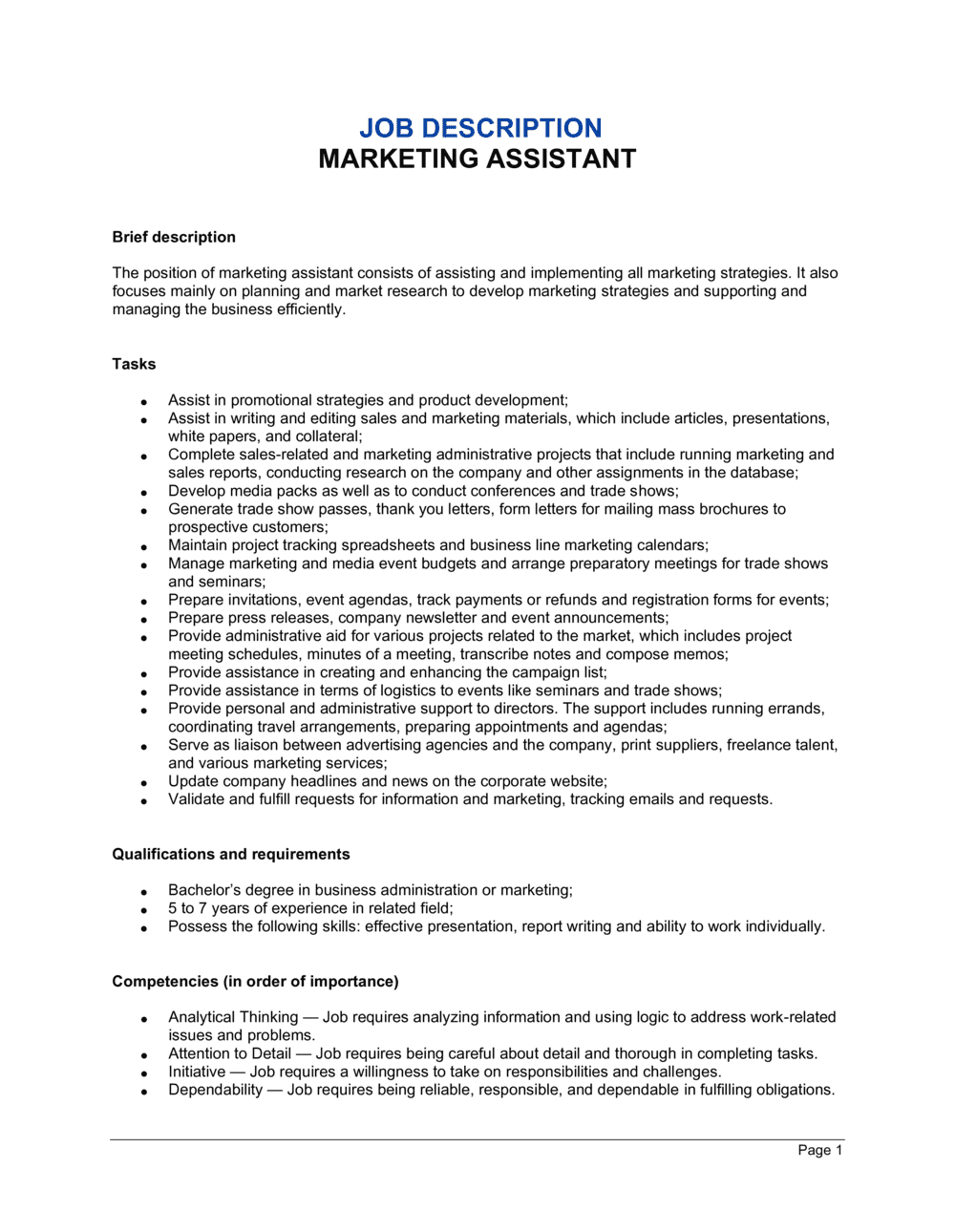
Marketing Assistant Job Description Template

Free Word download β€’ Edit online β€’ Save & share with Drive β€’ Export to PDF

2 pagesβ€’20–30 min to fillβ€’Difficulty: Standardβ€’Signature requiredβ€’Legal review recommended
Learn more ↓
FreeMarketing Assistant Job Description Template

At a glance

What it is
A Marketing Assistant Job Description is a formal document that defines the scope, duties, qualifications, compensation range, and reporting structure for a marketing assistant role. This free Word download gives you a structured, legally defensible starting point you can edit online and export as PDF to post on job boards, share with candidates, or attach to an employment offer package.
When you need it
Use it when opening a new marketing assistant position, backfilling a vacated role, or standardizing job documentation across a growing marketing team. It is also required when HR needs a written role definition to support compensation benchmarking, performance reviews, or workforce planning.
What's inside
Role summary and reporting line, a detailed list of day-to-day duties and responsibilities, required and preferred qualifications, compensation and benefits overview, working conditions, equal employment opportunity statement, and signature blocks for employer acknowledgment and candidate acceptance.

What is a Marketing Assistant Job Description?

A Marketing Assistant Job Description is a formal employment document that defines the scope, duties, qualifications, compensation range, working conditions, and legal terms for a marketing assistant role. It serves as the written record of what the position entails β€” used during recruiting to attract qualified candidates, during onboarding to align expectations, and during performance management to evaluate whether the employee is meeting their defined responsibilities. When signed by both the employer and the employee, it also provides legally defensible documentation that the hire understood and accepted the role's requirements before starting work.

Why You Need This Document

Hiring a marketing assistant without a clearly documented job description creates operational and legal exposure at every stage of the employment relationship. Without defined duties, scope disputes arise within the first 90 days β€” the employee believes they were hired for campaign strategy while the manager expected administrative support. Without an at-will disclaimer, a detailed compensation schedule attached to an offer letter can create implied contractual obligations in states like California, making routine terminations legally complicated. Without a signed acknowledgment, performance improvement plans and terminations for cause become harder to defend when the employee argues they were unaware of specific expectations. Pay transparency laws in Colorado, New York, California, and Washington now require employers to post a good-faith salary range β€” publishing a role without one risks regulatory complaints before the first interview is scheduled. A properly completed, signed marketing assistant job description closes all of these gaps in under 30 minutes and establishes the documentation foundation that HR, legal, and management depend on throughout the employment lifecycle.

Which variant fits your situation?

If your situation is…Use this template
Hiring a fully remote marketing assistant in another state or countryRemote Marketing Assistant Job Description
Engaging a freelance or contract marketing assistant for a fixed projectIndependent Contractor Agreement
Hiring a more senior role to own strategy and manage vendorsMarketing Manager Job Description
Bringing on an intern for a semester or defined program periodMarketing Intern Job Description
Defining a specialist role focused entirely on social media contentSocial Media Manager Job Description
Hiring an entry-level coordinator supporting multiple departmentsAdministrative Assistant Job Description
Documenting the role as part of a full employment contract packageEmployment Contract (At-Will)

Common mistakes to avoid

❌ Combining required and preferred qualifications into one list

Why it matters: Recruiters and candidates cannot distinguish must-haves from nice-to-haves, leading to inconsistent screening and potential disparate-impact exposure if the blended list disproportionately screens out a protected class.

Fix: Create two clearly labeled sections β€” 'Required Qualifications' and 'Preferred Qualifications' β€” and move every item into the correct one before posting.

❌ Omitting the at-will employment disclaimer

Why it matters: A detailed job description with a compensation schedule can be construed as creating implied contractual terms, particularly in California and Montana, making termination without cause legally risky.

Fix: Include a standalone at-will disclaimer paragraph immediately before the signature block, and have the employee sign it as part of their onboarding paperwork.

❌ Publishing a compensation range that is too wide to be meaningful

Why it matters: A $30,000–$70,000 range fails the 'good faith' standard required by pay transparency laws in Colorado, New York, California, and Washington, and signals to candidates that the employer has no defined budget for the role.

Fix: Set the range to no more than 1.5Γ— the minimum, anchored to current market data from at least two sources such as BLS Occupational Outlook data and a salary survey.

❌ Describing physical requirements in vague or subjective terms

Why it matters: Language like 'must be energetic and physically capable' invites ADA discrimination claims because it does not describe an actual job function β€” it describes a subjective trait.

Fix: Replace vague terms with specific, measurable requirements: 'ability to lift and carry up to 30 lbs; ability to stand for up to 2 hours during trade show events.'

❌ Skipping the signature acknowledgment block

Why it matters: Without a signed acknowledgment, the employer cannot demonstrate in a performance dispute or termination proceeding that the employee was aware of their defined duties and expectations.

Fix: Add a two-line signature block for both employee and supervisor, and attach the signed document to the personnel file on or before day one.

❌ Never updating the job description after the initial hire

Why it matters: Marketing roles accumulate new tools, platforms, and responsibilities quickly. A two-year-old description that no longer reflects actual duties undermines performance reviews and makes compensation adjustments harder to justify.

Fix: Set a calendar reminder to review and re-sign the job description annually, or any time the role's core responsibilities change materially.

The 9 key clauses, explained

Role Summary and Reporting Structure

In plain language: Introduces the position, its primary purpose, and who the marketing assistant reports to within the organization.

Sample language
The Marketing Assistant reports to the [TITLE β€” e.g., Marketing Manager / Director of Marketing] and provides administrative and creative support to the marketing department, assisting with campaigns, content, events, and market research.

Common mistake: Omitting the reporting line entirely. Without it, candidates cannot assess career trajectory and HR cannot route approvals β€” creating confusion from the first day of employment.

Duties and Responsibilities

In plain language: Lists the day-to-day tasks the employee is expected to perform, organized from most to least critical.

Sample language
Essential functions include: (a) assisting in the development and execution of marketing campaigns across digital and print channels; (b) maintaining and updating the company's social media accounts; (c) coordinating events, trade shows, and promotional activities; (d) conducting market research and compiling competitive analysis reports.

Common mistake: Writing an exhaustive task list instead of grouping by function. A list exceeding 15 bullet points is rarely read in full and creates a rigid scope that complicates future role evolution.

Required Qualifications

In plain language: States the minimum education, experience, skills, and certifications a candidate must have to be considered for the role.

Sample language
Required: Bachelor's degree in Marketing, Communications, or a related field, or equivalent experience. Minimum [X] year(s) of marketing or administrative support experience. Proficiency in Microsoft Office Suite and at least one social media management platform.

Common mistake: Setting qualification thresholds higher than the role actually requires. Requiring five years of experience for an entry-level assistant narrows the candidate pool unlawfully under disparate impact theory in some jurisdictions.

Preferred Qualifications

In plain language: Lists additional skills or experience that would strengthen a candidate's application but are not disqualifying if absent.

Sample language
Preferred: Experience with HubSpot, Salesforce, or comparable CRM platform. Basic graphic design skills using Canva or Adobe Creative Suite. Familiarity with Google Analytics 4 or comparable web analytics tools.

Common mistake: Mixing required and preferred qualifications into a single list. Candidates and recruiters cannot distinguish between the two, and it creates ambiguity during screening decisions that may produce inconsistent hiring outcomes.

Compensation and Benefits

In plain language: States the salary range or hourly rate, pay frequency, and an overview of benefits β€” health, dental, PTO, and retirement β€” offered with the role.

Sample language
Compensation: $[MIN]–$[MAX] per year ([HOURLY EQUIVALENT]/hour), paid bi-weekly. Benefits include medical, dental, and vision insurance; [X] days PTO; [X] paid holidays; and eligibility to participate in the company's 401(k) plan after [X] months.

Common mistake: Publishing a compensation range so wide β€” e.g., $35,000–$75,000 β€” that it provides no meaningful signal. Several US states now mandate pay transparency with a 'good faith' range; a 2:1 spread can draw regulatory scrutiny.

Working Conditions and Schedule

In plain language: Describes where and when the work is performed β€” on-site, hybrid, or remote β€” and any physical requirements of the role.

Sample language
This position is [on-site / hybrid: [X] days per week in-office / fully remote]. Standard schedule is Monday–Friday, [START TIME] to [END TIME], with occasional evening or weekend availability required during campaign launches or events. Physical requirements: ability to sit for extended periods and occasionally lift materials up to [X] lbs.

Common mistake: Describing physical requirements in vague terms like 'must be physically fit.' The ADA requires that physical requirements describe actual job demands β€” lifting weight, standing duration β€” not general fitness levels.

At-Will Employment Disclaimer

In plain language: States explicitly that the job description is not an employment contract and that employment is at-will unless otherwise documented in a signed agreement.

Sample language
This job description does not constitute a contract of employment, express or implied. Employment with [COMPANY NAME] is at-will and may be terminated by either party at any time, for any lawful reason, with or without notice, unless otherwise provided in a separate written employment agreement.

Common mistake: Omitting the at-will disclaimer in US-based job descriptions. Without it, a detailed duties list and compensation schedule can be argued to create implied contractual terms β€” particularly in California and Montana.

Equal Employment Opportunity Statement

In plain language: Affirms the employer's commitment to non-discriminatory hiring in compliance with applicable federal, state, and local employment laws.

Sample language
[COMPANY NAME] is an Equal Opportunity Employer. We do not discriminate on the basis of race, color, religion, sex, sexual orientation, gender identity, national origin, age, disability, veteran status, or any other characteristic protected by applicable law.

Common mistake: Using a generic EEO statement that omits protected classes added by recent state or local law β€” such as sexual orientation, gender identity, or source of income β€” exposing the employer to regulatory complaints.

Acknowledgment and Signature Block

In plain language: Records the employee's confirmation that they have read, understood, and agreed to the terms of the job description β€” and the date of that acknowledgment.

Sample language
I acknowledge that I have read and understand this job description and agree that it accurately reflects the general nature and level of work to be performed. Employee Signature: _______________ Date: _______________. Supervisor Signature: _______________ Date: _______________.

Common mistake: Skipping the signature block entirely. Without a signed acknowledgment, disputes about whether the employee understood their duties β€” central to performance management and termination documentation β€” become difficult to resolve.

How to fill it out

  1. 1

    Complete the role summary and reporting line

    Enter the job title, department, and the title of the direct supervisor. Write a two-to-three sentence summary of the role's primary purpose and how it supports the marketing team's goals.

    πŸ’‘ Avoid vague summaries like 'assists with marketing activities.' State the specific output β€” 'supports campaign execution, content scheduling, and competitive research for a [SIZE] marketing team.'

  2. 2

    Draft the duties and responsibilities section

    List essential functions first, grouped by category (e.g., campaign support, content management, administrative). Limit the list to 10–12 bullet points and mark the two or three most critical functions as 'Essential.'

    πŸ’‘ Flagging essential functions is not just best practice β€” it is required documentation for ADA reasonable accommodation decisions in the US.

  3. 3

    Set required and preferred qualifications separately

    Enter the minimum education level, years of experience, and hard skills a candidate must have to be considered. List desirable but non-mandatory qualifications in a separate 'Preferred' section.

    πŸ’‘ Benchmark your requirements against two or three live job postings for similar roles to ensure you are not inadvertently screening out qualified candidates with overstated prerequisites.

  4. 4

    Enter the compensation range and benefits

    Add the salary band or hourly rate range, pay frequency, and a summary of benefits. Check your jurisdiction's pay transparency laws before publishing β€” Colorado, New York, California, and Washington require disclosure of a good-faith range.

    πŸ’‘ Set the range no wider than 1.5Γ— the minimum (e.g., $42,000–$58,000) to signal a specific target and satisfy good-faith range requirements.

  5. 5

    Define working conditions and schedule

    Specify on-site, hybrid, or remote status. Include standard hours, any after-hours expectations, and specific physical requirements described in measurable terms β€” lifting capacity in pounds, standing hours per shift.

    πŸ’‘ For hybrid roles, state the minimum in-office days per week explicitly. 'Flexible hybrid' creates scheduling disputes β€” '3 days on-site, Tuesday through Thursday' does not.

  6. 6

    Confirm the at-will disclaimer and EEO statement

    Review both standard clauses for accuracy. Update the EEO statement to include any protected classes mandated by state or local law in your jurisdiction that are not covered by the federal baseline.

    πŸ’‘ California, New York City, and Chicago have extended protected classes beyond the federal list. If you hire in multiple locations, use the broadest applicable EEO statement.

  7. 7

    Obtain signatures before or on the first day

    Have both the hiring manager and the new employee sign the acknowledgment block before or on the employee's first day. Store the executed copy in the employee's personnel file.

    πŸ’‘ Attach the signed job description to the offer letter or employment contract as a schedule β€” this ensures the duties section is incorporated by reference into the main agreement.

  8. 8

    Schedule an annual review date

    Note a review date β€” typically 12 months from execution β€” to revisit duties, qualifications, and compensation bands. Marketing roles evolve quickly; an outdated description creates misalignment during performance reviews.

    πŸ’‘ Tie the review cycle to your annual compensation benchmarking process so the band and job description update at the same time.

Frequently asked questions

What is a marketing assistant job description?

A marketing assistant job description is a formal document that defines the duties, required qualifications, compensation range, reporting structure, and employment terms for a marketing assistant role. It serves as the authoritative written record of what the role entails β€” used during recruiting, onboarding, performance reviews, and compensation benchmarking. When signed by both parties, it also provides legal documentation that the employee understood their responsibilities.

What does a marketing assistant do?

A marketing assistant supports the day-to-day execution of marketing campaigns, social media management, content scheduling, market research, event coordination, and administrative tasks for the marketing department. Typical responsibilities include drafting copy, updating CRM records, preparing reports, coordinating with vendors, and assisting the marketing manager with campaign logistics. The exact scope varies by company size and industry, which is why a written job description is essential.

Is a job description a legally binding contract?

A job description is generally not a legally binding employment contract on its own. However, in some jurisdictions, a detailed job description with compensation terms attached to an offer letter can create implied contractual obligations if it lacks a clear at-will disclaimer. Including an explicit at-will statement and a clause specifying that the document does not constitute a contract reduces this risk significantly.

Do I need a signature on a job description?

While a signature is not legally required for a job description to be valid, obtaining a signed acknowledgment from the employee is strongly recommended. A signed copy provides documented evidence that the employee received and understood their duties β€” critical if the employer later needs to manage performance or justify a termination decision. It also helps protect against claims that the employee was unaware of specific responsibilities.

What qualifications should a marketing assistant job description require?

Most marketing assistant roles require a bachelor's degree in marketing, communications, or a related field, or equivalent practical experience. One to two years of marketing or administrative support experience is typical. Hard skills commonly required include proficiency in Microsoft Office, social media platforms, and at least one marketing or CRM tool such as HubSpot or Mailchimp. Preferred qualifications often add Google Analytics, basic design tools like Canva, and copywriting experience.

What salary range should I list for a marketing assistant?

Compensation varies significantly by location, industry, and company size. In the US, marketing assistant salaries typically range from $38,000 to $58,000 annually for full-time roles as of 2025, based on BLS and industry survey data. Several states β€” including Colorado, California, New York, and Washington β€” require employers to post a good-faith salary range. A range no wider than 1.5Γ— the minimum is considered best practice and satisfies most pay transparency requirements.

How is a marketing assistant different from a marketing coordinator?

A marketing assistant typically handles execution-level and administrative support tasks under close supervision β€” scheduling posts, compiling reports, coordinating logistics. A marketing coordinator generally operates with more autonomy, owns specific campaign components, and may manage vendor relationships or junior team members. The coordinator role usually requires more experience and commands a higher compensation band. Both roles benefit from a clearly documented job description to prevent scope overlap.

What employment laws affect a marketing assistant job description?

In the US, the FLSA governs overtime classification β€” marketing assistants are typically non-exempt and entitled to overtime unless they meet the salary and duties tests for the administrative exemption. The ADA requires distinguishing essential from marginal functions. Pay transparency laws in Colorado, New York, California, and Washington require salary ranges on postings. In Canada, employment standards acts in each province set minimum notice and wage requirements. In the UK, the Equality Act 2010 governs non-discrimination in hiring. Always review applicable local law before posting.

How often should a marketing assistant job description be updated?

A job description should be reviewed at least once per year, aligned with the annual performance review or compensation benchmarking cycle. It should also be updated any time the role's core duties change materially β€” for example, if a marketing assistant takes on ownership of a new channel or tool. An outdated description creates misalignment during reviews and makes it harder to justify compensation adjustments or performance improvement plans.

How this compares to alternatives

vs Marketing Manager Job Description

A marketing manager job description defines a senior role responsible for strategy, budget ownership, and team leadership. A marketing assistant description covers execution-level support tasks performed under supervision. Use the assistant template for entry-level hires and the manager template for roles that own campaign outcomes and manage staff.

vs Marketing Intern Job Description

A marketing intern job description governs a temporary, educational engagement β€” typically unpaid or minimum-wage β€” for students or recent graduates building foundational skills. A marketing assistant is a paid, ongoing employee role with defined performance expectations and full employment law protections. Use the intern template only for structured internship programs, not for permanent support hires.

vs Independent Contractor Agreement

An independent contractor agreement engages a self-employed individual for project-based marketing support with no employment entitlements β€” no benefits, no tax withholding, no overtime. Misclassifying a de facto employee as a contractor triggers back taxes and penalties. If you control how, when, and where the work is performed, an employment job description is the correct document.

vs Employment Contract (At-Will)

An employment contract is the comprehensive binding agreement covering compensation, IP assignment, confidentiality, non-compete, and termination. A job description defines the role's scope and duties. Both documents work together β€” the job description is typically attached as a schedule to the employment contract and incorporated by reference.

Industry-specific considerations

Technology / SaaS

Duties typically include CRM data entry, email campaign coordination in tools like HubSpot or Marketo, and content calendar management for product-led growth campaigns.

Retail / E-commerce

Emphasis on social media content scheduling, promotional campaign support, product photography coordination, and seasonal event logistics.

Professional Services

Focus on thought-leadership content support, conference and webinar coordination, LinkedIn management, and CRM maintenance for lead nurturing workflows.

Healthcare

Job descriptions must comply with HIPAA marketing restrictions and state health advertising regulations; duties are often limited to patient education materials and community outreach.

Retail / Hospitality

Roles frequently require event coordination, local SEO updates, review management, and social media community engagement across multiple location profiles.

Manufacturing

Support focuses on trade show preparation, product catalog updates, distributor communications, and B2B email campaigns targeting procurement audiences.

Jurisdictional notes

United States

Marketing assistants are typically classified as non-exempt under the FLSA and entitled to overtime pay at 1.5Γ— their regular rate for hours over 40 per week. Colorado, California, New York, and Washington require employers to post a good-faith salary range. California, Minnesota, and several cities restrict or prohibit post-employment non-compete clauses, which affects any restrictive covenants referenced in or attached to the job description.

Canada

Employment Standards Acts in each province govern minimum wage, overtime thresholds, and termination notice for marketing assistants. Quebec employers must provide the job description in French for provincially regulated workplaces. Ontario's Working for Workers Act now requires salary ranges on many job postings. At-will employment does not exist β€” the job description should reference a notice-period clause meeting provincial minimums.

United Kingdom

UK employers must provide a written statement of employment particulars β€” which incorporates the job description β€” on or before the employee's first day under the Employment Rights Act 1996. The Equality Act 2010 governs non-discrimination in hiring and requires that qualification requirements be objectively justified. Physical requirements must not indirectly discriminate against protected groups. Salary transparency is not yet legally mandated but is expected to become required under forthcoming pay transparency legislation.

European Union

The EU Transparent and Predictable Working Conditions Directive requires written employment terms, including role and duties, within seven calendar days of the start date. The EU Pay Transparency Directive (effective 2026 in most member states) will require employers to disclose salary bands in job postings. GDPR applies to any personal data collected from candidates during the hiring process, requiring a compliant data processing notice at the application stage.

Template vs lawyer β€” what fits your deal?

PathBest forCostTime
Use the templateSmall businesses and startups hiring a marketing assistant in a single US state or Canadian province with standard at-will or notice-period termsFree20–30 minutes
Template + legal reviewCompanies hiring in pay-transparency states, posting roles with sensitive IP exposure, or operating in jurisdictions with extended EEO protected classes$150–$4001–2 days
Custom draftedEnterprises with unionized workforces, highly regulated industries such as healthcare or financial services, or multi-jurisdiction hiring programs$500–$2,000+3–7 days

Glossary

Job Description
A formal document that defines the duties, qualifications, reporting structure, and employment terms for a specific role β€” used in hiring, performance management, and compensation benchmarking.
Essential Functions
The core duties that are fundamental to a role and cannot be reassigned without fundamentally changing the job β€” legally significant under the ADA and equivalent statutes.
Exempt vs. Non-Exempt
US classification under the FLSA: exempt employees are not entitled to overtime pay; non-exempt employees must receive 1.5Γ— their regular rate for hours over 40 per week.
FLSA (Fair Labor Standards Act)
US federal law setting minimum wage, overtime rules, and child labor standards β€” the primary statute governing whether a marketing assistant role is exempt or non-exempt.
ADA (Americans with Disabilities Act)
US law requiring employers to provide reasonable accommodations to qualified individuals with disabilities β€” job descriptions must distinguish essential from marginal functions to comply.
At-Will Employment
Employment that either party may end at any time, for any lawful reason, without advance notice β€” the default rule in most US states.
Reporting Line
The formal supervisory relationship specifying which position the marketing assistant reports to and whether any direct reports exist.
Compensation Band
The defined salary range for a role β€” typically a minimum, midpoint, and maximum β€” used to benchmark pay and guide offer decisions.
Equal Employment Opportunity (EEO)
A legal statement affirming the employer does not discriminate based on race, color, religion, sex, national origin, age, disability, or other protected characteristics.
At-Will Disclaimer
Language in a job description clarifying that the document does not constitute a contract of employment and that employment remains at-will unless otherwise agreed in writing.

Part of your Business Operating System

This document is one of 3,000+ business & legal templates included in Business in a Box.

  • Fill-in-the-blanks β€” ready in minutes
  • 100% customizable Word document
  • Compatible with all office suites
  • Export to PDF and share electronically

Create your document in 3 simple steps.

From template to signed document β€” all inside one Business Operating System.
1
Download or open template

Access over 3,000+ business and legal templates for any business task, project or initiative.

2
Edit and fill in the blanks with AI

Customize your ready-made business document template and save it in the cloud.

3
Save, Share, Send, Sign

Share your files and folders with your team. Create a space of seamless collaboration.

Save time, save money, and create top-quality documents.

β˜…β˜…β˜…β˜…β˜…

"Fantastic value! I'm not sure how I'd do without it. It's worth its weight in gold and paid back for itself many times."

Managing Director Β· Mall Farm
Robert Whalley
Managing Director, Mall Farm Proprietary Limited
β˜…β˜…β˜…β˜…β˜…

"I have been using Business in a Box for years. It has been the most useful source of templates I have encountered. I recommend it to anyone."

Business Owner Β· 4+ years
Dr Michael John Freestone
Business Owner
β˜…β˜…β˜…β˜…β˜…

"It has been a life saver so many times I have lost count. Business in a Box has saved me so much time and as you know, time is money."

Owner Β· Upstate Web
David G. Moore Jr.
Owner, Upstate Web

Run your business with a system β€” not scattered tools

Stop downloading documents. Start operating with clarity. Business in a Box gives you the Business Operating System used by over 250,000 companies worldwide to structure, run, and grow their business.

Start freeΒ Β·Β No credit card required