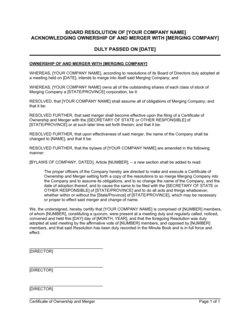
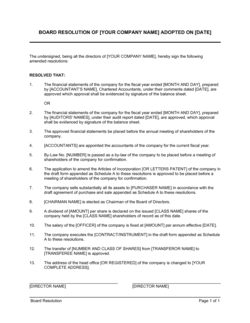
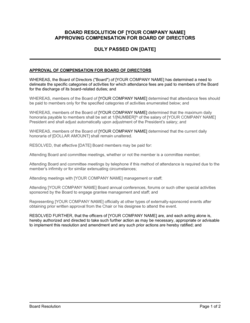
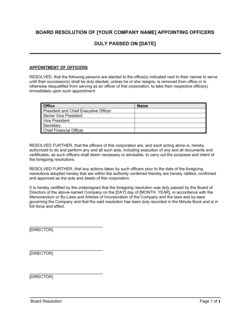
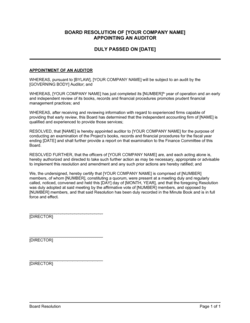
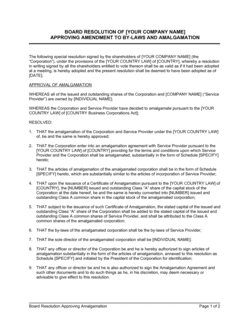
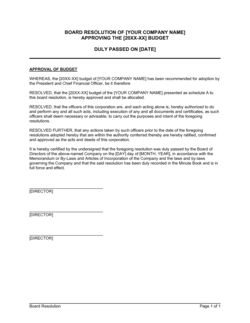
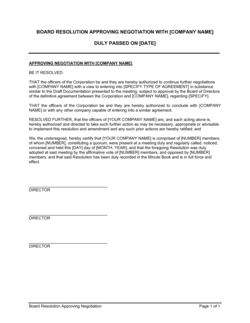
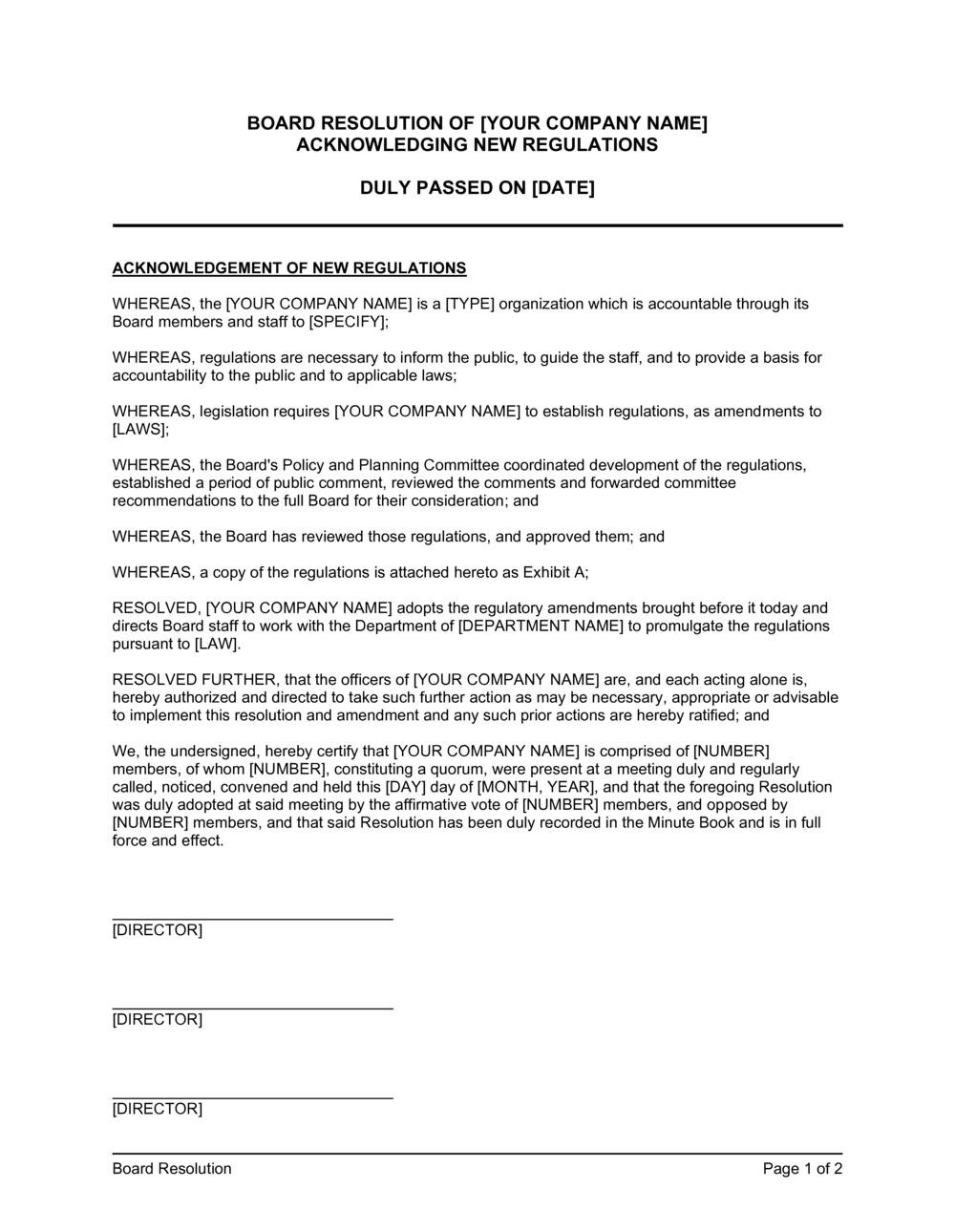
Board Resolution Acknowledging New Regulations Template

Free Word download • Edit online • Save & share with Drive • Export to PDF

2 pages20–30 min to fillDifficulty: StandardSignature requiredLegal review recommended
Learn more ↓
FreeBoard Resolution Acknowledging New Regulations Template

At a glance

What it is
A Board Resolution Acknowledging New Regulations is a formal corporate document in which a company's board of directors officially records its awareness of newly enacted or updated laws, rules, or regulations affecting the business. This free Word download gives you a structured, boardroom-ready starting point you can edit online and export as PDF for inclusion in your corporate minute book.
When you need it
Use it whenever a significant new law, regulatory update, or compliance requirement takes effect that the board must formally acknowledge — such as a new data privacy statute, environmental regulation, industry-specific rule change, or government mandate. Regulators, auditors, and courts may require documented proof of board-level awareness.
What's inside
The resolution covers the date and meeting details, the specific regulation being acknowledged, the board's formal statement of awareness, assigned compliance responsibilities, a directive to management to implement required changes, and the signatures of authorizing directors. Together these elements create an auditable record of governance due diligence.

What is a Board Resolution Acknowledging New Regulations?

A Board Resolution Acknowledging New Regulations is a formal corporate document in which a company's board of directors officially records its awareness of a newly enacted or amended law, rule, or regulatory requirement that affects the business. The resolution identifies the specific regulation by its official name and citation, confirms that the board received an informed briefing, formally acknowledges the company's compliance obligations, and directs named officers to implement required changes by a defined deadline. Once adopted and certified, it is filed in the corporate minute book as a permanent governance record.

The document operates at the level of fiduciary duty: directors have an obligation to stay informed of material legal developments affecting the company, and a properly executed resolution is the primary mechanism through which that obligation is documented. It differs from ordinary board meeting minutes in that it isolates a single formal decision — the board's acknowledgment — into a standalone legal record that can be produced quickly and cleanly to regulators, auditors, investors, or courts without requiring the full meeting transcript.

Why You Need This Document

Without a formal board resolution, a company that faces a regulatory investigation or audit cannot easily demonstrate that its directors were aware of the applicable legal requirement — let alone that they directed management to address it. Regulators in financial services, healthcare, data privacy, and environmental sectors routinely request evidence of board-level oversight as part of examinations; the absence of a resolution can result in governance deficiency findings that escalate penalties or trigger enhanced supervision. Auditors performing annual reviews similarly expect to find board acknowledgment of material regulatory changes in the minute book.

Beyond regulatory risk, the resolution creates internal accountability that informal awareness does not. By naming a specific officer, assigning concrete compliance actions, and setting a deadline for a written status report back to the board, the document converts a passive acknowledgment into an actionable governance directive. This template gives you a professionally structured starting point that covers every required element — recitals, operative clauses, director authorization, and certification — so you spend your time on the substance of the compliance response, not the format of the governance record.

Which variant fits your situation?

If your situation is…Use this template
Formally acknowledging a specific data privacy law such as GDPR or CCPABoard Resolution Acknowledging New Regulations
Authorizing a new corporate policy in response to a regulationBoard Resolution Adopting a Policy
Appointing a compliance officer to manage ongoing regulatory obligationsBoard Resolution Appointing an Officer
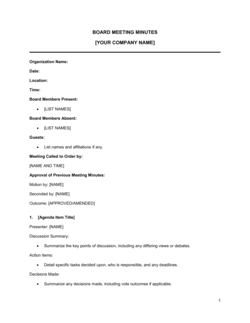
Documenting a specific vote taken at a board meetingBoard Meeting Minutes
Approving a major contract or transaction that requires board sign-offBoard Resolution Authorizing a Contract
Recording a unanimous written consent decision without a formal meetingUnanimous Written Consent of the Board
Acknowledging a change in the company's registered agent or addressBoard Resolution — Change of Registered Agent

Common mistakes to avoid

❌ Citing the regulation vaguely instead of by official name

Why it matters: A resolution that references 'recent privacy regulations' rather than 'the California Consumer Privacy Act, Cal. Civ. Code §1798.100 et seq., effective January 1, 2020' has no legal specificity. Auditors and regulators treat vague citations as evidence that the board did not actually review the requirement.

Fix: Always include the full statutory or regulatory name, official citation, enacting authority, and effective date in the whereas clause. Copy these details directly from the official government source.

❌ Failing to confirm a quorum was present

Why it matters: If quorum is not documented, any party challenging the resolution — a disgruntled director, a regulator, or a counterparty in litigation — can argue it was improperly adopted and therefore void.

Fix: State explicitly in the meeting header that a quorum of directors was present and identify how many directors were present versus required by the bylaws.

❌ Directing compliance action to 'management' without naming an accountable officer

Why it matters: A vague directive creates no individual accountability. Compliance deadlines slip, status reports are never filed, and the board cannot demonstrate it exercised meaningful oversight.

Fix: Name the specific officer title responsible for implementation — CEO, Chief Compliance Officer, or General Counsel — and attach a clear deadline to every directive.

❌ Adopting the resolution after the regulatory effective date without documenting the reason

Why it matters: A resolution dated months after a regulation took effect signals that the board was not monitoring its compliance obligations — which can aggravate regulatory penalties and weaken a good-faith defense.

Fix: If the resolution is being adopted after the effective date, include a whereas clause explaining why — for example, the regulation was clarified by subsequent guidance, or the company recently became subject to it — and note any interim compliance steps already taken.

❌ Omitting the authorization to incur compliance costs

Why it matters: Management that spends material amounts on compliance without express board authorization may face shareholder challenges or audit findings that the expenditure lacked proper governance approval.

Fix: Include a resolved clause expressly authorizing officers to incur reasonable costs and execute necessary agreements in connection with compliance implementation.

❌ No reporting-back requirement in the resolution

Why it matters: Without a follow-up reporting obligation, the board adopts the resolution and then has no mechanism to verify that compliance actually occurred. This can constitute a breach of the board's ongoing oversight duty.

Fix: Add a resolved clause requiring a written compliance status report to the board within a defined period — 60 to 90 days is standard — specifying who must deliver it.

The 9 key clauses, explained

Meeting header and date

In plain language: Records when and where the board meeting occurred, whether it was in-person or remote, and confirms that a quorum was present.

Sample language
A duly convened meeting of the Board of Directors of [COMPANY LEGAL NAME] (the 'Company') was held on [DATE] at [LOCATION / via [PLATFORM]], at which a quorum of directors was present throughout.

Common mistake: Omitting the quorum confirmation. Without it, the resolution may be challengeable as improperly adopted if a quorum was not actually present at the time of the vote.

Whereas — identification of the regulation

In plain language: Names the specific law, rule, or regulatory instrument being acknowledged, including its official citation, effective date, and the authority that enacted it.

Sample language
WHEREAS, [REGULATORY BODY] has enacted [NAME OF REGULATION / STATUTE / RULE], [CITATION], effective [DATE], which imposes [BRIEF DESCRIPTION OF REQUIREMENT] on companies engaged in [BUSINESS ACTIVITY];

Common mistake: Using a vague description like 'recent changes to privacy law' instead of citing the regulation by its full official name and effective date. Vague recitals undermine the document's value as an audit record.

Whereas — impact on the company

In plain language: Summarizes how the identified regulation affects the company's operations, obligations, or risk profile.

Sample language
WHEREAS, the Board has been advised that [NAME OF REGULATION] applies to the Company's operations in [JURISDICTION / BUSINESS UNIT] and requires the Company to [SPECIFIC OBLIGATIONS — e.g., update privacy notices, implement new reporting procedures, appoint a designated officer];

Common mistake: Overstating the regulation's impact to justify inaction — or understating it in a way that leaves the board open to claims it failed to appreciate the materiality of the requirement.

Whereas — management briefing confirmation

In plain language: Confirms that the board received a briefing from management, legal counsel, or an external advisor before adopting the resolution.

Sample language
WHEREAS, the Board has received and reviewed a briefing from [GENERAL COUNSEL / EXTERNAL COUNSEL / COMPLIANCE OFFICER] dated [DATE] regarding the requirements and compliance obligations arising under [NAME OF REGULATION];

Common mistake: Skipping this recital when a verbal briefing was actually given. The absence of a documented briefing confirmation makes it harder to demonstrate informed board decision-making in a subsequent dispute or regulatory inquiry.

Resolved — formal acknowledgment

In plain language: The operative clause in which the board formally and officially acknowledges the new regulation and its applicability to the company.

Sample language
RESOLVED, that the Board of Directors of the Company hereby acknowledges the enactment of [NAME OF REGULATION] and its applicability to the Company's business operations, and confirms that the Board has been duly informed of the Company's obligations thereunder.

Common mistake: Framing the acknowledgment as tentative — using language like 'the Board notes that the regulation may apply.' A resolved clause must be definitive; hedged language fails to create the clear governance record the resolution is meant to provide.

Resolved — directive to management

In plain language: Directs management — typically the CEO, COO, or compliance officer — to take specific steps to bring the company into compliance within a defined timeframe.

Sample language
RESOLVED FURTHER, that the [CEO / Chief Compliance Officer / TITLE] is hereby directed to implement all measures necessary to achieve compliance with [NAME OF REGULATION] by [COMPLIANCE DEADLINE DATE], including [SPECIFIC ACTIONS — e.g., updating data processing agreements, revising internal policies, filing required notices].

Common mistake: Failing to name a specific accountable officer. A directive to 'management generally' creates no individual accountability and is harder to enforce or audit against.

Resolved — authorization of expenditures or resources

In plain language: Authorizes management to incur costs — legal fees, technology upgrades, training, or staffing — reasonably necessary to achieve compliance.

Sample language
RESOLVED FURTHER, that the appropriate officers of the Company are hereby authorized to incur reasonable costs and expenses, including professional fees, in connection with implementing compliance with [NAME OF REGULATION], and to execute any agreements or documents necessary for that purpose.

Common mistake: Omitting this clause when compliance requires material expenditure. Without board authorization for spending, management may face challenges from shareholders or auditors questioning whether the costs were properly approved.

Resolved — reporting back to the board

In plain language: Requires the designated officer to report compliance status back to the board by a specific date, creating ongoing governance accountability.

Sample language
RESOLVED FURTHER, that the [TITLE] shall provide the Board with a written compliance status report no later than [DATE], confirming the measures taken and any remaining actions required to achieve full compliance with [NAME OF REGULATION].

Common mistake: Setting no reporting deadline. An open-ended reporting obligation is functionally the same as no obligation — compliance issues go unescalated and the board loses its oversight function.

Certification and signatures

In plain language: Confirms that the resolution was duly adopted by the requisite vote of directors and is certified by the corporate secretary as a true and accurate record.

Sample language
The undersigned, being the Corporate Secretary of [COMPANY LEGAL NAME], hereby certifies that the foregoing is a true and correct copy of a resolution duly adopted by the Board of Directors at a meeting held on [DATE], at which a quorum was present and acting throughout. [CORPORATE SECRETARY SIGNATURE / DATE] [DIRECTOR SIGNATURES]

Common mistake: Having only one director sign when the bylaws require the signatures of all directors present or a majority. A resolution signed by fewer directors than required by the governing documents may be invalid.

How to fill it out

  1. 1

    Insert the company's full legal name and meeting details

    Enter the registered corporate name exactly as it appears in your articles of incorporation. Record the meeting date, location or platform, and confirm in writing that a quorum was present.

    💡 Cross-check your bylaws for the quorum threshold — it may be a majority of directors in office, not a majority of those appointed.

  2. 2

    Identify the regulation by its official name and citation

    In the whereas clauses, state the full official name of the law or rule, its statutory or regulatory citation, the enacting authority, and the effective date. Do not paraphrase the title.

    💡 Attach a one-page summary of the regulation as an exhibit — it creates a cleaner primary document while preserving the full context for future reviewers.

  3. 3

    Describe the regulation's specific impact on the company

    Summarize in plain language how the regulation applies to the company's actual operations — which business unit, geography, or activity is affected and what the core obligations are.

    💡 Have legal counsel or your compliance officer draft this paragraph to ensure accuracy. An inaccurate recital of a regulation's scope can itself become a liability.

  4. 4

    Confirm the board received a formal briefing

    Add a whereas clause confirming the date of the management or counsel briefing, who delivered it, and that directors had an opportunity to ask questions before the vote.

    💡 Keep the briefing materials in the same minute book file as the resolution — if the board's awareness is challenged later, the briefing deck is your supporting evidence.

  5. 5

    Complete the resolved clauses with specific names and deadlines

    Name the individual officer responsible for compliance, specify the concrete actions required, set a compliance deadline, and authorize any expenditure the implementation will require.

    💡 Use the officer's title rather than their personal name in the resolution — titles survive personnel changes; names create amendment obligations when staff turns over.

  6. 6

    Set a board reporting deadline

    Add a resolved clause requiring the named officer to deliver a written compliance status report to the board by a specific date — typically 60 to 90 days after the resolution is adopted.

    💡 Calendar the reporting deadline immediately after the resolution is signed and send a reminder to the officer 30 days before it falls due.

  7. 7

    Obtain required signatures and certify the resolution

    Have the corporate secretary certify the resolution and collect signatures from all directors required under your bylaws. File the signed original in the corporate minute book.

    💡 Use Business in a Box eSign to timestamp each director's signature and store the executed resolution in BIB Drive alongside the meeting minutes for the same date.

Frequently asked questions

What is a board resolution acknowledging new regulations?

A board resolution acknowledging new regulations is a formal corporate document in which a company's board of directors officially records its awareness of a newly enacted or updated law or rule that affects the business. It identifies the specific regulation, confirms the board was briefed, and directs management to implement required compliance measures. The resolution is filed in the corporate minute book and serves as an auditable record of governance due diligence.

When should a board adopt a resolution acknowledging new regulations?

The resolution should be adopted as close to the regulation's effective date as possible — ideally before it takes effect. It is particularly important when a new law imposes material compliance obligations, when regulators or auditors are likely to ask for evidence of board awareness, or when the company is subject to governance frameworks that require documented board-level oversight of regulatory risk. Post-effective-date adoption is still valuable but should include a documented explanation.

Is a board resolution legally required when new regulations take effect?

No statute universally requires a board resolution for every new regulation, but many governance frameworks — including stock exchange listing rules, banking and financial services regulations, and environmental compliance regimes — require documented board-level acknowledgment of material legal changes. Even where not mandated, a resolution provides a strong good-faith defense in regulatory investigations, litigation, and audits by demonstrating that the board exercised its oversight responsibilities.

What is the difference between a board resolution and board meeting minutes?

Board meeting minutes are a comprehensive narrative record of everything discussed and decided at a board meeting — agenda items, discussion points, votes, attendees, and action items. A board resolution is a single formal decision extracted from (or adopted in lieu of) a meeting, focused specifically on one action or authorization. Minutes document the full session; a resolution documents one specific binding decision. Both should be filed in the corporate minute book, and a resolution is often attached to the minutes of the meeting at which it was adopted.

Can a board resolution be adopted without a formal meeting?

Yes. In most jurisdictions, directors can adopt a resolution by written consent — sometimes called a unanimous written consent — without convening a formal meeting, provided all directors (or the requisite majority under the governing bylaws) sign the document. Written consent resolutions are common for time-sensitive compliance acknowledgments when scheduling a full board meeting is impractical. Check your bylaws and applicable corporate statute for the specific signing requirements.

Who signs a board resolution acknowledging new regulations?

The resolution is typically certified by the corporate secretary and signed by the directors present at the meeting — or by all directors in the case of a written consent resolution. Some bylaws require only the chairperson and secretary to sign certified copies; others require the signatures of all directors who voted in favor. Review your specific bylaws and governing corporate statute to confirm the execution requirements for your jurisdiction and entity type.

Does this resolution need to be filed with any government authority?

In most cases, a board resolution acknowledging new regulations is an internal corporate document filed in the minute book — it is not submitted to a government registry. However, some regulatory regimes require the submission of compliance attestations or certifications to the relevant authority, and those filings may reference or attach the underlying resolution. Confirm with legal counsel whether the specific regulation at issue requires any external filing or reporting.

How specific does the regulation description need to be in the resolution?

The description must be specific enough to be unambiguous. Include the full official name of the law or rule, its statutory or regulatory citation (e.g., section number and act name), the body that enacted it, and its effective date. A vague reference to 'recent data protection changes' is insufficient — auditors and regulators reviewing the minute book will look for evidence that the board understood precisely which obligation it was acknowledging.

Can one resolution acknowledge multiple new regulations at once?

Yes, a single resolution can acknowledge multiple related regulations — for example, a suite of new environmental reporting rules issued under the same statutory framework. Each regulation should be separately identified with its own citation in the whereas clauses. However, for regulations that affect materially different areas of the business or require distinct compliance actions, separate resolutions are cleaner and easier to retrieve from the minute book when only one regulation is relevant to a future audit or inquiry.

How this compares to alternatives

vs Board Meeting Minutes

Board meeting minutes are a full narrative record of everything discussed and decided during a board session — agenda, attendance, discussion, votes, and action items. A board resolution is a single extracted decision document focused on one formal action. Minutes provide the full context of a meeting; a resolution provides the legally operative record of a specific decision. Both should be stored in the minute book, with the resolution typically attached to or referenced in the corresponding minutes.

vs Unanimous Written Consent of the Board

A unanimous written consent allows directors to adopt a resolution without convening a formal meeting, provided every director signs. A standard board resolution is adopted at a duly convened meeting with a quorum present and a majority vote. For urgent or administrative compliance acknowledgments, written consent avoids scheduling delays. For material regulatory matters where board discussion is important, a formal meeting resolution provides stronger governance documentation.

vs Corporate Policy Acknowledgment

A corporate policy acknowledgment is signed by individual employees or officers confirming they have read and understood an internal policy. A board resolution operates at the governance level — it is the board itself, as a collective body, formally acknowledging a regulatory requirement and directing management action. The two documents serve different audiences: policy acknowledgments address workforce compliance; board resolutions address fiduciary and governance obligations.

vs Board Resolution Adopting a Policy

A board resolution adopting a policy creates or approves a new internal rule for how the company will operate going forward. A board resolution acknowledging new regulations records awareness of an external legal obligation imposed on the company. They are often used together — the board acknowledges the regulation and in the same session (or a subsequent one) adopts a policy implementing the required changes. The acknowledgment resolution comes first; the policy adoption resolution follows.

Industry-specific considerations

Financial Services and Banking

Banking regulators such as the OCC, FCA, and OSFI routinely expect documented board-level acknowledgment of new prudential, AML, and consumer protection rules as part of examined compliance programs.

Healthcare and Life Sciences

HIPAA updates, FDA rule changes, and state-level telehealth regulations require formal board acknowledgment to satisfy accreditation bodies and defend against enforcement actions alleging governance failures.

Technology and SaaS

Data privacy laws such as GDPR, CCPA, and emerging AI governance regulations impose board-level accountability, making a formal acknowledgment resolution a standard governance deliverable for tech companies operating across multiple jurisdictions.

Manufacturing and Environmental

New EPA rules, emissions standards, and chemical reporting requirements under TSCA or REACH carry significant penalties for non-compliance — documented board acknowledgment supports both a good-faith defense and insurance coverage positions.

Nonprofit and Charitable Organizations

Changes to charitable solicitation registration laws, tax-exempt reporting requirements under IRS Form 990, and donor privacy rules require board acknowledgment to satisfy state attorneys general and maintain tax-exempt status.

Real Estate and Construction

Zoning law changes, building code updates, and new environmental disclosure requirements affecting property transactions require board-level acknowledgment for companies managing portfolios or development pipelines across multiple jurisdictions.

Jurisdictional notes

United States

Corporate governance is primarily governed by state law — Delaware, Nevada, and California each have distinct rules on quorum, written consent, and director duties. Federal regulators including the SEC, OCC, and EPA increasingly expect documented board-level acknowledgment of material regulatory changes as part of examined compliance programs. In regulated industries such as banking and healthcare, the absence of a board resolution can itself constitute a governance deficiency finding.

Canada

The Canada Business Corporations Act and provincial equivalents (including the Ontario Business Corporations Act) require boards to maintain proper corporate records, including resolutions. Federally regulated entities overseen by OSFI — banks, insurance companies, and trust companies — are subject to governance expectations that include documented board oversight of material regulatory change. Quebec corporations must maintain bilingual corporate records if operating in both French and English contexts.

United Kingdom

Under the Companies Act 2006, UK companies must keep minutes of board meetings and retain them for at least 10 years. FCA and PRA regulated firms face specific Senior Managers and Certification Regime (SM&CR) obligations requiring documented board-level governance of regulatory changes. Board resolutions are a standard mechanism for satisfying these requirements and should reference the specific FCA handbook provision or statutory instrument being acknowledged.

European Union

The EU Corporate Sustainability Reporting Directive (CSRD), GDPR, and sector-specific regulations such as DORA for financial entities all impose board-level governance and accountability obligations. Member state corporate law governs the specific format and procedural requirements for board resolutions, but the underlying obligation to document board awareness of material regulatory change is consistent across jurisdictions. GDPR in particular makes board acknowledgment of data protection obligations a governance best practice supporting the accountability principle under Article 5(2).

Template vs lawyer — what fits your deal?

PathBest forCostTime
Use the templateCompanies acknowledging a well-defined regulation with clear compliance obligations and no material jurisdictional complexityFree30–60 minutes
Template + legal reviewCompanies subject to multi-jurisdictional regulations, heavily regulated industries, or resolutions that will be reviewed by external auditors or regulators$200–$6001–3 days
Custom draftedPublic companies, financial institutions, healthcare organizations, or situations where the resolution will be submitted to a regulator or forms part of an enforcement settlement$1,000–$3,500+1–2 weeks

Glossary

Board Resolution
A formal written record of a decision made by a company's board of directors, which carries the legal authority of the full board once properly adopted.
Quorum
The minimum number of directors who must be present at a meeting for the board's decisions to be legally valid — typically a simple majority of directors in office.
Whereas Clause
A recital paragraph at the start of a resolution that sets out the factual background and reasons prompting the board's action.
Resolved Clause
The operative paragraph of a resolution stating what the board has formally decided, directed, or authorized.
Corporate Minute Book
The official bound or electronic record of a company's incorporation documents, share register, bylaws, and all board and shareholder resolutions.
Compliance Officer
The individual or role designated by the board or management to oversee the company's adherence to applicable laws and regulations.
Regulatory Acknowledgment
A formal statement by the board confirming it has been briefed on and understands a specific legal or regulatory requirement affecting the company.
Written Consent Resolution
A board resolution adopted without a formal meeting, signed by all directors or the requisite majority, treated as equivalent to a vote taken at a duly convened meeting.
Fiduciary Duty
The legal obligation of directors to act in the best interests of the company and its shareholders, which includes maintaining awareness of material compliance obligations.
Due Diligence
The process of exercising reasonable care to identify and address legal, regulatory, and operational risks — documented board resolutions are a standard element of corporate due diligence.
Ultra Vires
An act taken by a corporation or its officers that falls outside the powers granted by its charter or applicable law — board resolutions help confirm that management actions are within authorized scope.

Part of your Business Operating System

This document is one of 3,000+ business & legal templates included in Business in a Box.

  • Fill-in-the-blanks — ready in minutes
  • 100% customizable Word document
  • Compatible with all office suites
  • Export to PDF and share electronically

Create your document in 3 simple steps.

From template to signed document — all inside one Business Operating System.
1
Download or open template

Access over 3,000+ business and legal templates for any business task, project or initiative.

2
Edit and fill in the blanks with AI

Customize your ready-made business document template and save it in the cloud.

3
Save, Share, Send, Sign

Share your files and folders with your team. Create a space of seamless collaboration.

Save time, save money, and create top-quality documents.

★★★★★

"Fantastic value! I'm not sure how I'd do without it. It's worth its weight in gold and paid back for itself many times."

Managing Director · Mall Farm
Robert Whalley
Managing Director, Mall Farm Proprietary Limited
★★★★★

"I have been using Business in a Box for years. It has been the most useful source of templates I have encountered. I recommend it to anyone."

Business Owner · 4+ years
Dr Michael John Freestone
Business Owner
★★★★★

"It has been a life saver so many times I have lost count. Business in a Box has saved me so much time and as you know, time is money."

Owner · Upstate Web
David G. Moore Jr.
Owner, Upstate Web

Run your business with a system — not scattered tools

Stop downloading documents. Start operating with clarity. Business in a Box gives you the Business Operating System used by over 250,000 companies worldwide to structure, run, and grow their business.

Start free · No credit card required