Notice of Rescission of Release Template

Free Word download β€’ Edit online β€’ Save & share with Drive β€’ Export to PDF

1 pageβ€’15–20 min to fillβ€’Difficulty: Standard
Learn more ↓
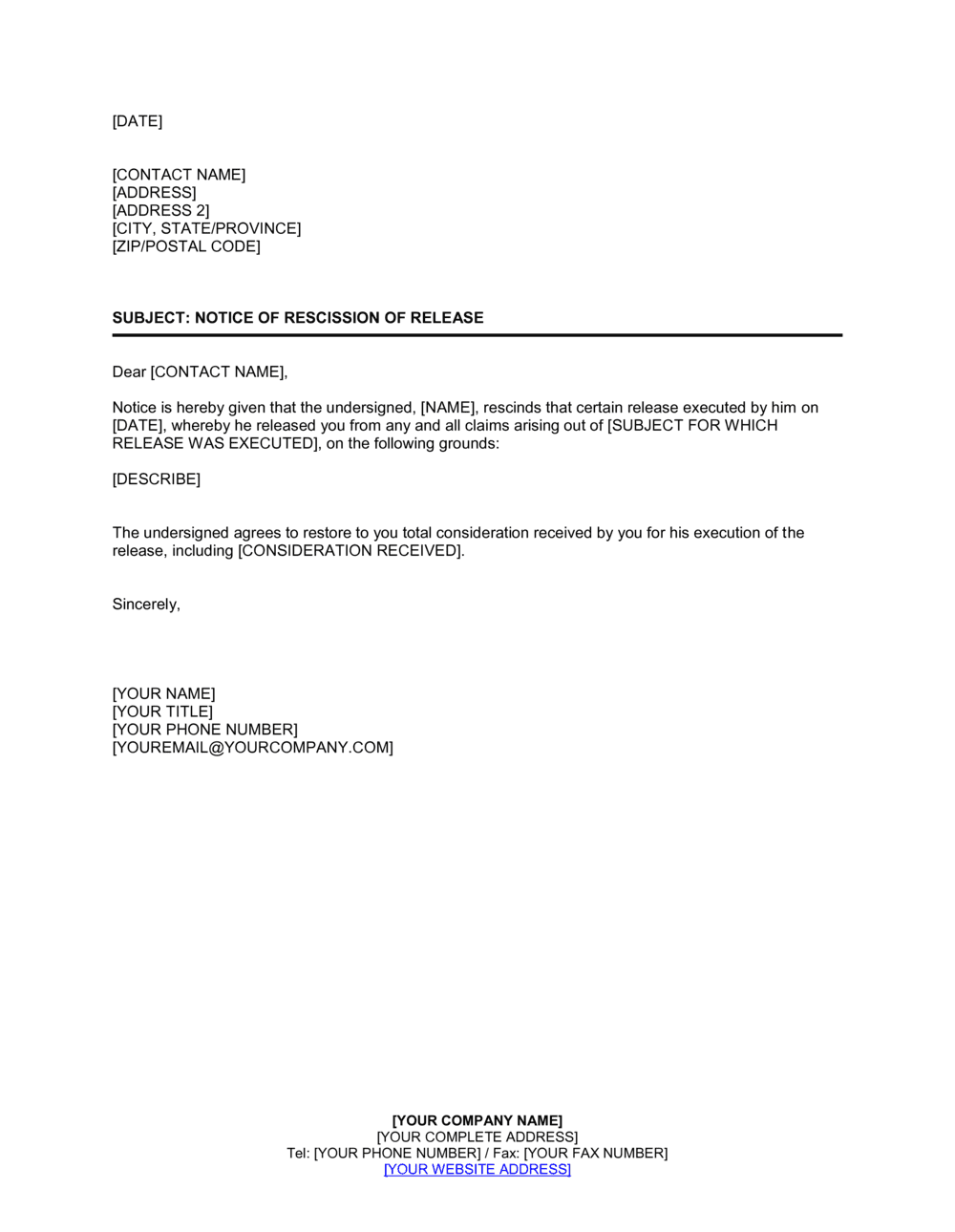
FreeNotice of Rescission of Release Template

At a glance

What it is
A Notice of Rescission of Release is a formal written letter used to withdraw or cancel a previously granted release, waiver, or discharge of claims. This free Word download gives you a ready-to-send letter structure you can edit online and export as PDF to notify the other party that the original release is no longer in effect.
When you need it
Use it when a release or waiver was signed under duress, based on misrepresentation, or without full knowledge of the facts β€” and you need to formally put the other party on notice that you are withdrawing your consent. It is also appropriate when a statutory rescission window applies and you intend to exercise that right within the permitted timeframe.
What's inside
Date and party identification, a clear reference to the original release being rescinded, the legal or factual grounds for rescission, a demand for restoration of the parties to their pre-release positions, and a closing statement of the sender's intent and contact information.

What is a Notice of Rescission of Release?

A Notice of Rescission of Release is a formal written letter that cancels or withdraws a previously signed release or waiver of claims. It serves as the official written record that the sender no longer considers the original release binding, and it puts the other party on notice that the underlying claims β€” surrendered when the release was signed β€” are being revived. To carry legal weight, the notice must identify the original release by date and parties, state a recognized legal ground for rescission (such as duress, misrepresentation, failure of consideration, or a statutory revocation right), and address the return of any consideration exchanged under the release.

Why You Need This Document

Failing to send a formal, written rescission notice is one of the most common ways a valid rescission right is forfeited. Verbal statements or informal emails are routinely disputed or ignored, and courts expect a clear, dated, written instrument to mark the moment rescission was exercised. Without this notice, the other party can argue the release remained in effect, and any action taken on the revived claims may be challenged as a breach of the release itself. A properly completed notice creates a timestamped paper trail, establishes the grounds for rescission on the record, and preserves every legal option available β€” from negotiated restoration to formal dispute resolution β€” before any deadline passes.

Which variant fits your situation?

If your situation is…Use this template
Rescinding a release signed as part of an employment severance agreementNotice of Rescission of Release (Employment)
Withdrawing a liability waiver signed before receiving servicesNotice of Rescission of Release of Liability
Cancelling a settlement agreement release due to misrepresentationNotice of Rescission of Settlement
Revoking a release within a statutory consumer rescission periodNotice of Rescission (Consumer Contract)
Withdrawing a general release of all claims between businessesNotice of Rescission of Release
Formally disputing the validity of a signed waiverNotice of Dispute of Release Validity

Common mistakes to avoid

❌ Using tentative language in the rescission statement

Why it matters: Phrases like 'I am considering rescinding' or 'I wish to withdraw' do not constitute a definitive notice and may not stop limitation periods from running.

Fix: Use present-tense declarative language: '[SENDER] hereby rescinds the Release dated [DATE], effective immediately.'

❌ Missing or vague grounds for rescission

Why it matters: A notice that says the release 'was unfair' or 'was a mistake' gives the recipient grounds to reject it and exposes the sender to a breach-of-release claim.

Fix: Name a recognized legal ground β€” duress, misrepresentation, failure of consideration, or a specific statutory right β€” and state the supporting facts in two to three sentences.

❌ Failing to address the return of consideration

Why it matters: Accepting a benefit under a release and then rescinding without returning it is a common basis for courts to deny rescission or reduce the claimant's recovery.

Fix: Include an explicit demand for mutual restoration and, where possible, tender or offer to return any payment received before sending the notice.

❌ Sending the notice without proof of delivery

Why it matters: A rescission notice that cannot be proved to have been received is effectively no notice at all β€” the other party will simply deny receiving it.

Fix: Send by certified mail with return receipt, tracked courier, or email with read-receipt enabled. Record the delivery method, tracking number, and date on the notice itself.

The 8 key clauses, explained

Date, sender, and recipient identification

In plain language: Opens the letter with the date of sending, the sender's full legal name and address, and the recipient's full legal name and address.

Sample language
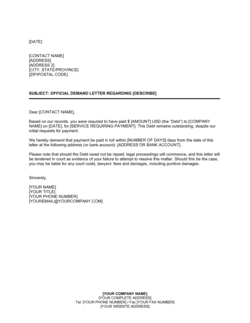
[DATE] [SENDER FULL NAME] [SENDER ADDRESS] To: [RECIPIENT FULL NAME / ENTITY NAME] [RECIPIENT ADDRESS]

Common mistake: Using a nickname or trade name instead of the legal name of the party who signed the original release β€” this can create ambiguity about which party is exercising rescission.

Subject line referencing the original release

In plain language: A brief subject line that identifies the specific release being rescinded by date, title, or reference number so the recipient can immediately locate the document.

Sample language
Re: Notice of Rescission of Release dated [ORIGINAL RELEASE DATE] between [PARTY A] and [PARTY B]

Common mistake: Omitting the date or description of the original release. A vague subject line delays the recipient's response and creates a record-keeping gap.

Opening statement of rescission

In plain language: The first substantive paragraph clearly and unambiguously states that the sender is rescinding the identified release as of the date of the notice.

Sample language
Please be advised that [SENDER NAME] hereby rescinds and withdraws the Release of Claims dated [DATE] ('the Release') executed in favor of [RECIPIENT NAME], effective as of the date of this Notice.

Common mistake: Using tentative language such as 'intends to rescind' or 'is considering rescission.' The notice must be definitive β€” any hedging weakens its legal effect.

Grounds for rescission

In plain language: States the factual or legal basis on which the sender is entitled to rescind β€” duress, misrepresentation, failure of consideration, statutory right, or mutual mistake.

Sample language
The Release was executed in reliance upon [RECIPIENT NAME]'s representation that [DESCRIPTION OF MISREPRESENTATION], which has since been determined to be materially false. Alternatively, the Release was signed under the following circumstances constituting duress: [DESCRIPTION].

Common mistake: Stating grounds too vaguely β€” 'the release was unfair' or 'I changed my mind' does not establish a recognized legal basis. Name the specific ground and the supporting facts.

Demand for mutual restoration

In plain language: Requests that both parties be restored to their pre-release positions, including the return of any consideration paid in exchange for the release.

Sample language
Pursuant to the rescission, [SENDER NAME] demands that [RECIPIENT NAME] return [DESCRIBE CONSIDERATION β€” e.g., the sum of $[AMOUNT] paid to [SENDER NAME] in exchange for the Release] within [X] business days of receipt of this Notice.

Common mistake: Failing to address consideration at all. If money or other value changed hands for the release, the notice must deal with its return β€” ignoring this invites a defense that rescission is incomplete.

Preservation of claims

In plain language: Explicitly states that by rescinding the release, the sender is preserving all rights and claims that existed prior to the release as if the release had never been executed.

Sample language
By this rescission, [SENDER NAME] expressly preserves all rights, claims, and causes of action that existed prior to the execution of the Release, including but not limited to [DESCRIBE CLAIMS β€” e.g., claims arising from the agreement dated [DATE]].

Common mistake: Omitting this clause and leaving it implied. Without explicit preservation language, the other party may argue that rescinding the release does not automatically revive the underlying claims.

Notice of intent and deadline for response

In plain language: Informs the recipient of the sender's intended next steps if the rescission is disputed, and requests confirmation of receipt or acknowledgment by a specific date.

Sample language
Please confirm receipt and acknowledgment of this Notice in writing no later than [DATE]. If [RECIPIENT NAME] disputes this rescission, [SENDER NAME] reserves the right to pursue all available legal remedies without further notice.

Common mistake: Setting no deadline for response. An open-ended request for acknowledgment is routinely ignored; a specific date creates a record of non-response.

Closing and sender's signature block

In plain language: A professional closing with the sender's printed name, title (if applicable), and contact information. A wet or electronic signature is optional but adds credibility.

Sample language
Sincerely, [SENDER FULL NAME] [TITLE, if applicable] [PHONE NUMBER] [EMAIL ADDRESS]

Common mistake: Closing the letter without any contact information. The recipient needs a way to respond promptly β€” omitting this slows the process and weakens the notice's paper trail.

How to fill it out

  1. 1

    Enter the date and full party names

    Use today's date as the notice date. Enter the legal names of both parties exactly as they appear in the original release document β€” not nicknames, trade names, or abbreviations.

    πŸ’‘ Pull the original release document and copy the party names character-for-character to avoid a mismatch that could be used to challenge the notice.

  2. 2

    Identify the original release in the subject line

    Reference the original release by its exact title, the date it was signed, and any document number or reference code. This connects the notice unambiguously to the specific instrument being rescinded.

    πŸ’‘ If the release was part of a larger agreement (e.g., a settlement or severance package), reference both the parent agreement and the release clause or exhibit number.

  3. 3

    State the rescission clearly in the opening paragraph

    Write a direct, unambiguous statement that you are rescinding the release effective the date of the notice. Avoid conditional or hedging language β€” the rescission either happens or it does not.

    πŸ’‘ Use the word 'hereby' to make the notice self-executing: 'Sender hereby rescinds...' signals immediate effect, not future intent.

  4. 4

    State the specific grounds for rescission

    Choose the applicable legal ground β€” duress, misrepresentation, failure of consideration, mutual mistake, or a statutory rescission right β€” and describe the supporting facts in two to three sentences.

    πŸ’‘ If you are relying on a statutory right (e.g., the ADEA's 7-day revocation period for age discrimination releases), cite the statute by name. This eliminates any argument that the rescission is contractual rather than statutory.

  5. 5

    Address the return of consideration

    Specify what was received in exchange for the release (a payment amount, a benefit, a promise) and demand its return within a defined number of business days. If you have already returned or offered to return consideration, note that here.

    πŸ’‘ Courts often require an offer to return consideration as a precondition to valid rescission. Include this demand even if you expect it to be disputed.

  6. 6

    Add the preservation of claims clause and response deadline

    Explicitly state that all underlying claims are preserved as of the rescission date and request written acknowledgment from the recipient by a specific calendar date β€” typically 5–10 business days.

    πŸ’‘ Send the notice by certified mail or tracked email so you have timestamped proof of delivery. Note the delivery method in the letter itself: 'Sent via certified mail, tracking number [X].'

Frequently asked questions

What is a Notice of Rescission of Release?

A Notice of Rescission of Release is a formal written letter that cancels or withdraws a previously signed release or waiver of claims. It puts the other party on notice that the sender no longer considers the release binding and intends to revive the underlying claims. To be effective, it must clearly identify the original release, state the grounds for rescission, and address the return of any consideration exchanged.

When can a release be rescinded?

A release can typically be rescinded when it was signed under duress, based on material misrepresentation, for a failure of consideration, or due to mutual mistake of fact. In addition, certain releases carry statutory rescission rights β€” for example, US federal law gives employees who sign an age-discrimination release under the ADEA at least 7 days to revoke it. Outside of statutory windows, the grounds must be legally recognized; simply regretting the decision is generally not sufficient.

Does a Notice of Rescission of Release need to be signed?

A signature is not strictly required for the notice to be valid in most contexts, but including one β€” wet or electronic β€” adds credibility and reduces the chance the recipient argues it was unauthorized. What matters most is that the notice is in writing, clearly identifies the sender, references the original release, and is delivered in a manner that creates a verifiable record.

How quickly does a rescission notice need to be sent?

Speed is critical. For statutory rescission rights, the window is fixed β€” missing it forfeits the right entirely. For common-law rescission grounds (duress, misrepresentation), most jurisdictions require the rescinding party to act promptly upon discovering the grounds; delay is treated as ratification of the release. Send the notice as soon as the basis for rescission becomes known.

Do I need to return the consideration I received before rescinding?

In most jurisdictions, an offer to return consideration received under the release is a practical and often legal precondition to effective rescission. Keeping a payment while rescinding the release that authorized it can defeat the rescission claim or reduce recovery. Include a mutual restoration demand in the notice and be prepared to follow through.

What happens after I send a Notice of Rescission of Release?

After the notice is delivered, the other party will typically either acknowledge the rescission and negotiate restoration, or dispute it in writing. If disputed, the underlying claims are preserved on the record and the parties may proceed to mediation, arbitration, or litigation to resolve the question of whether the rescission was valid. The notice establishes the date from which the revived claims are asserted.

Is a Notice of Rescission of Release the same as a Notice of Rescission?

They are closely related but not identical. A Notice of Rescission applies broadly to any contract β€” a purchase agreement, a service contract, or a consumer transaction. A Notice of Rescission of Release is specifically targeted at a release or waiver of claims document. The structure and grounds are similar, but the Notice of Rescission of Release must also address the revival of the claims that the original release extinguished.

Can a business rescind a release it granted to a vendor or contractor?

Yes. Rescission rights are not limited to individuals β€” businesses can rescind releases they granted if a recognized ground exists, such as the vendor's misrepresentation of the work completed, a mutual mistake about the scope of the release, or failure of the consideration on which the release was conditioned. The same notice structure applies: identify the release, state the grounds, demand mutual restoration, and preserve the underlying claims.

How this compares to alternatives

vs Notice of Rescission

A Notice of Rescission cancels a contract broadly β€” a purchase agreement, a service deal, or a lease. A Notice of Rescission of Release is specifically targeted at withdrawing a release or waiver of claims. The key distinction is that the release-specific version must also address the revival of the underlying claims that the original release extinguished.

vs Release of Claims

A Release of Claims is the document being undone by this notice β€” it is the original agreement surrendering a legal right. A Notice of Rescission of Release is the instrument that withdraws that surrender. When the rescission is accepted, the Release of Claims becomes void and the original claims revive.

vs Notice of Dispute

A Notice of Dispute challenges a specific obligation or amount but does not necessarily seek to void the underlying agreement. A Notice of Rescission of Release goes further β€” it seeks to cancel the release entirely and restore both parties to their pre-release positions. Use a Notice of Dispute when you want to contest a term; use this notice when you want to withdraw the release altogether.

vs Demand Letter

A Demand Letter requests action or payment from another party but does not by itself rescind any agreement. A Notice of Rescission of Release is self-executing β€” it declares the release void and revives claims without waiting for a response. When the goal is to cancel a release rather than merely threaten consequences, this notice is the appropriate instrument.

Industry-specific considerations

Human Resources / Employment

Employees rescinding severance-related releases under the ADEA's statutory 7-day revocation window or on grounds of duress or misrepresentation during the separation process.

Insurance

Policyholders rescinding settlement releases within statutory deadlines after discovering the full extent of losses was misrepresented at the time of signing.

Construction and Contracting

Project owners or contractors rescinding lien-waiver releases granted in exchange for progress payments later found to be short-paid or conditioned on concealed defects.

Retail and Consumer Transactions

Consumers rescinding liability waivers or purchase-related releases within applicable statutory cooling-off periods under federal or state consumer protection law.

Template vs pro β€” what fits your needs?

PathBest forCostTime
Use the templateIndividuals or businesses exercising a clear statutory rescission right within the permitted windowFree15–30 minutes
Template + professional reviewSituations involving common-law grounds such as duress or misrepresentation, where the legal basis for rescission may be contested$150–$400 for a one-hour attorney review1–2 days
Custom draftedHigh-value releases where revived claims exceed $50,000, or where the rescission is likely to be disputed and litigated$500–$2,000+3–7 days

Glossary

Rescission
The legal act of cancelling or voiding a contract or agreement, returning both parties to the positions they held before the agreement was made.
Release
A written document in which one party surrenders a legal claim or right against another party, typically in exchange for consideration.
Waiver
The voluntary and intentional relinquishment of a known right, which may be written or, in some contexts, implied by conduct.
Consideration
Something of value exchanged between parties that makes a contract legally binding β€” money, services, or a promise to act or refrain from acting.
Mutual Restoration
The requirement in rescission that both parties return any benefits received under the agreement being cancelled, restoring the pre-contract status quo.
Statutory Rescission Period
A time window defined by law during which a party may cancel certain agreements without penalty β€” commonly 3 business days for consumer contracts and 7–21 days for ADEA severance releases.
Duress
Pressure or coercion that overcomes a person's free will, making a contract voidable if the pressured party can demonstrate it affected their consent.
Misrepresentation
A false statement of fact made by one party that induces another to enter a contract; a ground for rescission when the misled party relied on the false statement.
Voidable Contract
A contract that is valid and enforceable unless and until the injured party elects to rescind it β€” as opposed to a void contract, which is unenforceable from the outset.
Notice
Formal communication to another party of a legal act, intention, or claim β€” typically in writing and delivered in a manner that creates a record of receipt.

Part of your Business Operating System

This document is one of 3,000+ business & legal templates included in Business in a Box.

  • Fill-in-the-blanks β€” ready in minutes
  • 100% customizable Word document
  • Compatible with all office suites
  • Export to PDF and share electronically

Create your document in 3 simple steps.

From template to signed document β€” all inside one Business Operating System.
1
Download or open template

Access over 3,000+ business and legal templates for any business task, project or initiative.

2
Edit and fill in the blanks with AI

Customize your ready-made business document template and save it in the cloud.

3
Save, Share, Send, Sign

Share your files and folders with your team. Create a space of seamless collaboration.

Save time, save money, and create top-quality documents.

β˜…β˜…β˜…β˜…β˜…

"Fantastic value! I'm not sure how I'd do without it. It's worth its weight in gold and paid back for itself many times."

Managing Director Β· Mall Farm
Robert Whalley
Managing Director, Mall Farm Proprietary Limited
β˜…β˜…β˜…β˜…β˜…

"I have been using Business in a Box for years. It has been the most useful source of templates I have encountered. I recommend it to anyone."

Business Owner Β· 4+ years
Dr Michael John Freestone
Business Owner
β˜…β˜…β˜…β˜…β˜…

"It has been a life saver so many times I have lost count. Business in a Box has saved me so much time and as you know, time is money."

Owner Β· Upstate Web
David G. Moore Jr.
Owner, Upstate Web

Run your business with a system β€” not scattered tools

Stop downloading documents. Start operating with clarity. Business in a Box gives you the Business Operating System used by over 250,000 companies worldwide to structure, run, and grow their business.

Start freeΒ Β·Β No credit card required