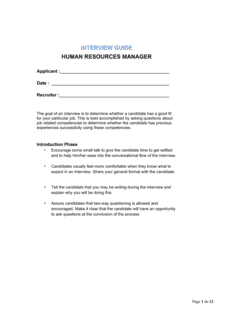
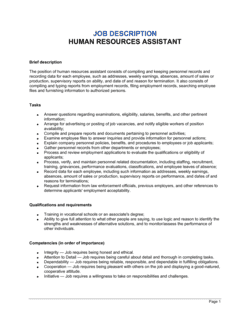
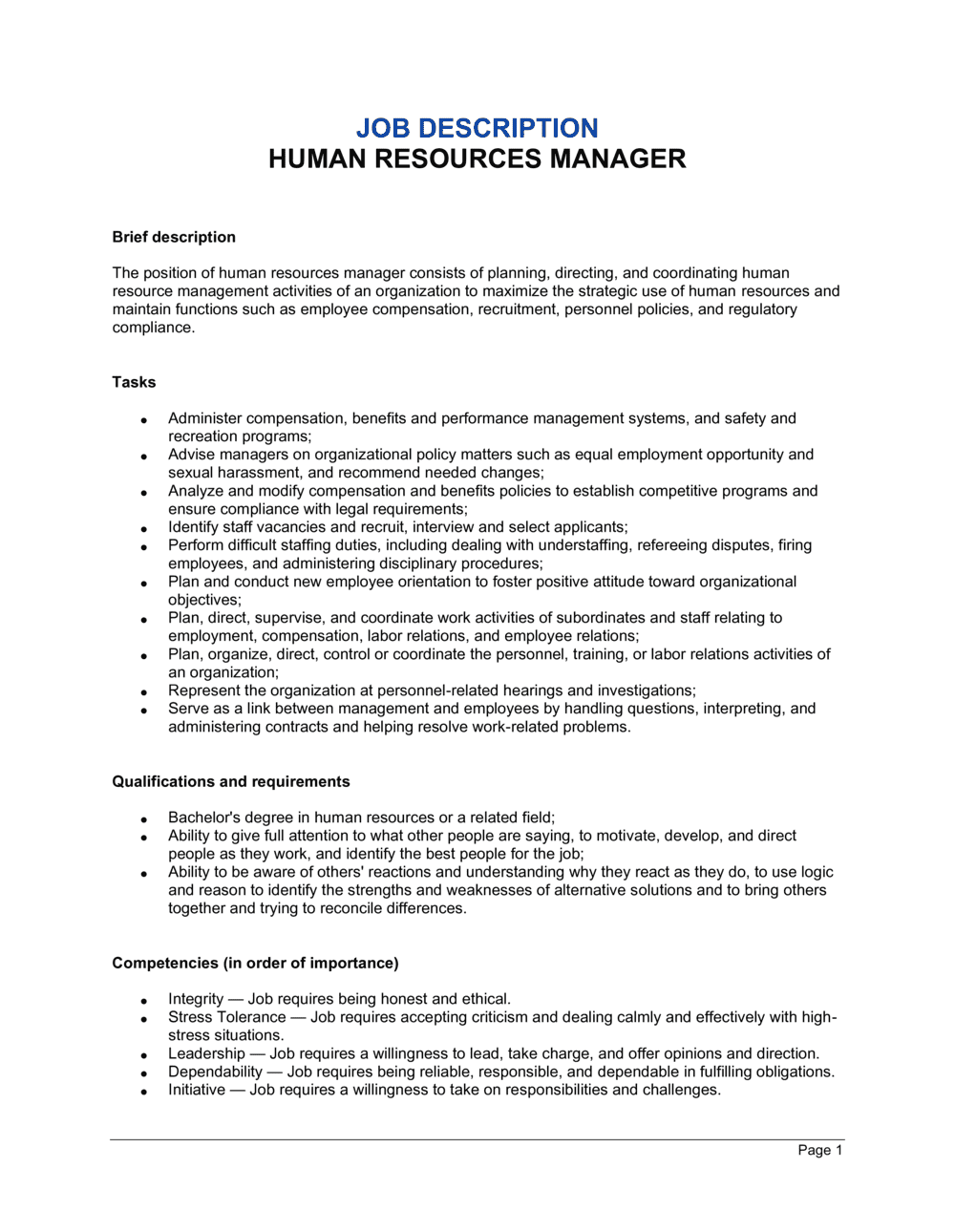
Human Resources Manager Job Description Template

Free Word download • Edit online • Save & share with Drive • Export to PDF

2 pages20–30 min to fillDifficulty: StandardSignature requiredLegal review recommended
Learn more ↓
FreeHuman Resources Manager Job Description Template

At a glance

What it is
A Human Resources Manager Job Description is a formal document that defines the scope, duties, qualifications, reporting structure, and performance expectations for an HR Manager role within an organization. This free Word download provides a professionally structured, editable template you can customize, attach to an employment contract, and use as the authoritative reference for hiring, onboarding, performance reviews, and role-change negotiations.
When you need it
Use it when posting an open HR Manager position, formalizing duties for a new or existing hire, updating responsibilities after a reorganization, or incorporating a defined role scope into an employment agreement. It is also referenced during performance improvement plans and termination proceedings when clarifying what was required of the role.
What's inside
Role summary and reporting structure, core duties and responsibilities, required and preferred qualifications, key performance indicators, compensation range and classification, and an acknowledgment block for employee and employer signatures. The document is designed to stand alone as a reference exhibit or attach directly to an employment contract.

What is a Human Resources Manager Job Description?

A Human Resources Manager Job Description is a formal document that defines the essential functions, required qualifications, reporting structure, compensation range, and measurable performance expectations for an HR Manager position within an organization. It functions as both an operational reference — used in recruiting, onboarding, and performance reviews — and a legal document that establishes the objective standard against which the employee's performance is evaluated. When incorporated by reference into a signed employment contract, it becomes a binding exhibit that governs what the employer can require and what constitutes a performance deficiency.

Unlike a casual job posting, a properly structured HR Manager job description separates essential from marginal functions (as required by the ADA and its international equivalents), distinguishes required from preferred qualifications to avoid inadvertent discrimination exposure, and includes a signed acknowledgment block that confirms the employee understood their duties before their first day of work.

Why You Need This Document

Operating without a formal, signed job description exposes your organization across multiple fronts at once. When an HR manager underperforms, an undocumented or vague role description makes it nearly impossible to demonstrate cause — courts and arbitrators look for objective written standards, and their absence benefits the employee. When a disability accommodation request arrives, you need to have identified essential functions in writing before the request, not after. When a terminated employee claims wrongful dismissal or discrimination, the job description is the first document opposing counsel requests — and a missing or outdated version is an immediate liability.

Beyond legal protection, a clear job description shortens time-to-hire by filtering misaligned applicants, reduces onboarding friction by giving the new HR manager a documented scope from day one, and provides the KPI baseline that makes annual performance reviews defensible rather than subjective. This template gives you a professionally structured, jurisdiction-aware starting point that covers all of these functions — ready to customize, sign, and file before your next HR manager walks through the door.

Which variant fits your situation?

If your situation is…Use this template
Posting an entry-level HR generalist roleHR Generalist Job Description
Hiring a senior VP or Chief People OfficerCHRO / VP HR Job Description
Describing a specialized talent acquisition roleRecruiter Job Description
Hiring an HR coordinator to support the managerHR Coordinator Job Description
Formalizing the job description as part of an employment contractEmployment Contract (At-Will Employee)
Hiring an HR manager for a fixed-term project or maternity coverFixed-Term Employment Contract
Engaging an HR consultant rather than an employeeIndependent Contractor Agreement

Common mistakes to avoid

❌ Merging required and preferred qualifications

Why it matters: Courts and the EEOC treat all listed qualifications as required unless explicitly labeled. Rejecting a protected-class candidate for failing a 'preferred' item that appears in the required list can support a discrimination claim.

Fix: Use two clearly labeled sections — 'Required Qualifications' and 'Preferred Qualifications' — and verify each required item can be defended as a business necessity.

❌ Omitting the non-contract disclaimer in the acknowledgment block

Why it matters: A signed, detailed job description without an express disclaimer has been interpreted in some jurisdictions as a promissory document, limiting the employer's ability to modify duties or reclassify the role without consent.

Fix: Include a one-sentence disclaimer: 'This job description does not constitute a contract of employment and may be amended with reasonable notice.' Have the employee initial it separately.

❌ Leaving compensation range blank

Why it matters: Colorado, California, New York, and Washington now legally require salary range disclosure in job postings. Omitting it triggers regulatory fines and reduces qualified applicant flow in states where candidates self-select based on range.

Fix: Add the compensation band to the template before posting. Use a range wide enough to accommodate negotiation (typically ±15–20% from midpoint) while reflecting market data.

❌ Failing to distinguish essential from marginal functions

Why it matters: Under the ADA (and equivalent legislation in the UK and Canada), accommodation decisions depend on whether a function is essential. If the job description does not label essential functions, the employer cannot later claim a duty was essential when denying an accommodation request.

Fix: Mark core duties explicitly as 'essential functions' and list occasional or marginal tasks separately. A brief parenthetical — '(essential function)' — after each listed duty is sufficient.

❌ Naming an individual instead of a title in the reporting line

Why it matters: When the named manager leaves, the job description creates ambiguity about reporting authority, approval chains, and who inherited management responsibilities — complicating decisions that reference the document.

Fix: Always use job titles (e.g., 'Reports to: VP of Human Resources') rather than personal names. Update the title if the role is restructured.

❌ Using the same generic job description across all office locations

Why it matters: State, provincial, and municipal employment laws vary materially — a job description compliant in Texas may violate salary transparency, non-compete, or classification rules in California, Ontario, or New York City.

Fix: Create a base template and maintain location-specific addenda that reflect jurisdiction-specific requirements. Flag postings in high-regulation locations for legal review before publishing.

The 10 key clauses, explained

Role title and department

In plain language: States the official job title, the department the role belongs to, and the employment classification (full-time, part-time, exempt, or non-exempt).

Sample language
Job Title: Human Resources Manager | Department: Human Resources | Reports To: [VP OF HUMAN RESOURCES / CEO / COO] | FLSA Classification: Exempt | Employment Type: Full-Time

Common mistake: Using an informal or internal nickname (e.g., 'People Ops Lead') instead of the legal title that will appear on the employment contract — creating a mismatch that complicates payroll records and termination documentation.

Role summary

In plain language: A two-to-four sentence overview of the position's purpose, scope, and the primary outcome the company expects from the role.

Sample language
The Human Resources Manager is responsible for overseeing all HR functions at [COMPANY NAME], including talent acquisition, employee relations, compliance, compensation administration, and performance management. This role serves as the primary HR contact for [NUMBER] employees across [LOCATION(S)] and reports directly to [TITLE].

Common mistake: Writing a role summary so generic it could apply to any HR role — omitting company size, location scope, and primary accountability leaves candidates and managers without a shared understanding of the role's actual weight.

Core duties and responsibilities

In plain language: An itemized list of the specific, material tasks the employee is required to perform — distinguished from tasks they may occasionally assist with.

Sample language
Essential functions include: (a) managing full-cycle recruiting for [X] open positions per quarter; (b) administering performance review cycles using [SYSTEM]; (c) ensuring compliance with federal, state, and provincial employment law; (d) overseeing onboarding and offboarding processes; (e) maintaining the HRIS platform [NAME]; (f) conducting employee relations investigations.

Common mistake: Listing aspirational duties that were never performed in the role — creating a gap between the written description and actual practice that weakens performance management and termination defenses.

Required qualifications

In plain language: The minimum education, experience, certifications, and skills a candidate must have to be considered for the role — distinct from preferred or nice-to-have attributes.

Sample language
Required: Bachelor's degree in Human Resources, Business Administration, or a related field; minimum [X] years of progressive HR experience; demonstrated knowledge of [STATE/PROVINCE] employment law; proficiency with HRIS platforms; SHRM-CP, SHRM-SCP, PHR, or SPHR certification preferred.

Common mistake: Including requirements that are not genuinely necessary and cannot be justified by business necessity — creating disparate-impact exposure under Title VII or equivalent legislation in the UK and Canada.

Preferred qualifications

In plain language: Additional skills, experience, or certifications that would distinguish one qualified candidate from another — clearly separated from required qualifications to avoid implying they are mandatory.

Sample language
Preferred: Master's degree in Human Resources or Organizational Psychology; experience with [SPECIFIC HRIS PLATFORM]; bilingual in [LANGUAGE]; prior experience in [INDUSTRY]; demonstrated success managing HR in a unionized environment.

Common mistake: Merging preferred and required qualifications into a single list — courts and regulators treat all listed qualifications as required unless they are explicitly labeled, which can support a discrimination claim if a protected-class candidate was rejected for failing a 'preferred' item.

Compensation range and benefits

In plain language: States the salary band, payment frequency, and a summary of benefits attached to the role — providing transparency and enabling pay-equity compliance.

Sample language
Compensation: $[MINIMUM] – $[MAXIMUM] annually, paid bi-weekly. Benefits include [HEALTH / DENTAL / VISION], [401(k) / RRSP] with [X]% employer match, [X] days PTO, and participation in the Company's standard benefits program as amended from time to time.

Common mistake: Omitting the compensation range entirely in jurisdictions that now mandate salary transparency on job postings — Colorado, California, New York, and Washington in the US require it; Ontario and the UK have increasing disclosure obligations.

Key performance indicators

In plain language: Measurable outcomes the employee will be evaluated against, linked to the core duties of the role — used in performance reviews, PIPs, and role-change negotiations.

Sample language
Performance in this role will be evaluated against the following KPIs: (a) time-to-fill open positions (target: [X] days); (b) voluntary turnover rate (target: below [X]%); (c) HR compliance audit results (target: zero material findings); (d) employee satisfaction score (target: [X]/10 or above on annual engagement survey).

Common mistake: Omitting KPIs entirely, leaving performance management subjective — making it difficult to document a performance deficiency or defend a termination for cause.

Reporting structure and direct reports

In plain language: Identifies who the HR manager reports to and which roles (if any) report to the HR manager, establishing the organizational chain of authority.

Sample language
This position reports to the [VP OF HUMAN RESOURCES / COO / CEO]. Direct reports include: [HR COORDINATOR], [RECRUITER], [PAYROLL ADMINISTRATOR] (as applicable). The HR Manager has authority to make hiring recommendations for direct-report roles, subject to [TITLE] approval.

Common mistake: Naming a specific individual as the reporting manager rather than a title — when that person leaves, the job description creates confusion about who inherited the reporting relationship and approval authority.

Physical requirements and work environment

In plain language: Documents the physical demands and work setting of the role — required by the ADA and its equivalents to correctly identify essential functions and support accommodation decisions.

Sample language
This role requires the ability to remain stationary for extended periods, operate standard office equipment, and occasionally lift materials up to [X] lbs. The role is [on-site at LOCATION / hybrid with X days per week on-site / fully remote]. Reasonable accommodations will be made for qualified individuals with disabilities.

Common mistake: Omitting this section and later being unable to demonstrate that an essential function was documented prior to a disability accommodation request — which can expose the employer to ADA or equivalent liability.

Acknowledgment and signature block

In plain language: Confirms the employee has received, read, and understood the job description, and that it does not constitute a contract of employment unless expressly incorporated into a signed employment agreement.

Sample language
I acknowledge that I have received and reviewed this job description and understand that it describes the essential functions of my role as of [DATE]. This document may be updated from time to time with reasonable notice. It does not constitute a contract of employment. Employee Signature: _______________ Date: ________ | Employer Representative: _______________ Date: ________

Common mistake: Omitting the disclaimer that the job description is not a contract of employment — in some jurisdictions, a detailed signed job description without this language has been treated as a promissory document limiting the employer's ability to modify duties.

How to fill it out

  1. 1

    Enter the role title, department, and classification

    Fill in the official job title exactly as it will appear on the employment contract and payroll records. Select the correct FLSA classification (exempt or non-exempt) based on salary level and the duties test for the HR Manager role.

    💡 HR Managers who manage two or more employees and exercise genuine managerial discretion generally qualify as exempt under the FLSA executive exemption — but confirm with an employment attorney if the role is borderline.

  2. 2

    Write the role summary with scope and reporting line

    Draft two to four sentences covering the position's primary purpose, the employee count or business unit it supports, the locations covered, and the direct reporting title. Avoid generic language that could apply to any HR role.

    💡 Include the headcount and location scope in the summary — 'HR Manager supporting 80 employees across two sites' gives candidates and courts a precise picture of the role's weight.

  3. 3

    List essential functions clearly and specifically

    Write each core duty as a separate, numbered item beginning with an action verb (e.g., 'Manages,' 'Oversees,' 'Administers'). Separate essential functions from marginal or occasional tasks and label them accordingly.

    💡 The ADA requires employers to distinguish essential from marginal functions. A numbered list with an explicit 'essential functions' label satisfies this requirement and strengthens accommodation decisions.

  4. 4

    Define required and preferred qualifications separately

    Place minimum mandatory qualifications in the 'required' section and desirable but non-essential attributes in a clearly labeled 'preferred' section. Verify each required qualification can be justified by business necessity.

    💡 If a qualification is truly required, document why — e.g., 'SHRM-CP required because the role independently advises on federal compliance matters.' This paper trail supports the requirement if it is challenged.

  5. 5

    Set the compensation band and benefits summary

    Enter the salary minimum and maximum for the role. Check whether the posting location requires salary range disclosure (Colorado, California, New York, Washington) and include the range in the posted version if mandated.

    💡 Use the midpoint of the band as your offer anchor — candidates who accept at or below midpoint leave headroom for merit increases, reducing renegotiation pressure within 12 months.

  6. 6

    Add measurable KPIs tied to core duties

    Select three to five KPIs directly linked to the essential functions listed earlier. Assign a target value for each so performance is evaluated against an objective standard rather than managerial impression.

    💡 KPIs set at signing become the benchmark for the first annual review — choose metrics you can actually track in your HRIS or payroll system, not aspirational proxies.

  7. 7

    Complete the physical requirements and work environment section

    Specify the work setting (on-site, hybrid, or remote), any physical demands, and the accommodation statement. Even for desk-based HR roles, document sedentary requirements and equipment use.

    💡 For hybrid roles, state the minimum on-site days as a specific number (e.g., 'minimum 3 days per week on-site') rather than 'as needed' — vague hybrid terms generate disputes within months of hire.

  8. 8

    Obtain signatures before or on the first day

    Have both the employer representative and the employee sign the acknowledgment block before or on the employee's first day. File the signed copy in the personnel record and attach it to the employment contract if applicable.

    💡 Send the job description alongside the offer letter so the candidate reviews it before accepting — obtaining a signature at offer stage eliminates any 'I didn't know what I was signing up for' claim later.

Frequently asked questions

What is a human resources manager job description?

A human resources manager job description is a formal document that defines the duties, qualifications, reporting structure, compensation range, and performance expectations for an HR Manager role. It is used in hiring, onboarding, performance reviews, and as an exhibit to employment contracts. A well-drafted job description also serves as a compliance document, identifying essential functions under the ADA and supporting lawful qualification requirements under equal employment opportunity law.

Is a job description legally binding?

A job description is generally not a standalone employment contract, but it can have legal weight in several contexts. If incorporated by reference into a signed employment agreement, it becomes contractually binding. Courts and regulatory bodies also reference job descriptions in discrimination, wrongful termination, and accommodation cases to determine what was actually required of the role. Including a clear non-contract disclaimer and an acknowledgment signature limits unintended legal exposure.

What should an HR manager job description include?

At minimum: job title and department, FLSA or employment classification, a role summary with reporting structure, itemized essential functions, required and preferred qualifications clearly separated, compensation range, measurable KPIs, physical requirements and work environment, and a signed acknowledgment block. Omitting any of these elements creates gaps in hiring, performance management, and accommodation decisions.

What qualifications are typically required for an HR manager?

Most HR manager roles require a bachelor's degree in human resources, business administration, or a related field, plus a minimum of three to seven years of progressive HR experience depending on company size. SHRM-CP, SHRM-SCP, PHR, or SPHR certification is frequently listed as required or strongly preferred. Familiarity with the employment laws of the applicable jurisdiction and proficiency with an HRIS platform are nearly universal requirements.

Do I need a lawyer to create an HR manager job description?

For most companies, a well-structured template is sufficient to create a legally sound job description. Legal review is advisable when the role is being posted in a jurisdiction with salary transparency mandates, when the qualifications list includes factors that could raise disparate-impact concerns, or when the job description will be formally incorporated into an employment contract or used to support a termination for cause defense. A 30–60 minute attorney review typically costs $150–$400 and is worthwhile for senior or sensitive roles.

Should a job description include salary?

Yes — and in a growing number of jurisdictions it is legally required. Colorado, California, New York, and Washington mandate salary range disclosure in job postings as of 2024–2025. Ontario is moving toward pay transparency requirements. Even where disclosure is not mandated, including a salary band reduces unqualified applications, shortens negotiation timelines, and supports pay equity compliance. Use a range rather than a fixed number to preserve offer flexibility.

What is the difference between a job description and a job posting?

A job description is an internal document defining the role's full scope, essential functions, and performance expectations — it is used for hiring, onboarding, performance reviews, and employment contract exhibits. A job posting is the external-facing advertisement derived from the job description, typically condensed and formatted for a job board. The job description is the authoritative governing document; the posting is a marketing summary.

How often should a job description be updated?

Review job descriptions at minimum annually and any time a role's duties change materially — due to a reorganization, technology change, or headcount shift. Outdated job descriptions that no longer reflect actual duties weaken performance management defenses and can create pay-equity audit findings. Obtain a fresh employee signature acknowledging the updated description whenever material changes are made.

Can a job description be used in a termination proceeding?

Yes, and this is one of its most important legal functions. A signed, dated job description that clearly lists essential functions and measurable KPIs establishes the objective standard against which performance was evaluated. In a wrongful termination claim, it provides evidence of what was required of the role and that the employee was informed of those expectations. A vague or unsigned job description leaves the employer without this evidentiary foundation.

How this compares to alternatives

vs Employment Contract

An employment contract is the binding legal agreement governing the entire working relationship — compensation, IP, confidentiality, non-compete, and termination. A job description defines the scope and expectations of the role itself. The two documents work together: the employment contract creates enforceable obligations; the job description defines what performance of those obligations looks like. Job descriptions are often attached as a schedule to the employment contract.

vs Offer Letter

An offer letter confirms the role, compensation, and start date to secure the candidate's acceptance. It is a summary document, not a comprehensive role definition. A job description provides the detailed duties, qualifications, and KPIs that the offer letter references but does not replicate. Attaching the job description to the offer letter gives the candidate full information before they sign.

vs HR Manager Performance Review

A performance review evaluates how well the employee has met the expectations of the role over a defined period. A job description defines what those expectations are. The two documents are linked: KPIs set in the job description become the evaluation criteria in the performance review. Without a current, signed job description, performance reviews lack an objective standard.

vs Independent Contractor Agreement

An independent contractor agreement engages a self-employed HR consultant for project-based or ongoing advisory work with no employment entitlements. A job description is specific to an employment relationship and establishes the ongoing, supervised duties that distinguish an employee from a contractor. Using a job description format for a contractor engagement can support a worker misclassification finding.

Industry-specific considerations

Technology / SaaS

HR managers in tech companies typically oversee distributed or remote teams, must address equity compensation administration, and navigate multi-state or multi-jurisdiction compliance for rapidly scaling headcount.

Healthcare

Healthcare HR managers handle credentialing verification, HIPAA workforce training obligations, union and non-union workforce management, and state licensing requirements as part of their essential functions.

Manufacturing

Manufacturing HR managers manage shift-based workforces, OSHA safety training compliance, collective bargaining agreement administration, and high-volume hourly hiring cycles with specific physical requirements documentation.

Professional Services

Professional services firms require HR managers to handle billable staff utilization data, professional licensing verification, competitive non-solicitation compliance, and high-value employee relations matters with significant legal exposure.

Retail / Hospitality

High turnover environments demand HR managers fluent in rapid onboarding, tip and wage compliance, variable scheduling rules, and multi-location employment law compliance across state or provincial lines.

Financial Services

Financial services HR managers must address FINRA or FCA licensing verification, clawback policy administration, heightened background screening requirements, and compensation disclosure obligations under sector-specific regulation.

Jurisdictional notes

United States

HR manager roles are typically classified as exempt under the FLSA executive or administrative exemption — verify the salary threshold ($684/week as of 2024) and duties test apply. Colorado, California, New York, and Washington require salary range disclosure on job postings. California additionally restricts the use of prior salary history in setting compensation. Non-compete clauses attached to job descriptions are unenforceable in California and increasingly restricted in other states.

Canada

Each province has its own employment standards legislation governing minimum terms — Ontario's Employment Standards Act, Alberta's Employment Standards Code, and BC's Employment Standards Act each set different floors. Job descriptions incorporated into employment contracts must not imply terms below provincial statutory minimums. Quebec employers must provide the document in French for provincially regulated workplaces. Pay transparency obligations are expanding, with Ontario's Pay Transparency Act requiring salary range disclosure on external postings.

United Kingdom

UK employers must provide a written statement of employment particulars — which typically references the job description — on or before day one of employment under the Employment Rights Act 1996. Job descriptions used to support a redundancy or capability dismissal must accurately reflect duties at the time of dismissal, not an outdated version. The Equality Act 2010 requires that qualification requirements be objectively justified as a proportionate means of achieving a legitimate aim.

European Union

The EU Pay Transparency Directive (2023/970) requires employers to provide salary range information to job applicants before interview and prohibits asking about pay history. Member states must implement the Directive by June 2026. Works council consultation may be required before issuing or materially amending job descriptions in Germany, France, and the Netherlands. GDPR applies to any personal data collected as part of the application process referenced in the job posting.

Template vs lawyer — what fits your deal?

PathBest forCostTime
Use the templateCompanies hiring an HR manager in a single domestic jurisdiction with standard duties and no equity or complex severanceFree30–60 minutes
Template + legal reviewRoles posted in salary-transparency states, multi-location companies, or where the description will be incorporated into a formal employment agreement$150–$400 (30–60 minute employment attorney review)1–3 business days
Custom draftedSenior HR leadership roles with equity, regulated industries (healthcare, financial services), unionized environments, or cross-border employment$500–$2,000+1–2 weeks

Glossary

Job Description
A formal written document outlining a position's duties, qualifications, reporting structure, and performance standards — used in hiring, performance management, and legal proceedings.
FLSA Classification
The US Fair Labor Standards Act designation of a position as exempt or non-exempt from overtime pay requirements, based on salary level and job duties.
Essential Functions
The core duties a role exists to perform, which must be identified clearly to comply with the Americans with Disabilities Act and its equivalents in other jurisdictions.
At-Will Employment
An employment relationship in most US states where either party may end the relationship at any time for any lawful reason, without cause or advance notice.
KPI (Key Performance Indicator)
A measurable metric used to evaluate whether an employee is meeting the expectations defined in their role, such as time-to-fill for open positions or employee retention rate.
Exempt Employee
A salaried employee who meets specific FLSA duties and salary tests and is therefore not entitled to overtime pay for hours worked beyond 40 per week.
Reporting Structure
The defined chain of command specifying who the employee reports to and, if applicable, who reports to the employee.
Acknowledgment Clause
A signed statement in which the employee confirms they have read, understood, and agree to the duties and expectations set out in the job description.
Equal Employment Opportunity (EEO)
The legal principle — and associated statement in job postings — that an employer does not discriminate based on race, color, religion, sex, national origin, age, disability, or other protected characteristics.
Compensation Band
The defined salary range — minimum, midpoint, and maximum — attached to a role level or grade, used to ensure pay equity and guide offer decisions.

Part of your Business Operating System

This document is one of 3,000+ business & legal templates included in Business in a Box.

  • Fill-in-the-blanks — ready in minutes
  • 100% customizable Word document
  • Compatible with all office suites
  • Export to PDF and share electronically

Create your document in 3 simple steps.

From template to signed document — all inside one Business Operating System.
1
Download or open template

Access over 3,000+ business and legal templates for any business task, project or initiative.

2
Edit and fill in the blanks with AI

Customize your ready-made business document template and save it in the cloud.

3
Save, Share, Send, Sign

Share your files and folders with your team. Create a space of seamless collaboration.

Save time, save money, and create top-quality documents.

★★★★★

"Fantastic value! I'm not sure how I'd do without it. It's worth its weight in gold and paid back for itself many times."

Managing Director · Mall Farm
Robert Whalley
Managing Director, Mall Farm Proprietary Limited
★★★★★

"I have been using Business in a Box for years. It has been the most useful source of templates I have encountered. I recommend it to anyone."

Business Owner · 4+ years
Dr Michael John Freestone
Business Owner
★★★★★

"It has been a life saver so many times I have lost count. Business in a Box has saved me so much time and as you know, time is money."

Owner · Upstate Web
David G. Moore Jr.
Owner, Upstate Web

Run your business with a system — not scattered tools

Stop downloading documents. Start operating with clarity. Business in a Box gives you the Business Operating System used by over 250,000 companies worldwide to structure, run, and grow their business.

Free Forever Plan · No credit card required