Reprimand Template

Free Word download β€’ Edit online β€’ Save & share with Drive β€’ Export to PDF

1 pageβ€’20–30 min to fillβ€’Difficulty: Standardβ€’Signature requiredβ€’Legal review recommended
Learn more ↓
FreeReprimand Template

At a glance

What it is
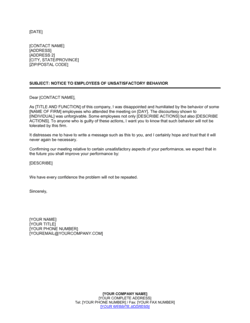
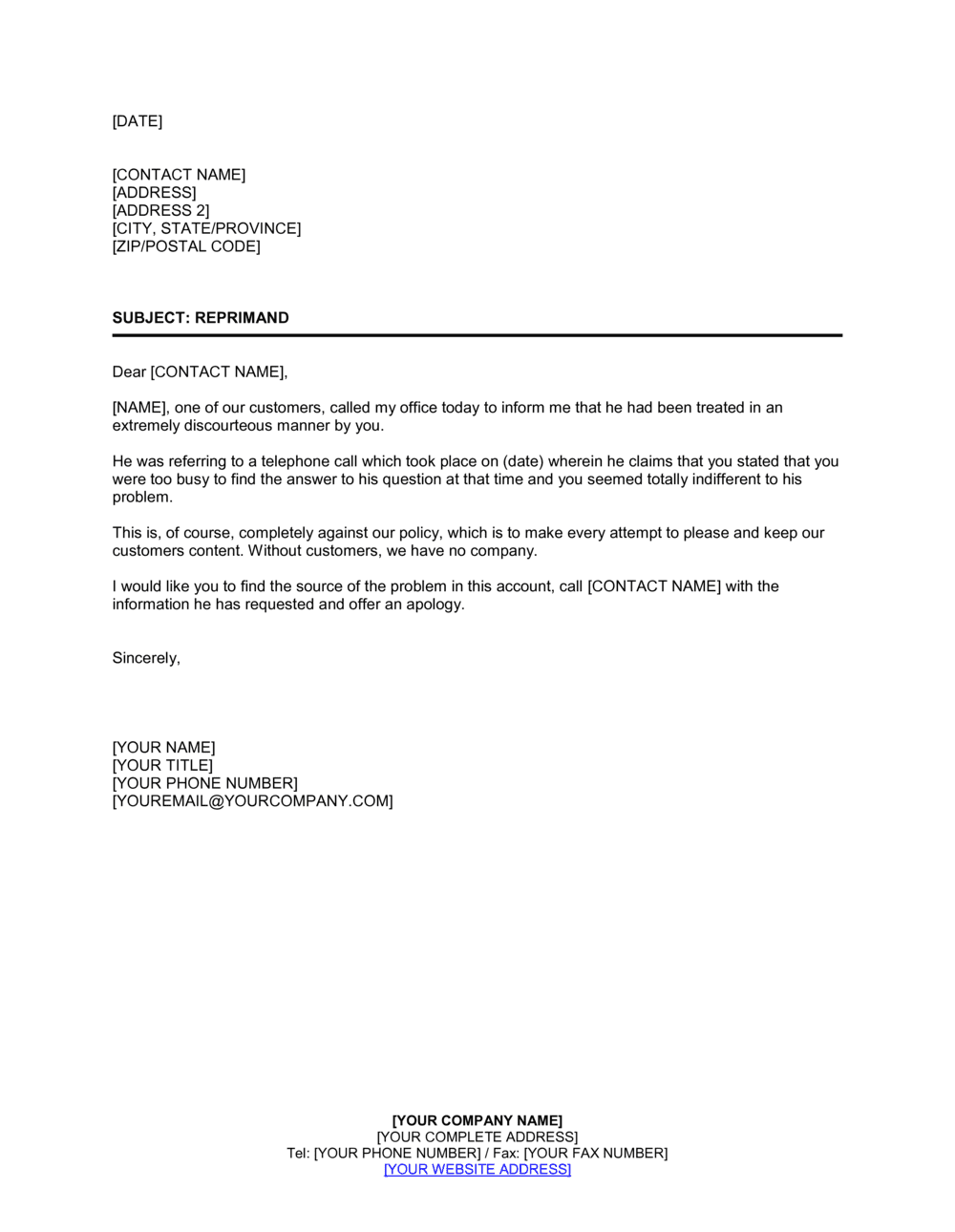
A Reprimand is a formal written disciplinary document issued by an employer to an employee to place on record a specific instance of misconduct, policy violation, or performance failure. This free Word download gives you a structured, legally defensible template you can edit online and export as PDF β€” documenting the incident, the applicable policy breached, the required corrective action, and the consequences of non-compliance.
When you need it
Issue it when an employee's conduct or performance requires formal disciplinary action beyond a verbal warning β€” typically as part of a progressive discipline process. A written reprimand creates the paper trail needed to support further disciplinary steps, including suspension or termination, if behavior does not improve.
What's inside
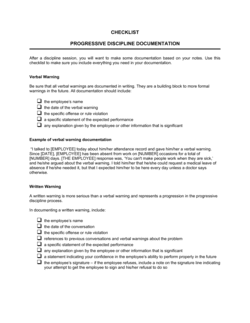
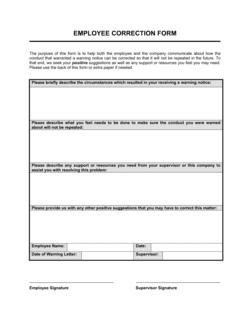
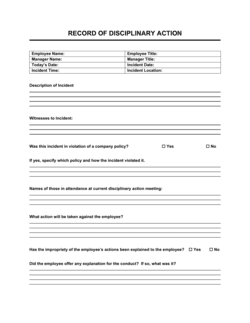
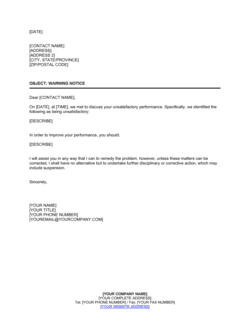
Employee and employer identification, a factual description of the incident or pattern of conduct, the specific policy or performance standard violated, prior warnings issued, required corrective actions with deadlines, a statement of consequences for continued non-compliance, an employee acknowledgement block, and supervisor and HR signatures.

What is a Reprimand?

A Reprimand is a formal written disciplinary document issued by an employer to an employee that places on permanent record a specific instance of misconduct, policy violation, or performance failure. Unlike a verbal warning, which leaves no durable evidence, a written reprimand is a signed, dated document stored in the employee's personnel file β€” describing the incident factually, citing the specific policy breached, setting out measurable corrective actions, and stating the consequences of non-compliance. It functions as the cornerstone of a defensible progressive discipline process, giving the employee formal notice that their conduct is unacceptable and that continued non-compliance may result in termination.

Why You Need This Document

Without a written reprimand on file, employers face two compounding risks simultaneously. First, they have no documented basis for a subsequent termination for cause β€” courts, arbitrators, and employment tribunals routinely reinstate employees or award substantial damages when an employer cannot produce evidence that the employee was warned, knew the rule, and was given a reasonable opportunity to correct their behavior. Second, an undocumented discipline process is almost impossible to apply consistently, creating exposure to discrimination and retaliation claims when an employee argues their treatment differed from that of colleagues. A properly drafted written reprimand eliminates both risks by creating a factual, policy-grounded, procedurally sound record from the moment the discipline is issued β€” protecting the employer whether the situation resolves or escalates.

Which variant fits your situation?

If your situation is…Use this template
First documented disciplinary action after a verbal warningWritten Reprimand (First Warning)
Second or final written warning before terminationFinal Written Warning
Performance failure rather than misconductPerformance Improvement Plan
Immediate serious misconduct requiring suspensionEmployee Suspension Letter
Termination following failed corrective actionEmployee Termination Letter
Documenting attendance or tardiness issues specificallyAttendance Warning Letter
Informal coaching before formal discipline beginsEmployee Counseling Form

Common mistakes to avoid

❌ Vague incident descriptions

Why it matters: Non-specific language like 'Employee has been insubordinate' cannot be defended in an employment tribunal or arbitration because it provides no factual basis for a just-cause finding.

Fix: Replace every characterization with a specific, dated, observable behavior β€” what exactly was said or done, when, where, and in front of whom.

❌ Referencing unacknowledged policies

Why it matters: Citing a policy the employee was never trained on or never signed eliminates the 'knowledge' element of just cause β€” a necessary component in virtually every disciplinary standard.

Fix: Before issuing the reprimand, confirm the employee signed the relevant policy. If they did not, attach the training record or communication showing the policy was communicated.

❌ Inconsistent enforcement across employees

Why it matters: If the same conduct is reprimanded in one employee but not another, the affected employee can claim discriminatory or retaliatory treatment β€” even when the original discipline was warranted.

Fix: Before issuing, confirm with HR that the same or similar conduct has been treated consistently. Document your consistency check in the HR file.

❌ Using 'I agree' signature language

Why it matters: Employees who disagree with the findings routinely refuse to sign agreement statements, creating a procedural standstill and delaying the document entering the personnel record.

Fix: Change the signature block to 'receipt and review only' language. The employee's acknowledgement of receipt is all that is legally required to establish notice.

❌ No consequences clause

Why it matters: Without an explicit statement of what further action may follow non-compliance, the employee can argue they had no notice their employment was at risk, weakening the basis for a subsequent termination for cause.

Fix: Always include a sentence stating that failure to meet corrective actions may result in further disciplinary action up to and including termination.

❌ Issuing without HR review

Why it matters: A reprimand issued unilaterally by a line manager β€” without HR review β€” is more likely to be inconsistent with company policy, procedurally deficient, or discriminatory in effect.

Fix: Route every written reprimand through HR for review and co-signature before delivery, regardless of the severity of the underlying conduct.

The 10 key clauses, explained

Parties and Employment Details

In plain language: Identifies the employer entity, the employee by full legal name and job title, their department, and the date the reprimand is issued.

Sample language
This Written Reprimand is issued on [DATE] by [EMPLOYER LEGAL NAME] ('Company') to [EMPLOYEE FULL NAME] ('Employee'), [JOB TITLE], [DEPARTMENT], Employee ID [ID NUMBER].

Common mistake: Using a manager's name as the issuing party instead of the legal employer entity. If the matter escalates to litigation, the named party must match the employer on record.

Statement of Incident or Conduct

In plain language: A factual, date-specific description of the conduct or performance failure that triggered the reprimand β€” what happened, when, where, and who was involved.

Sample language
On [DATE], at approximately [TIME], Employee [DESCRIBE SPECIFIC CONDUCT] at [LOCATION / DEPARTMENT]. Specifically, Employee [FACTUAL DETAILS OF INCIDENT] in the presence of [WITNESS NAME(S) IF APPLICABLE].

Common mistake: Writing a vague narrative like 'Employee has been difficult lately.' Vague language fails the just-cause standard and is routinely picked apart in wrongful termination claims. Every statement must be specific, factual, and dated.

Policy or Standard Violated

In plain language: Cites the specific company policy, handbook section, code of conduct provision, or performance standard the employee's conduct breached.

Sample language
Employee's conduct violates Section [X] of the Company's [Employee Handbook / Code of Conduct / Workplace Policy], specifically the provision prohibiting [DESCRIPTION], last updated [DATE] and acknowledged by Employee on [DATE].

Common mistake: Referencing a policy the employee was never trained on or never signed as reviewed. Courts and tribunals will ask whether the employee reasonably knew the rule β€” a signed acknowledgement is the only reliable proof.

Prior Warnings and Disciplinary History

In plain language: Documents any prior verbal or written warnings related to the same or similar conduct, establishing the progressive discipline context.

Sample language
Employee received a verbal warning on [DATE] regarding [RELATED CONDUCT]. A copy of that warning is attached as Exhibit A. This written reprimand constitutes the second step in the Company's progressive discipline process.

Common mistake: Issuing a written reprimand that references prior warnings without attaching them. If the prior record isn't documented and attached, it can be challenged as if it never occurred.

Required Corrective Actions

In plain language: Specifies the exact steps the employee must take to correct their conduct or performance, with measurable targets and specific deadlines.

Sample language
Employee is required to: (1) [SPECIFIC ACTION] by [DATE]; (2) complete [TRAINING / COURSE NAME] by [DATE]; (3) [BEHAVIORAL STANDARD] consistently beginning immediately. Progress will be reviewed on [REVIEW DATE].

Common mistake: Setting corrective actions that are vague or unmeasurable β€” 'improve attitude' or 'be more professional.' If the employer cannot objectively assess compliance with the corrective action, the reprimand provides no basis for a subsequent termination.

Consequences of Non-Compliance

In plain language: States clearly what further disciplinary action will follow if the employee fails to meet the corrective action requirements β€” typically final warning, suspension, or termination.

Sample language
Failure to meet the corrective actions outlined above, or any recurrence of the conduct described herein, may result in further disciplinary action up to and including termination of employment, without further warning.

Common mistake: Omitting the consequences clause entirely. Without it, the employee can argue they had no notice that their job was at risk, complicating any subsequent termination for cause.

Employee Response Section

In plain language: An optional space for the employee to provide a written response or objection to the reprimand, preserving procedural fairness.

Sample language
Employee's Comments (optional): [EMPLOYEE MAY STATE THEIR POSITION OR DISAGREEMENT HERE]. Employee's signature below does not constitute agreement with the content of this reprimand but confirms receipt and review.

Common mistake: Skipping this section to avoid giving the employee a platform. Omitting an opportunity for the employee to respond is a key procedural deficiency in UK and EU disciplinary processes and can render the reprimand procedurally unfair.

Acknowledgement of Receipt

In plain language: A signature block where the employee confirms they have received and read the reprimand β€” separate from agreeing with its contents.

Sample language
I, [EMPLOYEE FULL NAME], acknowledge receipt of this Written Reprimand on [DATE]. My signature confirms I have read and understood its contents. It does not constitute an admission of the conduct described. Signature: _______________ Date: _______________

Common mistake: Using language like 'I agree with the findings' in the signature block. Employees routinely refuse to sign agreement statements, stalling the process. 'Receipt only' language removes this obstacle while preserving the legal record.

Supervisor and HR Signatures

In plain language: Sign-off by the issuing manager and an HR representative, confirming the reprimand was reviewed, approved, and delivered in accordance with company policy.

Sample language
Issued by: _______________ [SUPERVISOR NAME], [TITLE] | Date: _______________ | Reviewed by: _______________ [HR REPRESENTATIVE NAME], Human Resources | Date: _______________

Common mistake: Having only the direct manager sign without HR review. A single-signature reprimand issued inconsistently across the organization exposes the employer to discrimination claims if the same conduct is treated differently by different managers.

Filing and Confidentiality Notice

In plain language: States that the reprimand will be placed in the employee's personnel file, how long it will be retained, and who has authorized access to it.

Sample language
This reprimand will be placed in Employee's official personnel file and retained for [X] years / until [CONDITION]. Access is restricted to HR, Employee's supervisory chain, and authorized legal counsel. Employee may request a copy at any time.

Common mistake: Not specifying a retention period. Retaining reprimands indefinitely β€” or failing to remove them as promised β€” can create claims of unfair treatment if a reprimand from five years ago is used to support a termination for an unrelated matter.

How to fill it out

  1. 1

    Enter the employer entity name and employee details

    Use the full registered legal name of the employer, not a division or brand name. Record the employee's legal name, job title, department, and employee ID exactly as they appear in payroll records.

    πŸ’‘ Confirm the entity name against your corporate registry or payroll system before issuing β€” mismatches create problems if the matter reaches an employment tribunal.

  2. 2

    Write a factual, dated description of the incident

    Describe what happened in specific, neutral language β€” date, time, location, what the employee did or failed to do, and any witnesses. Avoid characterizations like 'rude' or 'dishonest' without specific supporting facts.

    πŸ’‘ Stick to behavior you can directly observe or document. 'Employee raised their voice during the 9 am team meeting on May 1' is defensible. 'Employee has an anger problem' is not.

  3. 3

    Cite the specific policy or standard violated

    Reference the exact section of the employee handbook, code of conduct, or performance standard that was breached. Include the version date of the policy and the date the employee acknowledged it.

    πŸ’‘ If the employee has not signed a policy acknowledgement, note the date the policy was communicated and the method β€” email, training session, or onboarding record.

  4. 4

    Document prior warnings and attach supporting records

    Summarize any prior verbal or written warnings related to the same or similar conduct. Attach copies as exhibits and reference them by exhibit label in the body of the reprimand.

    πŸ’‘ If a verbal warning was given, check whether your HR system or a manager's note recorded it at the time. An undocumented verbal warning carries very little evidentiary weight.

  5. 5

    Set specific, measurable corrective actions with deadlines

    List two to four concrete steps the employee must take, each with an objective completion criterion and a specific date. Tie the actions directly to the conduct described in the incident section.

    πŸ’‘ Schedule a formal check-in meeting at the corrective action deadline and note it in the reprimand. This shows the employer followed through β€” a key factor in any subsequent just-cause determination.

  6. 6

    State the consequences of non-compliance explicitly

    Write a clear sentence stating that failure to meet the corrective actions β€” or any recurrence of the described conduct β€” may result in further disciplinary action up to and including termination.

    πŸ’‘ Use 'up to and including termination' rather than 'will result in termination' to preserve discretion for proportionate responses to different severity levels.

  7. 7

    Deliver the reprimand in person and obtain signatures

    Meet with the employee privately with an HR representative present. Review the document together, give the employee an opportunity to respond, and obtain their acknowledgement signature. If the employee refuses to sign, note the refusal and have a witness sign to that effect.

    πŸ’‘ In the UK and EU, the employee is entitled to be accompanied by a colleague or trade union representative at the disciplinary meeting β€” failing to offer this right can invalidate the process.

  8. 8

    File in the personnel record and set a review date

    Place the signed reprimand in the employee's confidential personnel file the same day it is delivered. Calendar the corrective action review date and document the outcome of that review in a follow-up memo attached to the same file.

    πŸ’‘ Set a calendar reminder for the reprimand's retention expiry β€” if your policy states it will be removed after 12 months of good standing, honor that commitment consistently across all employees.

Frequently asked questions

What is a written reprimand?

A written reprimand is a formal disciplinary document issued by an employer to an employee that places on record a specific instance of misconduct, policy violation, or performance failure. It describes the incident factually, cites the policy breached, sets out corrective actions the employee must take, and states the consequences of non-compliance. It is typically the second step in a progressive discipline framework, following a verbal warning.

What is the difference between a verbal warning and a written reprimand?

A verbal warning is an informal or semi-formal conversation in which a manager tells the employee their conduct is unacceptable β€” it may or may not be noted in an HR log. A written reprimand is a formal signed document placed in the employee's personnel file that creates a durable record of the disciplinary event. Written reprimands carry significantly more legal weight and are the primary evidence employers rely on to justify subsequent termination for cause.

Does an employee have to sign a written reprimand?

An employee cannot be forced to sign a reprimand, but their refusal should be documented. The recommended practice is to use a 'receipt only' signature block β€” the employee confirms they received and read the document without agreeing with its contents. If the employee still refuses to sign, have a witness note the refusal in writing on the document itself. This preserves the employer's record of notice delivery.

Can a written reprimand be used as the basis for termination?

Yes, in most jurisdictions a properly documented written reprimand is an important component of the paper trail supporting a termination for cause. The reprimand establishes that the employee was aware of the policy, knew it was violated, was given an opportunity to correct their behavior, and was warned of the consequences of non-compliance. Employers who skip this step often face successful wrongful termination claims even when the underlying conduct clearly warranted dismissal.

How long should a written reprimand stay in an employee's personnel file?

Retention periods vary by jurisdiction and company policy. A common practice is to retain the reprimand for 12–24 months and remove it upon a period of satisfactory conduct, provided the company policy explicitly states this. In the UK, the ACAS Code recommends that spent disciplinary warnings not be used as the basis for further action. Whatever the policy, apply it consistently β€” selectively retaining or removing reprimands exposes the employer to discrimination claims.

What should I do if the employee refuses to accept the reprimand meeting?

If an employee refuses to attend the disciplinary meeting, provide written notice of the meeting in advance β€” by email with read receipt or registered mail β€” and conduct it in their absence if they continue to refuse. Document the refusal, note it on the reprimand, and send a signed copy to the employee by a traceable method. In the UK and EU, rescheduling the meeting once to accommodate the employee is required under procedural fairness standards.

Is a written reprimand required before termination?

Not always. Termination for cause following serious misconduct β€” such as theft, violence, or gross negligence β€” does not typically require a prior written reprimand. However, for performance issues or conduct that falls short of gross misconduct, most jurisdictions and employment best practices require at least one formal warning before termination. In Canada, the UK, and the EU, bypassing progressive discipline significantly increases wrongful dismissal exposure.

Can I issue a reprimand to a remote or work-from-home employee?

Yes. The process is the same β€” the meeting should be conducted by video call with HR present, the document delivered electronically, and acknowledgement of receipt obtained via email or electronic signature. Ensure the delivery method creates a timestamped record. Courts and tribunals accept electronic delivery provided it is documented and traceable.

What is the difference between a reprimand and a performance improvement plan?

A reprimand addresses a specific incident of misconduct or policy violation β€” it is disciplinary in nature. A Performance Improvement Plan (PIP) is a structured document used when an employee's overall performance is consistently below the required standard β€” it is developmental in nature, setting measurable goals over a defined period. Some situations warrant both: a reprimand for the triggering event and a PIP for the broader performance pattern.

How this compares to alternatives

vs Performance Improvement Plan

A Performance Improvement Plan is a forward-looking developmental tool used when an employee's overall performance is consistently below standard β€” it sets goals and support structures over 30–90 days. A reprimand is a backward-looking disciplinary record of a specific incident or policy breach. Both may be issued simultaneously when a performance pattern is punctuated by a specific disciplinary event.

vs Employee Termination Letter

A termination letter ends the employment relationship and is typically the final step in a progressive discipline chain. A reprimand is an intermediate step that gives the employee notice and a documented opportunity to correct their conduct before termination is warranted. Issuing a reprimand before a termination letter is the primary evidence that due process was followed.

vs Verbal Warning Documentation

A verbal warning is an informal coaching conversation β€” often logged only as a brief HR note. A written reprimand is a formal signed document with legal evidentiary weight. Employers who rely only on verbal warnings frequently find they cannot establish a documented progressive discipline record when they need to justify a termination for cause.

vs Employee Suspension Letter

A suspension letter temporarily removes an employee from the workplace β€” typically used for serious misconduct investigations or as a step beyond a final written warning. A reprimand keeps the employee at work under a corrective action plan. Suspension is generally reserved for conduct that poses an ongoing workplace risk during investigation, rather than for performance or minor misconduct issues.

Industry-specific considerations

Retail and Hospitality

High staff turnover and shift-based work make consistent written documentation essential β€” verbal discipline is routinely forgotten or disputed across rotating management teams.

Healthcare

Regulatory and licensing bodies require documented disciplinary records for clinical staff; reprimands related to patient safety or HIPAA violations must meet elevated specificity standards.

Manufacturing

Safety rule violations and attendance infractions are common triggers; union agreements typically prescribe specific progressive discipline steps that the reprimand must follow to be grievance-proof.

Professional Services

Conduct and confidentiality breaches involving client data or conflicts of interest require reprimands that cite specific engagement-level policies and reference any regulatory obligations.

Technology / SaaS

IP misuse, code-of-conduct violations in distributed teams, and data security incidents are common triggers; reprimands should reference the specific acceptable-use policy version the employee acknowledged.

Financial Services

Regulatory compliance failures β€” such as FINRA or FCA breaches β€” require reprimands that are coordinated with compliance officers and may need to be disclosed to regulators.

Jurisdictional notes

United States

Most US states follow at-will employment, meaning employers can terminate without cause β€” but written reprimands are still essential to defend against wrongful termination, discrimination, and retaliation claims under Title VII, the ADA, and FMLA. Some states, including Montana, require cause after a probationary period, making documented progressive discipline mandatory. Ensure the policy cited in the reprimand has a signed acknowledgement on file.

Canada

Canadian employment law does not recognize at-will termination. Employers must demonstrate just cause for dismissal without notice and severance, which requires a documented and proportionate progressive discipline record. Provincial human rights codes prohibit disciplinary action based on protected characteristics β€” reprimands that could be linked to a human rights complaint should be reviewed by counsel before delivery. Quebec requires all formal workplace documents to be available in French for provincially regulated employers.

United Kingdom

The ACAS Code of Practice on Disciplinary and Grievance Procedures is the governing standard. Employers must investigate before issuing a formal reprimand, provide written notice of the disciplinary meeting, allow the employee to be accompanied by a colleague or trade union representative, and offer a right of appeal. Failure to follow the ACAS Code does not automatically void the reprimand but can increase any employment tribunal award by up to 25%.

European Union

EU member states generally require documented just cause for dismissal and impose procedural fairness obligations before any formal disciplinary action. Works council consultation may be required in Germany, France, and the Netherlands before issuing a formal reprimand to a works-council-covered employee. GDPR applies to personal data contained in disciplinary records β€” reprimands must be stored securely, with access limited to authorized personnel, and retention periods must comply with data minimization principles.

Template vs lawyer β€” what fits your deal?

PathBest forCostTime
Use the templateStandard first or second written warnings for conduct or attendance issues in at-will employment jurisdictionsFree20–30 minutes
Template + legal reviewReprimands involving discrimination, harassment, or safety complaints where the employee has filed or may file a counter-complaint$200–$500 for an HR or employment lawyer review1–2 days
Custom draftedUnionized workplaces, regulated industries (healthcare, financial services), or situations involving a concurrent regulatory investigation$500–$2,000+3–7 days

Glossary

Progressive Discipline
A structured disciplinary framework that escalates consequences in stages β€” typically verbal warning, written reprimand, final warning, suspension, then termination β€” giving employees the opportunity to correct behavior at each step.
Written Reprimand
A formal, signed document placing on record a specific disciplinary event, the policy breached, and the corrective action required β€” the standard second step in most progressive discipline systems.
At-Will Employment
An employment relationship in which either party may end the arrangement at any time for any lawful reason β€” but even at-will employers benefit from documented disciplinary records to defend against wrongful termination claims.
Corrective Action
Specific, measurable steps the employee must take β€” by a defined deadline β€” to bring conduct or performance into compliance with company policy.
Acknowledgement of Receipt
A signature block in which the employee confirms they have received and read the reprimand, without necessarily agreeing with its contents β€” important for establishing that notice was given.
Wrongful Termination
A claim by a former employee that their dismissal violated a contract, statute, or public policy β€” documented reprimands are the primary defense evidence employers rely on in these proceedings.
Personnel File
The official employer-maintained record of an employee's employment history, including disciplinary documents, performance reviews, and signed agreements.
Constructive Dismissal
A situation where an employer's conduct β€” including an unfair or improperly documented disciplinary process β€” effectively forces an employee to resign, which courts may treat as termination.
Just Cause
A defensible, documented reason for disciplinary action or termination β€” typically requiring evidence that the rule existed, the employee knew it, and enforcement was consistent.
ACAS Code of Practice
The UK Advisory, Conciliation and Arbitration Service code that sets the procedural standard for fair disciplinary processes β€” failure to follow it can increase any employment tribunal award by up to 25%.
Part of your Business Operating System

This document is one of 3,000+ business & legal templates included in Business in a Box.

  • Fill-in-the-blanks β€” ready in minutes
  • 100% customizable Word document
  • Compatible with all office suites
  • Export to PDF and share electronically

Create your document in 3 simple steps.

From template to signed document β€” all inside one Business Operating System.
1
Download or open template

Access over 3,000+ business and legal templates for any business task, project or initiative.

2
Edit and fill in the blanks with AI

Customize your ready-made business document template and save it in the cloud.

3
Save, Share, Send, Sign

Share your files and folders with your team. Create a space of seamless collaboration.

Save time, save money, and create top-quality documents.

β˜…β˜…β˜…β˜…β˜…

"Fantastic value! I'm not sure how I'd do without it. It's worth its weight in gold and paid back for itself many times."

Managing Director Β· Mall Farm
Robert Whalley
Managing Director, Mall Farm Proprietary Limited
β˜…β˜…β˜…β˜…β˜…

"I have been using Business in a Box for years. It has been the most useful source of templates I have encountered. I recommend it to anyone."

Business Owner Β· 4+ years
Dr Michael John Freestone
Business Owner
β˜…β˜…β˜…β˜…β˜…

"It has been a life saver so many times I have lost count. Business in a Box has saved me so much time and as you know, time is money."

Owner Β· Upstate Web
David G. Moore Jr.
Owner, Upstate Web

Run your business with a system β€” not scattered tools

Stop downloading documents. Start operating with clarity. Business in a Box gives you the Business Operating System used by over 250,000 companies worldwide to structure, run, and grow their business.

Free Forever PlanΒ Β·Β No credit card required