What documents does a customer service team actually need?
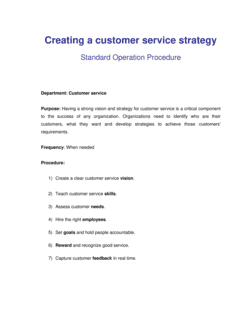
At minimum, every team needs a customer service policy, a complaint form, a feedback form, and at least one apology letter template. Growing teams add scripts for common call types, onboarding checklists for new clients, and a complaint resolution policy for escalations. The right stack depends on your volume and channels — a 3-person support team needs fewer documents than a 50-seat contact center.
How do customer service templates improve team performance?
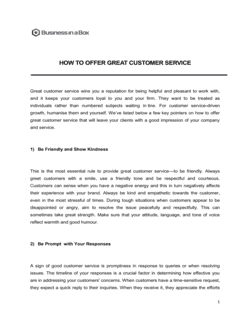
Templates reduce the cognitive load on individual reps by removing the need to draft responses from scratch. They also enforce consistency — every customer who complains receives the same quality of response regardless of who handles the ticket. Over time, templated workflows produce measurable improvements in resolution time, first-contact resolution rate, and customer satisfaction scores.
Can I use these templates for both B2B and B2C customers?
Yes. Most templates in this folder are written in neutral language that works for either context. B2B teams typically add more formal language, account references, and contractual terms; B2C teams lean toward shorter, warmer communication. Both uses are supported — the templates are designed to be edited to fit your customer base.
What is a customer service policy and who should have one?
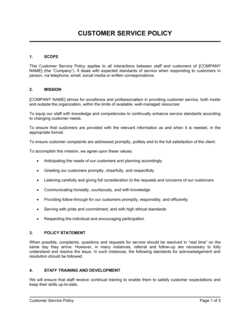
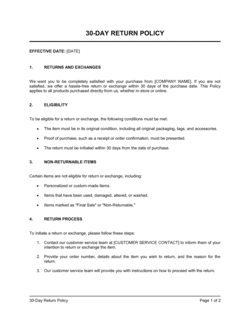
A customer service policy is a written document that defines your team's standards: how quickly you respond, how complaints are handled, what refund or exchange rules apply, and how escalations work. Any business that handles more than a handful of customer interactions per week benefits from having one — it reduces inconsistency, manages customer expectations, and gives staff a clear reference point.
What should a customer apology letter include?
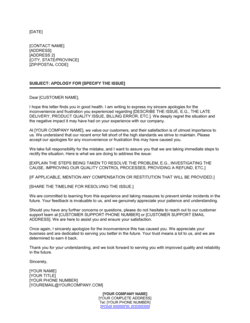
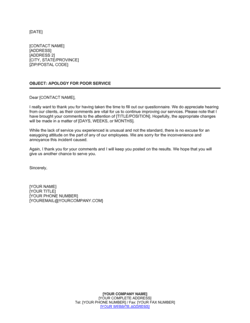
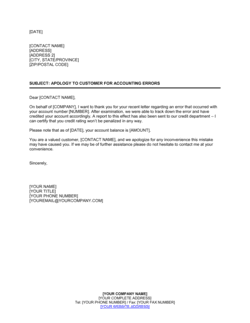
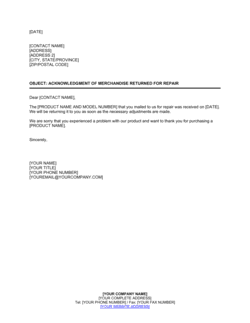
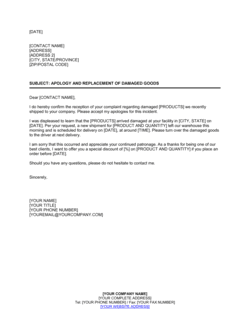
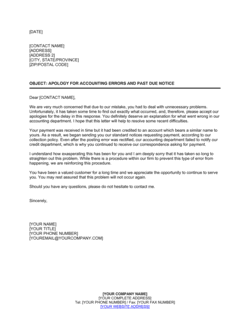
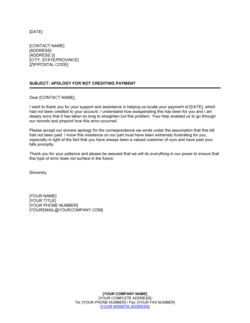
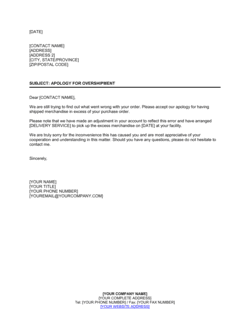
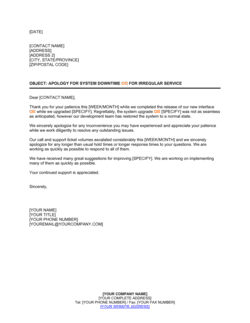
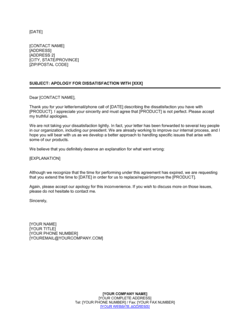
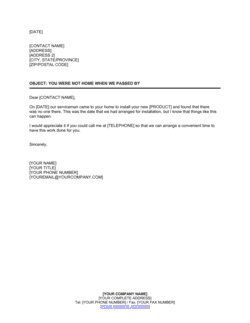
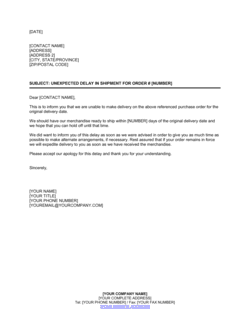
An effective apology letter should acknowledge the specific problem, take responsibility without excessive qualification, explain what caused the issue if known, state what you are doing to fix it, and offer a concrete remedy if appropriate. It should be signed by a named individual, not just "the team." Avoid generic apologies that don't reference the customer's specific experience — they tend to escalate rather than resolve.
How do I handle a customer complaint formally?
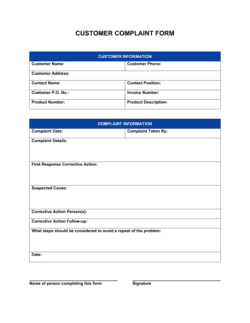
Log the complaint on a complaint form as soon as it arrives, capturing the date, the customer's details, the nature of the issue, and any supporting evidence. Acknowledge receipt within your stated timeframe, investigate the root cause, communicate a resolution, and close the complaint with a record of the outcome. A complaint resolution policy sets the rules; a complaint form captures each instance.
Are customer service agreements legally binding?
Yes, when properly executed by authorized representatives of both parties. A customer service agreement defines deliverables, response obligations, fees, liability limits, and termination conditions. It is generally enforceable when the scope is clear and both parties have signed. Consider having a lawyer review agreements that involve significant fees or complex service-level commitments.
How often should customer service documents be reviewed?
Policies and agreements should be reviewed at least annually or whenever there is a significant change in service channels, pricing, staffing, or regulation. Scripts and form templates should be reviewed quarterly — they become outdated quickly as products and processes change. Add a review date to every document so it's easy to track.
Customer service refers to the direct support provided when a customer has a question, problem, or request. Customer experience is the broader sum of every interaction a customer has with your brand — from first ad impression to post-purchase support. Good customer service is one input into the overall customer experience. Templates in this folder address both: reactive service documents (complaint forms, scripts) and proactive experience documents (onboarding checklists, personalized experience guides).
A customer service policy is an internal document that sets standards for how your team should behave — response times, escalation protocols, refund rules. A customer service agreement is an external, legally binding contract between your business and a client that defines deliverables, obligations, and remedies. Use the policy to guide your staff; use the agreement to protect both parties in a commercial relationship.
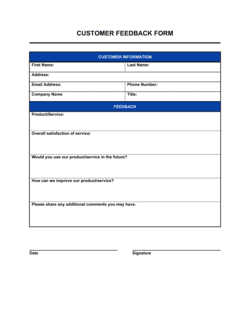
A complaint form is triggered by a specific problem — it logs what went wrong, when, and what resolution is expected. A feedback form is open-ended and proactive — it invites customers to rate or comment on their overall experience. Both generate data, but complaint forms are reactive and feedback forms are proactive. Many businesses use both in parallel.
A customer apology letter is a general-purpose document for any service failure — delivery delays, staff conduct, product defects. An apology for a poor service rating on a questionnaire is specifically triggered by a negative survey response and references that rating directly. Use the targeted apology when you have a documented survey score to respond to; use the general letter for all other situations.
Key clauses every Customer Service contains
Whether you're drafting a policy, an agreement, or a communication template, the documents in this folder share a common set of structural elements.
Scope of service. Defines what is and is not covered — which customers, channels, products, or issues the document applies to.
Response time commitments. States how quickly the business will acknowledge and resolve requests, complaints, or inquiries.
Escalation path. Describes what happens when a frontline rep cannot resolve an issue — who it goes to and in what timeframe.
Resolution and remedy. Specifies what the customer can expect as an outcome: refund, replacement, credit, or corrective action.
Data handling and confidentiality. Outlines how customer information collected during service interactions is stored, used, and protected.
Acknowledgment and signature. Confirms both parties have read and agreed to the terms, creating a documented record of the interaction.
Review and revision schedule. For policies, specifies how often the document is reviewed and updated to reflect changes in service standards.
How to write a customer service document
The format varies — policy, form, letter, checklist — but every effective customer service document is built from the same decisions.
1
Identify the trigger
Decide which specific customer interaction this document addresses — a complaint, a feedback request, an onboarding step, or a service failure.
2
Define your audience
Clarify whether the document is customer-facing (a letter or form they receive) or staff-facing (a script or policy your team uses internally).
3
State the purpose in the opening
The first paragraph or section should make the document's intent unmistakable — what the customer or employee can expect from reading it.
4
Set clear, measurable commitments
Replace vague language like 'as soon as possible' with specific timeframes: '48 hours', 'within 2 business days'.
5
Include the resolution or next step
Every service document should end with a clear action — what happens next, who is responsible, and by when.
6
Add a contact or escalation point
Give the reader a named person, email, or phone number so they can follow up without having to start over.
7
Review for tone
Customer-facing documents should read as helpful and direct — no jargon, no passive voice, no corporate hedging.
8
Version and store it
Date the document, assign a version number, and save it in a location your whole team can access and update.
At a glance
What it is
Customer service templates are ready-to-use documents that standardize how your team communicates with customers across complaints, requests, feedback, onboarding, and service recovery. They reduce response time, ensure consistency, and protect the business by creating a documented paper trail.
When you need one
Any time your team handles customer interactions at scale — from resolving complaints and requesting feedback to onboarding new clients and communicating service changes.
The right template depends on where the customer is in their journey and what outcome you need to achieve — setting expectations, resolving an issue, or strengthening the relationship.
Your situation
Recommended template
Formalizing service standards and expectations for customers
Sets out response times, escalation paths, and service-level commitments.
A commitment specifying the response or resolution time a customer can expect for a given type of inquiry.
First-contact resolution (FCR)
The percentage of customer issues resolved in the first interaction without requiring a follow-up or escalation.
Escalation
The process of passing an unresolved issue to a more senior person or specialized team.
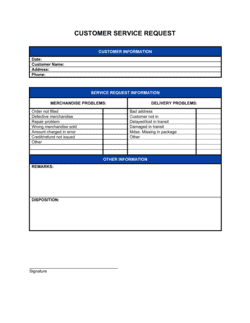
Customer complaint form
A structured document used to record the details of a customer complaint and track its resolution.
Customer feedback form
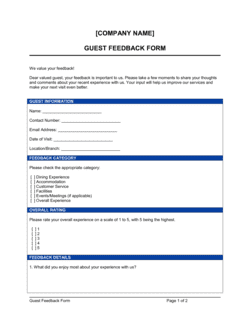
A structured document that invites customers to rate or comment on their experience with a product or service.
Customer onboarding
The process of welcoming a new customer, setting expectations, and ensuring they can successfully use a product or service.
Service recovery
The actions taken to restore customer satisfaction after a service failure.
Net promoter score (NPS)
A single-question metric asking how likely a customer is to recommend a business, scored on a 0–10 scale.
Customer service policy
An internal document that defines the standards, procedures, and expectations for how a team handles customer interactions.
Churn
The rate at which customers stop doing business with a company, often used as a measure of service quality.
Customer profile
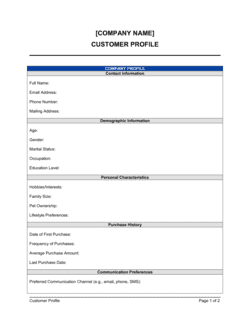
A documented summary of a customer's characteristics, preferences, history, and needs used to personalize service.
What is a customer service template?
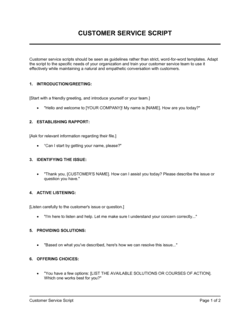
A customer service template is a pre-built document — form, letter, policy,
checklist, or script — that gives your team a ready-made structure for handling
any customer interaction. Rather than drafting responses from scratch or relying
on individual judgment each time a complaint arrives or a client needs
onboarding, templates standardize the process so every customer receives the
same quality of communication regardless of who handles their case.
The category spans a wide range of document types. Operational documents like
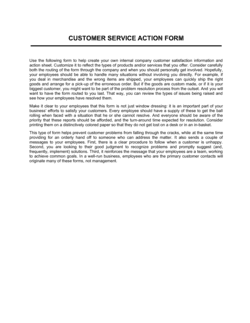
complaint forms, feedback forms, and action forms capture information and create
a record. Communication documents like apology letters, thank-you letters, and
service scripts determine how your team speaks to customers in critical moments.
Strategic documents like service policies, training guides, and customer
experience plans define the standards the entire organization works toward.
Together, they form the infrastructure of a consistent, accountable customer
service operation.
When you need a customer service template
If your business handles more than a handful of customer interactions per week,
ad-hoc communication becomes a liability. Inconsistent responses, missed
follow-ups, and undocumented complaints are the direct result of not having
standard documents in place. Templates solve that before it becomes a pattern.
Common triggers:
A customer submits a complaint and your team has no standard form for logging it
A negative survey response requires a formal written apology
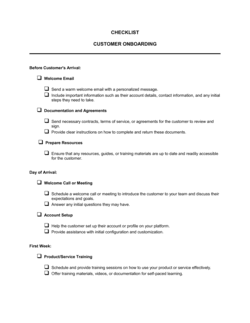
You're onboarding several new clients and need a repeatable checklist
A new hire joins the support team and needs a call script to follow
You're formalizing a service relationship with a client and need a binding agreement
A key account manager leaves and customers need a professional transition letter
You want to request feedback systematically after every completed service interaction
Leadership asks for a written customer service policy to share with staff and auditors
Without documented processes and communication standards, service quality varies
by individual — and that variation is visible to customers. A well-built library
of customer service templates gives every member of your team the same starting
point, reduces resolution time, and creates the paper trail that protects your
business when a dispute arises.
Award-winning platform
Great Place to Work 2025
BIG Award — Product of the Year 2025
Smartest Companies 2025
Global 100 Excellence 2026
Best of the Best 2025
Create your document in 3 simple steps.
From template to signed document — all inside one Business Operating System.
1
Download or open template
Access over 3,000+ business and legal templates for any business task, project or initiative.
2
Edit and fill in the blanks with AI
Customize your ready-made business document template and save it in the cloud.
3
Share with your team
Share your files and folders with your team. Create a space of seamless collaboration.
Save time, save money, and create top-quality documents.
★★★★★
"Fantastic value! I'm not sure how I'd do without it. It's worth its weight in gold and paid back for itself many times."
Managing Director · Mall Farm
RW
Robert Whalley
Managing Director, Mall Farm Proprietary Limited
★★★★★
"I have been using Business in a Box for years. It has been the most useful source of templates I have encountered. I recommend it to anyone."
Business Owner · 4+ years
MF
Dr Michael John Freestone
Business Owner
★★★★★
"It has been a life saver so many times I have lost count. Business in a Box has saved me so much time and as you know, time is money."
Owner · Upstate Web
DM
David G. Moore Jr.
Owner, Upstate Web
Run your business with a system — not scattered tools
Stop downloading documents. Start operating with clarity. Business in a Box gives you the Business Operating System used by over 250,000 companies worldwide to structure, run, and grow their business.