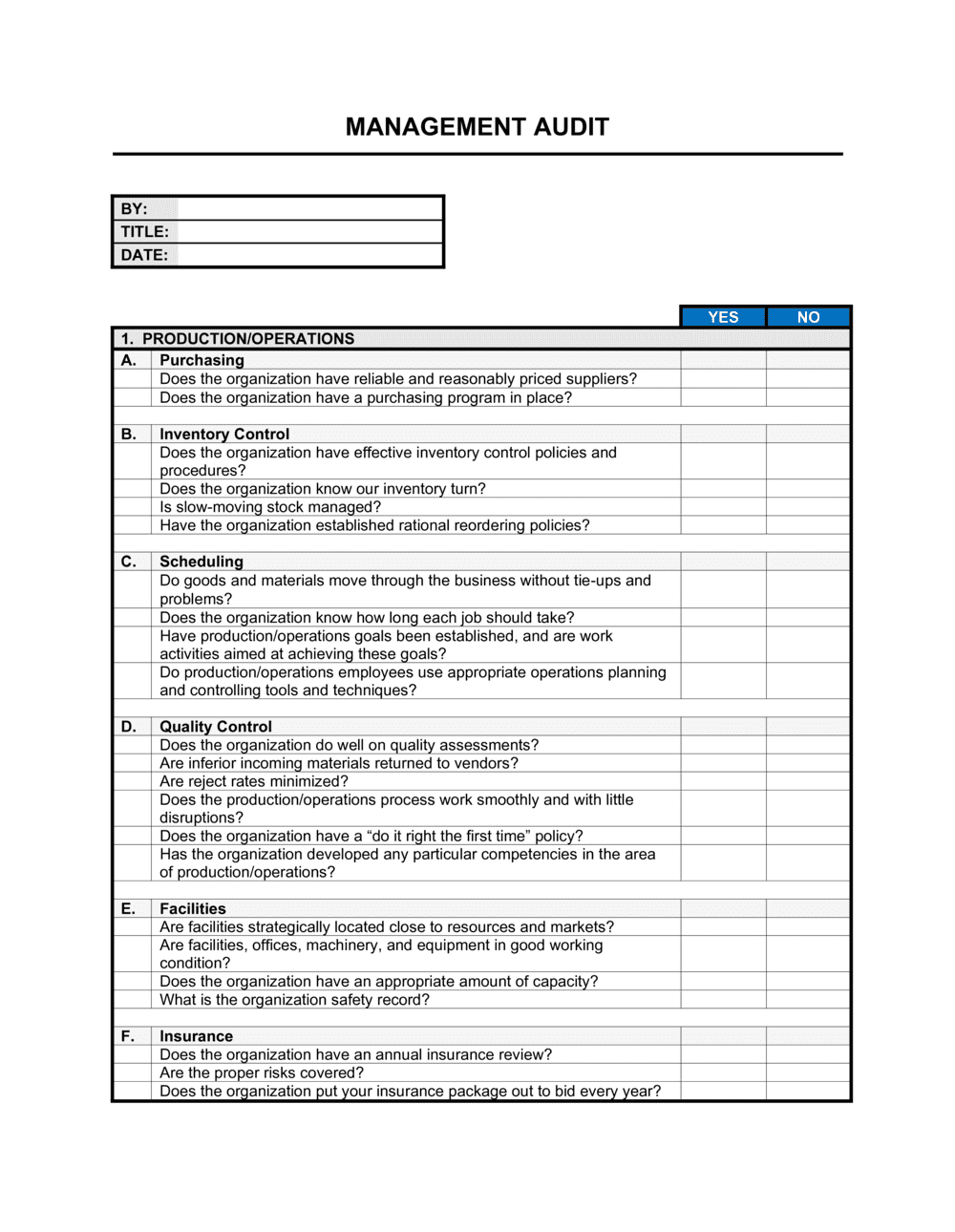
Management Audit Template

Free Word download • Edit online • Save & share with Drive • Export to PDF

6 pages30–40 min to fillDifficulty: ComplexSignature requiredLegal review recommended
Learn more ↓
FreeManagement Audit Template

At a glance

What it is
A Management Audit is a formal evaluation document that systematically assesses the effectiveness, efficiency, and compliance of an organization's management structure, leadership practices, and internal controls. This free Word download gives you a structured, board-ready template you can edit online and export as PDF to share with executives, shareholders, auditors, or regulatory bodies.
When you need it
Use it when a board of directors commissions a review of executive performance, when a potential acquirer conducts due diligence on leadership quality, or when an organization seeks to identify governance gaps before a regulatory examination or restructuring event.
What's inside
Scope and mandate, management structure assessment, leadership effectiveness criteria, internal controls review, risk management evaluation, performance metrics, findings and recommendations, and a formal sign-off block for auditors and authorized reviewers.

What is a Management Audit?

A Management Audit is a formal, documented evaluation of an organization's leadership structure, management effectiveness, internal controls, and governance practices — assessed against defined standards and benchmarks, and concluded with rated findings, root causes, and a binding remediation plan. Unlike a financial audit, which focuses on the accuracy of numbers, a management audit evaluates the people and structures that produce those numbers: whether decision-making authority is appropriately distributed, whether controls operate as designed, whether leadership is performing against measurable objectives, and whether the organization has identified successors for critical roles. The completed document is executed by the lead auditor, the board's audit committee chair, and a senior management representative, creating mutual accountability for the findings.

Why You Need This Document

Without a formal management audit, boards lose their most direct tool for holding executive teams accountable to governance standards — and that gap has concrete consequences. Regulators in banking, insurance, and healthcare treat the absence of documented management reviews as a control deficiency in its own right, triggering supervisory action that a completed audit would have prevented. In M&A transactions, an acquirer who cannot obtain a management audit relies on management's self-reporting to assess leadership quality, a conflict of interest that regularly surfaces as a post-close integration failure. Internally, the absence of a structured audit allows high-risk control gaps — segregation of duties failures, undefined KPIs, succession vacuums in critical roles — to compound undetected until a financial loss or personnel crisis forces an emergency response. This template gives boards, auditors, and governance consultants a structured, legally defensible document that converts a leadership review from an informal discussion into an accountability record with named owners, deadlines, and a signature line that closes the accountability loop.

Which variant fits your situation?

If your situation is…Use this template
Reviewing executive performance for board accountability purposesManagement Audit (Board Review Edition)
Assessing management quality during a merger or acquisitionDue Diligence Checklist
Evaluating internal financial controls and accounting oversightInternal Audit Report
Reviewing HR processes and workforce management practicesHR Audit Checklist
Assessing operational efficiency and process managementOperations Audit Report
Documenting compliance with regulatory governance requirementsCorporate Governance Report
Capturing a 360-degree leadership performance reviewPerformance Review Template

Common mistakes to avoid

❌ Scoping the audit too broadly without prioritization

Why it matters: Auditing every department at the same depth produces thin findings across the board rather than actionable insight in the highest-risk areas. Boards make poor remediation decisions when everything is flagged at the same level.

Fix: Before fieldwork begins, conduct a risk-ranking exercise with the audit committee to identify the two or three management areas of greatest concern, then allocate at least 60% of audit hours to those areas.

❌ Using subjective language instead of measurable findings

Why it matters: Phrases like 'management culture appears weak' cannot be remediated, tracked, or defended if the audit is challenged in a legal or regulatory proceeding.

Fix: Anchor every finding to a measurable gap — a KPI missed by a specific percentage, a control that failed a defined test, or a policy violated on a documented occasion.

❌ Omitting the independence declaration

Why it matters: Any existing or prior relationship between the auditor and the company's management that is not disclosed allows management to challenge the audit's objectivity and can result in the findings being disregarded by regulators or a court.

Fix: Include a formal independence declaration in the auditor credentials section and disclose any prior engagements, even if deemed immaterial.

❌ Assigning remediation actions to a team rather than a named individual

Why it matters: When a finding is owned by 'the finance department' rather than the CFO, accountability is diffused. At the next audit cycle, the same finding reappears open because no single person was responsible.

Fix: Every remediation action must carry the name and title of one accountable individual, a specific target date, and a reporting mechanism to the audit committee.

❌ Distributing the draft report before all signatures are obtained

Why it matters: A circulated draft without management sign-off can be treated as preliminary and non-binding, allowing management to disclaim the findings and remediation commitments.

Fix: Mark all pre-sign-off versions prominently as DRAFT — FOR REVIEW ONLY and establish a firm deadline for the signature process before any distribution outside the audit committee.

❌ Failing to document the evaluation framework used

Why it matters: Without a named framework, the audit cannot be replicated, compared across periods, or defended against a claim that the methodology was arbitrary or biased.

Fix: Name the specific standard (e.g., COSO Internal Control Framework, IIA International Standards for the Professional Practice of Internal Auditing) in the methodology section and retain all working papers that demonstrate how it was applied.

The 10 key clauses, explained

Audit mandate and scope

In plain language: Identifies who commissioned the audit, the legal or governance authority under which it is conducted, and the precise boundaries of what is and is not within scope.

Sample language
This Management Audit is commissioned by the Board of Directors of [COMPANY NAME] ('Company') pursuant to [BOARD RESOLUTION / SECTION X OF BYLAWS] dated [DATE]. The scope of this audit encompasses the management practices, organizational structure, and internal controls of [DEPARTMENTS / BUSINESS UNITS] for the period [START DATE] to [END DATE].

Common mistake: Defining scope too broadly — including every department with no prioritization — so the audit produces shallow findings across the organization instead of actionable depth in the areas of highest risk.

Auditor credentials and independence

In plain language: States who conducted the audit, their qualifications, and any independence or conflict-of-interest declarations required to give the findings credibility.

Sample language
[AUDITOR NAME / FIRM], a [CREDENTIAL, e.g., CPA / CIA / Chartered Accountant], declares that no material conflict of interest exists with [COMPANY NAME] or any named management personnel reviewed herein. This engagement was conducted independently of the Company's management team.

Common mistake: Omitting an independence declaration entirely, which allows management to challenge the audit's objectivity and can invalidate the findings in a regulatory or litigation context.

Methodology and evaluation criteria

In plain language: Describes the frameworks, benchmarks, and data-collection methods used to evaluate management — including interviews, document reviews, and the specific standards applied.

Sample language
The audit was conducted in accordance with [STANDARD, e.g., IIA Standards / ISO 9001 / COSO Framework]. Methods included structured interviews with [X] management personnel, review of [DOCUMENT TYPES], observation of [PROCESSES], and benchmarking against [CRITERIA / INDUSTRY BENCHMARKS].

Common mistake: Failing to cite the evaluation standard used. Without a named framework, the audit's conclusions cannot be independently verified or compared against prior audits.

Organizational structure assessment

In plain language: Evaluates whether the reporting hierarchy, spans of control, and role definitions support effective decision-making and accountability.

Sample language
The Company's current organizational structure comprises [X] management layers with an average span of control of [Y] direct reports per manager. The audit found [FINDING — e.g., excessive layering in the Operations division] resulting in [CONSEQUENCE — e.g., delayed escalation of operational issues to executive leadership].

Common mistake: Describing the org chart without evaluating whether it is fit for purpose — producing a documentation exercise rather than an audit finding.

Leadership effectiveness evaluation

In plain language: Assesses individual and collective management performance against defined KPIs, strategic objectives, and leadership competency benchmarks.

Sample language
Management performance was evaluated against [X] KPIs established for the [PERIOD]. Of these, [Y] were met or exceeded, [Z] were partially met, and [N] were not met. Notable areas of underperformance include [SPECIFIC AREAS] as further detailed in Appendix [X].

Common mistake: Using subjective language — 'leadership appears weak' — instead of tying findings directly to measurable KPI gaps, which exposes the audit to credibility challenges and makes remediation planning impossible.

Internal controls and risk management review

In plain language: Reviews the adequacy of management's control environment — segregation of duties, authorization limits, exception reporting, and the organization's risk register — and identifies material control gaps.

Sample language
The audit identified [X] control deficiencies, of which [Y] are classified as material weaknesses and [Z] as significant deficiencies per the materiality threshold of [THRESHOLD]. Key findings: [FINDING 1]; [FINDING 2]. Each deficiency is mapped to a remediation action in Section [X].

Common mistake: Classifying every deficiency as 'material' regardless of actual risk impact — this dilutes the urgency of genuinely critical findings and causes boards to deprioritize the wrong items.

Succession planning and talent assessment

In plain language: Evaluates whether the organization has identified and developed successors for critical management roles, reducing key-person dependency risk.

Sample language
Of [X] identified critical leadership roles, [Y] have a documented successor at the 'ready now' stage and [Z] have successors in development with an estimated readiness horizon of [TIMEFRAME]. Roles with no identified successor: [LIST].

Common mistake: Treating succession planning as a checkbox item and confirming that a plan exists without verifying whether named successors have been assessed for readiness or actually developed.

Findings summary and risk ratings

In plain language: Consolidates all audit findings into a structured table with a risk rating (high, medium, or low), root cause, and impact statement for each.

Sample language
Finding [REF]: [FINDING TITLE] | Risk Rating: [HIGH / MEDIUM / LOW] | Root Cause: [DESCRIPTION] | Impact: [CONSEQUENCE IF UNADDRESSED] | Recommended Action: [ACTION] | Responsible Owner: [NAME / ROLE] | Target Date: [DATE].

Common mistake: Presenting findings as a narrative paragraph rather than a structured table — making it impossible for the board to track remediation progress at a future review.

Remediation plan and accountability

In plain language: Assigns each material finding to a named owner with a specific corrective action, implementation deadline, and a mechanism for reporting completion back to the board or audit committee.

Sample language
Management of [COMPANY NAME] commits to implementing the remediation actions set out in Schedule A by [DEADLINE]. Progress reports will be submitted to the Audit Committee on [FREQUENCY — e.g., quarterly] basis. The Chief Executive Officer is ultimately accountable for the completion of all high-rated findings.

Common mistake: Assigning remediation to a department or team rather than a named individual — diffused accountability means no one owns the fix, and high-risk findings remain open at the next audit cycle.

Sign-off and certification

In plain language: Formal execution block where the lead auditor, the audit committee chair, and a senior management representative certify that the document accurately reflects the audit findings and that management accepts the remediation obligations.

Sample language
This Management Audit Report is certified as a true and accurate representation of findings by the undersigned. [AUDITOR NAME], [CREDENTIAL] — Date: [DATE]. [AUDIT COMMITTEE CHAIR NAME], on behalf of the Board — Date: [DATE]. [CEO / CFO NAME], on behalf of Management — Date: [DATE].

Common mistake: Obtaining only the auditor's signature and omitting management's sign-off — which means management can later disclaim knowledge of findings and avoids binding them to the remediation plan.

How to fill it out

  1. 1

    Define the mandate and scope before starting fieldwork

    Enter the commissioning authority (board resolution number or bylaw reference), the business units in scope, and the audit period. Confirm the scope in writing with the audit committee chair before conducting any interviews or document reviews.

    💡 A written scope agreement prevents scope-creep disputes mid-audit and gives the auditor protection if management later challenges the breadth of findings.

  2. 2

    State the auditor's credentials and independence

    Identify the lead auditor or firm by name and professional designation. Include a formal independence declaration confirming no financial, personal, or professional conflict of interest with the company or its management.

    💡 If a conflict exists — even a minor one — disclose it in full rather than omitting it. Undisclosed conflicts discovered later void the audit's credibility entirely.

  3. 3

    Select and document the evaluation framework

    Choose a recognized standard (COSO, IIA, ISO 9001, or a regulator-specified framework) and record it in the methodology section. Describe the data collection methods — interviews, document review, observation — and the sample sizes used.

    💡 Documenting the framework in the audit report itself allows a successor auditor to replicate the methodology at the next cycle, making trend comparisons meaningful.

  4. 4

    Complete the organizational structure assessment

    Map the reporting hierarchy, calculate the average span of control per management layer, and compare role definitions against the company's current strategic priorities. Flag any structural misalignments as preliminary findings.

    💡 An average span of control below four or above twelve for a management role is typically a red flag worth investigating — investigate the cause before labeling it a deficiency.

  5. 5

    Evaluate leadership performance against defined KPIs

    Obtain the KPIs formally set for each management role or team for the audit period. Score each KPI as met, partially met, or not met, and tie underperformance directly to business impact — not to subjective impressions.

    💡 If formal KPIs were never set for the audit period, document that fact as a finding in itself — it is a governance gap, not a data availability problem.

  6. 6

    Review internal controls and the risk register

    Test each key control in scope against its design and operating effectiveness. Classify deficiencies as material weakness, significant deficiency, or observation using the materiality threshold defined in the mandate.

    💡 Interview at least two people for each critical control — the person who designed it and the person who operates it. Design and operational failures often have different root causes.

  7. 7

    Compile findings with risk ratings and root causes

    Enter each finding into the findings summary table with a risk rating, root cause, impact statement, recommended action, responsible owner, and target completion date. Use consistent rating definitions throughout.

    💡 Limit high-risk ratings to findings that could result in financial loss, regulatory sanction, or material reputational harm if unaddressed within 90 days — otherwise the board cannot distinguish critical items from noise.

  8. 8

    Obtain all required signatures before distributing

    Circulate the draft to management for factual accuracy review, incorporate any corrections to the record (not to the findings), then obtain signatures from the lead auditor, audit committee chair, and a senior management representative.

    💡 Set a firm response deadline of 5–10 business days for management's factual review. Open-ended review periods frequently delay sign-off by months without a deadline.

Frequently asked questions

What is a management audit?

A management audit is a formal, documented evaluation of an organization's management structure, leadership effectiveness, internal controls, and decision-making processes against defined criteria. It is typically commissioned by a board of directors, audit committee, or external regulator and produces a written report with rated findings, root causes, and a remediation plan binding on management.

Who conducts a management audit?

Management audits are conducted by independent external auditors, internal audit departments with formal independence from the reviewed management, or specialist governance consultants. The key requirement is that the auditor has no material conflict of interest with the management being reviewed. For publicly listed companies, the audit committee typically oversees the engagement.

What is the difference between a management audit and a financial audit?

A financial audit evaluates the accuracy and compliance of financial statements — whether the numbers are correct and reported in accordance with accounting standards. A management audit evaluates the people, structures, and processes behind those numbers — whether management is effective, whether controls are adequate, and whether the organization is well-governed. The two often occur together but address different questions and require different skill sets.

When should a company commission a management audit?

Common triggers include: a board concerned about executive performance or governance gaps, a private equity or acquirer conducting pre-close due diligence, a regulatory body requiring a management review after a compliance failure, a restructuring event requiring an objective assessment of which management layers add value, and a succession planning exercise for a CEO transition.

Is a management audit legally required?

In most jurisdictions, management audits are not universally mandated by law for private companies. However, certain regulated industries — banking, insurance, and healthcare — face regulatory requirements to demonstrate adequate management controls, which effectively require a documented management review. Publicly listed companies in the US, UK, and EU face increasing governance disclosure requirements that make periodic management audits a board best practice rather than a purely voluntary exercise.

How long does a management audit take?

A focused management audit of a single business unit or department typically takes two to four weeks for fieldwork plus one to two weeks for reporting. A full-company management audit covering multiple divisions can run eight to sixteen weeks. Timeline depends heavily on the number of management roles in scope, the availability of documentation, and how quickly management responds to information requests.

What happens after a management audit is completed?

The audit report is presented to the board or audit committee, which reviews and formally accepts the findings. Management is then bound by the remediation plan included in the signed report. The audit committee typically schedules a follow-up review — commonly 90 days after sign-off for high-risk findings — to confirm that corrective actions have been implemented. A second management audit cycle is typically run 12 to 24 months later to measure improvement.

Can management challenge the findings of a management audit?

Management is typically given a formal factual review period — usually 5 to 10 business days — to correct factual inaccuracies in the draft report. They may not revise findings, risk ratings, or recommendations. If management disputes a finding, the auditor should note the disagreement in the report alongside the original finding. Once signed, the report stands as the authoritative record and management's signature indicates acceptance of the remediation obligations.

Does a management audit need to be signed?

Yes. A management audit report should be signed by the lead auditor or audit firm, the audit committee chair on behalf of the board, and a senior management representative (typically the CEO or CFO). The management signature is critical because it binds the organization to the remediation plan. An unsigned management audit report is a set of observations, not an accountability document.

How this compares to alternatives

vs Internal Audit Report

An internal audit report evaluates specific processes, transactions, or financial controls against defined policies and standards. A management audit evaluates the people and structures responsible for those processes — their effectiveness, accountability, and governance fitness. Internal audits are typically recurring and process-focused; management audits are periodic, leadership-focused, and often triggered by a specific governance event.

vs Due Diligence Checklist

A due diligence checklist is a transactional document used by an acquirer to gather information across legal, financial, and operational areas before closing a deal. A management audit is a standalone evaluative document that assesses leadership quality in depth. Due diligence checklists catalog what exists; management audits evaluate whether it is working and who is accountable.

vs Performance Review Template

A performance review evaluates an individual employee's output, behaviors, and development against their role objectives — typically on an annual cycle. A management audit evaluates an entire leadership tier or organizational unit as a governance document, often with legal and regulatory standing. Performance reviews feed into compensation decisions; management audits feed into board accountability and strategic restructuring decisions.

vs Corporate Governance Report

A corporate governance report describes how a company is structured and governed — board composition, committee mandates, and policy frameworks. A management audit tests whether those governance structures are actually working in practice — whether controls operate effectively, whether management is performing, and where the gaps are. Governance reports are descriptive; management audits are evaluative and produce rated findings.

Industry-specific considerations

Financial Services

Regulators such as the FCA, OCC, and OSFI routinely require documented management audits as part of supervisory reviews; findings on internal controls and risk governance carry direct regulatory sanction risk.

Healthcare

Hospital and health system boards use management audits to assess compliance with clinical governance requirements, CMS conditions of participation, and patient safety accountability structures.

Professional Services

Partnership governance reviews and managing-partner performance audits use this document to evaluate profitability accountability, client relationship management, and team leadership effectiveness.

Manufacturing

Management audits in manufacturing assess supervisory controls over production quality, safety compliance, shift management accountability, and supply chain oversight — areas where management failure carries direct liability.

Technology / SaaS

Boards of VC-backed and public SaaS companies use management audits pre-IPO or post-acquisition to verify that management controls, data governance, and organizational scalability match the company's growth stage.

Public Sector and Nonprofits

Grant funders, oversight agencies, and nonprofit boards commission management audits to confirm that leadership is executing on stated mission objectives and that fiduciary responsibilities over public funds are properly discharged.

Jurisdictional notes

United States

Publicly listed US companies are subject to Sarbanes-Oxley Section 404, which requires management and auditor assessments of internal control over financial reporting — management audits support this compliance obligation. SEC-registered companies must disclose material weaknesses identified in management reviews. State corporate law in Delaware and other major incorporation states requires boards to exercise oversight of management, making documented management audits a best-practice tool for director liability protection.

Canada

Canadian Securities Administrators (CSA) regulations impose CEO and CFO certification requirements for public companies that parallel SOX Section 302 and 404 obligations, making management control documentation essential. Federally regulated financial institutions supervised by OSFI are subject to Corporate Governance Guideline E-23, which expects boards to conduct regular assessments of management effectiveness. Quebec-domiciled companies must ensure all audit documentation meets French-language requirements under the Charter of the French Language.

United Kingdom

The UK Corporate Governance Code requires boards of premium-listed companies to conduct a formal and rigorous annual evaluation of their own performance and that of management. The FCA's Senior Managers and Certification Regime (SM&CR) imposes direct personal accountability on named senior managers, making documented management audits a critical tool for demonstrating that prescribed responsibilities are being discharged. Financial institutions regulated by the PRA face additional supervisory expectations around management controls documentation.

European Union

The EU's Corporate Sustainability Reporting Directive (CSRD) requires large companies to report on governance practices including management controls, increasing the evidentiary value of a formal management audit. Financial institutions supervised under the EBA's Internal Governance Guidelines are expected to document management body effectiveness reviews at least annually. GDPR considerations apply when the audit involves collection or processing of personal data about employees or management personnel — data minimization and access controls should be addressed in the methodology section.

Template vs lawyer — what fits your deal?

PathBest forCostTime
Use the templatePrivate companies and nonprofits conducting an initial internal management review or board-led governance checkFree2–4 weeks for fieldwork and reporting
Template + legal reviewCompanies facing a regulatory inquiry, pre-M&A due diligence, or a board dispute requiring a defensible documented finding$1,500–$5,000 for a governance consultant or external auditor review4–6 weeks
Custom draftedRegulated financial institutions, publicly listed companies, or post-acquisition integration audits with legal and litigation exposure$10,000–$50,000+ for a specialist audit firm engagement8–16 weeks

Glossary

Management Audit
A formal, documented evaluation of an organization's management structure, leadership effectiveness, and internal controls against defined criteria or standards.
Audit Mandate
The formal authorization from a board, executive sponsor, or regulatory body that defines the scope, purpose, and authority of the audit engagement.
Internal Controls
Policies, procedures, and systems put in place by management to prevent errors, detect fraud, and ensure that organizational objectives are met reliably.
Governance Framework
The structure of rules, practices, and processes by which a company is directed and controlled, typically including board oversight and management accountability mechanisms.
Span of Control
The number of direct reports a manager oversees; a widely used metric for assessing whether an organizational structure is efficient or over-layered.
Key Performance Indicators (KPIs)
Quantifiable metrics used to evaluate whether management is achieving defined strategic, operational, or financial objectives.
Succession Planning
The process of identifying and developing internal candidates to fill critical leadership roles if they become vacant unexpectedly.
Segregation of Duties
An internal control principle requiring that no single person controls all critical steps of a financial or operational process, reducing fraud and error risk.
Risk Register
A documented log of identified organizational risks, their likelihood, potential impact, and the mitigation actions assigned to responsible managers.
Materiality Threshold
The level of significance above which a finding, error, or control deficiency must be formally reported in the audit document.
Remediation Plan
A documented set of corrective actions, owners, and deadlines assigned to address deficiencies identified during an audit.

Part of your Business Operating System

This document is one of 3,000+ business & legal templates included in Business in a Box.

  • Fill-in-the-blanks — ready in minutes
  • 100% customizable Word document
  • Compatible with all office suites
  • Export to PDF and share electronically

Create your document in 3 simple steps.

From template to signed document — all inside one Business Operating System.
1
Download or open template

Access over 3,000+ business and legal templates for any business task, project or initiative.

2
Edit and fill in the blanks with AI

Customize your ready-made business document template and save it in the cloud.

3
Save, Share, Send, Sign

Share your files and folders with your team. Create a space of seamless collaboration.

Save time, save money, and create top-quality documents.

★★★★★

"Fantastic value! I'm not sure how I'd do without it. It's worth its weight in gold and paid back for itself many times."

Managing Director · Mall Farm
Robert Whalley
Managing Director, Mall Farm Proprietary Limited
★★★★★

"I have been using Business in a Box for years. It has been the most useful source of templates I have encountered. I recommend it to anyone."

Business Owner · 4+ years
Dr Michael John Freestone
Business Owner
★★★★★

"It has been a life saver so many times I have lost count. Business in a Box has saved me so much time and as you know, time is money."

Owner · Upstate Web
David G. Moore Jr.
Owner, Upstate Web

Run your business with a system — not scattered tools

Stop downloading documents. Start operating with clarity. Business in a Box gives you the Business Operating System used by over 250,000 companies worldwide to structure, run, and grow their business.

Start free · No credit card required