1
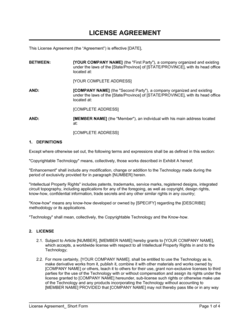
Enter both parties' legal entity names and addresses
Use the full registered name of each party — not a trade name or abbreviation. Include the entity type (LLC, Inc., Ltd.) and the principal business address for each.
💡 Check each party's corporate registry filing to confirm the exact legal name before completing this field.
2
Define the licensed property precisely
Describe the IP being licensed with enough specificity that a third party could identify it without further information. Reference patent numbers, trademark registrations, software version numbers, or attach Exhibit A with a detailed description.
💡 Attach a separate exhibit for complex IP portfolios rather than cramming all detail into the body — it keeps the main form readable and easier to amend.
3
Choose exclusivity and permitted use
Decide whether the license is exclusive or non-exclusive, and specify the field of use. Exclusive licenses command higher royalties and restrict the licensor from granting competing rights in the same territory.
💡 If exclusivity is limited to a specific field or channel (e.g., retail only), state it explicitly — silence creates disputes over adjacent use cases.
4
Set the territory
Enter the geographic scope — a single country, a list of countries, a region, or worldwide. If the licensor retains rights in certain markets, list those exclusions explicitly.
💡 For digital products, consider whether 'worldwide' is truly intended — some jurisdictions have mandatory IP provisions that affect enforceability.
5
Complete the royalty and payment section
Enter the royalty rate or flat fee, define the calculation base (Net Sales, Gross Revenue, or per-unit fee), set the payment frequency, and specify the reporting format the licensee must use.
💡 Define 'Net Sales' with a specific list of permitted deductions and a cap (e.g., returns not to exceed 5% of gross) to prevent royalty base erosion.
6
Set the term, renewal, and termination fields
Enter the initial term length, the auto-renewal interval if applicable, the notice period required to prevent auto-renewal, and the cure period for breach-based termination.
💡 Set the non-renewal notice window at 60–90 days — 30 days is too short for either party to evaluate and act on renewal decisions.
7
Select governing law and dispute resolution
Choose the jurisdiction whose law applies and the dispute resolution mechanism — arbitration is generally faster and more private than court litigation for IP disputes.
💡 If both parties are in different countries, a neutral arbitration seat (e.g., New York or London) often avoids jurisdictional disputes.
8
Attach exhibits and review before sharing
Complete any exhibits (IP description, royalty report format, approved sublicensees) before sending the form to the other party. Review all cross-references between the body and exhibits for consistency.
💡 A single inconsistency between the body and an exhibit — different royalty rates, for example — creates an ambiguity that typically resolves in the other party's favor.