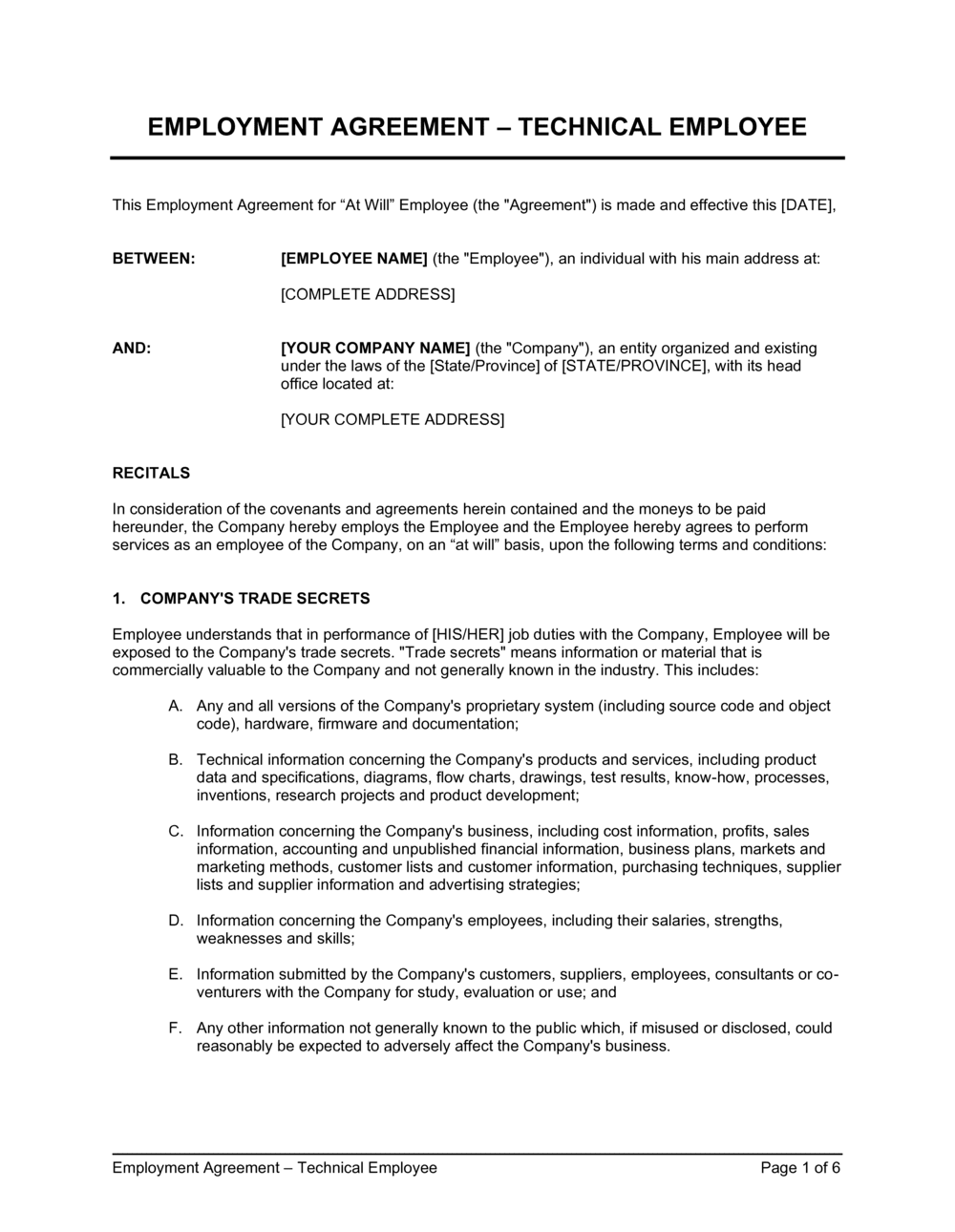
This employment agreement for technical employee template has 6 pages and is a MS Word file type listed under our human resources documents.
Employment agreement for technical employee template
EMPLOYMENT AGREEMENT - TECHNICAL EMPLOYEE This Employment Agreement for "At Will" Employee (the "Agreement") is made and effective this [Date], BETWEEN: [EMPLOYEE NAME] (the "Employee"), an individual with his main address at: [COMPLETE ADDRESS] AND: [YOUR COMPANY NAME] (the "Company"), an entity organized and existing under the laws of the [State/Province] of [STATE/PROVINCE], with its head office located at: [YOUR COMPLETE ADDRESS] Recitals In consideration of the covenants and agreements herein contained and the moneys to be paid hereunder, the Company hereby employs the Employee and the Employee hereby agrees to perform services as an employee of the Company, on an "at will" basis, upon the following terms and conditions: Company's Trade Secrets Employee understands that in performance of [HIS/HER] job duties with the Company, Employee will be exposed to the Company's trade secrets. "Trade secrets" means information or material that is commercially valuable to the Company and not generally known in the industry. This includes: Any and all versions of the Company's proprietary system (including source code and object code), hardware, firmware and documentation; Technical information concerning the Company's products and services, including product data and specifications, diagrams, flow charts, drawings, test results, know-how, processes, inventions, research projects and product development; Information concerning the Company's business, including cost information, profits, sales information, accounting and unpublished financial information, business plans, markets and marketing methods, customer lists and customer information, purchasing techniques, supplier lists and supplier information and advertising strategies; Information concerning the Company's employees, including their salaries, strengths, weaknesses and skills; Information submitted by the Company's customers, suppliers, employees, consultants or co-venturers with the Company for study, evaluation or use; and Any other information not generally known to the public which, if misused or disclosed, could reasonably be expected to adversely affect the Company's business. Nondisclosure of Trade Secrets Employee will keep the Company's trade secrets, whether or not prepared or developed by [HIM/HER], in the strictest confidence. Employee will not use or disclose such secrets to others without the Company's written consent, except when necessary to perform [HIS/HER] job. However, Employee shall have no obligation to treat as confidential any information which: Was in [HIS/HER] possession or known to me, without an obligation to keep it confidential, before such information was disclosed to Employee by the Company; Is or becomes public knowledge through a source other than Employee and through no fault of Employee; or Is or becomes lawfully available to Employee from a source other than the Company. Confidential Information of Others Employee will not disclose to the Company, use in the Company's business, or cause the Company to use, any information or material that is a trade secret of others. [HIS/HER] performance of this Agreement will not breach any agreement to keep in confidence proprietary information acquired by Employee prior to [HIS/HER] employment by the Company. No Conflicting Obligations Employee has no other current or prior agreements, relationships or commitments that conflict with this Agreement or with [HIS/HER] relationship other than the following: [SPECIFY; IF NONE, SO STATE]. Return of Materials When [HIS/HER] employment with the Company ends, for whatever reason, Employee will promptly deliver to the Company all originals and copies of all documents, records, software programs, media and other materials containing any of the Company's trade secrets. Employee will also return to the Company all equipment, files, software programs and other personal property belonging to the Company. Confidentiality Obligation Survives Employment Employee understand that [HIS/HER] obligation to maintain the confidentiality and security of the Company's trade secrets remains with Employee even after [HIS/HER] employment with the Company ends and continues for so long as such material remains a trade secret. Computer Programs Are Works Made for Hire Employee understand that as part of [HIS/HER] job duties Employee may be asked to create, or contribute to the creation of, computer programs, documentation and other copyrightable works. Employee agree that any and all computer programs, documentation and other copyrightable materials that Employee is asked to prepare or work on as part of [HIS/HER] employment with the Company shall be "works made for hire" and that the Company shall own all the copyright rights in such works. IF AND TO THE EXTENT ANY SUCH MATERIAL DOES NOT SATISFY THE LEGAL REQUIREMENTS TO CONSTITUTE A WORK MADE FOR HIRE, EMPLOYEE HEREBY ASSIGN ALL [HIS/HER] COPYRIGHT RIGHTS IN THE WORK TO THE COMPANY. Disclosure of Developments While Employee is employed by the Company, Employee will promptly inform the Company of the full details of all [HIS/HER] inventions, discoveries, improvements, innovations and ideas (collectively called "Developments") - whether or not patentable, copyrightable or otherwise protectible - that Employee conceives, completes or reduces to practice (whether jointly or with others) and which: Relate to the Company's present or prospective business, or actual or demonstrably anticipated research and development; or Result from any work Employee do using any equipment, facilities, materials, trade secrets or personnel of the Company; or Result from or are suggested by any work that Employee may do for the Company. Assignment of Developments Employee hereby assigns to the Company or the Company's designee, [HIS/HER] entire right, title and interest in all of the following, that Employee conceives or makes (whether alone or with others) while employed by the Company: All Developments; All copyrights, trade secrets, trademarks and mask work rights in Developments; and All patent applications filed and patents granted on any Developments, including those in foreign countries. Post-Employment Assignment Employee will disclose to the Company any and all computer programs, inventions, improvements or discoveries actually made, or copyright registration or patent applications filed, within [NUMBER] months after [HIS/HER] employment with the Company ends. Employee hereby assigns to the Company [HIS/HER] entire right, title and interest in such programs, inventions, improvements and discoveries, whether made individually or jointly, which relate to the subject matter of [HIS/HER] employment with the Company during the [NUMBER] month period immediately preceding the termination of [HIS/HER] employment. Execution of Documents Both while employed by the Company and afterwards, Employee agrees to execute and aid in the preparation of any papers that the Company may consider necessary or helpful to obtain or maintain any patents, copyrights, trademarks or other proprietary rights at no charge to the Company, but at its expense.
 Dashboard
 HR Management
 Links
Links Chat
Chat Connect
 Contacts
 Inbox
Inbox Business Al
 Project Management
 Notes
Notes Business Templates
 Cloud Drive
 Docs
Docs Sheets