- Merger
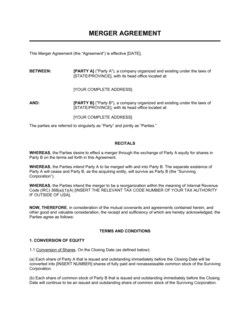
- The combination of two separate legal entities into a single new company, with both predecessor companies ceasing to exist independently.
- Acquisition
- A transaction in which one company purchases another and absorbs it, with the acquired entity typically ceasing to operate under its original name.
- Effective Date
- The specific calendar date on which the merger becomes legally operative and the new combined entity begins trading or operating.
- Surviving Entity
- The legal entity that continues to exist after a merger — either a newly formed company or one of the two predecessor companies.
- Continuity Assurance
- A statement in the announcement confirming that existing contracts, pricing, service levels, and key contacts remain in effect under the new entity.
- Strategic Rationale
- The business reasons behind the merger — expanded capabilities, new markets, cost efficiencies, or combined talent — communicated to help recipients understand the purpose.
- Stakeholder
- Any individual or organization with an interest in the merging companies, including customers, employees, suppliers, investors, and regulators.
- Transition Period
- The window of time after the effective date during which both legacy systems, brands, and communications channels may operate simultaneously before full integration is complete.
- Contract Novation
- The legal process of replacing a contract with a new entity as a party — required when existing contracts must formally transfer to the merged company rather than carry over automatically.
- Change-of-Control Clause
- A contract provision that gives the other party the right to terminate or renegotiate when ownership or control of one party changes, as it does in a merger.